• العربية
  • فارسی
Brand
  • Iran Insight
  • Politics
  • Economy
  • Analysis
  • Special Report
  • Opinion
  • Podcast
  • Iran Insight
  • Politics
  • Economy
  • Analysis
  • Special Report
  • Opinion
  • Podcast
  • Theme
  • Language
    • العربية
    • فارسی
  • Iran Insight
  • Politics
  • Economy
  • Analysis
  • Special Report
  • Opinion
  • Podcast
All rights reserved for Volant Media UK Limited
volant media logo

Iran's president highlights shortages amid foreign aid backlash

Dec 7, 2024, 12:30 GMT+0Updated: 12:13 GMT+0
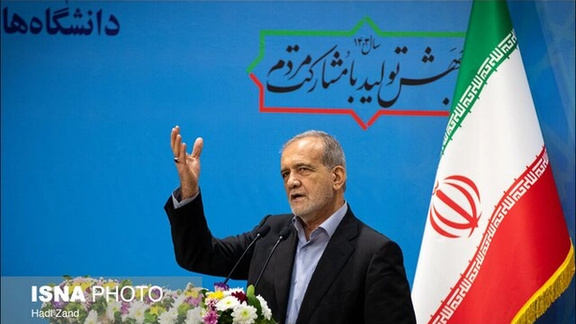
Iran's President Masoud Pezeshkian speaking at Tehran's Sharif University on December 7, 2024

Iranian president Masoud Pezeshkian has once again drawn attention to the country’s worsening shortages in critical areas such as electricity, water, oil, and gasoline, as Tehran maintains financial aid to its proxy forces.

Addressing students at Tehran's Sharif University of Technology on Saturday, Pezeshkian warned of a challenging winter ahead unless energy consumption is curtailed.

“We are facing serious challenges today,” Pezeshkian said, comparing the nation’s difficulties to a patient requiring an accurate diagnosis for effective treatment. He called for collective action to tackle Iran’s resource crisis, lamenting, “Whenever we try to make changes, people oppose it. Where should we begin?”

His remarks follow growing outrage over the government’s decision to allocate tens of millions of dollars in aid to mostly Shia Lebanese families affected by war.

The public discontent intensified after Hezbollah’s leader, Naeem Qassem, revealed last week that Iran funded most of a $77 million aid package to support nearly a quarter of a million families in Lebanon. In a televised address, Qassem expressed gratitude, stating, “We thank the Islamic Republic of Iran...for providing this generous support.”

Public reaction to foreign aid

People voiced their anger anonymously through messages sent to Iran International, warning of popular backlash.

“Mr. Pezeshkian, you say there’s no money and prices go up every day, so where does the money you send to Lebanon come from?” one viewer asked.

Another citizen criticized the government, saying, “The corrupt Islamic Republic regime fulfills the demands of all countries except the needs of its own people.”

A user on X from Iran also echoed these sentiments: “They spend the people’s money on Hezbollah instead of addressing the needs of impoverished Iranians or preserving Iran’s environment. For the clerics, the lack of heating for children in schools is not a concern. The absence of drinking water for citizens does not matter, but Hezbollah remains their priority.”

Economic woes deepen as winter nears

Iran’s looming energy crisis is compounded by an annual subsidy burden of tens of billions of dollars, according to Pezeshkian. “If we cannot control gas and energy consumption, we won’t be able to supply households with gas this winter,” he cautioned.

Iranian President Masoud Pezeshkian during a televised interview on December 2, 2024.
100%
Iranian President Masoud Pezeshkian during a televised interview on December 2, 2024.

Gasoline imports also remain a key financial strain. In a televised address on Monday, Pezeshkian warned that without parliamentary action to allocate foreign currency for imports, gasoline prices would inevitably rise, potentially worsening inflation and fueling public dissatisfaction. He described this challenge as part of a broader energy shortage that urgently requires resolution.

Some commentators in Iranian media warn that raising gasoline prices or cutting subsidies could reignite unrest similar to the protests in 2019 following fuel price hikes. Within parliament, divisions persist, with some lawmakers cautioning that such measures could destabilize an already fragile political climate.

As winter approaches, Pezeshkian’s call for reforms underscores the tough decisions Iran must face; however, people continue to question why, despite claims of shortages and insufficient funds, substantial aid is still sent to Iran’s proxy groups in the region.

Most Viewed

Iran negotiators ordered to return after internal rift over Islamabad talks
1
EXCLUSIVE

Iran negotiators ordered to return after internal rift over Islamabad talks

2
ANALYSIS

US blockade enters murky phase as tankers spoof signals and buyers hesitate

3
ANALYSIS

Why the $100 billion Hormuz toll revenue is a myth

4

US tightens financial squeeze on Iran, warns banks over oil money flows

5
ANALYSIS

US blockade targets Iran oil boom amid regional disruption

Banner
Banner

Spotlight

  • Hardliners push Hormuz ‘red line’ as US blockade tests Iran’s leverage
    INSIGHT

    Hardliners push Hormuz ‘red line’ as US blockade tests Iran’s leverage

  • Ideology may be fading in Iran, but not in Kashmir's ‘Mini Iran'
    INSIGHT

    Ideology may be fading in Iran, but not in Kashmir's ‘Mini Iran'

  • War damage amounts to $3,000 per Iranian, with blockade set to add to losses
    INSIGHT

    War damage amounts to $3,000 per Iranian, with blockade set to add to losses

  • Why the $100 billion Hormuz toll revenue is a myth
    ANALYSIS

    Why the $100 billion Hormuz toll revenue is a myth

  • US blockade targets Iran oil boom amid regional disruption
    ANALYSIS

    US blockade targets Iran oil boom amid regional disruption

  • Iran's digital economy battered by prolonged blackout
    INSIGHT

    Iran's digital economy battered by prolonged blackout

•
•
•

More Stories

Turkey, Iran, Russia, five Arab states warn of threat posed by Syria crisis

Dec 7, 2024, 12:10 GMT+0

The foreign ministers of Iran, Russia, Turkey, Saudi Arabia, Qatar, Iraq, Jordan and Egypt issued a joint statement on Saturday warning about the threat the Syria crisis poses to regional security, as rebels threaten Bashar al-Assad's rule from north and south.

The eight foreign ministers said a political solution was needed to stop military operations and protect civilians in Syria. The joint statement added that the crisis in Syria posed a threat to regional and international security.

"The Syrian crisis needs a political solution that leads to a halt to military operations," the eight foreign ministers said, calling for the cessation of military operations to prepare for the beginning of an inclusive political process.

The statement was released hours after the foreign ministers of Iran, Russia and Turkey - the three guarantor states of the so-called Astana Process - met in Doha over Syria’s escalating crisis, with Abbas Araghchi and Sergey Lavrov calling for continued talks between the Syrian government and some of the opposition.

"There was a consensus among all participants that the conflicts must end immediately, Syria's territorial integrity must be respected, and most importantly, political dialogues between the Syrian government and legitimate opposition groups must continue," Araghchi told reporters Saturday after he met with Russian and Turkish foreign ministers. He did not clarify which groups he considers as legitimate.

However, Russian Foreign Minister Sergey Lavrov emphasized that the Islamist insurgent group Hay'at Tahrir al-Sham in Syria is a terrorist group. He called for dialogue between the Syrian government and the "legitimate opposition," urged an immediate end to hostile activities in Syria, and added that Russia is doing all it can to prevent terrorists from prevailing in the country.

"We firmly reiterate our message about the territorial integrity and sovereignty of Syria," he said. "We call for an immediate end to military action and the start of dialogue between the government and legitimate opposition forces."

Araghchi also held separate meetings with Qatar’s Emir Tamim bin Hamad Al Thani and Turkey’s Foreign Minister Hakan Fidan on the sidelines of the Doha Forum. According to Iranian media, Araghchi described the discussions as focused on Syria, emphasizing support for its people, preserving the country’s territorial integrity, and avoiding regional fallout. He added that no clear decisions have been made yet, as consultations are ongoing.

Syrian insurgents have achieved their most significant battlefield victories since the civil war began 13 years ago. On Saturday, they reported securing Sanamayn, a strategic town just 20 kilometers south of Damascus, and taking control of Quneitra in the Syrian Golan near the Israeli border.

The advances come amid signs of reduced support for Assad from his key allies. Iranian-backed forces and the Syrian army have reportedly withdrawn from several positions, and there is little indication that Tehran is prepared to commit substantial forces to defend Assad. Similarly, Russia’s involvement has waned, with reports of troop withdrawals as Moscow has committed most of its forces to its invasion of Ukraine.

Turkey, Iran, and Russia have long been engaged in talks over Syria’s future through the Astana peace process. While Turkey supports the political and armed opposition to Assad, Iran and Russia remain his primary backers. However, the recent developments highlight a shifting dynamic, with Assad’s allies appearing less willing or able to maintain their earlier levels of support.

The upcoming trilateral talks in Doha are expected to address these shifts and explore ways to stabilize the region amidst the ongoing rebel surge and Assad’s weakening hold on power.

Iran denies embassy evacuation amid growing doubts over Assad's survival

Dec 7, 2024, 11:18 GMT+0

Iran’s foreign ministry has dismissed reports that its embassy in Damascus is being evacuated. Meanwhile, some Iranian media outlets have started to acknowledge the possibility that Bashar al-Assad could be overthrown in the near future.

Foreign ministry’s spokesperson Esmail Baghaei announced on Saturday that “The news regarding the evacuation of the Embassy of the Islamic Republic of Iran in Damascus is not true, and it continues its activities as usual.”

Syrian insurgents have made unexpected territorial gains in the past ten days, capturing large cities and positioning themselves just 200 km north of the capital Damascus. Iranian-backed forces have withdrawn from many positions together with the Syrian army, with no sign that Tehran is willing to commit large forces to defend Assad’s rule. His other ally, Russia, has also been largely inactive, with reports of some forces leaving Syria, as Moscow is bogged down in its invasion of Ukraine.

One of the more influential news websites in Tehran, Rouydad 24, carried an interview on Saturday with a well-known Iranian analyst, Mohammad Bayat, who said that Assad’s days as president of Syria might be numbered.

“Damascus is effectively under siege, and Bashar al-Assad will sooner or later relinquish power—unless Iran or Russia take significant action in the coming days to slow this trajectory. Otherwise, we must prepare to adjust our relations with a new government in Syria,” Bayat said.

This represents a rare candid acknowledgment permitted in Tehran's state-controlled media, which has consistently downplayed the significance of events in Syria. Meanwhile, many observers worldwide view Assad’s successive defeats as a major setback for Iran’s Islamic government.

Bayat in his assessment also said, “HTS forces have now entered Homs, captured Daraa, and there is even talk of their control over As-Suwayda, previously known as a stronghold of Assad's social base…Given the collapse of the Syrian army, they have concluded that moving toward Damascus is also achievable.”

In interviews with Arab media on Friday, Iran’s Foreign Minister Abbas Araghchi also spoke with less certainty and commitment about Assad.

“We are not fortune-tellers, and it is impossible to say or predict that Bashar al-Assad will fall; however, the resistance will certainly fulfill its duty,” Araghchi said, referring to regional forces operating under Tehran’s direction.

The insurgents prepared to continue their rapid advance on Saturday, while government forces scrambled to reinforce collapsing frontlines and launched bombardments on insurgent positions around Homs in an effort to preserve President Bashar al-Assad's 24-year rule.

Syria's military reported conducting airstrikes around Hama and Homs while bolstering forces on that front. It also stated it was repositioning troops near Daraa and Suweida, without addressing the rebels' capture of these areas.

Syrian rebel gains threaten Iran's regional hegemony

Dec 7, 2024, 07:56 GMT+0
•
Negar Mojtahedi

The stunning advances by Syrian rebel forces, which could ultimately unseat Bashar al-Assad, threaten to dismantle two decades of costly Iranian efforts to create dominance in the region.

Hardline Islamist-led opposition forces are just as much a threat to Iran as they are to Assad, a Syrian analyst told the Eye for Iran podcast.

“Iran's real borders, from the Iranian regime's perspective, are not in Iran. Iran's borders are in Syria,” said Qutaiba Idlbi, a senior fellow with the Washington DC-based Atlantic Council covering Syria.

Tehran has extended its influence to the Mediterranean through its Lebanese ally Hezbollah, using Syria, which has been under Assad family rule for decades, as a key conduit.

“Iran uses Syria as a land bridge to other places. As we've seen since 2019 there has been an extensive Iranian effort through the Islamic Revolutionary Guard Corps (IRGC) to try to get to Jordan through Syria using illicit networks. They've been trying to smuggle weapons and build networks within Jordan to try to have more influence over the country,” said Idlbi.

But that land bridge is currently not operational in part due to heavy Israeli airstrikes targeting Iranian interests in Syria. Iran’s alleged smuggling routes supplying Hezbollah and alleged IRGC weapons facilities have been the target of Israel for more than a year.

Because of its geographic strategic importance, Iran invested heavily in Syria over the years spending tens of billions of dollars, securing investment projects like allowing Iran to control phosphate mines and take over 5- thousand hectares of farmland and 1-thousand of oil and gas, according to Reuters.

Under the late President Ebrahim Raisi, Tehran and Damascus signed a “strategic cooperation memorandum of understanding."

Syria is of vital importance to Iran and its quest for regional hegemony, but there have been more recent blows to the Iran-backed axis losing access to key border crossings.

US-backed Syrian Democratic Forces (SDF), an alliance of Syrian Kurdish fighters, seized the eastern city of Deir ez-Zor and a nearby Iraqi-Syrian border crossing used by Iran to arm Lebanon's Hezbollah, Reuters reported on Friday.

Ultimately this undermines Iran's ability to rescue Assad.

As Iran's position weakens, Assad may become even less willing to abandon his closest ally, despite alleged pressure from the United States and Israel.

The reason, according to Idlbi, is that Iran may represent Assad's only viable chance for survival—and vice versa. Idlbi added that while Assad might tell world leaders he is willing to distance himself from Iran, he is unlikely to follow through, given his reputation for dishonesty.

"He [Assad] does have the reputation of being a big liar, basically, where no one can really trust a word that comes out or any promise or commitment that he makes for sure."

So far, there is no sign that Iran is planning to militarily intervene to save Assad. Local sources are reporting that some Iranian forces are withdrawing into Iraq from eastern Syria.

On the world stage Iran is full of bluster, Idlbi argued.

While the Iranian establishment is publicly supporting Assad, there is only so much aid Iran may be able to provide as city after city falls to the insurgents' lightning advance.

Convincing Iranians to fight in the war in Syria may be another challenge, said Idlbi.

Idlbi, who fled Syria after being imprisoned twice and faced torture for his political activities, said Iran would not be able to find an airport to land their plane.

Iran and its regional militia fighters, chief among them Hezbollah and Hamas, are all degraded after more than a year of war with Israel.

Other than sending Iran-backed Iraqi Shi'ite militias to Syria in addition to recruiting forces from Afghanistan, Iran's military might is limited but their determination is unbowed, according to Idlbi.

“I don't think Iran will stop looking for a solution. I think they're actively trying to break some of those boundaries to be able to provide the support to Assad.”

“Without Syria, the regime [Iran] would really lose a lot of its intelligence and military capabilities and leverage over countries in the region.”

And just how far Iran could go to salvage its stronghold on Syria largely depends on Russia’s next move.

It appears Russia isn’t going to save Assad like it did in 2015 by shoring up its rule with airstrikes and troop deployments. The Kremlin told all Russian citizens to flee Syria Friday as rebel forces continue to make advances in the north.

Idlbi said Russia doesn’t appear willing or even capable of saving Assad this time as Putin is preoccupied in Ukraine.

“It seems some in Russia, specifically in the Kremlin, are thinking maybe enough is enough. Maybe we've invested a lot in Assad. We have an important base in Syria's coast, in Latakia and Tartus.”

The lack of action on Russia’s part harms Iran, despite the hundreds of drones Tehran has sent to Russia to aid its full-scaled invasion of Iran.

You can watch the full episode of Eye for Iran featuring the Atlantic Council's Qutaiba Idlbi, on YouTube or listen on Spotify, Apple, Amazon, Castbox or any other major podcast platform.
US intelligence says Iran could quickly build nuclear weapons

Dec 6, 2024, 22:23 GMT+0

The United States assesses that Iran could rapidly build a nuclear weapon should it decide to do so, according to a November 2024 intelligence report released Thursday which said there were no indications yet it was building a bomb.

"The Intelligence Community continues to assess that as of 26 September 2024, Iran is not building a nuclear weapon. Tehran has, however, undertaken activities that better position it to produce one, if it so chooses," the Office of the Director of National Intelligence report said.

"Iran has continued to increase its stockpiles of 20-percent and 60-percent enriched uranium, manufacture and operate an increasing number of advanced centrifuges, and publicly discuss the utility of nuclear weapons," the report added.

These enriched uranium levels far exceed civilian needs, the ODNI said, and could be converted into material for more than a dozen nuclear weapons with further processing.

The ODNI’s assessment aligns with remarks made by Rafael Grossi, the chief of the International Atomic Energy Agency (IAEA) who on Friday told Reuters that Iran's capacity to produce uranium enriched to up to 60% purity, near weapons-grade, has seen a dramatic increase.

The ODNI report also highlighted a shift in public discourse within Iran, where officials and analysts are increasingly discussing nuclear weapons as a deterrent, particularly after Israeli airstrikes in April.

"This debate risks emboldening nuclear weapons advocates within Iran’s decision-making apparatus and shifting the thinking of current and future Iranian elites about the utility of nuclear weapons," it warned.

Kamal Kharrazi, a senior advisor to Supreme Leader Ali Khamenei said last month that Iran possesses the technical capability to produce nuclear weapons and indicated that the country's stance could change if faced with an existential threat.

Iran's ballistic missile arsenal, the largest in the Middle East, is also evolving.

The report noted that Tehran is "incorporating lessons learned from its missile and unmanned aerial vehicle (UAV) attack against Israel in April and from Russia’s operational use of Iranian UAVs against Ukraine."

Coupled with its space-launch vehicle program, these advancements could reduce the timeline for developing intercontinental ballistic missiles if Iran pursued them.

The ODNI cautioned that further sanctions or attacks on Iran’s nuclear program could prompt Tehran to enrich uranium to weapons-grade levels, install additional advanced centrifuges, or even withdraw from the Treaty on the Non-Proliferation of Nuclear Weapons.

Iranian officials and media resist acknowledging Syria setbacks

Dec 6, 2024, 18:26 GMT+0
•
Behrouz Turani

Some Iranian politicians and state-controlled media appear to be promoting a parallel narrative about huge Syrian military losses seemingly aimed at reassuring the Tehran's ideological supporters that the so-called axis of resistance it leads remains intact.

Iran's tightly controlled media has largely remained silent on the insurgents' advances, adhering to the official ideological stance that emphasizes the supposed strength of Syria's government, bolstered by support from Iran and Russia.

However, since Thursday evening, Iranian state television has adjusted its tone regarding developments in Syria, referring to the insurgents as "the armed opponents of Assad"—a neutral term compared to the earlier characterization as ISIS extremists.

This could indicate that Tehran is gradually realizing that the landscape is changing and "the armed opponents of Assad" are likely to be in far better position than the government forces.

The shock advance has been led by Hayat Tahrir al-Sham (HTS), a former affiliate of al-Qaeda that has been designated a terrorist organization by the United States.

The "axis of resistance" is a term coined by Iran's Supreme Leader Ali Khamenei to describe anti-US and anti-Israeli groups and governments in the Middle East, on whom Iran has spent billions of dollars since 2011 to secure their support.

Following Israeli strikes on Hezbollah and Hamas, the axis of resistance groups appear to have lost most of their ability to influence events. With Iran's air defense largely damaged or destroyed by Israel Iran cannot lent Syria and its proxy groups in the region serious support, fearing further Israeli attacks.

Nonetheless, despite advances by hardline Islamist-led insurgents and the fall of several cities in Syria, Iranian media - particularly state television - continues to promote exaggerated and demonstrably false reports of Syrian army victories and the recapture of lost territories.

"We know that the terrorists' advances in Syria have been blocked, and Iran and Russia have dealt them fatal blows," Beham Saeedi, Secretary of the parliament's National Security Committee, said.

"Assad's opponents' advances are temporary, and I can say with a high degree of certainty that the terrorists were defeated by the axis of resistance before and will be defeated again," Saeedi added, further accusing Israel and the United States of being behind the renewed HTS insurgency and likening it to an attack by Israel on Syria.

"Israel has done everything in its power to weaken the axis of resistance, and Iran will do whatever it takes to continue supporting it."

Meanwhile, Iranian state TV commentator Hassan Hanizadeh told the press in Tehran that Israel is indirectly involved in the war in Syria.

"Netanyahu, has started a new phase in weakening the axis of resistance with the help of the United States and Turkey ... in the coming days the situation will change in the interest of the Syrian government."

Hanizadeh reiterated that following the cease-fire with Hezbollah, Israel has shifted the battlefront to Syria by indirectly using the HTS to weaken the axis of resistance.

In the latest sign of a possible shift in Iran's media policy, state television in Tehran started to acknowledge that the relatively more moderate Syrian National Liberation Front is fighting Assad's forces along with the HTS.