• العربية
  • فارسی
Brand
  • Iran Insight
  • Politics
  • Economy
  • Analysis
  • Special Report
  • Opinion
  • Podcast
  • Iran Insight
  • Politics
  • Economy
  • Analysis
  • Special Report
  • Opinion
  • Podcast
  • Theme
  • Language
    • العربية
    • فارسی
  • Iran Insight
  • Politics
  • Economy
  • Analysis
  • Special Report
  • Opinion
  • Podcast
All rights reserved for Volant Media UK Limited
volant media logo
ANALYSIS

Iran and Qatar forge unlikely bond over shared interests

Shahin ModarresShir MorAriel Admoni
Shahin Modarres,
Shir Mor,
Ariel Admoni
Dec 8, 2024, 15:43 GMT+0Updated: 12:13 GMT+0
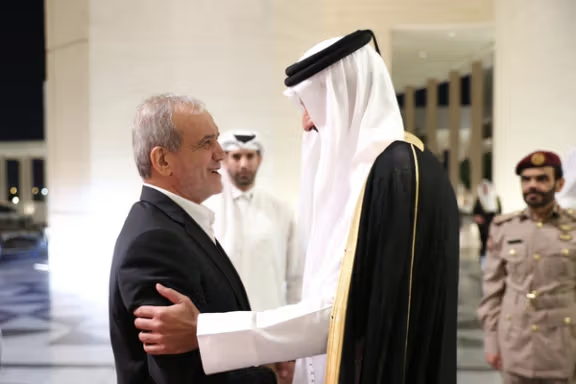
Iran's president Masoud Pezeshkian meets Qatar's Emir Sheikh Tamim bin Hamad al-Thani in Doha, Oct. 2024

The relationship between Qatar and the Islamic Republic of Iran is one driven by mutual interests over ideological alignment, helping both to fulfil regional and international objectives.

Qatar is a Sunni-led monarchy, while the Islamic Republic of Iran is a Shiite theocracy. This marked difference, however, has not undermined their relationship. Why? Because it serves both sides immensely.

For Qatar, this partnership balances its extensive Western ties with a regional power that opposes the United States. For Iran, it provides a diplomatic boost in international forums, helping circumvent its growing isolation.

In recent discussions, Iranian and Qatari officials emphasized expanding trade and economic cooperation. They outlined plans to facilitate business connections and improve infrastructure for bilateral projects. Notable examples include the initiative to construct the world’s longest undersea tunnel connecting the two countries and a joint currency exchange entity designed to bypass international sanctions and streamline financial transactions.

Amid rising tensions between Israel and Iran, Qatar has aligned itself closer to Tehran. This was evident during Iranian President Masoud Pezeshkian’s visit to Doha in October 2024. The two countries discussed enhancing cooperation in economy, energy, culture, and education, with a particular focus on resolving the $6 billion in Iranian assets frozen in Qatar.

The visit underscored Qatar’s role as a diplomatic mediator, as Pezeshkian met with regional leaders, including Hamas representatives, to address crises in Gaza and Lebanon. Such diplomatic collaborations draw much attention—and understandably so. But it often comes at the cost of closer look at realities that help explain the dynamics of this alliance.

The Reality in Iran

Under the leadership of Supreme Leader Ayatollah Ali Khamenei, Iran enforces Sharia law with a totalitarian grip. The regime systematically represses dissent through tactics like torture, extrajudicial killings, and harsh prison sentences targeting political dissidents, ethnic minorities, and women’s rights advocates.

The death of Mahsa Amini in 2022 ignited protests demanding gender equality and basic freedoms. In response, the regime imprisoned thousands, killed hundreds, and executed many in sham trials, showcasing its intolerance. Iran also targets dissidents abroad through abductions and assassinations, disregarding international norms.

Beyond its borders, Iran funds violence and instability across the Middle East through proxies like Hezbollah. These actions are often justified under the guise of “humanitarian support” but serve to advance Iran’s ideological and political agenda.

The Reality in Qatar

Qatar’s election to the UN Human Rights Council for 2025-2027 highlights a dissonance between its global image and its domestic record. Human Rights Watch has reported arbitrary arrests and abuse of LGBT individuals, along with discriminatory laws against women.

Labor law reforms, while significant, face concerns about enforcement, particularly after Qatar reinstated exit permits for domestic workers, increasing their vulnerability to exploitation.

Qatar's longstanding decision to host Hamas came under more scrutiny after October 7. It's a relationship that may be better described as seeking leverage---and not a humanitarian gesture, as Doha prefers to depict it.

A Masked Agenda

Though Qatar and the Islamic Republic of Iran present their partnership as a means to promote regional stability, their alliance is rooted in political and strategic interests.

The cooperation between Tehran and Doha is often framed in idealistic terms but conceals a deeper agenda focused on power, influence, and suppression.


Most Viewed

Iran diplomacy wobbles as factions compete to avoid looking soft on US
1
INSIGHT

Iran diplomacy wobbles as factions compete to avoid looking soft on US

2
ANALYSIS

The politics of pink: how Iran uses cuteness to rebrand violence

3

Scam messages seek crypto for ships’ safe passage through Hormuz, firm warns

4
EXCLUSIVE

Family told missing teen was alive, then received his body 60 days later

5
TEHRAN INSIDER

The future has been switched off here

Banner
Banner

Spotlight

  • Diplomacy tolls at Hormuz as conflict returns to its doorstep
    OPINION

    Diplomacy tolls at Hormuz as conflict returns to its doorstep

  • Opposition to US talks grows in Tehran as ceasefire deadline nears
    INSIGHT

    Opposition to US talks grows in Tehran as ceasefire deadline nears

  • Tehran moderates see ‘no deal–no war’ limbo as worst outcome
    INSIGHT

    Tehran moderates see ‘no deal–no war’ limbo as worst outcome

  • The future has been switched off here
    TEHRAN INSIDER

    The future has been switched off here

  • Lights out, then gunfire: Witnesses recount Mashhad protest crackdown
    VOICES FROM IRAN

    Lights out, then gunfire: Witnesses recount Mashhad protest crackdown

  • Is Iran entering its Gorbachev moment?
    INSIGHT

    Is Iran entering its Gorbachev moment?

•
•
•

More Stories

Iran may face domestic unrest after Assad's downfall

Dec 8, 2024, 15:00 GMT+0

The fall of Syrian President Bashar al-Assad has deprived the Islamic Republic of a key partner, weakening its influence abroad and tearing away a fear barrier which could inspire Iranians to rise against their own rulers.

Iran’s outpost in Syria has collapsed, Chris Doyle, director of the Council for Arab-British Understanding told Iran International, upending Iran's military strategy abroad so thoroughly that it may inspire opponents at home to oust the 45-year-old Islamic Republic.

“The Iranians have taken a huge hit here,” he told Iran International. “It’s certainly ripped up that important [smuggling] corridor it relied on, from Iran to the Mediterranean. Syria now will be a country not in Iran’s control. Iran will lose a lot of assets they’ve invested in, properties they took over won’t remain Iranian.”

He said that as a result of the rapid fall of Syria in less than a week, after being in the hands of the Assad family for five decades, it could also bode well for a full overthrow of the government in Iran, which has been growing ever weaker since the uprising of 2022.

“It will be inspiring many people across the region to see what Syria has done and that will be unnerving for the Iranian regime,” not least, with the weakening of Iran-backed allies Hezbollah in Lebanon and Hamas in Gaza, leaving Iran’s archenemy Israel now in a much stronger position.

“The borders of Syria are certainly not in the hands of the Assad regime now," he dais and highlighted that Kurds control the borders with Iraq. "If Iran wanted to smuggle weapons and fighters into Syria, the Iraqi border is very important. Iran will be reassessing its strategies here and with a Trump administration coming, who knows. It faces some stark choices."

Arash Azizi, a visiting fellow at Boston University’s Pardee Center for the Study of the Longer-Range Future, said he agrees.

"The fall of Assad is the most important blow the Iranian regime has suffered in years," he told Iran International. "It signals the collapse of its 'Axis of Resistance' [military allies across the region] which has been the mainstay of Khamenei’s policy during most of his decades-long term as Supreme Leader," he added.

Iran has for decades supported groups in countries including Yemen, Palestine, Lebanon and Syria.

"Khamenei already had problems saving face given the massive blows the Axis received in the last year but this leaves him further humiliated and isolated," he said, referring to the blows dealt to Iran's largest proxy Hezbollah in Lebanon, and Hamas in Gaza.

After the Hamas invasion of October 7 last year, Israel has been engaged in its longest ever conflict with the Iran-backed group, while Hezbollah on Israel's northern border attacked on a second front, with others from Yemen, Iraq, Syria and the West Bank.

Israel has killed huge swathes of Hezbollah's leadership, including long-time leader Hassan Nasrallah, and according to the Israeli military, taken it back decades. In Gaza, Hamas has also been dealt a huge blow, with the majority of its battalions and infrastructure across the strip destroyed.

Internally, it will also hurt Tehran, said Azizi, in addition to the risks it now faces from the incoming Trump presidency, who has vowed a "maximum pressure" approach to Iran and its allies.

"The fall of Assad shows the weakness of the Iranian regime and will be definitely a boost for the regime’s opponents. It will inspire them to take it on especially as the regime is hemmed in from other sides too: the return of Trump to White House will likely bring renewed pressure on it and Israel is also strengthened," he explained.

"But it will also have effects on the regime’s internal composition. Those factions who seek a deal with the West and want Iran to step back from some of its aggressive policies will see a boost. They will try to get a deal with Trump at any price that might get them some respite."

However, Azizi argued the opposition to the Islamic Republic must become better organized to capitalize on the changing landscape for the impact to be truly felt at home.

"The Iranian opposition could have used this as an excellent opportunity to act against the regime but it’s extremely disorganized and thus not able to," he said. "Its hope will rest on spontaneous movements from the Iranian people — which can never be predicted but is always possible."

Ehud Yaari, an Israeli Lafer International Fellow at The Washington Institute, wrote on Sunday that while concerns persist about weapons such as chemical arms, long-range rockets, and surface-to-surface missiles falling into extremist hands, it is “time to celebrate” the downfall of the Assad dynasty, which ruled for over 50 years.

He said the need to reinforce the Druze communities on Israel's northern border is vital, and that is now recognized by the Israeli government.

“The concerns about chemical weapons and heavy missiles falling into the hands of the rebels are certainly justified, but let us remember that there is a huge distance between seizing chemical materials and the ability and, of course, the desire to use them,” he wrote in his column for Channel 12.

“The rebel leaders already announced this morning that they are ready to help international organizations dismantle the chemical weapons that Assad has accumulated and announced that in any case they have no intention of using them."

Assad's fall is the fall of Islamic Republic's ideology – Analyst

Dec 8, 2024, 12:05 GMT+0

Hossein Aghaie, a researcher in strategic affairs and international relations, told Iran International, "The fall of Bashar al-Assad is, in fact, the fall of the Islamic Republic's ideology and regional terrorism.”

He emphasized that the Islamic Republic's nightmares continue with the Trump administration's maximum pressure campaign and Israel's operations across the region.

Aghaie attributed the fall of Assad to the collapse of the Syrian army and said, "If Russia's interests demand it, Putin will do to the Islamic Republic what he did to Assad."

According to him, the biggest loser in the Syrian war is the Islamic Republic, which has spent significant amount of money in the survival of Assad.

Assessing the post-Assad situation, Aghaie said that Putin will continue to use the Islamic Republic as a bargaining chip, Turkey will increase its geopolitical influence in Syria, and Israel will face a dual challenge of threat and opportunity.

Men carry Syrian flags as they gather at Oranienplatz square, after Syrian rebels announced that they have ousted President Bashar al-Assad, in Berlin, Germany December 8, 2024.
100%
Men carry Syrian flags as they gather at Oranienplatz square, after Syrian rebels announced that they have ousted President Bashar al-Assad, in Berlin, Germany December 8, 2024.

Iran calls for end to Syria conflict, urges inclusive national dialogue

Dec 8, 2024, 11:15 GMT+0

In its first official reaction to the recent developments in Syria, Iran on Sunday called for an end to the ongoing conflict and the initiation of inclusive national dialogues to shape the country’s future.

"The determination of Syria’s future and decisions about its destiny must remain in the hands of the Syrian people, without any destructive interference or external imposition," the Iranian Foreign Ministry said in a statement.

Iran, which was a key ally of Bashar al-Assad, has provided military, financial, and political support to maintain the former Syrian president's grip on power since the outbreak of the civil war in 2011. Iran’s backing included sending weapons, financial assistance, military advisors, and elite forces like the Islamic Revolutionary Guard Corps (IRGC), as well as allied militias.

In addition to urging a halt to conflicts, Iran’s statement, which followed the news of Assad fleeing the country, called for the safety of all Syrian citizens, the preservation of religious sites, and the protection of diplomatic and consular missions in accordance with international law.

"Tehran would continue its consultations with key regional stakeholders to promote security and stability in the country," it added.

"The long-standing and friendly relations between the peoples of Iran and Syria are expected to continue with a wise and forward-looking approach, based on shared interests and the fulfillment of international legal commitments," the statement concluded.

Meanwhile, Ahmad Nadri, a member of Iran’s parliament, suggested that the country shift its strategic focus following Assad’s downfall.

He proposed that Iran prioritize nuclear testing and reinvigorate the so-called resistance front, which he views as crucial for Iran’s regional influence post-Syria crisis.

Mohsen Rezaei, a member of the Expediency Council and an IRGC former commander wrote on his X account: "The fate of Syria must be determined by its people. The exploitation of foreign actors will result in nothing but the repetition of the Libya, Afghanistan, and Iraq models."

Iran, along with Russia, have tightened their grip on Russia in recent years, both having large swathes of military infrastructure across the country.

Torn posters of Hezbollah leader Sayyed Hassan Nasrallah and late Iran's Revolutionary Guards' top commander Qassem Soleimani hang at the Iranian embassy after Syrian rebels announced that they have ousted President Bashar al-Assad, in Damascus, Syria December 8, 2024.
100%
Torn posters of Hezbollah leader Sayyed Hassan Nasrallah and late Iran's Revolutionary Guards' top commander Qassem Soleimani hang at the Iranian embassy after Syrian rebels announced that they have ousted President Bashar al-Assad, in Damascus, Syria December 8, 2024.

Images published by Al Arabiya show Syrians storming the Iranian embassy Sunday, breaking windows, and damaging furniture, in a sign that Tehran's influence is no longer welcome.

Iran’s Foreign Ministry spokesman confirmed to Tehran Times that diplomats and staff had evacuated the embassy before armed forces arrived. Esmail Baghaei said that all personnel were now safe and in good health.

State-affiliated Iranian media have also softened their language in response to Assad’s fall. Before the collapse, opposition forces were regularly referred to as "terrorists" or "takfiris," but now they are being described as "armed opposition groups" or "militias," reflecting a shift in Iran’s public messaging.

Fars News, affiliated with the Islamic Revolutionary Guard Corps (IRGC), reported on the reasons behind the fall of Assad's government, saying that “the Syrian president did not pay enough attention to Iran’s advice regarding democracy and popular defense."

"The lack of popular support for the government, due to the dire economic situation, the weakening of the army, and corruption, along with the Syrian government's reliance on promises from foreign powers in exchange for abandoning resistance, are among the key mistakes," the government aligned publication wrote on Sunday.

Nadergholi Ebrahimi, a representative from Arak, and Hamid Rasaee, a representative from Tehran, have called for a closed session of parliament to discuss the situation as Tehran faces losing a key stronghold, the route key between Iran and the Mediterranean.

“The parliament needs updated, accurate, and clear information about the situation in light of the current regional circumstances,” Rasaee said.

Political analyst Rouhollah Rahimpour told Iran International that there appears to be no comprehensive or systematic analysis of the situation in Syria within Iran’s media.

“Some media outlets consider this a victory for Israel, while others view it as an internal Syrian matter,” he noted.

According to Rahimpour, Iran's internal calculations regarding Syria have been so disrupted by the recent developments that the government is struggling to form a clear stance on its position.

Costs of supporting Assad

The Islamic Republic’s support for Assad has come at a high cost. Human losses include over 2,100 Iranian forces killed in Syria, referred to as “Defenders of the Shrine,” and an estimated 7,308 Iranian casualties overall since 2011 when the crackdown on anti-Assad demonstrations turned into a civil war.

Financially, the cost of intervention is staggering. Former Iranian parliament members Heshamatollah Falahatpisheh and Bahram Parsaei have separately stated that Iran spent at least $30 billion in Syria, a figure that dwarfs other regional expenditures. This amount equals nearly 140 months of cash subsidies for Iran’s entire population, further fueling domestic frustration over the government’s priorities. However, a government document hacked last year revealed that Syria owes Iran $ 50 billion.

In addition to free oil supplies and loans to Assad's government, the Islamic Republic spent untold billions on its military involvement.

Internationally, Assad’s fall is seen as a significant blow to Tehran. A US official told CNN that the events in Syria mark the collapse of Iran’s broader strategy in the region. President-elect Donald Trump weighed in, suggesting that Assad fled after losing Russian support, framing both Russia and Iran as weakened powers.

The Israeli military announced a deployment in the UN-monitored buffer zone with Syria, emphasizing a defensive posture without direct involvement in Syrian affairs. Meanwhile, Turkey’s Foreign Minister Hakan Fidan called for a new Syria that does not pose a threat to its neighbors.

Since 2013, Iran’s presence in Syria has been justified by officials as a mission to protect Shia holy sites from Takfiri groups. However, evidence shows Tehran’s true aim was to bolster Assad’s government, a key ally.

IRGC-affiliated Fars News Agency admitted in 2020 that the Quds Force had been instrumental in training Syrian forces to suppress opposition, leveraging tactics used during Iran’s own protests.

The Islamic Republic’s involvement also included the recruitment of foreign fighters, such as the Fatemiyoun Division (Afghans) and Zainabiyoun Brigade (Pakistanis).

With Assad’s government now toppled, the Islamic Republic’s decades-long gamble in Syria appears increasingly costly, both financially and politically, as questions mount about its influence in the region and its ability to sustain its ambitions.

Syrian PM says ready to hand over power to rebels as Assad's rule ends

Dec 8, 2024, 04:08 GMT+0

Syrian President Bashar al-Assad's rule has ended, the country's army command announced early Sunday, with Syrian prime minister expressing readiness to hand over the government to the opposition forces who ousted Assad in a lightning offensive.

Syrian Prime Minister Mohammed Ghazi Jalali said he would not leave Syria and was ready to hand over power to the rebels.

"We are ready to cooperate with whoever the people choose," he said in a pre-recorded video from his home, shortly after rebels entered Damascus and announced that the capital was "now free of Assad".

The head of the Syrian Observatory for Human Rights, a UK-based opposition war monitor, said early Sunday that Assad left the country for an undisclosed location.

Syria's army command told officers that Assad's rule has ended, according to Reuters.

Thousands of Syrian people congregated at a main square in Damascus in cars and on foot, waving and chanting "Freedom" from the 50-year Assad family rule.

"We celebrate with the Syrian people the news of freeing our prisoners and releasing their chains and announcing the end of the era of injustice in Sednaya prison," the rebels said.

The Syrian government had detained thousands of people in Sednaya, a large military prison on the outskirts Damascus.

"All Syrians are saying that liberating Sednaya's prison is more significant than destroying Berlin's wall. Years of fear, torture, death, and subjugation will end tonight," one user wrote on X hours before the end of Assad's rule.

Assad meets Khamenei's top aide as he makes last-ditch efforts to remain in power

Dec 7, 2024, 22:17 GMT+0

A senior advisor to Iran's Supreme Leader Ali Khamenei met Bashar al-Assad in Damascus on Friday, an Iranian lawmaker confirmed, amid reports that the Syrian president is desperately reaching out to his friends and foes to secure his grip on authority.

Ali Larijani, the senior Iranian politician who visited Syria last month as Khamenei's special envoy, travelled to Damascus and met Assad to express Tehran's full support for him, according to Iranian MP Yaghoub Rezazadeh and the state-run Al-Alam TV.

The meeting was held as rebels have captured several cities in the country's north, east and south including Homs, Hama, Aleppo, Deraa, and Deir ez-Zor. Opposition activists and a rebel commander said on Saturday that the armed rebels have reached the suburbs of Damascus

The insurgents were active in the Damascus suburbs of Maadamiyah, Jaramana and Daraya, said Rami Abdurrahman, the head of UK-based war monitor Syrian Observatory for Human Rights.

Biden administration officials, watching the astonishing speed of the Syrian rebels' advance, increasingly see the possibility of Assad's government falling within days, CNN reported Saturday citing five US officials.

The advances come amid signs of reduced support for Assad from his key allies. Iranian-backed forces and the Syrian army have reportedly withdrawn from several positions, and there is little indication that Tehran is prepared to commit substantial forces to defend Assad.

Iran began to evacuate its military commanders and personnel including senior Quds Force commanders from Syria on Friday, New York Times reported, citing regional officials and three Iranian officials.

While the Syrian government insists that Assad is still in Damascus, CNN reported on Saturday that the Syrian president is not at any of the locations in Damascus where he is expected to be. "Assad’s Presidential Guard are no longer deployed at his usual place of residence, as they would be if he was there," the report said, citing informed sources.

Overture to Trump at the eleventh hour

Syria's longtime ruler is making a last-ditch attempt to remain in power, including indirect diplomatic overtures to the US and President-elect Donald Trump, Bloomberg reported on Saturday, citing people with direct knowledge of the situation.

He has told the US via the United Arab Emirates that he is ready to cut all involvement with Iran-backed militant groups, such as Hezbollah, should Western powers wield influence to stem the fighting.

In another initiative, Assad has dispatched a senior Christian leader to meet Hungarian President Viktor Orban, an ally of Trump, to relay what he sees as an existential threat to Syria’s Christian minority if Islamist rebels prevail.

"The intention was that Orban, a Trump ally, would convey this danger to the incoming US president," the Bloomberg report said, citing sources.

Earlier in the day, Trump said the US should not get involved in the conflict in Syria, as it is not the US' fight.

"Syria is a mess, but is not our friend, & THE UNITED STATES SHOULD HAVE NOTHING TO DO WITH IT. THIS IS NOT OUR FIGHT. LET IT PLAY OUT. DO NOT GET INVOLVED!," Trump said in a post on his Truth Social account.