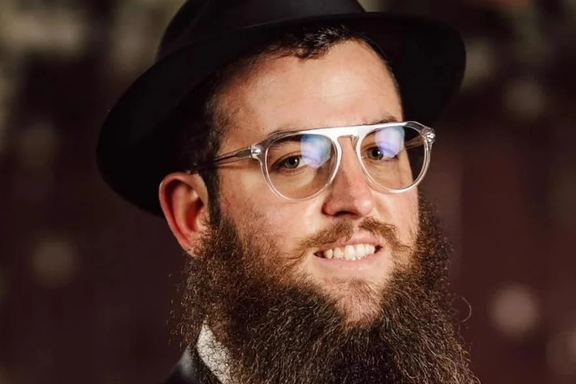
Zvi Kogan, a Chabad rabbi who was murdered in the UAE in November 2024
The murder of Israeli Rabbi Zvi Kogan in Dubai over the weekend, if linked to Iran, could herald a new front in the Islamic Republic's multi-faceted war with Israel.
That arena is not as well defined as the Mideast war zones in which Israel has dealt punishing blows to Iran-backed adversaries. It involves Israelis abroad coming within Iranian crosshairs as retribution for Israel’s airstrikes on Iran late last month.
No evidence yet links Iran to Kogan’s death and Tehran has denied any involvement.
The possible expansion of plots targeting Israelis beyond Israel's borders may be born out of Iranian weakness, according to Beni Sabti, an Israeli of Iranian origin who is a researcher at the Institute for National Security Studies (INSS).
“Iran cannot deal with Israel in a direct fight and war. Hezbollah and Hamas are not as strong as Iran wants them to be, so (Iran) opened an eighth round again, but from a place of weakness, not a place of strength,” Sabti told Iran International from Tel Aviv.
Israeli officials have said they are on the receiving end of attacks on seven fronts since the October 7 attacks launched by Hamas: Gaza, the occupied West Bank, Lebanon, Syria, Iraq, Yemen and Iran.
Far-flung targets
The most recent alleged Iranian attacks on Israelis were uncovered in Thailand and Sri Lanka.
In October, Iran International learned from a police source in Colombo that local authorities had foiled an Iran-linked plan to kill Israelis vacationing in Sri Lanka. Recently unsealed US Justice Department criminal complaints corroborated the plot.
A month later, Thai police warned of an attack aimed at Israeli citizens planned for a November 15 Full Moon party on a popular vacation Island.
There have been other alleged plots thwarted by domestic and Israeli intelligence agencies in Turkey, Azerbaijan, South Africa, Kenya and Western Europe.
The targeting of Jews outside of Israel is not new, with the deadliest coming in the form of the 1994 bombing of a Jewish community center in Buenos Aires.
85 people were killed and hundreds injured in an attack Argentinian prosecutors said was launched by Lebanon's Hezbollah at the instigation of Iran’s top leadership.
Arash Azizi, an Iranian journalist and author of What Iranians Want: Women, Life, Freedom, said Rabbi Kogan's murder fits with Iran’s modus operandi.
“The Iranian regime in the last decade or so has tried to kill Israeli citizens wherever it could find them. And it's usually failed in this attempt,” he said.
Abraham Accords
The United Arab Emirates may be a symbolic venue to strike because it represents of hub of people from the Middle East and has a growing Jewish community after formal relations were established with Israel following the Abraham Accords.
Kogan was an emissary to Abu Dhabi’s Chabad chapter and ran a kosher grocery store in Dubai.
With the weakening of Hamas and Hezbollah, Iranian attacks beyond the Jewish state may be on the rise.
Foreign lands may provide plausible deniability in order for Iran to avoid direct Israeli reprisals, said Jason Brodsky, policy director of Washington DC-based United Against Nuclear Iran.
“There has been an uptick ... Iran feels that it can't afford to get involved in a more direct armed conflict with Israel at a time when Israel sounds to be more risk ready than usual against the Iranian regime when the Biden administration is on its way out and has virtually no leverage anymore over Israel and the incoming Trump administration is unpredictable,” he said.
The cell responsible for Kogan's killing reportedly operated from Uzbekistan. 3 Uzbek nationals were arrested in the killing of an Israeli-Moldovan rabbi in the UAE.
While Brodsky sees the signs of Iran being behind Kogan’s killing, he cautioned that there may be a link to Islamic State, which has been heavily recruiting in Central Asia in recent years.
A hijab patrol has stopped a woman, who is led to a police van for questioning.
Iran’s parliament is due to announce next month its Hijab and Chastity Law which adds new fines for violating the theocracy's mandatory hijab rules, speaker Mohammad Bagher Ghalibaf said on Wednesday.
The parliament plans to formally refer the law on December 13 to President Masoud Pezeshkian, who is legally required to sign and implement it within five days.
The legislation, passed by parliament in September 2022 and approved by Iran's Guardian Council in late September this year, has faced delays as authorities weighed public backlash.
Parliament Speaker Mohammad Bagher Ghalibaf, a hardliner and a former senior Revolutionary Guards commander, said enforcement of the law will avoid direct confrontation with women - a controversial practice which has stoked mass protests.
"If an act of unveiling occurs, a text message will first be sent as a warning, followed by a second warning. Although the fine for the first offense is registered, it is not enforced initially. However, if the offense is repeated, the second fine will be applied," he added.
The law introduces significant fines, starting at 30 million rials (approximately $45) for a first violation, with repeat offenders facing fines of up to 240 million rials (around $350). The penalties, enforced through automated systems, represent a burden in a country where average monthly salaries range between $170 and $200.
The timing of the law's formal announcement was adjusted, Ghalibaf said, to account for security considerations tied to the anniversary of protests following the death of a young woman, Mahsa Amini, in morality police custody in 2022.
The months of mass demonstrations which followed saw many women publicly flout the compulsory Islamic dress code.
Ghalibaf in his remarks on Wednesday criticized the failure of most institutions to enforce previous hijab-related laws, saying that only the police had fulfilled their duties, albeit with occasional shortcomings.
However, questions linger about the infrastructure needed for implementation. Advanced equipment, such as surveillance cameras, remains limited. Ghalibaf acknowledged the gaps but added that measures are underway to ensure enforcement.
Public resistance and government control
The legislation faces strong public resistance, particularly since the Woman, Life, Freedom movement which lingers following Amini’s death.
Many women openly defy the hijab mandate, despite government crackdowns that have included the closure of businesses and impounding of vehicles linked to hijab violations.
Official reports indicate that at least 3,500 vehicles have been confiscated due to passengers violating hijab laws. Despite these crackdowns, many women continue to resist, with acts of civil disobedience such as public unveiling, sharing photos unveiled on social media and participating in protests.
This defiance highlights the pushback against what many perceive as a symbol of oppression, as widespread opposition to official inroads on women's rights and personal freedoms in the country festers.
Screenshot of the video showing Ahoo Daryaei disrobing at Tehran's Science and Research branch of Azad University on November 2, 2024.
On November 2, after reportedly being confronted and harassed by Basij paramilitary forces over her attire, she protested by removing her clothes and sitting partially undressed in the university courtyard.
Following her protest, Daryaie was detained by Iranian authorities, leading to concerns about her whereabouts and treatment. Reports indicate she may have been held in a psychiatric facility, raising international alarm over her condition.
Her action has drawn global attention, with human rights organizations calling for her immediate release.
Daryaie's protest occurred two years after the death of Mahsa Amini, which had previously sparked nationwide demonstrations against Iran's strict dress code laws.
“Iranian authorities are waging a war on women to punish defiance of forced veiling in the wake of the Woman Life Freedom uprising.”
The organization has called on Iranian authorities to end the punishment of women and girls for exercising their rights to bodily autonomy, freedom of expression, and freedom of religion. Amnesty has urged the immediate repeal of all mandatory hijab laws and regulations and demanded the dissolution of security forces tasked with enforcing these laws.
Iranian nuclear scientist Mohsen Fakhrizadeh, who was assassinated in his car in November 2020.
An Iranian court sentenced three Kurdish porters to death for smuggling in an Israeli robot weapon which killed a top nuclear scientist, with information obtained by Iran International indicating the cases relied on confessions extracted under torture.
The senior Islamic Revolutionary Guard Corps official was killed by a vehicle-mounted robotic gun, in a complex operation likely carried out by Tehran's arch-nemesis Israel.
Iran’s judiciary announced last week the sentencing of three cross-border porters, called Kolbars in Kurdish, to death for unwittingly bringing in components of the weapon into Iran from neighboring Iraq.
The men were identified earlier this month as Edris Aali, Azad Shojaei, and Rasul Ahmad Mohammad, the latter being a Sulaymaniyah resident in Iraqi Kurdistan.
In July 2023, after initial trials in Fakhrizadeh’s case, Iranian security forces arrested the three in Sardasht. One of them, Aali, spent eight months in detention before being moved to Urmia Central Prison.
Shojaei confessed to smuggling weapon parts under torture, Iran International has learned. Mohammad, the third accused, was apprehended after investigators found his number on Aali’s phone.
Two sources in Sardasht in Western Iran, and a contact close to the families told Iran International that two other porters, Rahman Qanjeh and Khaled Elyasi, were detained one month after Fakhrizadeh’s assassination in November 2020.
Kurdish porters Azad Shojaei (right) Edris Aali (left)
Qanjeh, a father of three who smuggled alcohol for his livelihood, and Elyasi, a porter between Iraqi Kurdistan and Iran, were accused of unknowingly transporting robotic weapon components.
Both men later confessed under duress, information obtained by Iran International shows, leading to an 8-year prison sentence.
He described intelligence operations that tracked suspects through Tehran, Arak, Hamedan, and Sanandaj before losing their trail in Saqqez.
"However, the case of (Mohsen) Fakhrizadeh was different. Everyone was identified. Nevertheless, we faced a vigilant enemy who, typically, would flee just half an hour before we could reach them,” added Alavi.
That admission appears to contradict the fresh death sentences related to the case for the Kurdish porters.
The November 2020 assassination of Mohsen Fakhrizadeh near Tehran initially appeared to be an armed ambush. However, it was later revealed that he was killed by a remote-controlled machine gun, smuggled into Iran in parts and assembled on-site. Israeli intelligence allegedly deployed artificial intelligence and facial recognition to execute the attack, which lasted just minutes.
In the operation's aftermath, Iranian authorities detained 20 individuals in Baneh near the Iraqi border, even showcasing photos of a suspected insider from Fakhrizadeh’s security team. Nevertheless, the intelligence minister’s admission of failure in apprehending the primary culprits has drawn criticism.
Activists accuse Tehran of scapegoating porters through forced confessions and harsh sentences to deflect attention from their intelligence failures.
Workers protest at Iran's South Pars Gas Complex, November 6, 2024.
Protests are intensifying across Iran as workers demand better wages and improved working conditions amidst the country’s financial crisis and energy shortages.
On Tuesday, refinery workers at the South Pars Gas Complex in Asaluyeh, a nerve center for Iran's natural gas production on the Persian Gulf, gathered to address grievances tied to delayed wage payments and unsatisfactory economic conditions.
Simultaneously, retired educators rallied outside the presidential office in Tehran, continuing demonstrations that have become frequent in recent months. Protesters voiced their frustrations, with banners highlighting the disparity between Iran’s resource wealth and their economic hardships.
They chanted slogans including, "Iran, a land of wealth, what has become of you?" as around one third of Iranians now live below the poverty line.
The oil and gas sector has increasingly replaced regular employees with contract workers, exposing them to precarious conditions and inadequate wages. Workers not only seek immediate improvements in pay but are also advocating for better dormitory accommodation and workplace safety measures.
"Tuesday's protests hold significant importance as workers from 12 refineries within the Pars Gas Complex united, demonstrating a powerful display of solidarity against the authorities," Sattar Rahmani, a workers' activist, told Iran International TV on Tuesday.
"While permanent employees struggle with minimal facilities, contractors face even harsher conditions, grappling with uncertainty about their future employment," he added. "The lack of a dependable and robust union to advocate for their rights exacerbates their plight, leaving them vulnerable and under immense pressure."
Nurses and healthcare workers have also been staging protests, including a large-scale strike in August involving around 50 cities and 70 hospitals. Their demands include higher wages, updated nursing tariffs, overtime pay, and the fulfillment of welfare benefits. Despite their consistent efforts, their grievances remain largely unaddressed due to the government’s significant budget deficit, estimated to exceed 50%. Many Iranian workers survive on monthly incomes of approximately $200, not even meeting the daily cost of living.
Iran has seen a surge in labor protests, with 428 recorded between April 2023 and April 2024, according to the Human Rights Activists News Agency (HRANA). Workers are grappling with issues such as delayed wage payments, low salaries, arbitrary layoffs, and privatization’s adverse effects.
Adding to these challenges, Iran is facing a severe energy crisis. This summer, the country endured power outages that halved industrial electricity supplies and caused widespread blackouts. Now, warnings of a severe gas shortage this winter have raised alarms. Parliament Speaker Mohammad Bagher Ghalibaf urged immediate measures to mitigate the crisis during a review of seasonal power and fuel shortages.
Iran’s natural gas production growth has slowed significantly, mainly due to the aging South Pars gas field, responsible for 75% of the country’s output. Natural declines, coupled with sanctions restricting access to advanced technology, have exacerbated the situation. The production growth rate over the past three years is now a third of the pace seen in the previous decade.
Mohammad Eslami, Head of Iran’s Atomic Energy Organization
Iran has escalated its nuclear program by injecting gas into thousands of advanced centrifuges, a process to enrich uranium which could ultimately be used to develop a nuclear weapon.
It comes on the back of an International Atomic Energy Agency (IAEA) censure resolution urging Tehran to enhance its cooperation with inspectors after enrichment of uranium reached 60%, near weapons-grade.
"We have begun injecting gas into several thousand advanced centrifuges, which is part of the nuclear industry's development program, and have put them into operational circuits," Mohammad Eslami, head of Iran’s Atomic Energy Organization, said Wednesday.
Speaking after a cabinet meeting, Eslami said it was a response to Europe's initiative at a recent Board of Governors meeting of the International Atomic Energy Agency (IAEA) to censure the Islamic Republic for its lack of cooperation with the UN nuclear watchdog.
According to Iran's Student News Agency, he said: "From the very beginning, we had stated that if the three European countries do not choose the path of engagement and instead pursue confrontation and resolution issuance, we will undoubtedly take reciprocal action without delay."
On Sunday, Parliament Speaker Mohammad Bagher Ghalibaf said that the activation of new centrifuges was in response to the resolution.
"The Islamic Republic of Iran's reciprocal response to this political misuse of the Board of Governors was immediately put into action, and the deployment of a set of new and advanced centrifuges has begun," he said on Sunday.
The IAEA resolution, adopted on November 21, follows three years of restricted access to Iran’s nuclear sites and growing uranium stockpiles. By late October, the agency reported that Iran’s reserves included 182.3 kilograms of uranium enriched to 60%, a significant step toward nuclear weapons capability.
Eslami, however, argued that Iran’s nuclear activities remain within international frameworks.
"All of Iran’s nuclear activities are under the supervision of the agency and carried out in accordance with the Safeguards Agreement and NPT provisions," he added.
Last year, Iran banned one third of the IAEA's inspectors with multiple politicians such as Ahmad Bakhshayesh Ardestani, a member of the National Security and Foreign Policy Commission of Iran’s Parliament, supporting nuclear armament as a military deterrent. Earlier, Tehran had restricted IAEA's monitoring cameras at its nuclear facilities.
"Under current circumstances, Iran should first move toward increasing uranium enrichment, potentially raising the enrichment level to 70% or 80%. In the second phase, Iran should pursue nuclear weapon production,” he told the Didban news website in Tehran.
Referring to the war of attrition with Israel amid global sanctions for exceeding international limits for enrichment, he added: "If we produce a nuclear bomb, the resulting tension will last no more than six months. Western countries will object to why we developed nuclear weapons, and we can respond by pointing out that they have sanctioned us enough already and have no new sanctions left to impose.”
A display of photographs honoring the victims of Iran’s state violence, featured at the "Memories Left Behind" exhibition, held from November 22 to 24, 2024, in Cologne, Germany.
Glasses left behind, a cherished jacket, a shirt bearing the last scent of dead man: the items on display moved many attendees of a unique exhibition on Iranian state repression to tears and tell a painful tale of Iran's suffering.
"Memories Left Behind" held over the weekend in Cologne, Germany paid tribute to the victims of 45 years of repression since the inception of the Islamic Republic in Iran.
The event coincided with the fifth anniversary of Iran's November 2019 protests, known as "Bloody November," in which security forces killed at least 1,500 protesters.
Organized by the Association of Victims' Families for Transitional Justice and the Association of Aban Families for Justice, the exhibition showcased personal belongings of victims, including handwritten letters, clothing and cherished keepsakes.
These items displayed served as a tribute to protesters, political prisoners, and victims of state repression beyond Iran's borders, spanning the mass executions of political prisoners in 1988 to the Woman, Life, Freedom uprising in 2022.
Soran Mansournia, whose brother Borhan was killed during the 2019 protests, reflected on the exhibition's meaning.
"We aimed to show the audience that the names and numbers seen in the news represent real people—human beings who fought for freedom and justice in Iran," said Mansournia, a co-founder Aban Families for Justice, whose name refers to the Persian month.
The brother of slain protestor Borhan Mansournia standing next to Borhan's shirt
Mahboubeh Ramezani, the mother of Pezhman Gholipour, who was also killed during the November 2019 protests, shared a message with attendees which was played for the audience.
"Every photo, every name, every item displayed here tells a story of courage. These are stories of integrity and honor, of those who gave their lives for freedom and justice. We will not forget the crimes of the Islamic Republic."
A composite photo of the hoodie worn by slain protester Pezhman Gholipour on display, alongside an image of his mother, Mahboubeh Ramezani, holding the bloodstained shirt he wore during the protests when he was shot and killed, with the shirt worn by slain protester Navid Behboudi also displayed.
Rahimeh Yousefzadeh, mother of Navid Behboudi, also killed during November 2019 protests remembered her son: “Navid, my passionate son, dreamed of justice and freedom, but the regime stole his dreams. We will not forget, and justice must be served.”
Fight against forgetting
The exhibition also commemorated the victims of the Woman, Life, Freedom uprising which began in September 2022 following the death of Mahsa Amini in morality police custody and was defined by months nationwide protests against theocratic rule.
Daughters of slain protestor, Minoo Majidi standing next to her dress
Among the items displayed was a dress belonging to Minoo Majidi, who was killed during the uprising on September 20, 2022 in Kermanshah, Western Iran.
"My mother wore this dress during her birthday celebration in England," her daughter, Mahsa Piraei, said. "It was the first and last time she wore it. One of the goals of the exhibition is to fight against forgetting. These souls were not just numbers; they were loved ones with families who adored them."
Slain teen protestor, Artin Rahmani's uncle standing next to Artin's jacket
Similarly, a jacket worn by 17-year-old protester Artin Rahmani killed during the same uprising on 16 November 2022 in Izeh, Southwestern Iran was on displayed.
"Artin joined the protests dressed in black the day after I warned him not to wear this jacket, as it was too identifiable during the previous day’s protests," his uncle, Foad Choobin recounted. "The next day at the protests, the Islamic Republic killed him with three bullets. We are here today to amplify Artin’s voice and the voices of others who were killed by the Islamic Republic."
Slain protestor Fereydoon Mahmoudi's brother standing next to Fereydoon's shoes
A pair of shoes belonging to Fereydoun Mahmoudi, who was killed on September 19, 2022 during the protests in the Kurdish city of Saqqez, Western Iran.
"When I saw the photos of our loved ones and Fereydoun’s shoes displayed, I choked up," his brother Farhad said.
"Those shoes, once worn at weddings and formal occasions, now serve as a memento far from his homeland. Fereydoun sacrificed everything for freedom, prioritizing the fight for his country’s liberty over his own ambitions."
Remembering PS752 Flight victims shot down by the IRGC
The exhibition also included items cherished by those who lost their lives in the downing of Ukraine International Airlines Flight PS752 by Iran’s Revolutionary Guards in January 2020.
A hat belonging to environmental activist Ghanimat Azhdari was among the artifacts. "This hat was part of her life," her sister, Azamat said. "Her memory and her fight lives on."
Azamat Azhdari standing next to her sister's hat and hair brush
1988 mass executions: a legacy of loss
The exhibition also featured a section paying tribute to the victims of the 1988 mass executions of political prisoners.
Khatereh Moini, whose brother Hebat Elah was executed during then, shared a heartbreaking memory as she stood next to her brother’s shirt.
"I wanted to smell his shirt, to see if I could still remember his scent," she said, pointing to the faded shirt returned to her after over 35 years.
Khatereh Moini standing next to her brother's shirt
"Twelve of my family members were killed by the Islamic Republic, including my brother and my sister’s husband, Kasri Akbari Kurdestani, in the summer of 1988," Moini said.
During this time, Khatereh Moini witnessed the heart-wrenching plight of families, including her own, as they searched for their loved ones in unmarked graves.
In the wake of the 1988 massacre of political prisoners, many victims’ bodies were neither identified nor returned to their families. Instead, they were buried in mass graves at Khavaran, a cemetery in southeastern Tehran, where thousands of victims remain.
Moini, one of the witnesses to this atrocity, recalled the painful experience of searching for her family members' final resting place.
"I remember my mother digging the graves, and it is something that will never leave me," she said, her voice breaking.
Ongoing tragedies and transnational repression
The exhibition also highlighted transnational repression and ongoing tragedies, such as the disappearance of former political prisoner Ebrahim Babaei while fleeing Iran in 2021.
Shima Babaei standing next to her father's glasses
Among the items displayed was a pair of glasses that belonged to Babaei. His daughter, Shima, spoke about the pain of his absence.
"Instead of embracing my father, I was handed his belongings. His glasses and other personal belongings are a testament to his memory and the crimes committed against him. Two years and eleven months have passed, and I still cling to hope."
A collective vow for justice
Organizer and activist Lawdan Bazargan said the exhibition aimed not just at preserving lost loved ones' memories but winning a better future for Iran.
"This is not just about remembering the past but amplifying the voices of victims and their families. We will not forget. The voices of our loved ones must be heard, and justice must prevail."
The exhibition drew dozens of attendees, many visibly moved by the stories and items on display.
Bazargan noted that the exhibition only scratches the surface of the crimes committed by Iranian authorities against their people.
"The sheer scale of these crimes shocks viewers. Our fight for justice will continue until it bears fruit."