• العربية
  • فارسی
Brand
  • Iran Insight
  • Politics
  • Economy
  • Analysis
  • Special Report
  • Opinion
  • Podcast
  • Iran Insight
  • Politics
  • Economy
  • Analysis
  • Special Report
  • Opinion
  • Podcast
  • Theme
  • Language
    • العربية
    • فارسی
  • Iran Insight
  • Politics
  • Economy
  • Analysis
  • Special Report
  • Opinion
  • Podcast
All rights reserved for Volant Media UK Limited
volant media logo

Iran pledges ‘decisive response’ to Israeli airstrikes
Nov 18, 2024, 10:38 GMT+0Updated: 15:20 GMT+0
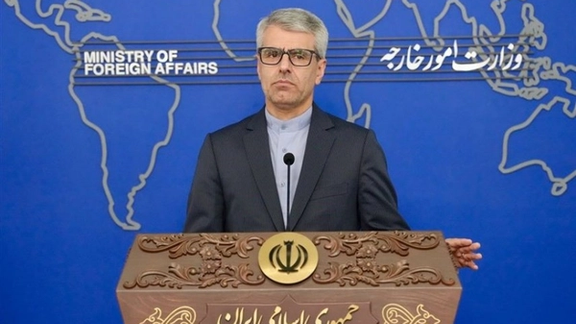
Iran's Foreign Ministry Spokesman Esmail Baghaei during his weekly briefing on November 18, 2024.

Iran's foreign ministry warned on Monday of a decisive response to Israel’s October airstrikes on its territory, adding that any attack on its nuclear facilities would violate a UN ban.

The strikes on October 26, targeted Iranian military facilities, including air defenses, following missile attacks on Israel by Iran earlier that month.

"In defending our territorial integrity and sovereignty, we seek no one's permission, and any aggression will undoubtedly be met with a decisive response," Foreign Ministry Spokesman Esmail Baghaei said Monday during his weekly briefing.

He also reaffirmed Iran’s support for regional militia groups, underscoring Tehran’s broader strategy in the region amidst ongoing hostilities.

Baghaei also said that the country's nuclear facilities must be protected from any potential attacks by Israel, in compliance with a resolution adopted more than three decades ago by the UN nuclear watchdog, the IAEA.

There is no UN Security Council resolution that bans attacks on nuclear facilities, but the International Atomic Energy Agency (IAEA) did adopt General Conference Resolution (GC(XXXIV)/RES/533) in 1990 that prohibits armed attacks on nuclear facilities, "devoted to peaceful purposes." The resolution also calls for strengthening international cooperation on nuclear safety and radiological protection.

"This resolution is a clear rule that prohibits any threats against nuclear facilities," Baghaei said, but did not mention the wording which says "devoted to peaceful purposes. "Such threats endanger the national security of states, and the United Nations must provide a decisive response to them."

Israel's new defense minister said last week that the Islamic Republic's nuclear facilities are now more exposed than ever, following Israel's October 26 airstrikes that targeted critical Iranian air defense systems.

In his remarks, Israel Katz said the vulnerability of Iranian nuclear sites has made it more plausible for Israel “to achieve the most important goal, to thwart and remove the threat of annihilation from hanging over the State of Israel."

“Our region has been familiar with the law-breaking approaches of the Zionist regime for decades. We will take all necessary actions to protect our nuclear facilities,” said Baghaei on Monday.

It is not clear what nuclear facilities Israel would target, but Iran's underground uranium enrichment sites, producing highly purified fissile material, might not be considered as peaceful.

Iranian authorities have consistently called for Israel's destruction, and until now, refused to call it anything other than “the Zionist entity.”

Responding to inquiries about European nations' willingness to negotiate, Baghaei said Iran is open to discussions. "We have never abandoned negotiations on the nuclear issue," he said. "The revival of the JCPOA has been an ongoing process, and Iran has consistently demonstrated its goodwill in these efforts."

Iran's nuclear talks during the Biden administration, centered around reviving the 2015 Joint Comprehensive Plan of Action (JCPOA), remain a focal point of international diplomacy. The agreement aimed to limit Iran's nuclear activities in exchange for sanctions relief, but its future is now uncertain since the US withdrew in 2018 and reimposed sanctions, prompting Iran to gradually breach its commitments. Recent negotiations have faced significant hurdles, including disagreements over sanctions relief, verification mechanisms, and guarantees against future US withdrawal. While Iran insists its nuclear program is peaceful, Western powers express concern over its enrichment of uranium to near weapons-grade levels.

Baghaei pointed to a recent visit by the International Atomic Energy Agency (IAEA) Director-General Rafael Grossi as evidence of what he called Iran’s constructive approach.

IAEA Director General Rafael Grossi pictured with Behrouz Kamalvandi, spokesperson for the Atomic Energy Organization, and Kazem Gharibabadi, Deputy Foreign Minister, at the Natanz nuclear site in Iran, Nov 15, 2024.
100%
IAEA Director General Rafael Grossi pictured with Behrouz Kamalvandi, spokesperson for the Atomic Energy Organization, and Kazem Gharibabadi, Deputy Foreign Minister, at the Natanz nuclear site in Iran, Nov 15, 2024.

"The visit was productive and positive, leading to constructive agreements. We expect the opposing parties to recognize Iran's positive approach and let the process proceed on a technical path, free from political pressure," he added.

He went on to say that ambiguities in Iran’s nuclear program raised by the IAEA lack a clear basis and were thoroughly discussed during Grossi's visit.

"Iran remains committed to ensuring that the Agency can operate without the disruptive and malicious pressures exerted by certain parties," Baghaei said, stressing the importance of allowing the IAEA to work independently of external political influences.

Iran's relationship with the IAEA has been fraught with tension in recent years, particularly over issues of transparency and compliance with nuclear agreements. The IAEA has repeatedly raised concerns about Iran's enrichment of uranium to near weapons-grade levels and its lack of cooperation in granting access to key sites. Tehran, in turn, accuses the IAEA of being influenced by political pressures from Western powers and insists that its nuclear activities are peaceful and within its sovereign rights.


Most Viewed

Iran negotiators ordered to return after internal rift over Islamabad talks
1
EXCLUSIVE

Iran negotiators ordered to return after internal rift over Islamabad talks

2
ANALYSIS

US blockade enters murky phase as tankers spoof signals and buyers hesitate

3
ANALYSIS

Why the $100 billion Hormuz toll revenue is a myth

4

US tightens financial squeeze on Iran, warns banks over oil money flows

5
ANALYSIS

US blockade targets Iran oil boom amid regional disruption

Banner
Banner

Spotlight

  • Hardliners push Hormuz ‘red line’ as US blockade tests Iran’s leverage
    INSIGHT

    Hardliners push Hormuz ‘red line’ as US blockade tests Iran’s leverage

  • Ideology may be fading in Iran, but not in Kashmir's ‘Mini Iran'
    INSIGHT

    Ideology may be fading in Iran, but not in Kashmir's ‘Mini Iran'

  • War damage amounts to $3,000 per Iranian, with blockade set to add to losses
    INSIGHT

    War damage amounts to $3,000 per Iranian, with blockade set to add to losses

  • Why the $100 billion Hormuz toll revenue is a myth
    ANALYSIS

    Why the $100 billion Hormuz toll revenue is a myth

  • US blockade targets Iran oil boom amid regional disruption
    ANALYSIS

    US blockade targets Iran oil boom amid regional disruption

  • Iran's digital economy battered by prolonged blackout
    INSIGHT

    Iran's digital economy battered by prolonged blackout

•
•
•

More Stories

Food poverty in Iran escalating amid rising inflation

Nov 18, 2024, 07:08 GMT+0

Over 32 million Iranians—more than one-third of the population—were living below the poverty line by March 2022 and are now grappling with food insecurity, according to a report by the Iran Chamber of Commerce Research Center.

The report, released on Saturday, attributed the trend to decades of double-digit inflation, which has significantly worsened since 2019, topping 40 percent. Whaqt triggered the jump in inflation was US economic sanctions imposed in 2018.

Food poverty in Iran surged from 18 million people in 2017 to over 26 million by 2020, the report said, noting that with the current inflation rate discussions about investment, economic growth, and poverty reduction is impractical.

The report argues, "Given the current circumstances, monetary and fiscal policies should focus on stabilizing inflation rather than pursuing significant reductions. Expecting a substantial decline in inflation through specific monetary and fiscal measures is unrealistic."

The Chamber of Commerce Research Center also admitted that the government’s measures and policies to curb the sharp devaluation of the national currency and support production had limited success. Since 2018, Iran's rial has fallen more than 15-fold against the US dollar as sanctions reduced Tehran's oil exports.

Inflation rates of Iranian calendar years according to the Central Bank of Iran  (undated)
100%
Inflation rates of Iranian calendar years according to the Central Bank of Iran

“Considering the pressures on Iran's economy due to sanctions, negative economic prospects, and the severe damage to production and investment, as well as the limited success of monetary control policies, it would be better not to overly focus on strict contractionary policies... Instead, efforts should be directed toward managing inflation and achieving price stability to stimulate production,” read the report.

According to a recent report by the parliament’s research center, Iran's poverty rate increased by 0.4 percent in the last Iranian year (ended March 2024) compared to a year earlier, reaching 30.1%. This means that at least one-third of the population was unable to meet their basic needs and lived below the poverty line.

Additionally, a report by Ham-Mihan newspaper in Tehran said Sunday that more than half of Iranian households live below the relative poverty line, often resorting to installment purchases for basic necessities like meat, dairy, and household items.

The study by Iran's Chamber of Commerce also highlighted systemic issues fueling inflation, such as government inefficiency, excessive spending on public sector, and reliance on printing money to cover budget deficits.

To offset budget deficits and secure loans from financial institutions, the Iranian government has pressured the Central Bank to print unsupported money. According to IMF figures, liquidity in Iran has surged annually by 25-40% in recent years, with projected increases above 27% this year and next.

This increased liquidity has fueled runaway inflation. Over the past several years, Iran has consistently ranked among the top 10 countries with the highest inflation rates, and next year it is expected to have the sixth-highest inflation globally.

Iran’s carpet exports unravel with 90% plunge

Nov 18, 2024, 03:00 GMT+0

Iran’s handwoven carpet exports, once thriving at $426 million annually, have plummeted to under $40 million in just seven years, prompting government intervention, amid sanctions and rising regional competition.

India has taken over as the dominant player in the global carpet market, capitalizing on Iran’s declining exports and securing the US market, which accounts for 44% of global carpet imports, Morteza Haji Aghamiri, chairman of the Carpet Commission at Iran’s Chamber of Commerce, told the Iranian Labour News Agency (ILNA).

Aghamiri added that Iran’s carpet exports, valued at $426 million in 2017, had plummeted to just $39.7 million by March 2024.

Official reports last March revealed that Persian carpet exports had reached their lowest level in 24 years. This decline, however, has been years in the making. In 1994, Persian carpets generated over two billion dollars for Iran, yet by 2019, exports had dropped to $69 million, plummeting further to just two million dollars in the second quarter of 2020.

Sanctions and currency regulations—specifically, the now-repealed “foreign exchange commitment policy,” which required exporters to repatriate earnings within a specified period—have been primary obstacles, Aghamiri said. Even with the policy’s repeal, exports remain constrained. “The competition from India, Turkey, and Afghanistan has only made things worse,” he added.

Adding to the challenge, Afghan carpets smuggled into Iran have flooded the domestic market. Aghamiri explained that US investment in Afghanistan’s carpet industry before the 2021 withdrawal, fueled production, making lower-quality Afghan carpets a growing presence in Iran’s markets, often sold as Iranian products.

A carpet store in Tehran. Undated
100%
A carpet store in Tehran.

The steep fall in exports has significantly impacted jobs across the carpet sector, exacerbating unemployment in Iran’s rural areas. Aghamiri also highlighted the lack of social insurance for carpet weavers and registered artisans, depriving them of minimum wages and benefits. He added that these issues have led to the loss of two million jobs in Iran and reduced production and exports in the handwoven carpet industry.

Committee to revive carpet exports

In response to the industry’s difficulties, Iran’s foreign minister Abbas Araghchi said that the government intends to form a special committee to address these export challenges.

On Friday, during a visit to the 31st Tehran International Handwoven Carpet Exhibition, Araghchi called on officials to support the production, sale, and export of Iranian carpets. “The vitality of Iranian carpets depends on exports,” he said, emphasizing that the committee will work to remove obstacles hindering the industry.

While sanctions are a significant factor, Araghchi highlighted the need to ease Iran’s export regulations as well.

To boost Iranian carpets abroad, the foreign ministry has instructed embassies to promote exports. “The foreign ministry’s economic department has been tasked with expanding markets for Iranian products, especially carpets,” Araghchi said. He also called for a comprehensive policy to guide each government agency’s role in supporting the industry.

Data from the Trade Ministry show that the export of traditional Iranian hand-woven carpets in 2001, when nuclear sanctions against Iran had not yet been imposed, was more than half a billion dollars, over a quarter of which was imported by the United States, with Germany, Lebanon, and Britain as other major customers.

The exports picked up again in 2017, immediately after the implementation of Iran's 2015 nuclear deal with world powers, the Joint Comprehensive Plan of Action (JCPOA). But exports started to fall again after the US withdrawal from the deal in 2018 when Washington reimposed sanctions on the import of Iranian rugs.

With President-elect Donald Trump taking office in January 2025, it remains to be seen whether President Pezeshkian’s administration’s proposed committee can revitalize the industry under a new wave of potential sanctions.

German lawmakers sponsor four Iranian protesters on death row

Nov 18, 2024, 00:02 GMT+0

Four German parliamentarians have taken on political sponsorships for four Iranian protesters who were recently sentenced to death over their alleged involvement in the killing of a Basij militia member during the 2022 nationwide protests.

On November 13, the Islamic Republic's Judiciary issued death sentences for Milad Armoun, Alireza Kafaei, Amir Mohammad Khosheghbal, Navid Najaran, Hossein Nemati, and Alireza Barmarzpournak, the six individuals accused of killing Basij member Arman Aliverdi in Tehran's Ekbatan apartment complex. The charges against them remain contested, however, due to a lack of clear evidence linking them to the crime.

In a statement, German Parliament members Tobias B. Bacherle, Oliver Kaczmarek, and Anne Monika Spallek, along with Lisa-Kristin Kapteinat from the North Rhine-Westphalia State Parliament, announced political sponsorships for four of the accused, urging Iran's government to release them immediately.

"We express our profound concern over the devastating developments... They were all sentenced to death by the brutal Iranian regime without a fair trial and under inhumane conditions," the German MPs said, adding that the Islamic Republic "seeks to carry out executions to suppress resistance entirely."

The Ekbatan Complex case, tied to the broader unrest that followed the death of Mahsa Amini in morality police custody, involves accusations that the defendants participated in Aliverdi's killing. A video circulating on social media showed Aliverdi, bleeding from the face and head as a protester kicked him. Authorities allege that protesters stabbed him, but the defendants deny the charges, with Ekbatan residents saying that Aliverdi was attempting to infiltrate the protests.

The controversy surrounding the case is compounded by reports of torture and mistreatment of the accused, with human rights organizations expressing concern over the fairness of the trial.

Iran's execution spree

The death sentences for the six protesters came against the backdrop of the Islamic Republic's execution spree over the past few years. At least 711 people have been executed in Iran since January, prompting female political prisoners at Evin prison in Tehran to call on authorities to stop issuing death sentences.

The Norway-based Iranian rights group Hengaw reported on Saturday that 13 of the 711 documented executions this year involved political prisoners. The group also documented 21 fatalities in Iran’s prisons in 2024, including four deaths of political detainees and eight deaths attributed to torture.

"Iran has an appalling record of executions, most recently evidenced by the execution of German citizen Jamshid Sharmahd," the four German parliamentarians said in their statement released on Saturday. "The systematic use of the death penalty to suppress political opinions constitutes a grave violation of fundamental human rights and has been strongly condemned by the international community."

On November 5, Iran’s judiciary announced that German-Iranian citizen Jamshid Sharmahd died in late October before his scheduled execution. “Jamshid Sharmahd's death sentence was set to be carried out, but fate offered no reprieve, and he died before the execution could proceed," the Judiciary's spokesman said.

Sharmahd was abducted by Iranian agents during a visit to the United Arab Emirates in 2020 and forcibly taken to Iran. In February 2023, Iran's Judiciary sentenced him to death on charges of endangering national security. Tehran says that Sharmahd was responsible for a 2008 attack on a mosque in Shiraz that killed 14 people and injured 200.

Who are Khamenei's likely successors?

Nov 17, 2024, 21:36 GMT+0
•
Morad Vaisi

On November 15, a member of Iran’s Assembly of Experts announced that the Assembly has selected three individuals as potential successors to Ali Khamenei in order of priority. However, the names of these candidates remain confidential.

This announcement by Abolhassan Mahdavi, the temporary Friday prayer leader in Isfahan, comes amid heightened tensions between Israel and the Islamic Republic and concerns over the possibility of Khamenei being assassinated by Israel. It is not the first time that a senior cleric makes a similar statement, but the timing on this occasion provokes more questions.

Concerns over Khamenei's assassination

Even before the recent escalation between Israel and the Islamic Republic, discussions about Khamenei’s succession were already ongoing. These concerns have now intensified. In recent meetings with the Assembly of Experts, the body responsible for selecting the next Supreme Leader, Khamenei urged members to be ready to swiftly choose a successor if needed. Analysts interpret these remarks as stemming from his fear of an Israeli assassination rather than concerns about natural causes.

During Friday prayers, Mahdavi emphasized that Khamenei is physically healthy, showing no signs of illness. This reinforced the view that what the establishment is most concerned about is external threats.

A "Martyrdom" atmosphere in recent Assembly meeting

Assembly member Heydari Kashani described Khamenei’s recent meeting with the Assembly of Experts as taking place in an atmosphere of “martyrdom.” According to Kashani, participants wept as Khamenei emphasized the need for the Assembly to quickly select a new leader in his absence. This underscores concerns about potential unrest and the heightened risk of the regime’s collapse without Khamenei.

Mojtaba Khamenei: The leading candidate

Mahdavi disclosed that three candidates have been selected as potential successors, though their identities remain confidential. Among them, Mojtaba Khamenei, the second son of Ali Khamenei and his most politically influential offspring, is widely regarded as the leading contender.

An undated photo of Mojtaba Khamenei with Qasem Soleimani.
100%
An undated photo of Mojtaba Khamenei with Qasem Soleimani.

Mojtaba has reportedly been groomed for leadership with his father’s approval. For over 27 years, he has played a behind-the-scenes role in shaping major policy decisions. Close associates, such as Abbas Palizdar and former IRIB head Mohammad Sarafraz, have also confirmed Mojtaba’s influence. His recent suspension of his advanced jurisprudence classes and the release of his first official video further signal preparations for a power transition.

Alireza Arafi: A likely second choice

Another potential candidate is Alireza Arafi, a trusted confidant of Khamenei. Arafi is the second deputy chairman of the Assembly of Experts, a member of the Guardian Council, Friday prayer leader of Qom, and an influential figure in the seminary. His position within the power structure enhances his chances of being chosen.

Ayatollah Alireza Arafi. undated
100%
Ayatollah Alireza Arafi

Hashem Hosseini Bushehri: A third possibility

The third likely candidate is Hashem Hosseini Bushehri. He is the first deputy chairman of the Assembly of Experts, the head of the Qom Seminary Society, and Friday prayer leader in Qom. His close ties to Khamenei and key leadership roles increase his prospects. In contrast, figures like Mehdi Mirbagheri, despite significant media coverage, are considered less likely candidates.

Ayatollah Hashemi Bushehri, holding a gun during a Friday sermon, as is customary for Islamic Republic.
100%
Ayatollah Hashemi Bushehri, holding a gun during a Friday sermon, as is customary for Islamic Republic.

Unlikely candidates

Names such as Ali Khomeini and Hassan Khomeini, grandsons of Ruhollah Khomeini (the founder of the Islamic Republic), have also been mentioned. However, their prospects are slim due to their exclusion from the regime's upper echelons. Hassan Khomeini was effectively sidelined after being barred from running for the Assembly of Experts nine years ago.

Hassan Rouhani faced a similar disqualification, while Sadeq Larijani, the current chairman of the Expediency Discernment Council, failed to win a seat in the Assembly of Experts during the last election. Additionally, Larijani’s resignation from the Guardian Council reportedly displeased Khamenei, further diminishing his chances.

Former president Ebrahim Raisi, who served as president and first deputy chairman of the Assembly of Experts, died under suspicious circumstances in a helicopter crash a day before the election of the Assembly’s new chairman in May. Meanwhile, Ayatollah Ahmad Khatami, who criticized the promotion of Mojtaba Khamenei’s leadership at the Assembly meeting, was immediately removed from the Assembly’s presidium.

Broader challenges for the establishment

While Mojtaba Khamenei is considered the most likely successor, the regime faces far greater challenges than leadership transition. Escalating tensions with Israel, the re-election of Donald Trump, and mounting public discontent over chronic shortages of electricity, natural gas, and fuel have placed the regime's survival in jeopardy. Growing frustration with government inefficiency, mandatory hijab laws, and internet restrictions has only deepened public anger and unrest.

Iran’s labor protests grow as workers, retirees demand economic action

Nov 17, 2024, 17:27 GMT+0

Labor and livelihood protests swept Iran on Sunday, as nurses, emergency personnel, retirees, and public transportation drivers highlighted dissatisfaction with the government’s economic and social policies.

In Yasuj, southwestern Iran, a group of nurses and healthcare staff gathered to demand improved working conditions and wages.

Simultaneously, emergency personnel in Shiraz protested outside the Fars provincial governor’s office. Their demands, outlined by the Coordination Council of Nurses’ Protests, included inflation-adjusted salaries, special allowances, recognition of hazardous job conditions, and job security.

Healthcare workers, critical during the COVID-19 pandemic, have repeatedly protested in recent years over broken promises, amid persistent 40% inflation and stagnant salaries since 2019.

On Saturday, nurses at Loghman Hospital in Tehran voiced frustrations over unpaid wages and overtime, echoing broader discontent that saw work stoppages in over 70 hospitals across 50 cities earlier this year.

Retirees and workers raise economic concerns

In Tehran, oil industry retirees protested outside the National Iranian Oil Company, chanting, "The retiree's refrigerator, emptier than ever," and decrying their financial hardships. A former minister, Ali Rabiei joined the workers in solidarity.

Social Security retirees held demonstrations in the southern cities of Ahvaz and Shush, with slogans such as "Enough with warmongering, our tables are empty," and "Forget the headscarf, tackle inflation."

The steel industry retirees in Isfahan joined the wave of protests, gathering in front of the Steel Retirement Fund building to criticize deteriorating living standards.

A separate protest by retired educators took place on Saturday in front of the Presidential Office in Tehran. Holding 100,000 rial notes, criticizing the government’s failure to implement salary equalization laws. The banknote that would have been worth around $1,500 before the 1979 revolution is now worth just 15 cents.

100%

Public transport drivers demand resolution

In Zahedan, Sistan-Baluchestan Province, public transportation drivers protested the month-long deactivation of their fuel cards. Despite assurances from provincial officials to resolve the issue, drivers claim no action has been taken. Their demands highlight the government’s inability to address even basic logistical challenges affecting livelihoods.

These protests reflect a broader crisis as citizens face increasing economic pressures amidst rising inflation, wage stagnation, and government inaction. Retirees, in particular, have held repeated protests over years, lamenting the worsening value of pensions and unfulfilled promises.

The consistent surge in demonstrations underscores mounting dissatisfaction with Masoud Pezeshkian’s administration, as workers and retirees across sectors demand the government address their grievances.