• العربية
  • فارسی
Brand
  • Iran Insight
  • Politics
  • Economy
  • Analysis
  • Special Report
  • Opinion
  • Podcast
  • Iran Insight
  • Politics
  • Economy
  • Analysis
  • Special Report
  • Opinion
  • Podcast
  • Theme
  • Language
    • العربية
    • فارسی
  • Iran Insight
  • Politics
  • Economy
  • Analysis
  • Special Report
  • Opinion
  • Podcast
All rights reserved for Volant Media UK Limited
volant media logo

IAEA chief tours key Iranian nuclear sites in possible boon to diplomacy

Nov 15, 2024, 18:38 GMT+0Updated: 15:21 GMT+0
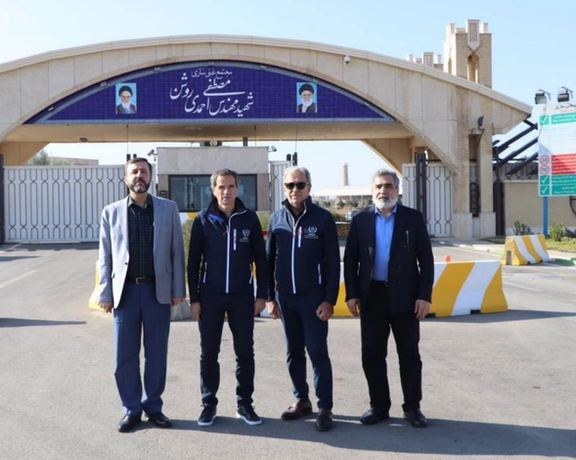
IAEA Director General Rafael Grossi pictured with Behrouz Kamalvandi, spokesperson for the Atomic Energy Organization, and Kazem Gharibabadi, Deputy Foreign Minister, at the Natanz nuclear site in Iran, 15 Nov 2024.

UN nuclear chief Rafael Grossi toured two of Iran’s key nuclear sites on Friday as Iran signaled readiness to restart negotiations over its disputed program in an effort to ease sanctions.

The Fordow site, located about 100 km south of Tehran, has been a focal point of tension due to its uranium enrichment activities. In February last year, inspectors discovered uranium particles enriched to 83.7% at the underground facility.

Iran said it started enriching uranium to 60% at Fordow two years ago, building on similar enrichment at the other site visited by Grossi, Natanz. This level, close to weapons-grade 90%, represented a significant escalation in its nuclear program.

Grossi’s trip to Tehran included meetings with key officials, including President Masoud Pezeshkian and Foreign Minister Abbas Araghchi.

President Pezeshkian signaled Iran’s willingness to cooperate with the IAEA to clarify ambiguities regarding its nuclear activities and again asserted the peaceful intentions of the program.

Meanwhile, Mohammad Eslami, head of Iran’s Atomic Energy Organization, warned that any resolution by the IAEA’s Board of Governors criticizing Iran’s nuclear program would prompt immediate retaliatory actions.

“We will not allow pressure to dictate the course of our peaceful nuclear activities,” Eslami said during a joint press conference with Grossi.

The IAEA’s Board of Governors is set to meet next week, and European powers are advocating for a resolution to increase scrutiny of Iran’s nuclear program and press Tehran to return to negotiations.

Simultaneously, the geopolitical landscape remains tense. Israeli strikes last month destroyed a nuclear weapons research facility in the Parchin military complex near Tehran, according to a report by Axios.

European powers, seeking to curb Iran’s nuclear advancements, are pushing for a comprehensive IAEA report detailing problem areas, including the discovery of unexplained uranium traces at undeclared sites.

Iranian state media, IRNA, emphasized the positive atmosphere during Grossi's visit, saying: "In Tehran, Grossi was met with goodwill from Iranian officials, who conveyed a message of readiness to negotiate and revive the path of constructive engagement."

This shift in tone is particularly striking given that just a year ago, Iran barred nearly one-third of the IAEA's monitoring team, a move Grossi described at the time as a severe impediment to oversight.

Tehran labeled the excluded inspectors as "extremists," further heightening tensions between Iran and the international community over its nuclear activities.

But, while Iran signals a willingness to cooperate, Washington remains wary.

“What we want to see from Iran is actual behavior change and action, not just signs of something or indications of something,” said Vedant Patel, Principal Deputy Spokesperson, adding that all options are on the table to prevent Iran from developing a nuclear weapon.

Iran’s diplomatic moves, including Grossi’s visit, appear aimed at de-escalating tensions ahead of the return of US President-elect Donald Trump, who is expected to adopt a hardline stance on Iran’s nuclear program.

The IAEA meeting next week may prove critical to gauge the direction of Iran’s nuclear program and any way forward for renewed negotiations.
Most Viewed

Iran negotiators ordered to return after internal rift over Islamabad talks
1
EXCLUSIVE

Iran negotiators ordered to return after internal rift over Islamabad talks

2
ANALYSIS

US blockade enters murky phase as tankers spoof signals and buyers hesitate

3
ANALYSIS

Why the $100 billion Hormuz toll revenue is a myth

4

US tightens financial squeeze on Iran, warns banks over oil money flows

5
ANALYSIS

US blockade targets Iran oil boom amid regional disruption

Banner
Banner

Spotlight

  • Hardliners push Hormuz ‘red line’ as US blockade tests Iran’s leverage
    INSIGHT

    Hardliners push Hormuz ‘red line’ as US blockade tests Iran’s leverage

  • Ideology may be fading in Iran, but not in Kashmir's ‘Mini Iran'
    INSIGHT

    Ideology may be fading in Iran, but not in Kashmir's ‘Mini Iran'

  • War damage amounts to $3,000 per Iranian, with blockade set to add to losses
    INSIGHT

    War damage amounts to $3,000 per Iranian, with blockade set to add to losses

  • Why the $100 billion Hormuz toll revenue is a myth
    ANALYSIS

    Why the $100 billion Hormuz toll revenue is a myth

  • US blockade targets Iran oil boom amid regional disruption
    ANALYSIS

    US blockade targets Iran oil boom amid regional disruption

  • Iran's digital economy battered by prolonged blackout
    INSIGHT

    Iran's digital economy battered by prolonged blackout

•
•
•

More Stories

Israel strikes Iran-linked targets in Damascus for second day in a row

Nov 15, 2024, 17:57 GMT+0

Israeli airstrikes targeted the Mazzeh suburb of Damascus on Friday, intensifying an air campaign against Iran-linked targets in Syria.

Explosions which Syrian state news agency SANA said were Israeli airstrikes hit the Mazzeh area for the second day in a row and appeared to target personnel from Hezbollah and Iran's Revolutionary Guards, as well as leaders from Palestinian groups like Hamas and Islamic Jihad.

While the specific targets of Friday’s strikes remain unclear, they follow a pattern of escalating action against Iran and its allies.

On Thursday, similar strikes in Mazzeh and nearby Qudsaya claimed fifteen lives, targeting military sites and Islamic Jihad’s headquarters.

The airstrikes occurred shortly before Ali Larijani, a senior adviser to Iran’s Supreme Leader Ali Khamenei, was scheduled to meet with Palestinian representatives at the Iranian Embassy in Mazzeh.

The escalation in Syria reflects a broader regional dynamic. On Tuesday, the United States conducted successive airstrikes on Iranian-backed militia facilities in eastern Syria in retaliation for attacks on US personnel.

These strikes, combined with the Pentagon’s deployment of additional air and naval assets to the region, indicate increasing US involvement in countering Iranian allies.

Simultaneously, Israeli forces expanded their operations beyond Damascus, targeting strategic infrastructure along the Syrian-Lebanese border. A bridge near Qusayr in Homs was destroyed to disrupt weapons transfers to Hezbollah, further intensifying pressure on Iranian-aligned groups.

While Israel has long carried out airstrikes on Iran-linked targets in Syria, the frequency and intensity of these operations have grown significantly since the October 7 attack by the Palestinian group Hamas last year, which triggered the Gaza war.

Is Iran quietly sweeping controversial hijab law under the rug?

Nov 15, 2024, 15:20 GMT+0
•
Maryam Sinaiee

Iran's President and Parliament Speaker appear to have put the brakes on the enforcement of the ultra-hardliners’ controversial Hijab Act by refraining from officially communicating it to the government for implementation.

The enforcement of the legislation, which imposes harsh penalties—including heavy fines and prison sentences—on women for not adhering to strict hijab regulations and on businesses for failing to enforce them, could be highly provocative under the current circumstances and risk igniting anti-government protests.

The legislation must have been sent to the President within five days of its approval by the ultra-hardline Guardian Council in late September to sign and communicate to all government bodies.

The finalization of the legislation, which seemed deliberately delayed during Ebrahim Raisi's presidency to avoid a popular backlash and shield his government from vulnerability, was completed shortly after the new administration took office. This move has largely been interpreted as a direct challenge to Pezeshkian and his administration, who promised to adopt a softer stance toward hijab violations.

Normally, as seen under previous presidents, the Parliament Speaker would send the new law to government agencies within three days if the president chose not to.

However, neither Masoud Pezeshkian, who vowed to prevent violence and pressure on women over hijab, nor Mohammad-Bagher Ghalibaf, who has consistently supported hijab restrictions, has taken this step or provided any explanation.

In the past few days, ultra-hardliners have taken new steps to keep the hijab issue alive and push the government to enforce the legislation including an announcement about a “clinic” in Tehran to rehabilitate women who flout the mandatory hijab.

The state hijab enforcement enity, Amr-e be Marouf Headquarters, is headed by Kazem Sediqqi, one of Tehran’s several interim Friday imams. The imams are considered appointees of the Supreme Leader Ali Khamenei.

The establishment of the ‘hijab rehabilitation clinic’ is meant to prevent Pezeshkian’s government from easing hijab enforcement, veteran politician Mohammad Tavassoli, the former leader of the reformist Iran Freedom Movement (Nehzat-e Azadi) contended in a tweet.

Government officials have denied having any part or knowledge of the facility's establishment.

The official, Mehri Talebi-Darestani, defined the mission of the “clinic” as offering “scientific and psychological treatment” to women to bring them to voluntarily abide by the Islamic dress code.

While she described visits to the “clinic” as “optional,” a senior official from the same state body revealed in an interview with a news website that participation in these rehabilitation programs would be offered as an alternative to the cash fines imposed on women by the courts.

Social media users, the "reformist" media, and mental health professionals have widely criticized the move.

In a joint statement Wednesday, the Iranian Psychological Association and Psychotherapy Associations condemned ultra-hardliners’ new move.

The use of the words “clinic” and “rehabilitation” suggests that not abiding by the prescribed Islamic dress code is a mental disorder or illness, the statement said, adding that they considered it a “clear example of misapplication of psychology and psychiatry.”

“You can mock this hijab rehabilitation clinic now but you will find out what they have in store for the nation when they drag people there, make up a record of mental illness for them, as well as a lot of financial costs,” a critic tweeted while warning Pezeshkian to be wary of the consequences of hardliners new plan.

Senior Iran envoy endorses ceasefire efforts in visit to Lebanon

Nov 15, 2024, 13:12 GMT+0

A senior Iranian official in a visit to Beirut blessed efforts to reach a US-mediated ceasefire between Israel and Hezbollah, in one of the clearest signs yet Tehran wants to wrap up a year of conflict there.

Ali Larijani is a personal envoy of Iran's Supreme Leader Ali Khamenei and his meetings with senior Lebanese officials come as the United States has stepped up efforts toward a ceasefire.

Larijani told reporters his presence was not aimed at obstructing that initiative.

"We are not looking to sabotage anything. We are after a solution to the problems," he said. "We support in all circumstances the Lebanese government."

Larijani met with Lebanese caretaker Prime Minister Najib Mikati and Hezbollah-aligned Parliament Speaker Nabih Berri to discuss a ceasefire, according to a tweet from the Iranian Embassy in Lebanon.

Larijani also carried a personal message from the Supreme Leader to Berri, according to Iranian state media, the contents of which were not disclosed.

Mikati, speaking on the same day, stressed Lebanon’s commitment to fully implementing United Nations Security Council Resolution 1701 without amendments. The resolution, adopted to end the conflict between Hezbollah and Israel in 2006, calls for southern Lebanon to remain free of weapons outside state control.

Currently, a US-brokered proposal is under discussion that would require Hezbollah to relocate its forces and weapons north of the Litani River, about 18 miles from the Israeli border, according to the Wall Street Journal.

The Lebanese military and United Nations peacekeepers would be tasked with preventing the group’s return. Israeli Strategic Affairs Minister Ron Dermer briefed Donald Trump on the plan at Mar-a-Lago, with Trump endorsing the proposal and expressing hope for its implementation before his inauguration on January 20.

Meanwhile, Iran appears to be extending an olive branch—or at least a strategic handshake—on multiple fronts. Last month, the Speaker of Iran’s Parliament indicated Tehran’s willingness to negotiate with France to implement UN resolutions concerning southern Lebanon.

On Thursday, Iranian President Mohammad Pezeshkian expressed Iran’s willingness to cooperate with the International Atomic Energy Agency (IAEA) to address questions about its nuclear program.

A senior Iranian official said that Tehran would send a message to three European powers through visiting IAEA Chief Rafael Grossi emphasizing Iran’s seriousness about resolving its nuclear standoff with the West, Reuters reported Thursday.

Elon Musk's meeting with Iranian envoy sparks controversy

Nov 15, 2024, 11:05 GMT+0
•
Mardo Soghom

Iranian officials have so far remained silent on reports that Elon Musk, a Trump team insider, met with Tehran’s ambassador to the UN. However, some state-controlled media outlets have described the meeting as potentially beneficial.

The New York Times reported on Thursday that Musk had a secret meeting with Amir Saeid Iravani in New York. Two Iranian officials speaking with the newspaper described the meeting as “positive” and “good news.”

Neither Elon Musk nor President-elect Donald Trump’s team has denied the report, suggesting it may represent an initial step by the incoming administration to establish contacts and engage with the Islamic Republic. This development comes despite widespread expectations that Trump will adopt a hardline approach toward Tehran, for example allowing Israel to launch more direct strikes.

Faced with the dual threats of aggressive Israeli actions and the election of Donald Trump, Tehran has been signaling its willingness to show flexibility, as reflected in statements by Foreign Minister Abbas Araghchi throughout the week. However, the IRGC has maintained its hardline rhetoric.

After the news about Musk’s meeting in New York, the conservative website Nameh News in Tehran expressed optimism that Trump has changed and is willing to compromise.

“An early and direct meeting between a senior Iranian official and Elon Musk hints at the possibility of negotiations and a potential agreement on the horizon. It appears that Trump has genuinely decided to adopt a different approach toward Iran, perhaps, as Abbas Araghchi put it, moving from 'maximum pressure' to 'maximum rationality,'” the website argued in an article on Friday.

Some Iran watchers on social media warned that Tehran is playing its old and tested method of enticing the United States with the prospect of negotiations and an agreement, trying to buy time to outlast the Trump administration.

Iran nuclear program analyst Andrea Stricker, from the Foundation for Defense of Democracies—a think tank critical of the Islamic Republic—tweeted a message directed at Musk, stating, “Don’t lay the groundwork for a bad deal with Iran. Tehran’s goal is simply to outlast Trump while preserving its nuclear capabilities.”

Others expressed doubt about the accuracy of the NYT report, questioning if Musk would meet with an Iranian official. An Iranian-American activist tweeted that "The more I learn about the 'meeting' between Elon Musk and Amir Saeid Iravani the more questions I have. The story that broke has IRI propaganda written all over it."

Another Tehran website quoted an analyst who said that goodwill by individuals such as Musk are not enough to bring about a serious change. Trump needs to form dedicated teams to draft negotiating positions regarding outstanding issue.

Although during his campaign Trump emphasized that he would not allow Iran to acquire nuclear weapons, this is not the only major issue in potential discussions between the two countries. Iran's regional policies and its support for anti-Israel militant groups represent another Gordian knot that an Israel-friendly administration needs to address.

For now, Iran’s diplomats and civilian officials have stopped threatening a retaliatory missile attack on Israel for the October 26 air strikes that targeted Iranian military sites. But the IRGC and its supporters still renew the threat.

On Thursday, former IRGC commander Mohsen Rezaei warned that Iran is preparing the retaliation. Earlier in the day, Army Commander-in-Chief Abdolrahim Mousavi said, Iran would “choose the timing and nature of our response to the Zionist regime, and when the moment arrives, we will act without hesitation," adding that "Our response will be decisive and uncompromising.”

Other senior IRGC officials intensified their warnings. Islamic Revolutionary Guard Corps Chief Hossein Salami said Iran was determined to respond.

“Our eyes are fixed upon you, and we will fight to the very end. Retribution will come; we will respond with painful blows—just wait and see,” Salami warned.

Three IRGC officers, four gunmen killed in Iran’s restive southeast

Nov 15, 2024, 09:35 GMT+0

Three IRGC officers and four assailants were killed, while six others were arrested, in an attack that took place during a military operations in Iran’s Sistan-Baluchestan province on Thursday.

Hours after the attack, Jaish al-Adl, a Sunni Baloch insurgent group, released a statement claiming that its operatives had engaged in direct clashes with IRGC special forces and intelligence units in the Jalalabad area of Sarbaz County.

The IRGC said that its forces were conducting drills in the province’s southern region near the Pakistani border, aimed at enhancing security. It pledged to continue operations until all objectives are achieved. However, it appears that government forces are engaged in anti-insurgency operations, rather than drills.

The attack is part of escalating violence in the region. Earlier this week, militants killed five IRGC Basij forces in a border outpost attack in Saravan, near the Iranian-Pakistani border. Governor Mansour Bijar identified the victims as local Baloch Sunni Muslims and said the attackers came from a neighboring country.

Last week, Jaish al-Adl killed an IRGC officer in the same area during clashes that also left four of their members dead and three civilians injured. Hours after Friday’s attack, Jaish al-Adl claimed responsibility, stating that their fighters had clashed with IRGC special forces and intelligence agents in the Jalalabad area of Sarbaz County.

The United Nations Security Council condemned the Jaish al-Adl attacks, calling them "cowardly terrorist acts." The group seeks an independent Baluchistan, uniting Baluch communities on both sides of the Iran-Pakistan border, and has a long history of ambushes, bombings, and raids in southeastern Iran. Their operations frequently target Iranian security forces and have caused numerous military and civilian casualties.

Iran's Sistan-Baluchestan province has long been a hotspot for violence, frequently targeted by Jaish al-Adl, a militant group with a history of ambushes, bombings, and other armed operations that have claimed the lives of both civilians and security forces.

The group has orchestrated numerous attacks in southeastern Iran, further destabilizing an already volatile region. The Baluch are one of the poorest ethnic groups in Iran, suffering from lack of decent public services and infrastructure.