• العربية
  • فارسی
Brand
  • Iran Insight
  • Politics
  • Economy
  • Analysis
  • Special Report
  • Opinion
  • Podcast
  • Iran Insight
  • Politics
  • Economy
  • Analysis
  • Special Report
  • Opinion
  • Podcast
  • Theme
  • Language
    • العربية
    • فارسی
  • Iran Insight
  • Politics
  • Economy
  • Analysis
  • Special Report
  • Opinion
  • Podcast
All rights reserved for Volant Media UK Limited
volant media logo

Iran to stand firm on ties with China, Russia despite Trump win

Nov 19, 2024, 10:25 GMT+0Updated: 15:20 GMT+0
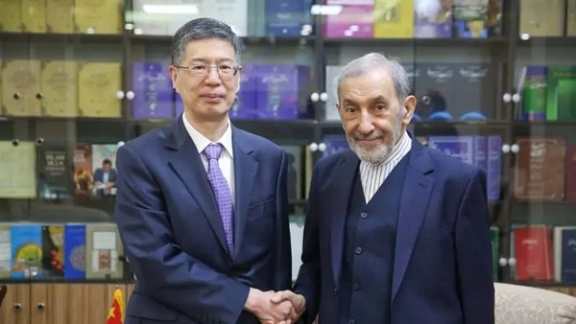
Ali Akbar Velayati, Advisor to the Supreme Leader meets Chinese Envoy to Tehran on November 17, 2024.

Iran has pledged to strengthen its strategic alliances with China and Russia, dismissing concerns that a potential return of Donald Trump to the White House could alter its foreign policy.

Ali Akbar Velayati, Advisor to the Supreme Leader on International Affairs, reaffirmed the Islamic Republic’s commitment to fostering these relationships during a meeting with Zong Peiwu, China’s Ambassador to Iran.

“The expansion of relations between Iran, China, and Russia in various fields, including frameworks like Shanghai and BRICS, will have significant and lasting effects,” Velayati said Sunday.

Tehran views its partnerships within the BRICS bloc and the Shanghai Cooperation Organization (SCO) as critical tools for countering Western sanctions.

BRICS, established in 2009 by Brazil, Russia, India, and China, added South Africa in 2010 and approved Iran’s membership in 2024.

Similarly, the SCO, founded by China and Russia in 2001, now includes ten members, including Iran, which formally joined in 2023.

Despite optimism about these alliances, criticism within Iran remains. President Masoud Pezeshkian recently called BRICS a talking club, saying that the group has yet to deliver practical solutions against US sanctions.

This frustration highlights a growing gap between Tehran’s aspirations and the tangible benefits of its Eastern pivot.

Nonetheless, Velayati emphasized the importance of these collaborations, pointing to their potential to bolster Iran’s international standing. He framed the partnerships as a cornerstone of Iran’s foreign policy, unaffected by external pressures, including changes in US leadership.

The Trump administration is expected to adopt a harder stance on China, with key figures such as John Ratcliffe, Trump’s nominee for CIA director, labeling Beijing as the primary global threat.

Ratcliffe has warned of China’s ambitions to dominate economically, militarily, and technologically, stressing a US agenda that could complicate Tehran’s growing ties with Beijing.

Velayati’s remarks come as Iranian officials maintain their defiance against US sanctions and pressure.

During Trump’s previous presidency, the United States withdrew from the 2015 nuclear deal, known as the JCPOA, and imposed a maximum pressure campaign. This led to severe economic repercussions for Iran, prompting the country to ramp up its nuclear activities, including enriching uranium to near weapons-grade levels.

Trump’s return has reignited concerns about a revival of these policies. On November 16, the Financial Times reported that the incoming US administration aims to reintroduce maximum pressure to force Tehran into renegotiating its nuclear and regional policies.

Some Iranian officials, however, are urging a more aggressive approach. Ahmad Naderi, a member of Iran’s parliament, criticized the nuclear program for failing to deliver security benefits and suggested that testing a nuclear weapon might be necessary to achieve regional balance.

"I believe we must pursue atomic weapons testing, as no other path remains for us given the lack of regional balance," he added, in an apparent reference to setbacks by Iran's regional proxies.

Velayati’s remarks signal Iran’s intent to remain focused on its strategic alliances while navigating the challenges posed by shifting US foreign policy.

Most Viewed

Iran negotiators ordered to return after internal rift over Islamabad talks
1
EXCLUSIVE

Iran negotiators ordered to return after internal rift over Islamabad talks

2
ANALYSIS

US blockade enters murky phase as tankers spoof signals and buyers hesitate

3
ANALYSIS

Why the $100 billion Hormuz toll revenue is a myth

4

US tightens financial squeeze on Iran, warns banks over oil money flows

5
ANALYSIS

US blockade targets Iran oil boom amid regional disruption

Banner
Banner

Spotlight

  • Hardliners push Hormuz ‘red line’ as US blockade tests Iran’s leverage
    INSIGHT

    Hardliners push Hormuz ‘red line’ as US blockade tests Iran’s leverage

  • Ideology may be fading in Iran, but not in Kashmir's ‘Mini Iran'
    INSIGHT

    Ideology may be fading in Iran, but not in Kashmir's ‘Mini Iran'

  • War damage amounts to $3,000 per Iranian, with blockade set to add to losses
    INSIGHT

    War damage amounts to $3,000 per Iranian, with blockade set to add to losses

  • Why the $100 billion Hormuz toll revenue is a myth
    ANALYSIS

    Why the $100 billion Hormuz toll revenue is a myth

  • US blockade targets Iran oil boom amid regional disruption
    ANALYSIS

    US blockade targets Iran oil boom amid regional disruption

  • Iran's digital economy battered by prolonged blackout
    INSIGHT

    Iran's digital economy battered by prolonged blackout

•
•
•

More Stories

Families of American victims from October 7 seek to hold Iran accountable

Nov 19, 2024, 09:15 GMT+0
•
Negar Mojtahedi

Iris Haggai, who lost both her parents on October 7, is one of several families of American victims, who have sued Iran, equipped with newly – unsealed documents revealing Tehran’s alleged fingerprints on the atrocities.

The victims' families filed the lawsuit against Iran in the US District Court in Washington on November 17. Forty-six Americans were among the more than 1,200 killed during the attack and 12 American citizens were among the more than 250 hostages kidnapped to Gaza. 

The suit, which has been reviewed by Iran International, is based on the evidence presented by attorneys for the plaintiffs in what they refer to as secret documents uncovered by lawyer Gary Osen.

“The October 7 Attack, led by Hamas and joined by PIJ, the PFLP and others, was part of a fully coordinated plan, financed and managed by Iran through the IRGC QF, to annihilate Israel by attacking it from multiple fronts simultaneously,” the lawsuit reads.

Documents include a list of payments made by Iran to Hamas leaders over the years and discussions of mutual defense agreement between Palestinian groups, Iran, and its proxies.

The complaint also includes a decision to request the Islamic Republic send Hamas $7 million monthly for mobilization of a planned confrontation.

The lawsuit also alleges that Iran and its proxies planned what they called a big deception before Yahya Sinwar’s “Big Project” with Iran’s Axis of Resistance.

“It appears that Hamas, Hezbollah, and the IRGC pulled off a 'double bluff' in planning the October 7 operation—deceiving Israel by openly stating their intentions in a way that convinced Israel that they were saber-rattling rather than carrying out a concrete plan of attack,” the lawsuit claims.

Ruby Chen's son Itay, 19, was understood to have been held hostage until it was confirmed this year that the young soldier was killed on October 7 and his body taken to Gaza.

For the bereft father, the lawsuit is at least a step to help prevent other families suffering the same tragedy and the chance to broaden a crackdown on terror funding.

"Iran funds a global terrorism financing network which Hamas benefits from. Money to support terrorism raised worldwide is currently 'parking' in various 'charity organizations' in countries such as Turkey, Kuwait, Indonesia and others," he told Iran International.

"The court case is to prevent those funds from being used for future terrorist attacks and deter other countries from funding terrorism."

While the concept of justice seems elusive to the families of the 101 hostages in Gaza, around half believed to be dead, their loved ones' return the only possible compensation, he said there is a bigger mission.

"We would like to see the expansion of the list of terrorist countries to organizations such as financial institutions or charity funds that enable the global terrorist financial network to be blacklisted and enable US victims to sue them as well and be accountable for the money transferred to Hamas and enabled the vicious October 7 attacks," he added.

For Iris, this is about holding Iran accountable and to send a message.

“It’s about making sure we understand the role that the IRGC is playing in all of this. It’s about the October 7th attack that was led by Hamas, but it was also led by the Islamic regime in Iran, who makes sure that Hamas has their weapons, make sure that they operate the same way that the Islamic regime in Iran wants them to operate,” Iris told Iran International.

She lost not only her parents, but 117 people that she knew growing up in Kibbutz Nir Oz were suddenly dead, missing or kidnapped in just one day. Judi Weinstein Haggai and Gadi Haggai, like much of Kibbutz Nir Oz, were pro-peace activists who abhorred war, said their daughter Iris.

On October 7, their morning routine walk in their Kibbutz turned into tragedy.

Judi witnessed her husband being killed. She called medical emergency services, describing in detail what had happened over the phone. Iris said she listened to the recordings. Judi had also been shot by Hamas, and it is not known if she died of her wounds or if she was killed after. Both their bodies are being held hostage in Gaza,

“It's not just about my parents. It's about the whole community. 117 people disappeared from my life in one day,” said Iris.

Iris said the lawsuit has evidence of Iran’s role in October 7 and that she is hoping this will help put the spotlight on that to dissuade Iran from using its proxies as a cover.

The lawsuit could have an indirect or direct impact on the Islamic Republic establishment, Gissou Nia, an international human rights lawyer told Iran International.

Nia, who helped lead the successful campaign to remove the Islamic Republic of Iran from the UN Commission on the Status of Women, said most of the Islamic Republic’s direct assets were seized and have already been paid out.

But she said the impact can sometimes be direct, like in the case of US authorities seizing Iranian flag tankers in open waters. The proceeds from that liquidated tankers go into a fund for US Victims Fund of State sponsored terror.

“But if people evade sanctions, if companies, for example, BNP Paribas, a bank that was doing banking with Islamic Republic of Iran officials and other affiliated entities, if they had to pay a certain penalty to the U.S. government because they were found in violation of that, that's the kind of money that would go into a fund.”

Foreign governments are generally considered beyond the jurisdiction of US courts, but the terrorism exception to the Foreign Sovereign Immunities Act (FSIA) allows the courts to hold these countries accountable, where immunity is not absolute.
Zarif fires back at Netanyahu in rare video message to Jews

Nov 19, 2024, 08:00 GMT+0

Presidential aide and former foreign minister Mohammad-Javad Zarif accused Israeli Prime Minister Benjamin Netanyahu of undermining the 2015 nuclear deal and fueling regional conflicts, in a rare video message directed at Jews worldwide.

In the Monday video message, published on Zarif’s X and Instagram accounts, the Iranian vice-president for strategic affairs said the deal, officially known as the Joint Comprehensive Plan of Action (JCPOA), “could have been the foundation of a new era of peace, tranquility, regional cooperation, and freedom from threats, conflicts, and escalating tensions.”

“However, before too long, Netanyahu and his Zionist and extremist cohorts succeeded in their satanic effort to rob the region and the world of this historic opportunity, standing on the wrong side of history,” Zarif said. “The agreement would have ensured that the ‘wolf’ this habitual liar was always ‘crying’ about, would never come to town.”

In the video, Zarif appears as a peace-loving, compassionate politician, calling for peace and harmony, while he spent most of his career as a diplomat representing and defending the Islamic Republic's domestic authoritarian rule and aggressive, anti-Israel and anti-West policies.

Over the years, Zarif’s attempts to deny or explain away human rights violations in Iran have led to a lot of attacks by critics who say he has been whitewashing the Islamic Republic’s record. The same can be said about his defense of Tehran’s policies in the region, its role in the Syrian civil war, and support for militant groups in the region.

Back in 2022, Netanyahu called the JCPOA a “horrible agreement because it allowed Iran basically with international approval, to develop a nuclear and basically an atomic arsenal paved with gold, with hundreds of billions of dollars of sanction relief.”

Before Donald Trump withdrew the United States from the JCPOA in 2018, the International Atomic Energy Agency had extensive inspection powers that it used to verify Tehran’s compliance with strict enrichment limits. Since 2019, Iran has responded to US ‘maximum pressure’ sanctions by boosting the nuclear program far beyond JCPOA limits, with some estimates suggesting that the country’s nuclear weapon breakout time is “just a week”.

Zarif’s Monday message seemed to be mirroring Netanyahu's years-long series of videos addressed directly to Iranians. In his latest message released last Tuesday, Netanyahu said Iran's clerical rulers fear their own people more than anything.

"There’s one thing Khamenei's regime fears more than Israel. It’s you – the people of Iran. They spend so much time and money trying to crush your hopes and curb your dreams," he added. "Don't let your dreams die. Don't lose hope and know that Israel and others in the free world stand with you.”

Zarif, who is known as the architect of the JCPOA, is defending the nuclear deal at a time when his government is expressing its willingness to resume negotiations over its nuclear program as US President-elect Trump is expected to restore his so-called maximum pressure policy against Tehran.

France, Britain, Germany, and the United States are expected to introduce a censure resolution against Iran at the upcoming meeting of the IAEA Board of Governors despite Tehran's threats to retaliate, a German foreign ministry spokesperson confirmed to Iran International on Monday.

The decision by the US and its European allies to move forward with the censure resolution comes despite Iran's threat to retaliate if such a resolution is adopted.

Iran allowed Grossi and his team to tour Fordow and Natanz, two key nuclear sites, on Friday apparently in hopes that it would convince the Board of Governors not to move forward with the censure resolution. However, that strategy does not seem to have worked.

“Iran has not fulfilled its obligations under the NPT and Safeguards Agreements. The recent visit of IAEA Director General Rafael Grossi to Tehran has not changed this assessment," the German foreign ministry spokesperson told Iran International.

Khamenei resurrects 'moderate' Larijani after regional setbacks

Nov 19, 2024, 07:40 GMT+0
•
Maryam Sinaiee

Former Iranian Parliament Speaker Ali Larijani’s visit to Lebanon and Syria as the Supreme Leader’s special envoy after years of isolation has sparked speculations about his possible political return.

During the two high-profile visits last week amid Israeli air strikes, Larijani delivered personal messages from Ali Khamenei to allied militant groups, the Lebanese authorities and Syrian President Bashar al-Assad.

Both visits received extensive coverage from domestic, regional, and international media, although very few details were revealed about the messages he carried and the talks he held.

The veteran politician who had kept a very low profile since 2020, when his tenure ended in the parliament, reportedly relayed Khamenei’s blessing for a US-mediated ceasefire with Israel to Hezbollah.

According to Iranian media, during his visit, he delivered a message of support and reassurance to the Syrian president in light of Israel's threats to target him. The visit, they suggest, may also serve to counter allegations that ties between Tehran and Damascus have weakened following Israel's strikes on Iran in late October.

“It must be born in mind that after Israel’s strikes on Iran, some [groups or people] tried to change the course of Iran's relations with Syria, saying Syria had been passive or even claiming that the country had allowed Israeli fighter jets to use its airspace,” Rouydad24 news website said in a commentary titled “What is Larijani’s Mission in Damascus” Thursday.

“But now with Larijani’s visit it has been revealed that the relations between the Islamic Republic of Iran and Assad are as strong as before,” the article added.

Pundits and Iranian media suggest that Khamenei’s decision to entrust the moderate-conservative Larijani with delivering his messages signals a move to assign Larijani a prominent role in Iran's foreign affairs apparatus.

Larijani, who served as secretary of Iran's Supreme National Security Council from 2005 to 2008 and, prior to that, headed the state broadcaster IRIB from 1994 to 2004 by Khamenei's appointment, chose not to seek re-election to parliament in 2020 after twelve years of leadership. Instead, he set his sights on the presidency.

The ultra-hardliner Guardian Council, however, barred him from running for the presidency then and again this year after Ebrahim Raisi’s death in a helicopter crash by announcing that it had been able to “ascertain” his qualifications for running for the post without any further explanations despite Larijani’s insistence.

To most in Iran, the rejection of Larijani’s candidacy in two consecutive terms signaled the end of his political career and his “political death”.

However, Khamenei had appointed Larijani as a member of the Expediency Council and as an adviser to the Supreme Leader in 2020, which was largely seen as ceremonial and of little political importance.

“Choosing Ali Larijani to relay the messages of the Leader of the Revolution also suggests that approval of the Guardian Council [as in Jalili’s case] does not necessarily mean approval by the great Leader of the Revolution and disqualification by the Council also does not mean lack of qualification [for participation] in the country’s political structure,” Rouydad wrote.

In a commentary on Sunday titled “Radicals Dream of Eliminating Larijani Did Not Come True” Khabar Online, a news website believed to represent Larijani’s interests, claimed his “special appointment” by Khamenei has raised concerns among ultra-hardliners who fear President Masoud Pezeshkian may appoint him as the Secretary of the Supreme National Security Council.

By law, the secretary of the Council does not have a vote in its decisions. However, they can gain voting rights if appointed as the Supreme Leader's representative to the Council, as has been the case in most prior instances.

Both positions are currently held by ultra-hardliner Saeed Jalili who after losing the elections to Masoud Pezeshkian appears to have somehow also fallen from Khamenei’s favor, too.

Dutch law firm aided Iran’s oil sales - BNR News Radio

Nov 19, 2024, 00:30 GMT+0

A Dutch law firm has helped Iran's oil industry evade US sanctions for years, according to an investigation by Netherlands’ BNR News Radio.

International Law Firm Taheri (ILFT) has played a key role in helping Iran's oil sales by establishing at least six shell companies since 2020 and using intermediaries as directors to conceal the true ownership of the oil tankers, the report added.

A series of US-led sanctions on Iranian oil over the past decade have forced Iran’s government to resort to a network of tankers, often referred to as a shadow or ghost fleet - which consists of hundreds of vessels controlled by Iranian interests via intermediaries - to evade restrictions.

The Dutch law firm helped selling Iran's crude through a Surinamese subsidiary based in Capelle aan den IJssel, a town in the western Netherlands.

Last month, the US Treasury Department sanctioned several entities for their alleged involvement in shipments of Iranian petroleum and petrochemical products for US-designated entities National Iranian Oil Company (NIOC) or Triliance Petrochemical Company.

Three of the sanctioned companies were registered at ILFT's Suriname address.

ILFT owner Masoud Taheri, 44, told BNR that he is merely a service provider offering a solution for a client that faces a legal issue at an international level.

Taheri noted that trading Iranian oil is not prohibited in Europe or the South American country of Suriname, emphasizing that his firm and its subsidiary are operating within the law.

However, he declined to disclose the identity of the tanker fleet's owner, although the website of his firm features the logo of the NIOC under the heading 'Important Clients'.

Claire Jungman, head of the Iran Tanker Tracking Program at United Against Nuclear Iran (UANI), described the ships registered through ILFT as among the most important carriers of Iranian oil.

UANI estimates that these six tankers alone have exported 160 million barrels of oil valued at about $10 billion at current market prices since US sanctions took effect.

Iran exported more than $70 billion worth of oil after the 2015 nuclear deal, according to the data released by the Organization of the Petroleum Exporting Countries (OPEC). This fell to less than $10 billion in 2020, following a unilateral US withdrawal from the nuclear agreement and then-President Donald Trump’s so-called maximum pressure campaign.

The figure rose again to just above $40 billion in 2023, in large part due to a myriad of smaller Chinese refineries purchasing Iranian oil masked as originating from other countries.

Outspoken Iranian activist sews lips shut, stages silent sit-in

Nov 18, 2024, 21:58 GMT+0

One of Iran's most vocal dissidents outside of prison is trying a new tack: sewing his lips shut and staging a silent protest at one of Tehran's busiest intersections.

Alone and defiant with one fist in the air in the middle of a busy intersection in Tehran, prominent Iranian dissident and blogger Hossein Ronaghi held a sit-in protest that briefly landed him in jail, according to his mother who spoke to Iran International.

Ronaghi had posted a photo of himself with his lips sewn shut on Saturday.

“Perhaps this will be a wake-up call … Long live Iran.”

Ronaghi was repeating the final words of his friend Kianoosh Sanjari, a journalist and activist who took his own life last week to protest the imprisonment of fellow dissidents.

Ronaghi has since been released from prison.

Videos posted to social media show Ronaghi protesting on Monday in the busy Valiasr junction as cars, motorbikes and pedestrians cross by without seemingly making any reaction.

Ronaghi’s mother Zoleikha Mousavi told Iran International that the street was filled with plainclothes officers, most of them women.

Some officers also allegedly attacked Mousavi, but after her shouting and protests, they let her go.

She told Iran International exclusively that an ambulance sped towards her son, but said she intervened to stop it. Several agents later took Ronaghi away in what she described as a violent arrest.

On Telegram, Ronaghi’s account posted that he was arrested in the early evening at the intersection by several armed officers and that after several hours of detention he was dropped off in front of his home by the same officers.

Ronaghi also announced that he would appear before a Revolutionary Court in Tehran with his sewn lips in another form of resistance.

The gesture would be protest, he said, “against the occupiers of this land, against poverty, against executions, against the oppression of women and imprisonment of the people, and against every form of injustice imposed on this country by the Islamic Republic," he wrote on X.






