• العربية
  • فارسی
Brand
  • Iran Insight
  • Politics
  • Economy
  • Analysis
  • Special Report
  • Opinion
  • Podcast
  • Iran Insight
  • Politics
  • Economy
  • Analysis
  • Special Report
  • Opinion
  • Podcast
  • Theme
  • Language
    • العربية
    • فارسی
  • Iran Insight
  • Politics
  • Economy
  • Analysis
  • Special Report
  • Opinion
  • Podcast
All rights reserved for Volant Media UK Limited
volant media logo

Iranians blame foreign policy for economic woes but back military role - poll

Oct 26, 2024, 07:00 GMT+1Updated: 15:33 GMT+0
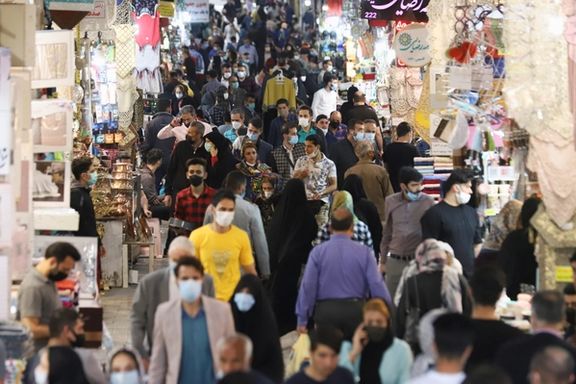
People shopping in Tehran Bazaar in 2021

A new public opinion poll suggests conflicted Iranian attitudes toward foreign policy, with a majority blaming it for domestic economic woes but approving of the country’s military role in the Middle East.

The survey was conducted by polling firm Stasis in association with Washington DC-based thinktank the Middle East Institute in late September and early October, and included 1,189 Iranians aged 18 and older.

The results show Iranians are critical of certain aspects of foreign policy yet resolute on others, particularly around Tehran's military influence in the region.

78 percent of respondents said they believed Iran’s foreign policy was harming their livelihood yet 60 percent said they favor providing military support to allied armed groups across the Middle East.

On the diplomatic front, around two in three respondents favored establishing relations with the United States but most opposed normalization with Israel. Only around a quarter said they completely or somewhat agree with the statement that “Iran should normalize its relationship with Israel.”

100%

“The extraordinary circumstances surrounding the survey period—with Iran and Israel teetering on the brink of war—likely heightened patriotic or emotional responses, particularly toward Iran’s military activities in the region,” said Alex Vatanka, Director of the Iran Program at the Middle East Institute.

He added that this urgency could help explain the significant support for maintaining a military presence in the Middle East and backing allied groups, despite widespread discontent over the cost.

Around half of those who took part in the survey approved of Iran’s presence in Syria.

Vatanka said this could point to possible gaps in public understanding of foreign policy and its scope. “Some respondents may have failed to see that the Islamic Republic’s regional military engagements are central to its foreign policy. They appear to have overlooked the connection between Iranian activities in the region and the isolation that has left the economy in ruins”.

100%

The poll captured Iranian sentiment during a period marked by geopolitical tension, including the assassination of Hezbollah leader Hassan Nasrallah by an Israeli air strike last month and Iran’s retaliatory attack against Israel on Oct. 1.

A majority of those who took part in the survey (59 percent) felt Iran was in a stronger position following these developments. Even more (69 percent) said they felt safer as a result of the country’s military involvement in the Middle East, including its backing of regional armed groups.

Iranians were nearly evenly divided over the country’s alignment with global powers. 34 percent expressed a preference for strengthening ties with Russia and China, and an equal 34 percent preferred Western partnerships, including with the United States and Great Britain. Sixteen percent chose both, and another 16 percent were undecided.

Gauging the public mood in Iran is challenging, especially on issues of national security. Dozens are tried and jailed every year for expressing views on issues that the government deems sensitive.

“Rapid changes in the political environment of the region could potentially affect public opinion regarding some survey questions, especially those directly related to Iran’s foreign affairs,” Statis, the polling firm, wrote in its report.

Most Viewed

Iran negotiators ordered to return after internal rift over Islamabad talks
1
EXCLUSIVE

Iran negotiators ordered to return after internal rift over Islamabad talks

2
ANALYSIS

US blockade enters murky phase as tankers spoof signals and buyers hesitate

3
ANALYSIS

Why the $100 billion Hormuz toll revenue is a myth

4

US tightens financial squeeze on Iran, warns banks over oil money flows

5
ANALYSIS

US blockade targets Iran oil boom amid regional disruption

Banner
Banner

Spotlight

  • Hardliners push Hormuz ‘red line’ as US blockade tests Iran’s leverage
    INSIGHT

    Hardliners push Hormuz ‘red line’ as US blockade tests Iran’s leverage

  • Ideology may be fading in Iran, but not in Kashmir's ‘Mini Iran'
    INSIGHT

    Ideology may be fading in Iran, but not in Kashmir's ‘Mini Iran'

  • War damage amounts to $3,000 per Iranian, with blockade set to add to losses
    INSIGHT

    War damage amounts to $3,000 per Iranian, with blockade set to add to losses

  • Why the $100 billion Hormuz toll revenue is a myth
    ANALYSIS

    Why the $100 billion Hormuz toll revenue is a myth

  • US blockade targets Iran oil boom amid regional disruption
    ANALYSIS

    US blockade targets Iran oil boom amid regional disruption

  • Iran's digital economy battered by prolonged blackout
    INSIGHT

    Iran's digital economy battered by prolonged blackout

•
•
•

More Stories

Israel pounds Iranian missile sites, says operation complete

Oct 26, 2024, 05:34 GMT+1

Israeli jets completed air strikes on military and missile sites in Iran in the early morning hours of Saturday which it described as retaliation for an October 1 Iranian ballistic missile attack on Israel.

The move appeared calibrated to avoid pushing the Mideast closer to all-out war between two of its strongest military powers, with no casualties immediately reported.

Combat pitting the Jewish state against Iran-backed Lebanese Hezbollah and Palestinian Hamas has ratcheted up in recent weeks, bringing Iran and Israel into more direct confrontation.

Multiple explosions were heard in and around Tehran at around 2:15 am local time and several hours later again in the capital and in two southwestern cities.

The Israeli military said "The retaliatory strike has been completed and the mission was fulfilled," adding that "aircraft struck missile manufacturing facilities used to produce the missiles that Iran fired at the State of Israel over the last year."

Targets also included surface-to-air missile and anti-aircraft capabilities, the military added.

“Iran reserves the right to respond to all attacks and there’s no doubt that Israel will get a proportionate response to any action” IRGC-affiliated Tasnim news agency quoted an informed source as saying.

They added that "initial assessment shows the Zionist regime’s actions were weak.”

The United States, Israel's main political and military backer, described the attack on their mutual archenemy in the region as self-defense.

"We understand that Israel is conducting targeted strikes against military targets in Iran as an exercise of self-defense and in response to Iran’s ballistic missile attack against Israel", US National Security Council spokesman Sean Savett said in a statement.

Jonathan Harounoff, International Spokesperson for Israel at the United Nations told Iran International Israel had to respond to Iran's missile barrage.

"Israel has a right and a duty to defend itself from a regime that has continued to attack Israel relentlessly over the past year, directly and through its terror proxies," he said.

Iran's Oct. 1 ballistic missile fusillade against Israel came in response to Israel's likely assassination of Hamas leader Ismail Haniyeh in Tehran in July and killing of Hezbollah chief Hassan Nasrallah last month.

It was the second direct attack by the Islamic Republic on Israel this year after an earlier salvo in April which also caused minimal damage or casualties and was repelled with US help.

Israel's strike on Iran unfolded in three stages, Israel's public broadcaster said.

Blasts were also heard in the southwestern cities of Ahvaz and Abadan in Khuzestan province, residents told Iran International.

Mizan News agency in Iran reported sounds of renewed explosions in central Tehran.

Strikes hit Parchin, a large area of military factories for missiles and drones, according to Beni Sabti, an expert on Iran from the Israeli National Security and Strategy Institute (INSS).

Sabti used to serve as a Persian spokesperson for the Israeli government on Iranian issues and is in frequent contact with senior Israeli officials.

The Israeli military announced the completion of its retaliatory strikes against Iran around 6am local time, saying they damaged Iran's military infrastructure - including air defense systems and ballistic missiles capabilities.

Israeli military officials told reporters in a briefing that dozens of fighter jets participated in the attack and have all returned to their bases safely.

The operation was code named "Days of Repentance," and marks the first time Israel took responsibility for an attack in Iran. 

US pledged to protect Saudi Arabia in case of Iranian attack - Bloomberg

Oct 25, 2024, 22:00 GMT+1

The United States assured Saudi Arabia it is prepared to help defend the kingdom against any attack from Iran or its regional allies as oil-producing Arab states fear being drawn into a war between Iran and Israel, Bloomberg reported on Friday.

Riyadh and other Arab allies of the United States in the Persian Gulf region have been relieved to some extent after receiving what Bloomberg called a "tacit offer" presented by the Biden administration over the past few weeks.

Bloomberg did not specify whether the assurance was given during US Secretary of State Antony Blinken's trips to Saudi Arabia and Qatar earlier this week.

Blinken visited the two Arab countries following a trip to Israel, as the entire region braecs for a long-awaited Israeli response to the October 1 missile barrage Tehran launched.

Earlier this month, Iran warned its Arab neighbors that it would be "unacceptable" to allow Israel or the United States to use their airspace or bases against Iran, threatening a response if they do.

"Israel is receiving contacts and requests from (Persian) Gulf countries to inform it in advance of the expected response so that it can take precautions in the event of a counterattack," US-funded outlet Alhurra cited an Israeli source saying earlier this week.

However, Iran's exchanges with regional countries do not appear to be limited to threats, as Foreign Minister Abbas Araghchi sought to also shore up support among regional nations to mitigate Israel’s actions during a recent tour of the Middle East which included visits to Saudi Arabia, Qatar, Oman, Jordan, Egypt, Syria, and Iraq.

'Israel ready to attack after multiple delays'

"The Israeli military's preparations for an attack on Iran have been completed, and they are now only awaiting the political leadership's order to carry out the attack," Israel's Channel 11 reported Friday.

The report added that Israel has delayed its planned attack "several times" over the past weeks. While it said it cannot disclose the reason for delaying the response, new unverified documents, allegedly leaked from the Pentagon and circulated on social media over the past 24 hours, indicate that Israel originally planned to attack "major military facilities" in Iran on October 19, between 03:00 and 04:00, according to a report by the Israeli website Ynet.

The Israeli air force intended to use bunker-busting bombs to hit targets in Iran and electronic warfare to neutralize Iran’s air defenses in its planned attack on October 19 which was closely coordinated with the US, according to the unverified leaked documents.

If authentic, the documents suggest that Israel delayed the planned attack hours after a pro-Iran Telegram channel leaked classified Pentagon documents on the Israeli attack plan. However, it remains unclear whether the alleged October 19 attack was canceled due to the leak or for other reasons.

The FBI launched an investigation into the leak while Republican critics ripped the Biden administration for mishandling intelligence just two weeks before the November 5 elections.

The top-secret documents began circulating online on Friday after being posted on Telegram by an account called "Middle East Spectator." Dated October 15 and 16, the intelligence on Israel's attack plan was intended for viewing only by the US and its "Five Eyes" allies, which include Australia, Canada, New Zealand, and the United Kingdom.

While the timing and specifics of Israel's retaliation remain unclear, sources informed CNN last week that it is expected to take place before the US presidential election on November 5.

Previous reports from multiple news outlets indicate that Israel has assured the US it will refrain from targeting nuclear or energy infrastructure, though other reports suggest that all options are still on the table.

Friday prayer imam shot dead, becomes third killed in town since 1979

Oct 25, 2024, 20:03 GMT+1

The Friday Prayer Imam of Kazeroun in southern Iran was shot dead on Friday, Iran’s official IRNA News reported, in the latest murder to unseat the provincial town's top cleric since the dawn of the Islamic Republic.

Mohammad Sabahi's mysterious death makes him the third Friday Imam of the relatively small town of around 100,000 people to have been killed since the 1979 Islamic revolution.

“Despite the efforts of the doctors and medical staff at Namazi Hospital in Shiraz, the Friday Imam has passed away due to the severity of his injuries,” Kazeroun’s governor, Mohammad Ali Bekhrad, told IRNA on Friday evening.

While refraining from using the word “martyred” - typically deployed when a person's death has a political or religious background - IRNA added that Sabahi was shot by an assailant after Friday prayers.

Imams are appointed to lead Friday prayers by official religious authorities ultimately led by Iran's supreme leader Ali Khamenei.

Conflicting reports initially emerged, with Iranian media first announcing Sabahi’s death and later describing his condition as critical following an armed attack in which the assailant committed suicide.

Bekhrad earlier denied the attack was an act of terrorism, instead suggesting that a personal conflict may have been behind the shooting.

While also refraining from using the word “martyred”, the governor told IRNA investigations into the details of the incident are ongoing.

Three slain imams

Shortly after news of the shooting broke, a popular Telegram channel claimed the assailant was a war veteran. Mehdi Mazarei, head of Kazeroun’s Martyrs Foundation, contradicted the report and warned that anyone spreading false information would face prosecution.

Mizan News, affiliated with Iran’s judiciary, also reported that initial claims identifying the assailant as a war veteran were false, saying, “this individual is not a veteran but has a criminal record.”

According to Mizan, the assailant attempted to harm a judge 20 years ago using explosives, resulting in self-inflicted injuries, and later served six years in prison for a bombing in Gachsaran in southwestern Iran as well as for weapon theft and bribery.

Sabahi previously served as the Friday Imam of Kharameh in Fars province for a decade before resuming his role in Kazeroun in November 2019.

In a similar case on May 29, 2019, Mohammad Khorsand, another Friday Imam of Kazeroun, was fatally stabbed while returning from a Ramadan prayer.

Security forces quickly apprehended a suspect named Hamid Reza Derakhshandeh, who was sentenced to death by Iran’s judiciary, with his execution confirmed and carried out by the Supreme Court within two months.

On July 31, 1981, Abdolrahim Daneshjou, then the Friday Imam of Kazeroun, was shot dead near his home after evening prayers. State sources linked this attack to members of the People's Mujahedin of Iran also known as MEK, which is now an exiled opposition group in Albania.

Hardline clerics defy Israeli strike threat in sermons nationwide

Oct 25, 2024, 15:40 GMT+1

Friday Prayers leaders who are the voice of Iran's theocratic system expressed defiance and pledged a forceful response to a looming Israeli military response to Iran's October 1 missile barrage against the Jewish state.

Ahmad Khatami in Tehran warned that Iran stands ready to deliver a third missile volley against Israel after the October salvo and another attack in April.

"If Israel makes a wrong move, it will be struck by the True Promise Operation 3," Khatami said during his sermon on Friday.

Khatami, a hardliner, referenced a Quranic verse, saying, "God says in Surah An-Nisa, verse 71, to always be prepared. The enemy wants you to be negligent in this matter." He emphasized that the verse encourages "military, cultural, economic, psychological, and all kinds of preparedness."

Earlier this year, Iran carried out its first direct strike on Israeli territory, which Tehran labeled "Operation True Promise." The April 13 attack involved over 350 drones and missiles almost all of which were intercepted by a U.S.-led coalition, according to Israeli sources.

The state’s second strike was dubbed "Operation True Promise 2" and involved 181 missiles and was carried out in retaliation for the assassinations of Hezbollah leader Hassan Nasrallah in Beirut and Hamas political chief Ismail Haniyeh in Tehran.

Although most missiles were intercepted, a few struck military targets and caused minor damage. After the April attack, Israel responded with air strikes on an air defense site in central Iran.

"Resistance has a cost"

In the city of Qom, another hardline cleric and Friday Prayers leader said past compromises with adversaries have proven ineffective.

“Resistance has a cost, but what endures, holds value, and earns God's satisfaction is resistance,” Imam Mohammad Saeedi said.

Meanwhile, Ayatollah Hossein Noori Hamedani, a senior figure in Iran's Shi'ite clerical hierarchy, expressed concern over apparent divisions within the nation's preeminent seminary in Qom, suggesting that some may support recognizing Israel’s existence.

"We will not allow, under these difficult conditions in Lebanon and Palestine, for some within the seminary to speak of a supposedly independent country," Noori said on Friday.

“The seminary must uphold its authentic traditions and emphasize preserving the people's faith and the nation's greatness. There should be no division within the seminary,” he added.

In another clerical center in Mashhad, Ahmad Alam al-Huda said “national unity,” a slogan of the current government, bolsters the Resistance Front - a term Tehran uses for its allied militias in the region.

“The Front that has formed today in Palestine and Lebanon, where homes are destroyed over people's heads, individuals are displaced, and lives are lost under the rubble, is our front and the front of resistance."

"Today, we are obliged to support the Resistance movement with any available resources; we are indeed supporting the front of Islam.”

With Israel's attack expected imminently, Tehran has intensified its diplomatic outreach across the region, aiming to strengthen alliances with neighboring Arab nations.

On Wednesday, Israeli Defense Minister Yoav Gallant told Air Force crews at the southern Hatzerim Air Base that any counterattack would "levy a heavy price," adding in a video shared on X, “After we attack Iran, everyone will understand your might.”

US President Joe Biden has expressed support for an Israeli response to the Oct. 1 Iranian strike but has said he does not endorse an attack on Iran's nuclear facilities.
Khamenei's sons mourn Sinwar at Hamas office in Tehran

Oct 25, 2024, 15:14 GMT+1

The sons of Supreme Leader Ali Khamenei visited the Hamas office in Tehran on Friday, extending condolences for the death of Yahya Sinwar, according to the Supreme Leader's official website.

Mojtaba Khamenei is widely seen as a frontrunner to succeed his father as Supreme Leader and the move may signal a desire to continue backing armed allies abroad as Hamas pledged to carry on its fight with mutual arch-foe Israel.

“In this meeting, they underscored Ayatollah Khamenei's recent directive to extend support to the people of Palestine and Lebanon, detailing the Iranian nation’s collective contributions,” the website read.

“They highlighted the national campaign 'Iran in Solidarity' as a prominent example of these efforts, symbolizing unity with the fighters and resilient communities of Palestine and Lebanon,” it added.

Khaled Qaddoumi, Hamas’s representative in Tehran, said following the meeting that the death of its leader would not undercut the group's strength.

"(Sinwar) devised a mechanism for leading the Resistance so that in his absence things would not come to a standstill," he said. "Today, no gap in the leadership of the resistance is felt."

US Secretary of State Anthony Blinken was in the Qatari capital Doha to restart talks over a Gaza ceasefire on Friday, but Qaddoumi sounded a defiant note.

“The Americans believe that now is a good opportunity to eradicate the resistance, but, God willing, this will not happen. The era of America is over,” Qaddoumi added.

As Israeli threatens to strike Iran, the hardline core of the establishment shows little sign of backing down in its support for Hamas and Hezbollah. However, efforts by Iranian authorities to raise public donations for Hezbollah have stirred anger among citizens who have been facing five years of 40% annual inflation.

While levels of support have varied over time, US officials estimated in 2018 that Iran provides approximately $700 million annually to Hezbollah.