• العربية
  • فارسی
Brand
  • Iran Insight
  • Politics
  • Economy
  • Analysis
  • Special Report
  • Opinion
  • Podcast
  • Iran Insight
  • Politics
  • Economy
  • Analysis
  • Special Report
  • Opinion
  • Podcast
  • Theme
  • Language
    • العربية
    • فارسی
  • Iran Insight
  • Politics
  • Economy
  • Analysis
  • Special Report
  • Opinion
  • Podcast
All rights reserved for Volant Media UK Limited
volant media logo

Iran’s intelligence system under fire amid accusations of Israeli infiltration
Oct 14, 2024, 09:16 GMT+1Updated: 15:38 GMT+0
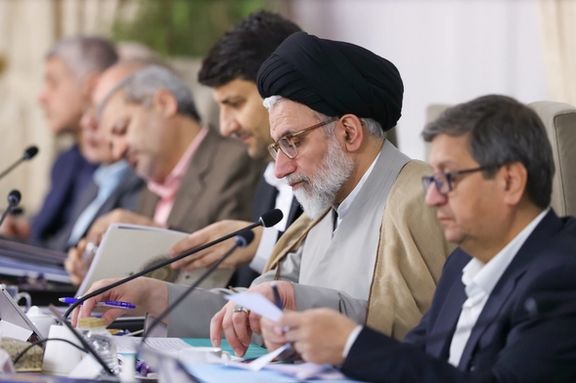
Iran's Intelligence Minister Esmail Khatib during a cabinet meeting in Tehran (October 2024)

Iran's intelligence services are facing internal and external criticism amid accusations of failures to confront Israel's security threats and allegations of espionage.

Mehdi Kharatian, who leads the Institute for Policy Revival, has led the criticism surrounding the weaknesses in Iran's security and intelligence infrastructure, highlighting what he described as a lack of serious response to Israeli activities, citing the killing of Seyed Razi Mousavi in Syria last December as a prime example.

Mousavi, linked to the Revolutionary Guards, was killed in a strike widely attributed to Israel. Kharatian criticized the response from Iranian intelligence agencies. “The day after the assassination, everyone was home by 2 p.m.” he said, implying that security forces did not treat the incident as a critical alert. "They just say Netanyahu wanted to fabricate achievements. But they should analyze why Israel decided to act at this moment."

An Iranian woman carrying a poster of senior Iranian Revolutionary Guard general Razi Mousavi during his funeral service in Tehran (December 2023)
100%
An Iranian woman carrying a poster of senior Iranian Revolutionary Guard general Razi Mousavi during his funeral service in Tehran (December 2023)

The criticisms come as Iran faces a series of high-profile allegations involving intelligence officials accused of collaborating with Israeli agencies. Among the most recent cases is Esmail Qaani, commander of the elite Quds Force of the Revolutionary Guards, who was reportedly placed under guard and questioned as part of an investigation into significant security breaches.

Iran has officially denied the claims. Multiple sources told Middle East Eye that while Qaani remains alive and unhurt, his status reflects the growing concern over internal vulnerabilities.

Commander of the Islamic Revolutionary Guard Corps' Quds Force Esmail Qaani (Undated)
100%
Commander of the Islamic Revolutionary Guard Corps' Quds Force Esmail Qaani

Kharatian said Iran consistently underestimates Israel’s capabilities in information and cyber warfare. "Israel's upper hand in the information war casts a shadow over all our achievements," he stated.

Kharatian further accused Iranian intelligence of misallocating resources away from essential functions. He referenced a conversation with a deputy in the intelligence service, noting, "I pointed out the mistakes of the head of the intelligence agency… strategic mistakes were made." According to Kharatian, this included diverting funds to less critical areas, weakening the country’s capacity to respond to external threats.

The Iranian intelligence apparatus is also faulted for prioritizing internal surveillance over external threats like Israel.

Kharatian suggested that efforts have been focused on monitoring domestic dissidents, including high-profile figures such as Faezeh Hashemi, the daughter of a former Iranian president, or the vocal political commentator Sadegh Zibakalam, rather than countering Israeli operations.

"Either drop the 'Death to Israel' slogan or stop making it a hundredth priority in intelligence departments," he said.

The criticisms extend beyond intelligence agencies. Iran’s diplomatic stance is also under fire, with Kharatian pointing out the lack of an “Israel desk” in the Ministry of Foreign Affairs, something even countries like Pakistan maintain.

"We don’t even have an Israel desk," he said, emphasizing that the absence of a specialized diplomatic effort further highlights gaps in Iran’s approach to the Israeli threat.

Meanwhile, questions about intelligence competence have grown in the wake of recent incidents.

In July, an alleged Israeli airstrike saw the political leader of Iran-backed Hamas, Ismail Haniyeh, assassinated in the heart of Iran's security apparatus at an IRGC compound in Tehran.

Former Iranian parliament member Morteza Motahari publicly criticized security services for failing to protect the location. "The Zionists have always relied on terror, but how did they know his residence?" he wrote on social media.

This photo released by IRGC-affiliated media shows the Hamas chief's residence in Tehran where he was assassinated (Undated)
100%
This photo released by IRGC-affiliated media shows the Hamas chief's residence in Tehran where he was assassinated

Earlier this month, in an interview with CNN Turk, former president Mahmoud Ahmadinejad accused the head of a counter-intelligence unit assigned to identify Israeli operatives as himself a Mossad agent.

Ahmadinejad added that the official, along with others, leaked sensitive intelligence, including documents about Iran’s nuclear program, to Israel. These leaks, he suggested, influenced the Trump administration’s decision to withdraw from the 2015 nuclear deal.

Ahmadinejad alleged that an additional 20 agents within the Iranian intelligence team, assigned to monitor Israeli espionage activities, had also defected and were working against Tehran.

After the high-profile killing of Hezbollah leader Hassan Nasrallah, Iran's most powerful proxy, by an alleged Israeli airstrike in Beirut, the threats to Tehran's key circle have become ever more real, highlighting a series of intelligence shortcomings, including in the heart of Tehran.


Most Viewed

State media slam Araghchi's Hormuz tweet, say it let Trump claim victory
1

State media slam Araghchi's Hormuz tweet, say it let Trump claim victory

2
OPINION

The Hormuz get out of jail card turned to a grave

3

Iran International says it won’t be silenced after London arson attack

4
INSIGHT

How Tehran bends its own red lines to boost state rallies

5

Iran halts petrochemical exports to supply domestic market

Banner
Banner

Spotlight

  • Too early to tell who is winning Iran war, experts say
    PODCAST

    Too early to tell who is winning Iran war, experts say

  • How Tehran bends its own red lines to boost state rallies
    INSIGHT

    How Tehran bends its own red lines to boost state rallies

  • Iran blackout cripples freelancer, small business incomes
    VOICES FROM IRAN

    Iran blackout cripples freelancer, small business incomes

  • Ideology may be fading in Iran, but not in Kashmir's ‘Mini Iran'
    INSIGHT

    Ideology may be fading in Iran, but not in Kashmir's ‘Mini Iran'

  • US blockade enters murky phase as tankers spoof signals and buyers hesitate
    ANALYSIS

    US blockade enters murky phase as tankers spoof signals and buyers hesitate

  • Why the $100 billion Hormuz toll revenue is a myth
    ANALYSIS

    Why the $100 billion Hormuz toll revenue is a myth

•
•
•

More Stories

Four Israelis killed, over 50 injured in Hezbollah attack - IDF

Oct 13, 2024, 23:08 GMT+1

The Israeli military confirmed early Monday that four Israeli soldiers were killed in a Hezbollah drone attack which, according to the Iran-backed Lebanese group, targeted a Golani Brigade camp in Binyamina in northern Israel.

Seven troopers were also critically injured, the IDF said in a statement.

A report by the Times of Israel says two Hezbollah drones entered the Israeli airspace from the sea, one of which was shot down off the coast of Haifa.

The drones were of Mirsad model, known in Iran as the Ababil-2, which is considered Hezbollah’s main suicide drone, the report said, citing preliminary investigations into the deadly attack.

The Hezbollah attack comes after the United States announced it will be sending Israel its THAAD missile defense system.

Pentagon's spokesman said in a statement that Defense Secretary Lloyd Austin authorized the deployment of the THAAD battery at the direction of President Joe Biden.

He said the system will help bolster Israel's air defenses following Iran’s ballistic missile attacks on Israel in April and October and protect Americans in Israel against future Iranian attacks.

The Hezbollah attack comes amid Israel's preparations for a retaliatory strike on Iran in reaction to Tehran's October 1 missile barrage.

The United States has been privately urging Israel to calibrate its response to avoid triggering a broader war in the Middle East, officials say, with Biden publicly voicing his opposition to an Israeli attack on Iran's nuclear sites and his concerns about a strike on Iran's energy infrastructure.

Now the Israeli war cabinet is under greater pressure for responding to attacks by Iran and its Lebanese proxy.

Hezbollah's Sunday attack comes a couple of weeks after Israeli airstrikes killed its leader Hassan Nasrallah and almost all other top commanders of the group.

Iran's oil loadings plunge 70% amid Israeli retaliation threats

Oct 13, 2024, 22:00 GMT+1
•
Dalga Khatinoglu

Iran's oil loadings plummeted nearly 70% in the first ten days of October, as its tanker fleet dispersed in anticipation of potential Israeli strikes, which may target the country's oil terminals.

Data obtained by Iran International from tanker tracking firms indicates that Iran loaded only 600,000 barrels of oil per day in the first 10 days of October, much less than the 1.5 million barrels shipments volume average in recent months.

Tanker tracking data shows a relative increase in the number of tankers at Iran's Kharg oil terminal after October 10. Armen Azizian, a senior oil risk analyst at Vortexa, told Iran International that while loadings have resumed, they are progressing much slower than usual. Recent estimates suggest that volumes have slightly increased to 800,000 barrels per day since mid-week.

The Kharg oil terminal, located in the western Persian Gulf, handles 90% of Iran’s oil loadings, particularly for Very Large Crude Carriers (VLCC) with a capacity of 2 million barrels. Observers have identified the terminal as a potential target for Israeli strikes.

According to a report, published by Vortexa, a slowdown at Kharg is already visible, with only two VLCCs loaded between October 1-10, compared to an average of 1.1 VLCCs per day in the first nine months of the year. Most of Iran’s oil, shipped despite US sanctions, are purchased by small Chinese refineries.

Iran's Kharg Island serves as the country's main oil loading terminal. File photo
100%
Iran's Kharg Island serves as the country's main oil loading terminal. File photo

Iran had around 40 million barrels of floating oil storage, out of Persian Gulf in early October, enough to continue exports to China for only one month. Azizian said that during October 1-10, the floating storage has been declining as tankers, which held stored oil, are departing Iran.

It is still unclear whether the Kharg oil terminal is among Israel's targets. However, an attack on this terminal could cripple Iran's economy. Reports suggest that after Iran’s large-scale missile attack on Israel on October 1st, Tehran immediately withdrew its tankers from the Kharg Island to prevent them from being targeted by Israeli retaliatory strikes.

Informed sources have told some Western media that Iran has also made numerous confidential contacts with the regional Arab neighbors over the past week, asking them to urge the US to prevent Israel from attacking Iran’s oil facilities.

Soon after Iran's missile attack on Israel, the Iranian president traveled to Qatar, followed by a rare visit to Saudi Arabia by Iran's foreign minister.

Oil exports make up 65% of Iran’s government budget and 8% of its GDP. However, a recent report by Iran's Court of Audit revealed that in the first five months of the current fiscal year (March 21 to August 22), the government fell short of realizing a quarter of its projected oil revenues.

Additionally, tanker tracking data indicates that in August and September, Iran's daily oil exports dropped by about 300,000 to 400,000 barrels compared to previous months, falling to 1.4 million barrels per day. This suggests a deepening of Iran's oil budget deficit in coming months.

The reason behind this drop was the decline in oil demand from China, a country that purchases over 95% of Iran’s exported oil.

Iran has repeatedly threated regional and western states to blockade Persian Gulf’s Strait of Hormuz, where 20% of oil traded worldwide passes through.

Vortexa reports that with China now accounting for over 95% of Iran’s oil exports as its top trade partner, a blockade of the Strait of Hormuz is unlikely. “Such a move would trigger severe economic instability and jeopardize Iran’s vital relationship with China,” the firm stated.

From January to September, China imported 4.2 mb/d of crude via the Strait of Hormuz, accounting for 43% of its seaborne crude. This included n increased volume of Iranian oil as more Chinese refiners turned to Tehran’s discounted feedstocks to improve refining margins.

Swedish PM urges EU to list Iran's IRGC as terrorist organization

Oct 13, 2024, 20:50 GMT+1

Swedish Prime Minister Ulf Kristersson on Sunday called on the European Union to designate Iran's Islamic Revolutionary Guard Corps (IRGC) as a terrorist organization.

The Swedish prime minister's remarks came shortly after reports that Tehran had enlisted criminals to carry out armed attacks on Israeli embassies in Stockholm and Copenhagen.

"We want Sweden to seriously address with the other EU countries the incredibly problematic connection between the IRGC, their destructive role in the region, but also their escalating actions around various European countries, of which Sweden is one of them," said Kristersson.

"The only reasonable consequence is that we get a common terror classification, so that you can act more broadly than the sanctions that already exist," he added, according to a report by Expressen.

In May 2023, the Swedish Parliament voted in favor of designating the Islamic Revolutionary Guard Corps as a terrorist organization. It followed the execution of Swedish-Iranian Habib Chaab (Asyud).

Later in January 2024, the European Parliament called on the EU to list the IRGC as a terrorist entity, blaming it for the harsh repression of domestic protests and the supply of drones to Russia for use in its war against Ukraine.

EU Foreign Policy Chief Josep Borrell said on Jan. 23 before a meeting of foreign ministers in Brussels that there are legal reasons why the EU can't list the organization as a terror entity. "It is something that cannot be decided without a court, a court decision first."

However, a report commissioned by the Hague Initiative refuted the EU foreign policy chief's argument for not listing the IRGC on the EU's terror list, saying the argument that the EU cannot list the IRGC as terrorists until an EU court has determined that they are is baseless.

In late June, the German Press Agency (DPA) quoted diplomats as saying that “multiple EU countries including Germany are pushing to classify the IRGC as a terrorist organization on the basis of a German court ruling.”

The German legal ruling earlier this year is from the High Court in the city of Düsseldorf, stating that a 2022 attack on a synagogue in the city of Bochum was traced to the “Iranian state authorities.”

A senior EU official told the Wall Street Journal on October 4 that the European Union's legal services have said the Dusseldorf decision is grounds enough for a potential IRGC terror listing and that the decision on this is now a political one.

US says will deploy THAAD battery to Israel to bolster defense against Iran

Oct 13, 2024, 18:45 GMT+1

A US air defense battery will be stationed in Israel to bolster air defense against Iran's potential ballistic missiles, the Pentagon confirmed on Sunday, amid preparations for a possible Iranian response to a highly-anticipated Israeli retaliatory attack.

"At the direction of the President, Secretary Austin authorized the deployment of a Terminal High-Altitude Area Defense (THAAD) battery and associated crew of US military personnel to Israel to help bolster Israel's air defenses following Iran's unprecedented attacks against Israel on April 13 and again on October 1," the Pentagon's press secretary announced in a statement.

The THAAD Battery will augment Israel's integrated air defense system, the Pentagon statement said, adding that the deployment "underscores the United States' ironclad commitment to the defense of Israel, and to defend Americans in Israel, from any further ballistic missile attacks by Iran."

On October 1, Iran launched over 180 ballistic missiles at Israel, prompting Israel to vow retaliation. While Israel has yet to respond, a counterattack is widely anticipated. Tehran, in turn, has vowed to retaliate any Israeli strike.

Iran's Foreign Minister Abbas Araghchi on Sunday criticized the Biden administration's decision to deploy the THAAD battery to Israel, saying the deployment will put the lives of American soldiers in danger.

"The US has been delivering record amount of arms to Israel. It is now also putting lives of its troops at risk by deploying them to operate US missile systems in Israel," Araghchi tweeted.

The US military earlier helped Israel intercept Iranian missiles attacks both in April and on October 1. This time, however, the Pentagon seems to be convinced that the current air defenses are not sufficient, and a Terminal High Altitude Area Defense (THAAD) battery needs to be stationed in Israel.

The Pentagon's statement made it clear this is not the first time the US has deployed a THAAD battery to the region, as the President previously directed the military to send a THAAD battery to the Middle East last year following the attacks on October 7, to protect American troops and interests in the area. Additionally, a THAAD battery was deployed to Israel in 2019 for training purposes and an integrated air defense exercise, it added.

Middle East on the brink of war

In a Sunday press conference with his Iraqi counterpart, Araghchi warned that "the likelihood of escalation in the region and the outbreak of a large-scale war is high."

“We are prepared for any kind of circumstances. We are ready for war, but we are also ready for peace. This is the definitive stance of the Islamic Republic. We are entirely ready for a military conflict, we are not afraid of war, but we do not wish for war. We want peace and we will seek a just peace in Lebanon and Gaza," he said.

IRGC Aerospace Commander Amirali Hajizadeh, who received a Fath Medal from Iran's Supreme Leader Ali Khamenei last week for his central role in Iran's October 1 attack on Israel, reiterated threats to retaliate any Israeli response on Sunday.

"We are fully alert and ready to deliver a response that will make the enemy regret any mistake they make," he said.

Iran’s government is reportedly highly nervous, engaging in urgent diplomatic efforts with Middle Eastern countries to assess whether they can limit the scope of Israel’s potential response to its missile attack earlier this month, according to sources familiar with the matter cited by CNN.

Tehran, at the same time, has publicly and privately warned that it will respond to a possible Israeli retaliatory attack. The Biden administration has urged Tehran, through backchannels, to calibrate its response if Israel attacks, CNN reported citing a US official.

While Qatar regularly speaks to the Iranians and relays back to the US what they say, the US official said that ultimately “we just do not know what [Iran] will do.”

Possible targets

US-based analyst Alex Vatanka told Iran International's Eye for Iran podcast this week that the Islamic Republic is extremely concerned about an attack on its nuclear facilities, because the atomic program is its only major accomplishment in 45 years.

However, NBC News reported on Saturday that "there is no indication that Israel will target nuclear facilities or carry out assassinations." US officials believe Israel has narrowed down what they will target in their response to Iran’s attack, which these officials describe as Iranian military and energy infrastructure, the report said.

American officials stressed that the Israelis have not made a final decision about how and when to act.

Hundreds of Israeli homes damaged in Iran's Oct. 1 missile attack - official figures

Oct 13, 2024, 15:30 GMT+1

Damage to private property from Iran’s October 1 missile barrage on Israel amounted to $40 million to $53 million, figures provided by Israel’s tax authority reveal, making it the costliest since the beginning of war a year ago.

Only in the town of Hod Hasharon, over 1,000 homes were damaged, insurance claims cited by Bloomberg show.

Another epicenter of the attack was a commercial and living complex near north Tel Aviv’s coast, where dozens of apartments and a restaurant were hit.

It’s not clear how much of the damage was caused by direct hits and how much from falling debris as missiles were intercepted, the report said.

The October 1 strikes marked Iran's second direct assault on Israel, following an earlier attack in April that involved 300 drones and 100 ballistic missiles. During that attack, only four or five missiles successfully breached Israel's air defense system.

However, Israeli reports indicate that this time, Iran deployed more advanced weaponry, allowing a greater number of missiles to enter Israeli airspace.

One person was killed near the West Bank town of Jericho, while a few others sustained minor injuries in different locations.





