• العربية
  • فارسی
Brand
  • Iran Insight
  • Politics
  • Economy
  • Analysis
  • Special Report
  • Opinion
  • Podcast
  • Iran Insight
  • Politics
  • Economy
  • Analysis
  • Special Report
  • Opinion
  • Podcast
  • Theme
  • Language
    • العربية
    • فارسی
  • Iran Insight
  • Politics
  • Economy
  • Analysis
  • Special Report
  • Opinion
  • Podcast
All rights reserved for Volant Media UK Limited
volant media logo

Israeli PM says Hezbollah 'hit in ways it could not imagine' after major operation

Sep 22, 2024, 17:29 GMT+1Updated: 22:55 GMT+1
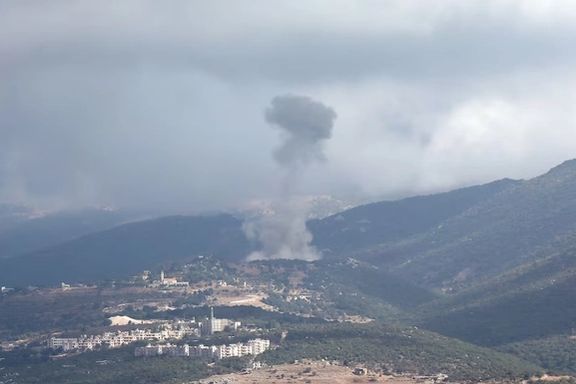
Smoke billows over southern Lebanon, amid ongoing cross-border hostilities between Hezbollah and Israeli forces, as pictured from Marjayoun, Lebanon, near the border with Israel, September 22, 2024.

Israel's Prime Minister Benjamin Netanyahu said that Iran-backed Hezbollah had been "hit in ways it could not imagine" after retaliatory attacks for an overnight bombardment struck deep in the heart of the group's infrastructure.

His address came after Hezbollah struck deeper into Israel reaching the northernmost city of Haifa in overnight strikes which saw schools in the north closed and residents advised to stay near shelters.

The Israeli military said it struck around 290 targets on Saturday, including thousands of rocket launchers, one of the biggest offensives since the conflict began 11 months ago.

"No country can accept the wanton rocketing of its cities. We can't accept it either. We will take whatever action is necessary to restore security and to bring our people safe back to their homes," he said, as 63,000 Israelis remain displaced amid the conflict sparked by the war in Gaza.

In southern Lebanon, the almost daily exchanges of fire have also seen around 100,000 civilians displaced.

"On October 7th, the Hamas terrorist monsters burst into Israel, murdered our people, raped and beheaded our women, burnt babies alive, and took 255 innocent people hostages, including many Americans," Netanyahu said of the day nearly 1,200 mostly civilians were murdered by Iran-backed Hamas.

"A day later, on October 8th, another Iranian terrorist proxy, Hezbollah, attacked Israel completely unprovoked. They fired missiles and rockets into our cities. They made 60,000 Israelis leave their homes along the Lebanon border, becoming refugees in their own land. In the subsequent months, they haven't stopped for a single day attacking us."

The Israeli military said that over 150 projectiles had been fired overnight from Lebanon, with over 8,000 in total having been fired from Lebanon since October 8 as Hezbollah fights in allegiance with Hamas in Gaza in the country's south.

While most were intercepted, several buildings were struck, including from interception shrapnel, leaving Kiryat Bialik north of Haifa ablaze.

On Sunday, Hezbollah claimed to have hit military and military-industrial sites, but Israel did not comment on the claims.

"We have entered a new phase, the title of which is the open-ended battle of reckoning," Hezbollah deputy chief Naim Qassem told mourners at the funeral of one of the group's commanders killed last week in Beirut.

Israeli Defence Minister Yoav Gallant said strikes would continue until it was safe for the evacuated people in the north to return as the war took a new turn last week.

Last week, hundreds of pagers and walkie-talkies belonging to Hezbollah operatives exploded in a two-day operation which struck deep into Iran's biggest proxy. Israel has not commented on the operation which led to at least 42 deaths and the overwhelming of Lebanon's healthcare system as 3,000 more were injured.

Then on Friday, 37 people including 16 commanders were killed by Israel as it targeted a meeting of the top echelons of the group's leadership. On Sunday, Hezbollah's parliamentary representative Hussein Fadlallah, said the group has already replaced the commanders killed over the weekend.

“There is no vacuum - on the night of the attack in Dahieh, the new commanders were already appointed and began to plan an attack on the enemy. Not a single outpost remains empty of commanders for even a single day,” he said.

On Sunday, the Iran-backed Islamic Resistance in Iraq also claimed to have sent drones targeting an Israeli military base amid the Lebanese onslaught.

The attack from Iraq is believed to be a retaliation for the killing of one of the group’s commanders.

A statement from the group said that on Sunday, the funeral of Abu Haider al-Khafaji, the senior commander of the Iraqi Hezbollah Brigades was taking place at 4pm local time. The group said he was killed in an attack attributed to Israel in Damascus on Friday morning. The funeral is being held in Baghdad.

"Escalation in Lebanon means escalation from Iraq," an official from the group said.

Most Viewed

Iran negotiators ordered to return after internal rift over Islamabad talks
1
EXCLUSIVE

Iran negotiators ordered to return after internal rift over Islamabad talks

2
ANALYSIS

US blockade enters murky phase as tankers spoof signals and buyers hesitate

3
ANALYSIS

Why the $100 billion Hormuz toll revenue is a myth

4

US tightens financial squeeze on Iran, warns banks over oil money flows

5
ANALYSIS

US blockade targets Iran oil boom amid regional disruption

Banner
Banner

Spotlight

  • Hardliners push Hormuz ‘red line’ as US blockade tests Iran’s leverage
    INSIGHT

    Hardliners push Hormuz ‘red line’ as US blockade tests Iran’s leverage

  • Ideology may be fading in Iran, but not in Kashmir's ‘Mini Iran'
    INSIGHT

    Ideology may be fading in Iran, but not in Kashmir's ‘Mini Iran'

  • War damage amounts to $3,000 per Iranian, with blockade set to add to losses
    INSIGHT

    War damage amounts to $3,000 per Iranian, with blockade set to add to losses

  • Why the $100 billion Hormuz toll revenue is a myth
    ANALYSIS

    Why the $100 billion Hormuz toll revenue is a myth

  • US blockade targets Iran oil boom amid regional disruption
    ANALYSIS

    US blockade targets Iran oil boom amid regional disruption

  • Iran's digital economy battered by prolonged blackout
    INSIGHT

    Iran's digital economy battered by prolonged blackout

•
•
•

More Stories

Iran unveils 'Jihad' missile with enhanced capabilities

Sep 22, 2024, 15:12 GMT+1

Iran showcased a new ballistic missile named Jihad, developed by the Islamic Revolutionary Guard Corps (IRGC) Aerospace Force, during a military parade in Tehran on Saturday.

The Jihad missile system was officially unveiled for the first time on Saturday, introducing a new launch platform for liquid-fueled missiles, according to Iranian government media and IRGC sources.

According to the IRGC-affiliated Tasnim website, it is a ballistic missile with a range of 1,000 kilometers, featuring a dual-missile launcher that distinguishes it from other Iranian liquid-fueled missiles.

Tasnim stated, "A glance at the Jihad missile reveals that it is an optimized version of the Qiam missile, whose range was previously increased from 800 kilometers to 1,000 kilometers, and its warhead became guided."

First generation of Iran's Qiam missile (Undated)
100%
First generation of Iran's Qiam missile

The Qiam missile, Iran's first liquid-fueled missile without fins, was introduced in 2010 with an initial range of 800 kilometers. Its design modification for fin removal allowed for launch from various missile silos. Subsequent enhancements included the replacement of the standard triple-cone warhead with a detachable, guided variant, improving accuracy to within 50 meters, according to Tasnim.

In October 2018, images from an operation revealed the Qiam missile with newly added small fins to enhance its flight profile. By 2021, the Ministry of Defense reported further advancements in the Qiam missile, achieving a range of 1,000 kilometers and marking the emergence of what the IRGC says is a new generation.

According to Tasnim, the Jihad missile is equipped with a warhead weighing approximately 600 kilograms and travels at speeds exceeding eight times the speed of sound. It employs a different launch platform, enabling the simultaneous launch of two missiles, thus enhancing operational efficiency despite the longer preparation time typically associated with liquid-fueled missiles.

Although the Islamic Republic has made continuous advancements in its ballistic missile program, it is not possible to independently verify claims of developing advanced weapons. Around 350 missiles and drones launched against Israel in April, 99% were intercepted by Israeli air defenses and allied warplanes.

Following the introduction of the Kheibar-Shekan and Martyr Haj Qasem missiles, Tasnim reported that a new generation of Iranian ballistic missile launch platforms has also become operational. This platform, used in the Fattah missile, is equipped with the DRU (Precise Navigation System), providing highly accurate positioning data. "This enables rapid firing immediately after deployment, along with swift closure and exit capabilities," the report added.

Iran's first hypersonic ballistic missile Fattah  (Undated)
100%
Iran's first hypersonic ballistic missile Fattah

Iran's missile program has generated ongoing concerns among Western nations, particularly the United States and its allies, as Iran invests heavily in developing various ballistic and cruise missiles. The advancements in missile technology have raised alarms about potential threats to regional stability, especially regarding Iran's backing of non-state actors and militant groups.

The potential development of intercontinental ballistic missiles (ICBMs) has prompted calls for tighter controls over Iran's missile program.

In response to the tensions, the United States and its allies have imposed sanctions targeting Iran's missile development, aiming to restrict access to materials and technologies that could enhance missile capabilities.

New sanctions were recently implemented against Iran and its state airline, Iran Air, following allegations of missile deliveries to Russia.

Despite international scrutiny, Iran maintains its right to develop missile capabilities, framing it as a matter of national sovereignty.

Israel launches over 100 'preemptive' air raids in Lebanon in one hour

Sep 21, 2024, 22:33 GMT+1

Israeli warplanes on Saturday launched their largest air strikes in southern Lebanon since October 7, following reports of Hezbollah's plans to retaliate after Israeli attacks earlier in the week killed dozens of Iran-backed fighters.

A report by Lebanon’s state news agency NNA said Israeli warplanes carried out a total of 111 airstrikes in one hour - between 1:30 p.m. and 2:30 p.m. local time - on Saturday in Nabatieh, Iqlim al-Tuffah, and Western Bekaa.

The Israeli military's spokesman Daniel Hagari earlier said 400 Hezbollah launchers were hit in its airstrikes in southern Lebanon on Saturday. An IDF statement said approximately 90 projectiles were fired from Lebanon into Israel.

The number of Israeli strikes on Saturday is among the highest recorded since the Tehran-backed militant group started firing rockets into northern Israel last year in support of Hamas amid Israel’s war in Gaza, a CNN report said.

The US State Department urged American citizens to leave Lebanon via commercial options while they are still available amid "unpredictable nature of ongoing conflict between Hezbollah and Israel and recent explosions throughout Lebanon."

The Jordanian Foreign Ministry also issued a similar statement, warning its citizens against travelling to or staying in Lebanon amid fears Israel and Hezbollah may start a full-fledged war.

Iran's response

A possible breakout of the Israel-Hezbollah war can lead to Iran's intervention, igniting a broader regional war.

“After Lebanon, they (Israelis) may bring the war towards Iran," said former IRGC chief-commander Mohsen Rezaei who now serves as a member of Iran's Expediency Council. “Netanyahu is constantly provoking us and taking actions such as attacking embassies and assassinating Ismail Haniyeh to drag us into an all-out war with the United States.”

Iranian authorities have largely tried to avoid getting engaged in a tit-for-tat cycle with Israel, despite huge pressure by the Islamic Republic's supporters following the Israeli assassination of Hamas chief Ismail Haniyeh in Tehran and several others attacks on Iran and its proxies blamed on Israel.

"Iran will handle these matters with vigilance. Israel will certainly not achieve its goals of escalating tensions, but it will face consequences for its crimes," Iran's Foreign Minister Abbas Araghchi said during his ongoing visit to New York, referring to a Friday Israeli air raid killing top Hezbollah commanders.

Hezbollah, a powerful Iran-backed group, said that 16 members including senior leader Ibrahim Aqil and another commander, Ahmed Wahbi, were among those killed in the deadliest strike in nearly a year of conflict with Israel. 21 others were also killed in the Israeli air strikes that hit Beirut's southern suburbs on Friday.

Israel's army said it hit an underground gathering of Aqil and leaders of Hezbollah's elite Radwan forces and had almost completely dismantled its military chain of command.

Friday's strike sharply escalated the conflict and inflicted another blow on Hezbollah after two days of attacks this week in which pagers and walkie-talkies used by its members exploded. The total death toll in those attacks has risen to 39, and more than 3,000 were injured.

The attacks on communications devices were widely believed to have been carried out by Israel, which has neither confirmed nor denied involvement.

Iran withheld launchers for missiles sent to Russia - Reuters

Sep 21, 2024, 13:48 GMT+1

Iran did not include mobile launchers with the close-range ballistic missiles that Washington last week accused Tehran of delivering to Russia for use against Ukraine, Reuters reported on Saturday citing three sources with knowledge of the matter.

The sources - a European diplomat, a European intelligence official and a U.S. official - said it was not clear why Iran did not supply launchers with the Fath-360 missiles, raising questions about when and if the weapons will be operational.

The U.S. official, who like the other sources spoke on condition of anonymity, said Iran had not delivered the launchers at the time of the U.S. announcement about Iran's delivery of the weapons. The European intelligence official said without elaborating that they did not expect Iran to provide launchers.

Two experts told Reuters there could be several reasons why the launchers were not sent. One is that Russia may plan to modify trucks to carry the missiles, as Iran has done. Another is that by withholding the launchers, Iran is allowing space for new talks with Western powers on easing tensions.

The Russian defense ministry declined to comment.

The U.S. National Security Council did not immediately respond to a request for comment and the Pentagon declined to comment.

Iran’s mission to the United Nations did not immediately respond to a request for comment.

Tehran denies providing Moscow with the missiles or with thousands of drones that Kyiv and Western officials have said Russia uses against military targets and to destroy civilian infrastructure, including Ukraine’s electrical grid.

U.S. Secretary of State Antony Blinken said on Sept. 10 that Iran had delivered the Fath-360s to Russia and would “likely use them within weeks in Ukraine.”

The missile would pose an additional challenge for Ukraine, which is constantly adapting its air defenses to innovations by Russian forces. Iran's semi-official Fars news agency says the missile travels at four times the speed of sound when approaching targets.

Blinken said the missiles threatened European security and would be fired against short-range targets, allowing Russia to reserve more of its extensive arsenal for targets beyond the front lines. The Fath-360 has a range of up to 75 miles (121 km).

The United States, Germany, Britain and France imposed new sanctions on Iran, and the EU said the bloc was considering fresh measures targeting Iran's aviation sector.

The Kremlin at that time declined to confirm its receipt of the missiles but acknowledged that its cooperation with Iran included “the most sensitive areas.”

Blinken did not say how many Fath-360s Iran supplied to Russia or when they were sent.

Reuters determined through shipping data that a Russian freighter sanctioned by Washington, the Port Olya-3, made voyages between Iran’s Caspian Sea port of Amirabad and the Russian port of Olya several times between May and Sept. 12.

Fabian Hinz, an expert on Iranian missiles with the International Institute for Strategic Studies, said he could not confirm that Tehran withheld the launchers.

Ballistic missiles require specifically designed launchers in order to be fired.

According to Hinz, one reason Iran didn't send launchers may be that the civilian trucks that Iran modified to launch these and other missiles are not robust enough to operate in rough terrain during Ukraine's harsh winter. Iran modifies trucks made by Mercedes and other companies and turns them into easily disguised missile launchers, he said.

That suggests, he continued, that Russia could modify its own military-grade vehicles.

"A commercial, off-the-shelf Mercedes truck is just not that off-road capable," he said

David Albright, a former U.N. nuclear inspector who heads the Institute for Science and International Security, also could not say whether Iran delivered the launchers.

But he noted that Iran’s new president, Masoud Pezeshkian, and other Iranian officials will be meeting with European officials on the sidelines of next week’s U.N. General Assembly in New York to test the potential for diplomacy on Tehran’s nuclear program, regional tensions and other disputes.

“It could be that they (Iran) are holding back the launchers to provide a little space for these talks,” he said. “One can imagine that if there are Iranian missiles raining down (on Ukraine) there would be condemnation at the General Assembly.”

But he was skeptical of any progress, saying he doubted Iran would make the necessary compromises.
Iran hints at diplomatic response following shocking attacks on Hezbollah

Sep 21, 2024, 08:57 GMT+1
•
Mardo Soghom

Iran will continue to oppose US and Western "unilateralism," Foreign Minister Abbas Araghchi stated upon his arrival in New York for the UN General Assembly. He also strongly condemned Israel’s recent attacks against Hezbollah.

“The policy of the Islamic Republic of Iran has always been to resist the unilateralism of the United States and generally the Western countries, who pursue their own excessive demands and continue their colonial policies in a new form. This will remain our policy moving forward,” Araghchi was quoted as saying by IRNA, the official government news website.

Araghchi, who was deeply involved in Iran’s nuclear talks with the West a decade ago and in 2021, was appointed foreign minister in the new government of President Masoud Pezeshkian in August. The President, during his election campaign and upon assuming office, referred to a policy of engagement with the West, initially raising hopes that Tehran might be willing to adopt a more pragmatic foreign policy.

Araghchi with Hezbollah leader Hassan Nasrallah. Undated
100%
Araghchi with Hezbollah leader Hassan Nasrallah. Undated

Araghchi, condemning attacks against Tehran’s ally and proxy, the Lebanese Hezbollah this week, made it clear that the Iranian delegation will focus on a diplomatic campaign against Jerusalem.

“In this situation, it is natural that the most important topic in our meetings on the sidelines of the UN General Assembly, as well as in the sessions held by the Non-Aligned Movement, the Organization of Islamic Cooperation, BRICS, ECO, and others, will be…the criminal actions of the Zionist regime, which must be confronted by the international community,” Araghchi stated. He went on to say that “It is natural that the crimes of the Zionist regime, especially those committed in the past few days, will be the main topic of these discussions.”

While the explosion of thousands of Hezbollah communication devices, which killed scores and seriously wounded hundreds of militiamen and commanders, has shocked the world, Tehran has so far refrained from issuing any specific threats against Israel. Additionally, more than 50 days after the killing of Hamas leader Ismail Haniyeh in Tehran, Iran has not launched a military retaliatory strike, possibly indicating the government's reluctance to escalate the conflict further.

Iran's IRGC displaying missiles during a military parade on September 21, 2024
100%
Iran's IRGC displaying missiles during a military parade on September 21, 2024

On Saturday, President Pezeshkian declared during a military parade that “Iran's defensive power and deterrence capabilities have grown to such a level that no evil force would even dare to entertain the thought of aggression against the country.” He was speaking during ceremonies on the 44th anniversary of Iraq’s invasion of Iran that led to a bloody and destructive 8-year war between the two countries.

However, his reference to Iran’s deterrence power contrasted with many incidents of bombings and sabotage since mid-2020 targeting Iran’s nuclear program and military and strategic installations, widely believed to have been launched by Israel. The latest incident was Haniyeh’s killing in Tehran while he was a high-level government guest. The incident led to debates even in government-controlled media in Tehran about serious security breaches and veiled accusations against security and intelligence organs.

In a message of condolence to Hezbollah's Hassan Nasrallah, Araghchi said, "As I arrive in New York to attend the 79th session of the United Nations General Assembly, I consider it my Islamic and humanitarian duty to be the resounding voice of justice for the heroic people of Palestine and Lebanon against the criminal and aggressive Zionist regime."

However, Araghchi, echoing other statements by other Iranian officials, indicated a cautious approach to the issue of responding to Israel. “Regarding Lebanon's issues, it is natural that Hezbollah will make its own decisions and respond appropriately. Other matters will be addressed as the situation requires. The assassination of martyr Ismail Haniyeh in Tehran will not go unanswered.”

Top Hezbollah commanders killed in Beirut air strike, Israel says

Sep 20, 2024, 17:15 GMT+1

Israel said an air strike it launched in south Beirut on Friday killed top Hezbollah commanders in a meeting of the Iran-aligned group's elite Radwan unit, escalating a week of devastating attacks in Lebanon.

"Ibrahim Aqil and the Radwan commanders who were eliminated today were planning Hezbollah’s 'Conquer the Galilee' attack plan, in which Hezbollah intended to infiltrate Israeli communities and kidnap and murder innocent civilians in a similar manner to the October 7 Massacre," it said in a post on X.

Hezbollah has yet to confirm the identities of those killed in the attack.

Aqil, Hezbollah's operational commander, was among the founding members of the group and was wanted by the United States for his alleged role in bombings of the US embassy in Beirut and a nearby marine corps barracks in 1983 which killed around 300 people.

At least 10 people were killed and nearly 60 others injured in the Israeli attack which leveled a building in the densely populated southern suburbs of Beirut, the Lebanese Health Ministry announced.

The United States had maintained a bounty of up to $7 million on Aqil, whom the State Department said was a key member of Hezbollah’s predecessor organization Islamic Jihad.

Aqil also directed the taking of American and German hostages in Lebanon in the 1980s, US authorities alleged.

His killing comes shortly after two days of suspected Israeli attacks on the communication devices of Hezbollah fighters beginning on Tuesday which killed over three dozen people on Tuesday and Wednesday.

Iran condemned the Friday air strike as an unlawful attack on civilians.

"We condemn in the strongest terms the Israeli madness and arrogance that crossed all boundaries by targeting residential areas in the southern suburbs of Beirut, resulting in the martyrdom and injury of dozens, including children and women," the Iranian embassy in Beirut said in a post on X.

Hamas in a statement condemned Israel's air strike on the southern suburbs of Beirut as “an escalation of Zionist aggression".

An Israeli air strike on the same area on July 30 killed Hezbollah's top military commander Fuad Shukr, who was also wanted by the United States for his role in the 1983 bombings and was viewed by Israel as a key deputy of Hezbollah's leader Hassan Nasrallah.