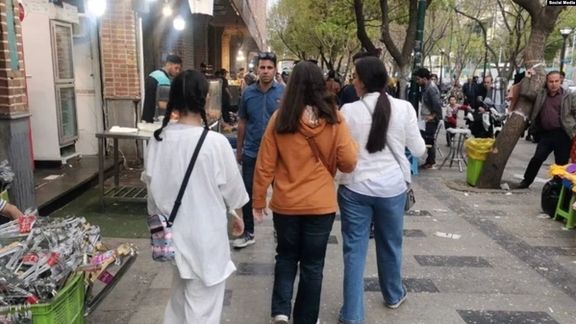
Young women without hijab in Tehran streets. Undated
Iran's president must decide whether to enforce the hardliners' new hijab law, risking alienation of millions of voters, or refuse to sign it and challenge the conservative establishment.
The hijab law that hardliner lawmakers have succeeded in finalizing will impose an array of penalties including heavy cash fines and prison terms on women for not conforming with strict hijab regulations and businesses for not enforcing them.
The hardline Guardian Council’s approval of the legislation this week means Pezeshkian must now decide whether to officially communicate the new law to government organizations for implementation.
Hardliners in parliament and elsewhere insist that "all government forces must cooperate in its implementation, and no one should cause obstruction.,” as an influential lawmaker said on September 18.
The announcement coincided with the second anniversary of Mahsa (Jina) Amini's death in custody, which, after her arrest for violating hijab rules, sparked months of protests and unrest across Iran in September 2022.
The Guardian Council's approval of the law, a year after it passed Parliament, could pose significant challenges for Pezeshkian as he travels to New York on Sunday to deliver a speech at the UN General Assembly on Tuesday. The timing makes him vulnerable in potential interviews with international media, adding pressure during his visit.
The President has five days, from the time his office receives the notification from Parliament, to sign and communicate the law for implementation. It is not clear whether Pezeshkian’s office has already received the legislation or not.
If Pezeshkian declines to sign and communicate the new law within the required timeframe, the responsibility will fall to Parliament Speaker Mohammad-Bagher Ghalibaf to deliver it to government agencies.
Ghalibaf has formed an undeclared alliance with Pezeshkian against ultra-hardliners who he holds responsible for his defeat in the recent presidential elections. Many among his supporters are also against the implementation of the hijab law.
Pezeshkian will not be the first president to leave the communication of legislation he disapproves of to the speaker. Both Mahmoud Ahmadinejad and Hassan Rouhani have done that before.
Taking such a stance will provide ammunition to his opponents who will accuse him of favoring ‘lawlessness’ despite his repeated assertions that for him the Law comes above everything.
In early August, Parliament approved all Pezeshkian’s proposed ministers, possibly because they received ‘advice’ that Supreme Leader Ali Khamenei wanted a cabinet to be formed urgently and without too much ado in the wake of Israel’s killing of Hamas leader, Ismail Haniyeh, in the heart of the Iranian capital.
Ultra-hardliner lawmakers then began pushing again for the finalization of the controversial hijab bill by the Guardian Council. Pundits say the Council delayed the approval of the bill and its implementation during Ebrahim Raisi’s presidency for the fear of a popular backlash and making Raisi’s government vulnerable.
Raisi’s government, nevertheless, launched the Nour (Light) Plan in early April to force women, who increasingly appeared in public without the compulsory hijab, back into submission to the rules.
Sources on the ground say the presence of women with no hijab in public is now 'very normal' in Tehran and many other large and small cities and towns.
Under the plan, thousands of businesses have been shut down for failing to ensure compliance among their customers. Similarly, tens of thousands of cars have been impounded for carrying unveiled passengers.
Pezeshkian takes pride in the fact that the women in his family, including his daughter—who has frequently appeared by his side since he registered to run—wear the hijab. However, he firmly maintains that violence against women is neither acceptable nor justified. During his campaign debates and meetings, Pezeshkian labeled the proposed hijab law the "Darkness Plan" and pledged to end morality police patrols and the use of violence against women for not adhering to hijab rules. In a 2014 interview, Pezeshkian revealed that he had personally led efforts to enforce hijab on university hospital staff in the early days of the Islamic Revolution, four decades ago.
Captain Mojtaba Nazari and Lieutenant Colonel Mokhtar Morshedi , 'martyred' following the August gas leak at an IRGC workshop in Isfahan
In a Wednesday broadcast, an Iranian Internet TV channel revealed that Israeli operatives pulled off a clandestine mission in Iran over the past month, leading to casualties and the theft of sensitive documents.
Vahid Khazab, a host on the internet TV channel "Asr," remained tight-lipped about the specifics of the operation, revealing only that a well-connected friend within the security services had informed him about the attack.
Curiously, the Wednesday episode—which covered the latest developments involving Israel and Palestine—has since become inaccessible.
After the program aired, attention quickly shifted to an incident, which could fit the criteria: a reported gas leak on August 29 at an IRGC facility in Isfahan, resulting in the deaths of two senior officers, Captain Mojtaba Nazari, and Lieutenant Colonel Mukhtar Morshidi, and injuring 10 others. In its official statement at the time, the IRGC kept details deliberately vague, omitting the name of the facility and its operations. The statement attributed the incident to a "gas leak" but did not clarify whether the officers died from gas asphyxiation or an explosion.
The host of the "Meydan" program left things ambiguous, not specifying whether he was referring to this particular incident or an undisclosed operation that neither Iranian officials nor the media have acknowledged so far.
Criticizing the strategy of concealing operations on Iranian soil, the other host of the program, Ruhollah Razavi, pointedly remarked: "It seems there's no intention to mention that Iranians, same as the Lebanese, have also been martyred."
Khazab, nodding in agreement, remarked, "Hasn’t Israel conducted operations this past month? Has anyone said a word? Haven’t these operations resulted in martyrs?" His statement trailed off as he deliberately avoided mentioning specific names. He then sharply criticized the silence from officials and relevant agencies, saying, "It seems the strategy is to remain silent so that no one truly knows what’s happening."
The hosts hinted that officials might believe keeping things under wraps avoids public scrutiny—after all, with no visible retaliation and security looking a bit shaky, it might not paint the best picture.
"It's a strategy that if these things are brought up, expectations rise. For example, an ordinary person might say, 'Oh come on, they just talk and do nothing!'" Khazab added.
This scenario has already unfolded, with Tehran issuing multiple declarations of retribution for the killing of Ismail Haniyeh in July in Tehran, yet no retaliatory actions have materialized. The lack of any visible response has led some to question whether the promises were ever meant to be fulfilled, ultimately undermining the image Tehran seeks to project as a strong and dominant power in the region.
Later on Saturday, IRGC-affiliated Tasnim News refuted the statements made in the program, quoting an unnamed security official who stated, “All the facts in this report are incorrect, and it is unclear which uninformed source provided such information to them.”
The "Asr" Internet TV website provides no information about its ownership, yet the channel's content closely aligns with the IRGC's narrative. However, in 2014, Ramezan Sharif, then head of IRGC public relations, denied claims that the IRGC had launched a private radio-television network under the name "Asr."
Sharif said in his statement: "The IRGC has never intended to create a private radio-television network. The 'Asr' network is part of the Islamic Republic of Iran Broadcasting (IRIB), designed as part of the national media's broader effort to meet audience needs."
A group of Iranian Americans have launched ‘Iranians for Trump’, a movement to mobilize support for presidential candidate Donald Trump in the upcoming US elections.
Sarah Raviani, the spokesperson for the group’s English division, is the opposite of what a stereotypical traditional Trump supporter, often portrayed in mainstream media, would be.
She’s young, from generation Z, educated, and comes from an immigrant background. Her family fleeing shortly after the clerical establishment, once led by Ruhollah Khomeini, ousted the monarchy and created the Islamic Republic of Iran in 1979.
Photo of Sarah Raviani after launching 'Iranians for Trump'
“We think that President Trump is the best option for our community to support the policies that we want and we need for freedom and democracy in Iran and for protecting and safeguarding American national security,” said Raviani.
The issue of national security and policies implemented during the first Trump administration on Iran such as pulling out of the JCPOA nuclear deal, the listing of the IRGC as a terrorist entity and the assassination of Gen. Qassem Soleimani, proved to Raviani that the former President was tough on the Iranian regime.
National security and international relations analyst Shayan Sami’i said the Biden-Harris administration's policies towards Iran have tilted some Iranian Americans towards Trump.
“Disillusionment with the Democrats, a perception of strength by Trump, and the perception of an “appeasement” approach toward the Islamic Republic by the Biden Administration makes Iranian Americans gravitate toward Trump.”
The Biden administration issued a waiver in 2023 for international banks to transfer $6 billion in frozen Iranian money from South Korea to Qatar, in exchange for the release of five American citizens detained in Iran. As part of the deal, the administration also agreed to release five Iranian citizens in the United States. Republicans point to the fact that the Oct. 7 attack on Israel, launched by Iran-backed Hamas, happened shortly after the release of these funds.
The mentality of the Iranian American voter is also influenced by the history of the Islamic Revolution.
The Islamic Revolution happened under during the Jimmy Carter's Democratic administration, meaning Iranians historically have been weary of the Democrats, said Sami’i.
“The 1979 Islamic Revolution occurred during a Democratic party administration and Democratic administrations were harsher on Iran’s monarchy, making Republicans appear as their true friends. However, Republican presidents, just like their Democratic counterparts, have provided nothing more than lip service and back-pedaling. They have stated good and heart-warming words but no concrete action.”
The “tough” guy image of Trump is often seen as big win for the Iranian Americans whose way of thinking is valuing toughness. This especially applies to those who fled at the start of the revolution, having great fear of the Islamic Republic, Sami’i told Iran International.
Nicole Namdar, a 35-year-old business advisor from Great Neck, NY, now living in Florida, is Iranian Jewish and she’s voting for Trump.
She’s a liberal when it comes to social issues, but she often feels the Democrats respond ‘too little, too late’ and are ‘blind to the realities’ of the threat of the Islamic Republic. Namdar said as a Jewish person, who lost her homeland of Iran to the revolution, she said she needs to feel safe in the land her family came to seek refuge.
“I don’t want to live through an Islamic revolution that my family lost their country to,” said Namdar.
The Foundation for Defense of Democracies' Behnam Ben Taleblu, said while no group is a monolith, the social impact of Trump’s Iran policy has earned him support from a wide verity of Iranian Americans.
“The breaking of taboos to include vocally and vociferously supporting the Iranian people in every iteration of their protests against the regime, killing Iran’s chief terrorist Qassem Soleimani, and unilaterally reimposing sanctions on the regime to rob it of revenues has earned the former president deep support from broad swaths of the Iranian American community,” said Taleblu.
While political engagement and participation is key in any election, Iranian Americans are not going to have significant impact on the outcome of the election, according to Arash Ghafouri , the CEO of Statis Consulting.
In the previous election, according to a poll by Zogby Research Services, 87 percent of Iranian Americans were registered to vote in the US. Of that number, 52 percent are Democrats and 8 percent are Republicans. But 40 percent identify themselves as either independent or have no party affiliation.
Raviani believes that has shifted significantly in the past 4 years and gave her own personal experience of an Iranian American activist who went from being a staunch Democrat, a never Trump voter, to now being one of his biggest supporters.
“I see a lot of the community has shifted into becoming single issue voters, and this happened as a result of the uprising in 2022 in Iran. And like I said, a lot of Iranian Americans identified as either apolitical Democratic voters or independents.”
Click on YouTube Iran Internationa's Podcast playlist to watch the full episode of this week's special edition of Eye for Iran from Washington DC.
The IRGC-Intelligence Organization's former Foreign Intelligence chief Reza Seraj
Reza Seraj, the IRGC-Intelligence Organization's former foreign intelligence chief who played a critical role in Iran’s overseas assassination plots for many years, died on September 21 after undergoing surgery for a brain tumor.
His death followed reports on September 2 about his deteriorating health, though IRGC-affiliated Fars website had initially denied the severity of his condition.
A longtime member of Iran's security apparatus, Seraj was designated by the US Treasury Department last year for his role in overseas assassination plots and human rights abuses in Iran.
He had earlier served as the head of the Special IRGC Intelligence Directorate, also known as Unit 4000, before being removed after a plot to assassinate an Israeli in Cyprus was uncovered. Following his removal, Javad Ghaffari, a figure expelled from Syria, took over the leadership of this unit.
In the last years of his life, the IRGC brigadier general held the position of spokesperson and deputy for communications at the Supreme National Security Council. However, Seraj came to be recognized for his human rights violations.
Starting his career in the 1990s, Seraj rose through the ranks as a senior interrogator within the IRGC Intelligence. Operating under the alias "Alavi," he became known as “the chief interrogator for many political and student activists, extracting forced confessions through pressure and torture.”
His actions during this period left a mark on the lives of many activists, including Ali Afshari, a political figure who in an interview with Iran International identified Seraj as the lead interrogator during his 2000 arrest.
Ahmad Batebi, a journalist at VOA Farsi also wrote on X: “This accursed individual was one of those who played a significant role in torturing me during interrogation and applying psychological pressure to force a false confession in front of state TV cameras. He also tortured many students and political activists to fit them into the absurd scenarios created by the security agencies.”
Seraj was also appointed head of the Student Basij and later appeared as an "analyst and academic" regularly featured in state-controlled media. As the head of the Student Basij, he was actively involved in suppressing students during the 2009 protests, according to Dadgostar, a site documenting human rights violators in Iran.
Saeed Haddadian, Ali Khamenei's favorite eulogizer, and Reza Seraj at a ceremony honoring Qasem Soleimani in 2017.
Throughout his career, Seraj held various roles within the IRGC, including the political deputy of Sarallah Headquarters in Tehran, deputy head of the IRGC Intelligence Organization, and head of the Prophet Muhammad faculty and Imam Hossein University.
In addition to his political and security roles, Seraj was also involved in the interrogation and torture of Fahimeh Dorri Nogourani, the wife of Saeed Emami, a former Deputy Minister of Intelligence.
Seraj was also one of the commanders responsible for the attack on political prisoners in Ward 350 of Evin Prison on April 17, 2014, an incident that came to be known as the Black Thursday of Evin.
In the aftermath of the attack, political prisoner Gholamreza Khosravi Savadjani reported that Seraj had personally escalated his sentence from three years in prison to execution. Khosravi was hanged less than two months later, on June 1, 2014, in Rajai-Shahr Prison.
Hossein Salami, IRGC Commander-in-Chief, praised Seraj in a statement on Saturday, calling him "effective" in confronting what he described as the "sedition movement," a reference to anti-government protests. Salami said, “Seraj played a significant role in confronting sedition … and raising awareness in dealing with various deviations that threatened the Islamic Revolution.”
Grieving families holding a memorial ceremony for their loved ones who died during the 2022 Woman Life Freedom movement, 19 September 2024
In the wake of the "Woman, Life, Freedom" uprising's anniversary, grieving families across Iran, in the face of heightened security, have gathered in cities nationwide, quietly holding private memorials to honor their lost loved ones.
Since 2022, hundreds of Iranian families have marked the beginning of fall by grieving the loss of their loved ones, who were killed during nationwide anti-state protests.
Each day has become a solemn anniversary of a protester’s death, as the uprising against the state continues to resonate deeply among Iranian society.
These families have remained in mourning, affected by the regime's brutal crackdown on protesters that followed the killing of 22-year-old Mahsa Jina Amini while in the custody of the so-called morality police on September 13, two years ago.
Amini was detained by agents for allegedly violating state-imposed Islamic hijab regulations. Her family has consistently asserted that the head injuries she sustained while in custody led to her death three days later at Kasra Hospital in Tehran. The UN has since held the Iranian state responsible for her death.
On Friday, her father, Amjad Amini, posted a message on Instagram to commemorate his daughter's birthday, which also falls in September. He wrote: "My beautiful, innocent, and dear daughter, my beloved Jina, Mahsa of Iran—today marks the blessed anniversary of your blooming."
Amini expressed his enduring sorrow, writing: “Even after two years, we continue to carry the weight of that bitter day, finding solace only in the fact that your beautiful name is still spoken with grace and purity. Your memory remains forever etched in our hearts and in the hearts of those who love you.”
Human rights organizations estimate that throughout the months-long nationwide protests, at least 551 protesters, including 68 children and 49 women, were killed at the hands of state security forces.
This year, while some families have held memorials in private settings, others have observed the occasion in different ways, as public mourning remains restricted by authorities. For example, the Al-Jawad cemetery in Nowshahr, where several victims of the movement are buried, was sealed off with chains, and public access was restricted starting on Thursday.
A table is adorned with photos of victims from the 2022 'Woman, Life, Freedom' movement during a memorial ceremony on September 19, 2024.
As the second anniversary of Nika Shakarami's death, one of the teenage protesters killed amid the anti-state protests, approached on Friday, her family reported that authorities had blocked the routes leading to the cemetery where she was buried, preventing them from visiting her grave.
On Friday, Nobel Peace Prize laureate Shirin Ebadi marked the second anniversary of Shakarami's murder with a statement on Instagram.
"The killing of 16-year-old Nika Shakarami, like the murder of hundreds of other young people and children, is a stark example of the Islamic Republic's crimes against humanity," Ebadi wrote.
The lawyer and former judge further remarked, "The government is attempting to render the pursuit of justice meaningless."
Leila Mahdavi, the mother of 16-year-old Siavash Mahmoudi, who was killed during the protests, marked the second anniversary of her son's death on Thursday by sharing images from a memorial ceremony held in his honor, seemingly in a private venue, on Instagram, where she firmly stated: "Your killers will face the consequences for what they have done."
Hasti Khazaei, sister of Erfan Khazaei, another victim of the uprising, shared a video on Instagram from a memorial event marking the second anniversary of her brother’s passing.
Accompanying the video, she wrote: “In the name of joy that was taken from us, stolen, denied, killed, and buried. In the name of the wedding attire you never wore, whose absence lingers in our hearts forever. In the name of the love that radiated within you, my dear brother. In the name of your sweet life that was cut short.”
As the anniversary of those killed during the uprising approached, the Islamic Republic has, over the past month, escalated its pressure on grieving families across Iran.
A renewed wave of repression, aimed at civil and political activists as well as the families of the victims, began in September. During this time, dozens of citizens have been arrested, summoned, or subjected to interrogation by security forces.
Supreme Leader Ali Khamenei meeting with participants in the Islamic Unity Conference and government officials, 21 September 2024.
Amid heightened Israeli pressure on Hezbollah, Iran’s key proxy in the region, Supreme Leader Ali Khamenei adopted a notably measured tone in his Saturday speech, emphasizing the importance of soft power.
Gone was the usual fiery rhetoric or direct threats; instead, Khamenei highlighted the importance of cultural influence, diplomacy, and ideological strength, signaling a more subtle shift in Iran's regional strategy amid ongoing tensions. Despite this measured approach, he still condemned Israel, accusing it of committing "shameless crimes."
The violence in Lebanon has escalated quickly, beginning with explosions on Tuesday and continuing into Wednesday. The attacks, which involved detonating pagers and walkie-talkies, are widely believed to have been orchestrated by Israel. The blasts killed scores of Hezbollah members and injured more than 3,000. On Friday, Hezbollah confirmed that senior commanders Ibrahim Aqil and Ahmed Wahbi were killed in an air strike on a residential building in the Hezbollah-controlled southern suburbs, which left 31 dead, including around 20 top commanders.
During his speech at the 38th Islamic Unity Conference, where the theme of unity was front and center, Supreme Leader Khamenei struck a tone of quiet frustration. He reiterated his long-standing vision: "With the formation of an Islamic Ummah, Muslims can, through their internal strength, remove the malignant cancer of the Zionist regime from Palestine and eliminate the oppressive influence, domination, and interference of the United States in the region." Yet, in the same breath, Khamenei acknowledged the challenge, admitting that "governments don't have the motivation" for unity, signaling his growing frustration with his lack of influence on many Arab governments.
"Islamic countries should completely sever their economic ties with this criminal gang. This is the least they can do, and it must be done," Khamenei said.
His remark underscored not only frustration but also Iran's growing isolation in the region. Despite repeated calls for cooperation from both Khamenei and President Masoud Pezeshkian, their appeals seem to be falling on deaf ears, reverberating in a region where Iran's influence is increasingly sidelined by the very leaders it hopes to rally.
“Politicians, scholars, academics, scientists, influential thinkers, poets, writers, political and social analysts – these are the groups that can have an impact,” Khamenei said, emphasizing soft power.
“Now, imagine if for ten years, all the media outlets in the Muslim world consistently focused on the unity of Muslims, with articles being written, poets composing poems, analysts providing insights, professors explaining, and religious scholars issuing rulings. Without a doubt, over the course of those ten years, the situation would change drastically,” he added. “Once the nations awaken, governments will be forced to act accordingly.”
This isn’t the first time Khamenei has dialed down the rhetoric in recent months. Recently, he spoke of a "tactical retreat" as Iran continues to hold off on the revenge once promised by IRGC leaders after the killing of Ismail Haniyeh in Tehran last July. Even in a speech on August 25, Khamenei shifted the tone, remarking, that the battle against the camp of the enemies (Israel and the US), doesn’t always have to be fought with guns. "One can also fight them with poetry and verse." It seems, for now, the weapons of choice may be words rather than warfare.
With the country grappling with a mounting financial and economic crisis, Tehran’s restrained approach persists, even as Israeli pressure ramps up. Instead of saber-rattling, Iran appears to be banking on patience while contemplating a breakthrough to reduce US sanctions, while not relinquishing its anti-Israeli foreign policy in the region.