• العربية
  • فارسی
Brand
  • Iran Insight
  • Politics
  • Economy
  • Analysis
  • Special Report
  • Opinion
  • Podcast
  • Iran Insight
  • Politics
  • Economy
  • Analysis
  • Special Report
  • Opinion
  • Podcast
  • Theme
  • Language
    • العربية
    • فارسی
  • Iran Insight
  • Politics
  • Economy
  • Analysis
  • Special Report
  • Opinion
  • Podcast
All rights reserved for Volant Media UK Limited
volant media logo

Iranian president calls for European style borderless Islamic union

Sep 12, 2024, 13:11 GMT+1Updated: 15:55 GMT+0
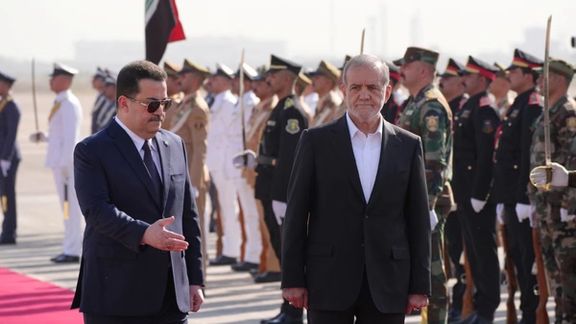
Iran’s President Masoud Pezeshkian (right) in Iraq, September 11, 2024

During his visit to Iraq, the Iranian president advocated for the formation of a European style borderless Islamic union while the very borders he suggests opening are hotbeds of smuggling and extremist infiltration.

Masoud Pezeshkian’s vision to remove borders between Islamic countries comes across as an unrealistic proposition in spite of framing it as a solution to strengthen ties among Islamic nations and counteract Western sanctions, mainly affecting Iran. 

The Islamic president failed to acknowledge the intricate web of illegal activities that thrive at the borders. For years, Iran has been at the center of illicit smuggling networks, ranging from narcotics to weapons, that have destabilized not only its own economy but those of its neighbors.

Observers say Pezeshkian’s rhetoric dismisses the truth that removing the borders would not create the utopian unity he envisions but would instead exacerbate the already rampant flow of narcotics and illegal goods.

Iran has long been a hub for drug trafficking, particularly with its proximity to Afghanistan, one of the world’s largest producers of opium. The smuggling routes that traverse Iran’s eastern and western borders bring vast quantities of heroin and other narcotics into the region, causing immense harm to public health and economic stability in Iran and the region.

Beyond narcotics, smuggling of goods, especially dollars, has been an issue for Iran. Pezeshkian’s government, facing international sanctions, has increasingly relied on its proxy forces in countries like Iraq to funnel dollars back into Iran. This has led to severe economic instability in Iraq, with the US imposing restrictions on Iraqi banks to curb the illegal dollar trade.

The result has been a dual exchange rate system and skyrocketing inflation in Iraq, which has spurred public protests and deepened the country’s economic crisis.

The president’s speech also neglected the security threats, and terrorism that exist due to Iran’s own destabilizing actions in the region. For years, Iran has created and supported proxy militias in countries like Iraq, Syria, and Yemen, contributing to civil conflicts and power struggles. In Iraq, these groups have political power and control over key institutions, making it difficult for any genuine economic or political unity to be achieved.

Middle Eastern nations are generally very protective of their borders, mainly concerned about their security potentially threatened by state and non-state actors.

Meanwhile, informed sources have told Iran International that in a meeting Iraq’s foreign minister strongly opposed Masoud Pezeshkian’s proposal for settling Baghdad’s debt to Tehran using a joint currency during a lengthy meeting. Iraq insists that Iran can only receive its payments by purchasing non-sanctioned goods from the country.

Sources said that during Pezeshkian’s meeting with Iraqi Foreign Minister Fuad Hussein, Pezeshkian requested that Iraq settle its debt to Iran using "a joint currency similar to the Russia-Iraq project."

The meeting, which lasted about 40 minutes longer than scheduled, saw Iraq’s foreign minister firmly reject Pezeshkian’s proposal. The Iraqi side argued that settling the debt based on Pezeshkian’s suggestion could weaken the value of the Iraqi dinar.

Iran’s President Masoud Pezeshkian arrived in Iraqi Kurdistan region on September 12, 2024
100%
Iran’s President Masoud Pezeshkian arrived in Iraqi Kurdistan region on September 12, 2024

On Thursday, Pezeshkian arrived in Erbil for his first official visit to the Kurdistan Region since taking office in July. Upon his arrival at Erbil International Airport, Pezeshkian was welcomed by Kurdistan Region President Nechirvan Barzani, as part of his wider tour of Iraq and the Kurdistan Region.
During his visit, Pezeshkian is set to hold separate meetings with key Kurdish leaders, including Kurdistan Democratic Party (KDP) President Masoud Barzani, Kurdistan Region President Nechirvan Barzani, and Kurdistan Regional Government (KRG) Prime Minister Masrour Barzani.

Most Viewed

Ghalibaf defends Iran-US talks amid hardline backlash
1
INSIGHT

Ghalibaf defends Iran-US talks amid hardline backlash

2
VOICES FROM IRAN

Bread shortages, soaring prices strain households in Iran, residents say

3
ANALYSIS

From instability to influence: Pakistan’s pivotal role in US-Iran diplomacy

4
ANALYSIS

100 days on: why Iran’s January protests spread across social classes

5

War-hit homeowners feel abandoned as Iran’s reconstruction aid fades

Banner
Banner

Spotlight

  • Iran crackdown reaches cemeteries as graves of slain protesters defaced
    EXCLUSIVE

    Iran crackdown reaches cemeteries as graves of slain protesters defaced

  • Iran diplomacy wobbles as factions compete to avoid looking soft on US
    INSIGHT

    Iran diplomacy wobbles as factions compete to avoid looking soft on US

  • The politics of pink: how Iran uses cuteness to rebrand violence
    ANALYSIS

    The politics of pink: how Iran uses cuteness to rebrand violence

  • Bread shortages, soaring prices strain households in Iran, residents say
    VOICES FROM IRAN

    Bread shortages, soaring prices strain households in Iran, residents say

  • 100 days on: the anatomy of Iran’s January crackdown
    INSIGHT

    100 days on: the anatomy of Iran’s January crackdown

  • Ghalibaf defends Iran-US talks amid hardline backlash
    INSIGHT

    Ghalibaf defends Iran-US talks amid hardline backlash

•
•
•

More Stories

Bread prices soar in Iran as working class falls below poverty line

Sep 12, 2024, 12:59 GMT+1

Iran's government has admitted that the price of bread in Iran has increased by 40 to 66 percent, but more rises are predicted ahead amid the country's economic crisis.

While households are already struggling to provide for basic needs like food and clothing, Tehran has already seen new bread prices announced, showing a sharp rise in costs. The price of lavash, a common flatbread, has climbed by roughly 40 percent, while the popular Sangak has seen a 66 percent jump. 

The prices have been approved by the Ministry of Interior, according to Fatemeh Nazari, the head of the Tehran Traditional Bakers Union.

The price hikes have been seen across the board for Iranians, one in three now living below the poverty line, affecting the likes of school supplies and transportation. As children return to school after summer break, parents are already reeling from a 35 percent rise in stationery prices and a 45 percent increase in school bus fees.

A Sangak bakery in Iran (Undated)
100%
A Sangak bakery in Iran

While the minimum wage in Iran hovers around $120 per month, this is simply not enough to meet the rising costs of daily living, especially for families with children, most incomes being drained by rental costs.

Meanwhile, Iran’s leadership, disconnected from the realities faced by its citizens, continues to push for higher birth rates despite the fact that most cannot afford to sustain even their current number of dependents.

Iran’s leadership, disconnected from the realities faced by its citizens, continues to push for more children in families, despite the fact that most cannot afford to sustain even their current number of dependents.

Fuel price hike looms amid confusion and contradiction

Iranians may soon face a further rise in gasoline prices while the government is currently rationing fuel. There have been mixed messages from government officials, with some calling for an increase to bring domestic fuel prices in line with global standards, while others warn that such a move could spark unrest.

A gas station in Iran (Undated)
100%
A gas station in Iran

President Masoud Pezeshkian has criticized Iran’s low fuel prices, but officials like Abdolnasser Hemmati, Minister of Economy, have cautioned against the shock such a price hike would inflict on a society already on edge. Despite the warnings, Iran’s ruling elites, who remain insulated from the economic crisis engulfing the nation, seem to be inching closer to a decision that could push more people to the breaking point.

As rations remain in place, most gas stations across the country are refusing to sell gasoline to the public, stating that only those with remaining rations can fill their vehicles, while there is no gasoline available for those who have exhausted their 60-liter quota.

Economist Ahmad Alavi told Iran International that the government’s lack of a transparent economic policy only deepens the crisis.

"If the decisions related to increasing gasoline prices are implemented inefficiently or delayed due to execution issues, this could lead to greater contradictions within the government and public dissatisfaction," he said.

Filmmaker blasts Pezeshkian after travel ban reinstated

Sep 12, 2024, 10:52 GMT+1

Iranian filmmaker Maryam Moghadam has criticized Iran's President Masoud Pezeshkian, accusing him of leading society into a “swamp of hypocrisy” rather than towards growth and reform.

She and her husband, fellow filmmaker Behtash Sanaeeha, were once again banned from leaving Iran, with their passports confiscated at the airport.

The couple had previously been barred from attending their film's premiere at the Berlin Film Festival in February. They were set to attend the Swedish premiere of their latest film, My Favourite Cake, on Friday, when they found out that they cannot leave.

Moghadam shared on Instagram, "Yesterday, just when I had set off to the airport to leave the country intending to pay a visit to my family in Sweden and attend our film’s premiere, my passport was confiscated at Tehran’s airport and I was informed that we (me and Behtash Sanaeeha) are barred from leaving the country again."

She highlighted that they had received their passports back only a week earlier, only to have them confiscated once more. Expressing her frustration, Moghadam questioned the authorities' motives: "It was only a week ago after our passports were given back to us. All this happened only after I had got tickets, paid the exit fees, and a lot of more expenses which had obviously gone in vain. I have really hard time to figure out why we were given back our passports when it was their intention not to let us leave. Is it because of a hidden agenda to mentally and psychologically abuse us?"

The couple co-wrote and directed the 2024 drama film My Favourite Cake, which has received international acclaim. The movie tells the story of a woman striving to live out her desires in a country where women's rights are heavily restricted.

The renewed travel ban on the two filmmakers coincided with Iran’s Cinema Day on Wednesday.

As the anniversary of the Woman, Life, Freedom movement approaches—a movement sparked by the 2022 death in custody of 22-year-old Mahsa Amini—the Independent Filmmakers Association issued a statement noting that legal cases have been filed against 300 filmmakers. The statement emphasized that in a climate where the fundamental civil rights of cinema professionals are under threat, “praising national cinema feels like a farce, turning the new presidency into a dark, bitter, and absurd black comedy.”

The association further expressed its support for those impacted, stating, "We extend congratulations not only on Cinema Day but also on the Day of Humanity to those filmmakers who have steadfastly upheld the principles of the ‘Woman, Life, Freedom’ movement, and continue to bear the consequences of their stance."

On Monday, Rasoul Sadr-Ameli, spokesperson for the House of Cinema, announced that this year's festival for Cinema Day would not be held, attributing the decision to the absence of these artists.

In a press conference, Sadr-Ameli remarked, "Every year, a festival was held as part of the House of Cinema celebrations, with works judged and awards presented to the best. However, we concluded that, given the absence of several filmmakers, such judging would not be fair."

US weakness on Iran puts Israel at risk, security chief says

Sep 12, 2024, 10:40 GMT+1

In an interview with Iran International, an Israeli security chief criticized the Biden administration for putting Israel at risk after years of taking a soft approach on Iran.

“Never once did the Americans threaten an attack on Iran - not once - they only talked about ‘defending’,” he said, speaking on condition of anonymity. He argued that the lack of a firm stance has emboldened Tehran, increasing security threats to the region and compromising Israel's safety.

“The US uses soft terminology, and it has zero deterrent effect,” he added, meaning that the proxies Iran has across Israel’s borders remain as big a threat as ever.

Since Iran-backed Hamas’s invasion on October 7, 2023, Israel has been bombarded almost daily with rocket, missile and drone attacks on its northern border from Iran’s biggest proxy, terror-listed group Hezbollah. Other projectiles have been fired at Israel from Iran’s proxies in Iraq, Yemen and Syria.

While the US is urging a ceasefire, that to Israel, would mean surrendering to Hamas, “it places us at huge risk across the country by sending a message to terrorists that they have won” he explained.

“They are treating Hamas like they have always treated Iran, with kid gloves,” the security chief said. “We have Hezbollah in the north, multiple terror groups including Hamas in the West Bank, the Houthis sitting on the Red Sea in the south as well as Hamas, and Syria. That’s not to mention Iraq,” he added.

As the US presidential elections approach, the Biden administration is desperate to go out with a bang, sealing a ceasefire deal to win over the Democratic electorate as the death toll in Gaza mounts and 101 Israeli hostages remain in the strip.

“The Gaza war has been totally manipulated around the elections and the Iranians can see that,” he added. “It plays right into their hands. But more importantly, Bibi [Israeli Prime Minister, Benjamin Netanyahu] also sees that and he won’t be pressured for the sake of someone’s political gains in the US.”

On Monday, the US State Department spokesman, Vedant Patel, spoke of “getting a ceasefire deal across the finish line” which critics see as meaning sealing a deal for Biden before he leaves office.

Patel acknowledged the risks of tensions spreading, citing the need for security “not just in the immediate Gaza Strip and the surrounding areas but the region broadly, and the benefits that it [a ceasefire] could have when it comes to peace and stability and calm and the reduction of tensions in the West Bank as well.”

Currently, 60,000 Israelis have been displaced from Israel’s north amid the conflict with Hezbollah and as many or more Lebanese have been displaced in Lebanon.

“One of the reasons we continue to be so committed to a ceasefire and getting one across the finish line is because of the benefits that it could have in the north for creating the conditions so that both Israeli and Lebanese civilians could be able to return home,” Patel said.

President Joe Biden has been slammed at home and abroad for his weak stance on Iran which since his taking office, has seen Iran enrich uranium close to weapons grade levels, increase illicit oil sales, and implement high level diplomatic hostage diplomacy, despite global sanctions.

Last year alone, five US citizens held unlawfully in Iran were released in exchange for $6bn worth of frozen Iranian funds.
Iran offers cautious response to Western sanctions for missiles to Russia

Sep 12, 2024, 08:42 GMT+1

Iran's reactions to US and European condemnation and sanctions following revelations of its ballistic missile sales to Russia have been restrained, primarily consisting of official statements from officials.

On Wednesday, Iran's Foreign Minister Abbas Araghchi claimed that Tehran has not sent any missiles to Russia. Araghchi wrote in a post on X: "Once again, US and E3 act on faulty intelligence and flawed logic - Iran has NOT delivered ballistic missiles to Russia. Period - Sanction addicts should ask themselves: how is Iran able to make & supposedly sell sophisticated arms? Sanctions are NOT a solution, but part of problem."

These controlled responses suggest a careful approach by Tehran, seeking to manage the diplomatic fallout without escalating tensions further.

Meanwhile, IRGC-linked Fars News Agency also denied the news quoting "an informed military source" as saying that Iran has not sent ballistic missiles to Russia. Fars wrote that the news was part of psychological warfare against Tehran.

On Thursday, Tehran-based analyst Ali Bigdeli appeared to align with the official narrative, telling a local website that the accusations regarding missile sales are part of a conspiracy aimed at pressuring the Islamic Republic. He suggested this pressure is timed to coincide with President Masoud Pezeshkian's planned meetings with European leaders during the upcoming UN General Assembly in New York later this month.

Tehran-based foreign policy analyst Ali Bigdeli - File photo
100%
Tehran-based foreign policy analyst Ali Bigdeli - File photo

All media outlets in Iran strictly adhere to government directives on sensitive national security issues. As a result, those reporting on the missile transfers stuck to basic coverage, echoing official statements. Many repeated lines such as labeling Western accusations as “a new wave of psychological warfare,” avoiding any independent analysis or criticism.

However, there were a couple of exceptions. In a commentary entitled "New sanctions for the sake of Russia," conservative Nameh News website wrote: "Iran is paying a high cost for Russia's war against Ukraine. Iran has not been gaining anything from Russia's war against Ukraine."

Nameh News went on to say that the recent missile sales to Russia have triggered new sanctions, including those on Iran Air, which had previously been lifted following the 2015 nuclear deal. The website also emphasized that these sanctions have a direct impact on the Iranian people, underscoring the broader consequences of the missile sales for the nation.

The website stated that if Iran has not sent missiles to Russia, it should pursue international legal action against the US and EU. It also quoted US Secretary of State Antony Blinken, who warned that sending ballistic missiles to Russia would dangerously escalate the conflict in Ukraine. Iranian missiles, Blinken noted, could significantly enhance Russian forces' capabilities and flexibility, further intensifying the war. These comments reflected concerns over Iran’s involvement and the potential consequences of its missile sales.

The website suggested that Russia should clarify the situation, as Iranian officials have repeatedly claimed neutrality in the Ukraine war. Despite this, Tehran has faced sanctions twice due to its alleged support for Russia. The article also criticized Russia for its silence on the issue and for backing the United Arab Emirates' claim over three Iranian islands in the Persian Gulf, highlighting tensions in Iran's relationship with Russia despite their cooperation.

The Kremlin's Spokesperson Dimitry Peskov finally denied the news Wednesday afternoon and saying reports about Iranian missile supplies were not accurate. Peskov, however, called Iran one of Moscow's important trade partners.

The ultraconservative Kayhan newspaper, funded by Khamenei's office and known for its support of Russia and close ties with Moscow, has remained silent on the missile issue, leaving many in Tehran disappointed as they awaited its reaction. Currently, Kayhan finds itself more isolated than ever, as other outlets criticize its controversial stances on both domestic and international issues.

Iranian actress faces legal action for dancing in web series

Sep 12, 2024, 06:43 GMT+1

Iranian judicial authorities have taken legal action against actress Sahar Dolatshahi for allegedly “dancing” in a scene from a drama series, Dariush, as the government continues its crackdown on personal freedoms.

The judiciary labeled her actions “contrary to Islamic principles,” sparking outrage among Iranians who see the move as yet another sign of the government's control over cultural expression.

The Mizan website, a mouthpiece for Iran’s judiciary, announced on Tuesday that Dolatshahi, the production company of the series, and the streaming platform Filimo, have all been subjected to judicial proceedings. The authorities provided no details on the specific charges or punishments.

The scene in question, featured in the seventh episode of Dariush, shows Dolatshahi and veteran actor Atash Taghipour engaging in what could barely be described as dance-like movements. 

Dancing has been officially banned in Iran since the 1979 revolution, with clerics branding it a "sinful act" and "an act of lust." In the eyes of the system, even the most innocent forms of self-expression are to be policed, particularly when they involve prominent public figures like Dolatshahi. Despite these laws, the Iranian people continue to engage in cultural traditions such as ethnic dance which the government refers to as "rhythmic movements" in an attempt to avoid the word "dance."

While Iranian officials claim that content is vetted and approved before release, Dolatshahi’s case is yet another example of Iran's unpredictable enforcement of its laws. The series was released with the necessary permissions from Satra, the censorship body under the state TV regulator, IRIB.

The silence from those involved including Satra, the series producer, and Filimo, reflects the fear of the severe repercussions which could result.

Since the revolution, Iran’s cultural sector has been controlled by the government, and artists have faced constant censorship, harassment, and even imprisonment.

Observers believe that in a society where the economy is crumbling, unemployment is rampant, and basic freedoms are denied, these attacks on artists are nothing more than distractions meant to appease hardliners.

The action has ignited a wave of backlash on social media, with many Iranians mocking the absurdity of the charges. One user sarcastically noted, “Soon, they’ll start punishing people for smiling in public. What’s next, a ban on laughter?” Others have pointed out the system’s “hypocrisy” in its claim to support "cultural development" while simultaneously stifling creativity and entertainment.

As the Islamic Republic continues its authoritarian rule, artists, women, and free-thinkers remain among its primary targets. But the people of Iran, particularly the younger generation, show no signs of giving up their fight for freedom, defying the efforts to control every aspect of their lives, from politics to culture and dress.