• العربية
  • فارسی
Brand
  • Iran Insight
  • Politics
  • Economy
  • Analysis
  • Special Report
  • Opinion
  • Podcast
  • Iran Insight
  • Politics
  • Economy
  • Analysis
  • Special Report
  • Opinion
  • Podcast
  • Theme
  • Language
    • العربية
    • فارسی
  • Iran Insight
  • Politics
  • Economy
  • Analysis
  • Special Report
  • Opinion
  • Podcast
All rights reserved for Volant Media UK Limited
volant media logo

Grossi: Iran’s enriched uranium stockpiles continue to grow
Sep 9, 2024, 19:52 GMT+1Updated: 06:52 GMT+1
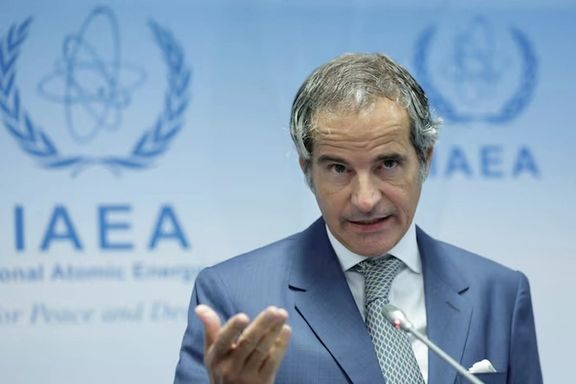
International Atomic Energy Agency (IAEA) Director General Rafael Grossi addresses the media during their Board of Governors meeting in Vienna, Austria, September 9, 2024.

Rafael Grossi, the Director General of the International Atomic Energy Agency (IAEA), has raised alarms over the continuous increase in Iran’s stockpile of uranium enriched to 20% and 60%.

Grossi also highlighted the agency's growing concerns over Tehran’s failure to provide critical information about its nuclear program, further escalating international fears of Iran's advancing nuclear capabilities.

"Iran’s stockpile of uranium enriched up to 20% and up to 60% continues to increase, and that Iran has expanded the number of cascades it is using to enrich UF6," said Grossi, in his latest statement on the Iranian nuclear issue.

The diplomatic landscape surrounding Iran’s nuclear program has been tense for years, but recent developments have escalated the situation. Iran halted its implementation of nuclear commitments under the Joint Comprehensive Plan of Action (JCPOA) more than three years ago, and its stockpile of enriched uranium continues to rise. With international inspectors barred from accessing key facilities, the IAEA now finds itself in the dark about Iran’s centrifuge inventory, uranium ore, and heavy water stocks.

"The Agency has lost continuity of knowledge in relation to the production and inventory of centrifuges, rotors and bellows, heavy water and uranium ore concentrate," Grossi explained, underscoring the gaps in oversight created by Tehran’s refusal to cooperate.

Iran's defiance has not been limited to the technical aspects of nuclear verification. Grossi pointed out that Iran has failed to resolve "outstanding safeguards issues," particularly regarding the discovery of uranium particles at undeclared sites, a discovery that contradicts Tehran’s claims of transparency.

As the IAEA calls for renewed cooperation, Iran has instead accelerated its nuclear enrichment efforts. According to the latest reports, the installation of additional centrifuge cascades at the Natanz and Fordow nuclear facilities has intensified, bringing the nation closer to reaching the 90% purity required for a nuclear weapon.

This expansion comes on the heels of repeated IAEA requests for Iran to resume compliance with the JCPOA, an agreement Tehran abandoned following the US withdrawal under the Trump administration. Since then, efforts to reinstate or renegotiate the deal have stalled.

"I call upon Iran to implement the Joint Statement through serious engagement with the Agency’s concrete proposals," Grossi urged, signaling a desire to reestablish dialogue with the newly elected Iranian leadership.

"He (Pezeshkian) agreed to meet with me at an appropriate juncture," Grossi said, referring to an exchange after Pezeshkian's election in July.

"I encourage Iran to facilitate such a meeting in the not-too-distant future so that we can establish a constructive dialogue that leads swiftly to real results," he added.

In July, US Secretary of State Antony Blinken noted that Iran’s nuclear breakout time—the time needed to produce enough 90% enriched uranium for a nuclear weapon—has likely shrunk to "one or two weeks."

Reports indicate that Iran is ramping up efforts in its secretive nuclear weapons program, edging the country closer than ever to the development of a nuclear bomb, a threat that has persisted for over two decades.

Earlier this month, Abbas Araghchi, Iran's newly appointed Foreign Minister, stated that reviving the 2015 JCPOA nuclear agreement with the six major world powers is "untenable in its current form."


Most Viewed

Ghalibaf defends Iran-US talks amid hardline backlash
1
INSIGHT

Ghalibaf defends Iran-US talks amid hardline backlash

2
INSIGHT

Iran diplomacy wobbles as factions compete to avoid looking soft on US

3
VOICES FROM IRAN

Bread shortages, soaring prices strain households in Iran, residents say

4
ANALYSIS

The politics of pink: how Iran uses cuteness to rebrand violence

5

War-hit homeowners feel abandoned as Iran’s reconstruction aid fades

Banner
Banner

Spotlight

  • Lights out, then gunfire: Witnesses recount Mashhad protest crackdown
    VOICES FROM IRAN

    Lights out, then gunfire: Witnesses recount Mashhad protest crackdown

  • Family told missing teen was alive, then received his body 60 days later
    EXCLUSIVE

    Family told missing teen was alive, then received his body 60 days later

  • Is Iran entering its Gorbachev moment?
    INSIGHT

    Is Iran entering its Gorbachev moment?

  • Iran crackdown reaches cemeteries as graves of slain protesters defaced
    EXCLUSIVE

    Iran crackdown reaches cemeteries as graves of slain protesters defaced

  • Iran diplomacy wobbles as factions compete to avoid looking soft on US
    INSIGHT

    Iran diplomacy wobbles as factions compete to avoid looking soft on US

  • The politics of pink: how Iran uses cuteness to rebrand violence
    ANALYSIS

    The politics of pink: how Iran uses cuteness to rebrand violence

  • Bread shortages, soaring prices strain households in Iran, residents say
    VOICES FROM IRAN

    Bread shortages, soaring prices strain households in Iran, residents say

•
•
•

More Stories

Iranian dissident gang-raped in Germany by alleged 'Islamic Republic loyalists'

Sep 9, 2024, 17:00 GMT+1

An Iranian dissident man was gang-raped in Germany by four men who are believed to be Islamic Republic loyalists, in an attack that has shocked the town of Iserlohn in North Rhine-Westphalia, according to German media reports.

The incident, which occurred on Saturday night at an abandoned brewery site, is being investigated as a politically motivated crime with deep ties to Tehran’s repressive government, according to a report by Der Spiegel.

Witnesses, alarmed by the victim’s screams, alerted the authorities, who responded quickly. IKZ reports that emergency services found the victim tied up and severely abused. He was immediately rushed to a hospital, but the full extent of his injuries has not been disclosed.

The attackers fled the scene, but law enforcement, including a helicopter and multiple patrol units, initiated a rapid search and apprehended four suspects—aged 24, 34, 42, and 46—shortly after in a nearby forest. One of the suspects sustained injuries while attempting to evade capture.

Spiegel and WDR report that all four men are believed to be ardent supporters of the Islamic Republic, underlining the political nature of the attack.

According to information obtained by Spiegel, the 30-year-old victim, an Iranian refugee who had fled persecution back home, was targeted due to his outspoken opposition to the Islamic Republic. The alleged perpetrators—four men with alleged loyalty to the Islamic Republic—sought to "sexually humiliate" and silence him, according to German authorities.

'Sexual humiliation'

"Based on the current state of knowledge, the victim should above all be humiliated," said Michael Burggräf, the prosecutor of Hagen in North Rhine-Westphalia, highlighting the intent behind the attack: to silence dissent through sexual violence. "The attack was primarily intended to sexually humiliate the victim."

The German prosecutor's remarks reinforce the suspicion that the assault was more than a mere political dispute and was rather an orchestrated act of brutality meant to break the spirit of a dissident.

This act of violence is being seen as an extension of the Islamic Republic’s long-standing campaign of intimidation and repression against dissidents, even beyond Iran’s borders.

The clerical government has a well-documented history of targeting its critics and defectors, often using extreme measures to silence opposition. The brutal nature of the latest assault echoes the tactics employed by Iran’s intelligence apparatus, which has been linked to various forms of violence and coercion against dissidents in Europe.

Dozens of assassinations have been attempted ever since the 1979 Revolution, often involving non-Iranians that help those who order the attacks deny complicity.

In June, another Iranian dissident escaped an assassination attempt in the Netherlands in what seemed to be yet another sign of Iran’s resolve to silence voices of dissent outside the country. The targeted dissident, Siamak Tadayon Tahmasebi, was singled out in an Iranian intelligence press release last summer, accused of leading a “terrorist” ring inside Iran from exile. On 6 June, Tahmasebi noticed two men attempting to enter his home near Amsterdam. He alerted the police, who arrived in time to arrest the armed intruders.

In May, Israeli and Swedish intelligence agencies revealed that criminal gangs operating on Iran’s behest were behind several terror attacks on Israeli embassies in Europe.

Over the past few years, Iranian journalists working outside Iran have become a prime target for Tehran's campaign of terror and intimidation. Iran International presenter Pouria Zeraati was stabbed outside his home in south London in March but survived with injuries to his leg. Investigations into the crime suggested that the three suspected assailants were recruited in Eastern Europe and flown to the UK to "intimidate" Zeraati. Also in June, another Iran International reporter, Mehran Abbasian, had to be moved to a secure location following threats to his life.

The threats against Iran International staff have become a recurrent issue, stemming back to 2022. The threats reached a climax with the UK's MI5 saying it could no longer protect the team, forcing a temporary relocation to the US.

Two Iranians allegedly tortured to death by security forces

Sep 9, 2024, 14:13 GMT+1

Two young Iranian men have become the latest victims of Iran's security forces after being tortured to death as Iran continues to violate international human rights laws.

Amir Reza Hamedi, a young conscripted soldier, had been enlisted into Iran’s compulsory military service, and was killed at the hands of law enforcement officers in Shaft, Gilan.

Sources told Iran International that Hamedi, who had previously been detained for his participation in the recent nationwide protests, was deeply troubled by conflicts with his superiors and had expressed to his family that he did not wish to continue his mandatory service.

Despite his pleas, his father took him back to his post, where, just hours later, the family received a call saying Hamedi had "committed suicide." However, sources confirmed that the young man’s death was the result of beatings, with visible injuries on his body.

In the other case, Maziar Moaddab, 35, was beaten to death after being tortured in a police detention center in Rasht. He was accused of theft, but instead of facing a fair investigation, was reportedly beaten with batons until he succumbed to his injuries.

His family, unaware of his arrest or the charges against him, was later informed that he died while being transported to the hospital. Fearing the worst, the family has since hired a lawyer, suspecting their son’s death was caused by torture at the hands of the police.

These latest deaths are not isolated incidents, echoing a pattern of abuse in the Islamic Republic’s military barracks and detention centers, where torture, beatings, and suspicious "suicides" have claimed countless lives. For decades, the system has been accused of covering up deaths resulting from violence in custody, using intimidation tactics to silence the families of victims.

Hamedi’s death, in particular, shines a light on the realities of compulsory military service in Iran, where soldiers often find themselves at the mercy of corrupt and abusive superiors. Many young men are subjected to punishments, prolonged detentions, and physical violence, especially if they are suspected of harboring dissenting views.

Last week, Mohammad Mir-Mousavi also succumbed to injuries from severe torture while in custody again in Gilan province.

Mohammad Mir Mousavi, a 36-year-old Iranian, whose death under torture in police custody has sparked outrage.
100%
Mohammad Mir Mousavi, a 36-year-old Iranian, whose death under torture in police custody has sparked outrage.

The Islamic Republic refuses to join the United Nations Convention against Torture. However, despite Article 38 of Iran’s own constitution banning the use of torture, the reality on the ground reveals a government that systematically violates its citizens' most basic rights. Families of victims are often left to seek justice in a system that offers none, their voices silenced by threats from security forces.

Amnesty International reported that between January 2010 and September 2021, at least 72 people died in Iranian prisons and detention centers due to torture or other forms of physical abuse inflicted by intelligence and security agents or prison officials. Iranian authorities have repeatedly denied responsibility for the deaths.

Human Rights Watch has also reported on the common use of torture in Iran. In April, they reported "Iranian security forces’ use of torture and sexual assault against men, women, and children, as well as suspicious deaths in detention". They said that the "authorities did not provide medical treatment or even basic hygiene supplies to those assaulted by security forces, exacerbating their long-term injuries, and have not investigated these cases or held anyone accountable for these serious violations."

Iran’s fuel distribution system hit by similar cyberattacks twice, VP admits

Sep 9, 2024, 13:20 GMT+1

Mohammad Reza Aref, Iran’s First Vice President, revealed that the country's fuel distribution system was hit by two identical cyberattacks within a year, both targeting critical infrastructure without any preventive measures taken.

Speaking at a ceremony on Sunday to introduce new Oil Minister Mohsen Paknejad, Aref referenced the cyberattacks carried out by the hacking group Predatory Sparrow in 2023, which crippled Iran’s fuel supply system.

Aref’s comments highlighted the government's ongoing failure to secure key infrastructure. "It is said once bitten twice shy, but two identical attacks happened within a year," Aref said, directly criticizing the lack of security improvements. He urged Paknejad to prioritize cybersecurity across the oil industry, a sector that continues to face threats under the system's mismanagement.

The remarks come as gas stations in multiple Iranian cities are facing major shortages. Citizens report being stranded as fuel is only available with government-issued ration cards, with no access to gas at market prices, which are double the subsidized rate.

A gas station in Iran (Undated)
100%
A gas station in Iran

The December 18, 2023, attack affected around 70% of Iran’s gas stations. With the fuel distribution system offline, subsidized gasoline purchases were blocked, and fuel was only available at market rates in certain areas.

Following the attack, Gholamreza Jalali, head of the Passive Defense Organization, admitted that a "vulnerability in the payment and receiving network" allowed hackers to breach the system. The Passive Defense Organization later confirmed that malware had caused widespread disruption, warning the Oil Ministry in 2020 about insecure connections in the fuel system—warnings that were ignored.

However, Aref did not specify the exact timing of the second attack within the year, as the only one publicly reported occurred on December 18.

This was not the first time Iran’s fuel network was targeted. In November 2021, just before the second anniversary of the Islamic Republic’s crackdown on the November 2019 protests, hackers once again paralyzed the country’s fuel stations, leaving many without access to fuel for weeks. At the time, 4,300 stations were disrupted, and hackers managed to hijack billboards in Isfahan with slogans like “Khamenei! Where’s our gasoline?” mocking the government's inability to provide basic services.

Congestion at an Iranian gas station (file photo)
100%
Congestion at an Iranian gas station (file photo)

Despite claims from officials that the Islamic Republic’s national internet, or "intranet," would bolster cybersecurity, the country’s critical systems remain vulnerable. Hadi Beigi-Nejad, a member of the parliament, stated in December that "the enemy" had infiltrated Iran’s infrastructure, signaling internal vulnerabilities.

The Passive Defense Organization reported in December that it had identified and thwarted 10 major attacks on national infrastructure in 2022. However, the organization warned that Iran’s fuel system remains at risk, confirming the ongoing inadequacies in the ach to cybersecurity.

Female Iranian activist dies from gunshot wounds sustained in 2022 protests

Sep 9, 2024, 11:51 GMT+1

Sara Deldar, a former political prisoner, has died due to multiple infections caused by pellet wounds sustained during the 2022 nationwide protests after being shot by Iranian security forces.

After her arrest, Deldar was sentenced to more than one year in Rasht’s Lakan Prison, among thousands arrested in a mass roundup of opponents to the government. She was released on parole after serving more than six months, but her health was already deteriorating.

In her final Instagram post in July, Deldar described her severe ill health after her release citing infections, anemia, and the enlargement of her spleen, kidneys, and ovaries. The ailments were likely exacerbated by the bad treatment and conditions of her imprisonment where prisoners are often denied access to adequate healthcare.

Deldar also revealed that other prisoners released from Lakan Prison were suffering from similar illnesses.

Sara Deldar’s death is not an isolated incident. For over four decades, Iran’s prisons have become a graveyard for political prisoners and those who dare to defy the regime.

Among the many others suffering a similar fate is Mosayeb Yeganeh, who was returned to Tehran’s notorious Evin Prison from a hospital before his treatment was complete, and ultimately died due to his lack of medical care. Another Kurdish prisoner, Hasan Omarpour, was so desperate that he self-immolated at the same prison.

Many others have committed suicide either in detention or shortly after their release, often as a result of the brutal physical and psychological abuse they endure behind bars. In the last few months alone, several political prisoners have taken their own lives, unable to cope with the trauma inflicted by the state’s torturers.

Actress Taraneh Alidoosti and filmmaker Mostafa Al-Ahmad have been diagnosed with diseases after serving time in Iranian prisons
100%
Actress Taraneh Alidoosti and filmmaker Mostafa Al-Ahmad have been diagnosed with diseases after serving time in Iranian prisons

Suspicious deaths have been reported in prisons across the country, including Lakan Prison, where Deldar was held, the Central Prison of Tabriz in East Azarbaijan Province, and Ilam Prison in Ilam Province.

The 2022 Woman, Life, Freedom protests, sparked by the killing of Mahsa Amini in the custody of the morality police, led to the deaths of over 500 protesters in the hands of Iran's security forces. Many more protesters died suspiciously in detention or shortly after their release, adding to an already mounting death toll.

Conservative politicians shun Iran’s radicals, support president

Sep 9, 2024, 11:28 GMT+1

After the decisive defeat of ultraconservative candidate Saeed Jalili in Iran’s July presidential election, his political allies have become increasingly isolated in both the political arena and the Iranian parliament (Majles).

Adding to this, a former aide to ex-President Mahmoud Ahmadinejad revealed that Ahmadinejad, who had Jalili as his nuclear negotiator from 2007 to 2013, had almost fired him during his tenure. This internal criticism further highlights Jalili’s diminishing influence.

In an interview with Khabar Online, hardline cleric Abbas Amirifar claimed that Saeed Jalili has never secured more than four million votes in any election. In the most recent presidential race, Jalili reportedly received around 3.5 million votes out of the nearly 30 million ballots the government claims were cast.

He also argued that Jalili could not be an effective president, although he was Masoud Pezeshkian’s main rival in the election, because he lacks executive experience. "He has never been even a deputy minister or the head of a small organization,” Amirifar said.

Former president Mahmoud Ahmadinejad (left) and Abbas Amirifard (undated)
100%
Former president Mahmoud Ahmadinejad (left) and Abbas Amirifard

The cleric also alluded to the transformation of the political balance in recent months with the election of conservative Mohammad Bagher Ghalibaf as parliament speaker and Masoud Pezeshkian as president. This has weakened the ultraconservatives, he said and quoted Ghalibaf as saying that "some individuals do not want the government to be successful," he clear reference to Jalili and his allies.

Amirifar pointed out that some hardliners entered parliament with as little as 3 percent of the vote in their constituencies. He also claimed that Jalili's 3.5 million votes in the recent presidential election were partly due to the influence of hardline local officials. Furthermore, Amirifar suggested that hardliners harbor resentment toward Speaker Ghalibaf for steering the parliament in a way that ensured all of Pezeshkian's cabinet ministers received a vote of confidence, undermining their political influence.

The cleric further accused hardliners in the Majles of opposing Supreme Leader Ali Khamenei, despite his call for full support of Pezeshkian’s administration. He pointed out that some of these hardliners have been convicted of various offenses and should not even be in parliament. Amirifar emphasized that their resistance to Khamenei’s directive and their questionable backgrounds raise concerns about their credibility and commitment to national interests.

Meanwhile, conservative activist Hossein Naqavi Hosseini has also told reporters that the hardliners in the Majles are the same individuals who were nicknamed as the "deviant group" during Ahmadinejad's presidency. He said the hardliners, particularly the members of the ultraconservative Paydari Party are the only group in parliament who do not believe in Pezeshkian's "national accord" policy.

He stated that Iran's conservatives have already warned hardliners they are on the wrong path. They have told them that fair criticism of the government is not the same as outright confrontation. Conservatives cautioned the ultraconservatives that they risk isolation if they refuse to join the unity call by Pezeshkian.

In another development, former conservative lawmaker Mostafa Mirsalim claimed that unlike the hardliners in the ultraconservative groups, the main body of the Iranian conservatives are quite transparent in their political behavior. He said the radicals among ultraconservatives will soon vanish from Iran's political scene.

Prominent conservative commentator Nasser Imani told reporters that Iranian conservatives have a responsibility to confront the radicals among ultraconservatives. He added: "We are facing a group of radical politicians who should not be allowed to expand their influence."

Like Amirifar, Imani accused radicals in the Majles of ignoring Khamenei's advice to maintain parliamentary calm. However, he noted that by overwhelmingly endorsing Pezeshkian's administration, the main body of the Majles has demonstrated its independence from radical influence. This overwhelming vote of confidence, he suggested, shows that the radicals do not have the control they claim, and the broader parliament is committed to supporting the new government rather than aligning with extreme factions.