• العربية
  • فارسی
Brand
  • Iran Insight
  • Politics
  • Economy
  • Analysis
  • Special Report
  • Opinion
  • Podcast
  • Iran Insight
  • Politics
  • Economy
  • Analysis
  • Special Report
  • Opinion
  • Podcast
  • Theme
  • Language
    • العربية
    • فارسی
  • Iran Insight
  • Politics
  • Economy
  • Analysis
  • Special Report
  • Opinion
  • Podcast
All rights reserved for Volant Media UK Limited
volant media logo
ANALYSIS

Pezeshkian’s economic 'surgery': Will it heal or hurt Iran?

Majid Mohammadi

Contributor

Sep 7, 2024, 09:55 GMT+1Updated: 15:57 GMT+0
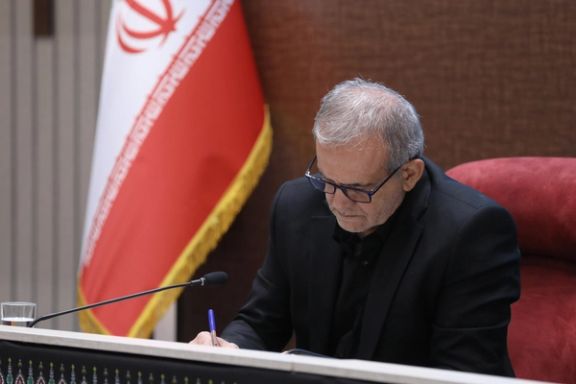
Iranian PResident Masoud Pezeshkian during a meeting in Mashhad (September 2024)

This week, Iran's new president, Masoud Pezeshkian, pledged an "economic surgery" to address the nation’s worsening crisis. With millions of impoverished citizens expecting relief, he faces mounting pressure to deliver reforms.

"If people know what is in their interest, they will leave themselves in the hands of an expert surgeon…Naturally, we have to have surgeries in many areas to get the country out of this situation," Pezeshkian said. He emphasized that people must be brought onboard of any reforms and must agree with government actions.

Pezeshkian and other Islamic Republic leaders recognize the political risks of a major economic "surgery," which could cause immediate hardship for citizens before showing benefits. However, Pezeshkian is banking on two factors. First, cooperation from all regime factions: "If we want to do surgery, we must join hands with all politicians and officials," he said, a strategy that helped secure parliamentary approval for his cabinet. Second, he hopes the economic pain will not impact a large portion of the population, emphasizing the need to protect vulnerable groups.

The key question is what kind of "surgery" Pezeshkian envisions to pull the government out of its deepening economic crisis. To answer this, we must first assess the current crises. By mid-2024, the Iranian government faces six major socio-economic challenges, each of which has the potential to trigger security risks.

1. Energy crisis: Iran faces a growing gap between energy production and consumption. Electricity demand exceeds supply by 10,000 megawatts, leading to power outages of up to 8 hours in some areas, including industries. Gasoline consumption is 10 to 12 million liters higher than production, forcing the government to import fuel at a cost of $4 to $8 billion annually. Additionally, natural gas shortages result in winter outages, highlighting the urgent need for energy sector reforms.

2. Government budget deficit: A 50% budget deficit crisis, led to money printing in the past 6 years and over 40% annual inflation.

3. Crisis in the banking system: Chronic issues like the government’s budget deficit, excessive borrowing, high levels of bank debt, sanctions, and misaligned credit policies plague Iran’s banking system. Many banks are burdened with debts that exceed their assets, creating a severe financial imbalance. These systemic problems contribute to instability, making the banking sector a significant weak point in the country’s economy.

4. Environment - Iran faces severe environmental crises, including water resource depletion, soil erosion, and air pollution, which have led to the depopulation of half of the country’s villages. Urban and agricultural land subsidence, critical water shortages in many provinces, and the drying up of lakes and rivers have compounded the problem. These issues have pushed water availability to critical levels, resulting in the collapse of many farming operations and the widespread bankruptcy of farmers, further destabilizing the country’s rural economy.

5. Pension fund crisis: Iran's pension funds are effectively bankrupt. The National Pension Fund currently covers only 4% of retirees' salaries, leaving the government to cover the remaining 96%, placing immense pressure on public finances.

6. Employment crisis: With 24 million employed out of a working-age population of 65 million, the government’s unemployment figures appear unreliable. After accounting for students and conscripts, about 55 million are eligible to work, meaning roughly 55% of the population is outside the labor market, signaling a severe employment gap.

The Pezeshkian administration does not plan to address the third to sixth crises and lacks the capacity to do so. However, to tackle the energy crisis and budget deficit (and, by extension, inflation), Pezeshkian proposes removing energy and wheat subsidies and reallocating funds to the government budget and low-income groups, who now make up around 70% of the population. He believes that by increasing energy costs, consumption will decrease, reducing gasoline imports and bread waste. However, similar efforts by previous administrations failed to yield these results.

Pezeshkian has few options left. The Rouhani and Raisi administrations already pushed taxes to the market's capacity, and any further increases risk igniting widespread strikes.

The only viable option left for the current administration is to raise the prices of bread and energy, particularly gasoline, which constitute a large portion of the subsidies. This move comes despite the deadly consequences of the 2019 gasoline price hike, which led to over 1,500 deaths. However, the likelihood of a similar gasoline price surge as seen in 2019 is very small. Pezeshkian faces difficult choices, as further tax increases would likely provoke strikes, leaving subsidy cuts as the only remaining path.

The authorities may consider several approaches to raising gasoline prices, but regardless of the approach, raising gasoline prices will have widespread economic consequences, affecting the cost of nearly everything and significantly driving up inflation, which poses a substantial challenge for the government.

As seen during Rafsanjani's economic adjustments in the 1990s and Ahmadinejad’s energy subsidy cuts, such "economic surgeries" in the Islamic Republic have historically worsened poverty without addressing structural issues. Institutionalized corruption and lack of transparency remain major obstacles to meaningful reform. These policies have consistently led to widespread public unrest, with protests erupting across dozens of cities in the 1990s and hundreds of cities in the 2010s. The risk of repeating these outcomes remains high if similar measures are pursued without structural changes.
Most Viewed

State media slam Araghchi's Hormuz tweet, say it let Trump claim victory
1

State media slam Araghchi's Hormuz tweet, say it let Trump claim victory

2
OPINION

The Hormuz get out of jail card turned to a grave

3

Iran International says it won’t be silenced after London arson attack

4
INSIGHT

How Tehran bends its own red lines to boost state rallies

5

Iran halts petrochemical exports to supply domestic market

Banner
Banner

Spotlight

  • Too early to tell who is winning Iran war, experts say
    PODCAST

    Too early to tell who is winning Iran war, experts say

  • How Tehran bends its own red lines to boost state rallies
    INSIGHT

    How Tehran bends its own red lines to boost state rallies

  • Iran blackout cripples freelancer, small business incomes
    VOICES FROM IRAN

    Iran blackout cripples freelancer, small business incomes

  • Ideology may be fading in Iran, but not in Kashmir's ‘Mini Iran'
    INSIGHT

    Ideology may be fading in Iran, but not in Kashmir's ‘Mini Iran'

  • US blockade enters murky phase as tankers spoof signals and buyers hesitate
    ANALYSIS

    US blockade enters murky phase as tankers spoof signals and buyers hesitate

  • Why the $100 billion Hormuz toll revenue is a myth
    ANALYSIS

    Why the $100 billion Hormuz toll revenue is a myth

•
•
•

More Stories

Iran ‘more active than ever’ in attempts to sway US voters

Sep 7, 2024, 05:52 GMT+1

Iran is doing more than ever to influence American voters in the run-up to the November elections, a senior US intelligence official said on Friday, in the latest warning about potential foreign influence in US politics.

In recent months, US officials, cybersecurity experts, and global tech corporations like Microsoft and Meta have reported Iranian-linked attempts to hack American individuals and organizations with the specific aim to “stoke discord and erode trust” in the US institutions.

On Friday, a senior US intelligence official once again mentioned Iran along with Russia and China as actors attempting to sway the November 2024 presidential election, saying that Tehran has stepped up its involvement compared to previous years.

US intelligence agencies have issued warnings to those targeted by foreign influence campaigns, the American official said.

"Pro-Iran" websites

In a report released on Friday, the Foundation for Defense of Democracies (FDD) named 19 websites as part of a "pro-Iran" network aimed at destabilizing the US political system. The report did not explicitly link the sites to the Iranian government but urged US authorities to shut down the sites with the cooperation of allied countries where the websites may be hosted.

The FDD also recommended further investigations to identify Iranian actors behind the influence campaign, proposing sanctions or legal action as necessary.

Among the websites flagged by the FDD, two are highlighted for their audience reach: Afro Majority and Not Our War. The former, FDD says, targets African American communities, with content hostile to former President Donald Trump and supportive of Vice President Kamala Harris. The latter has focused on US veterans, criticizing both Trump and current President Joe Biden, promoting a narrative that undermines trust in the US, according to FDD.

Examples include a post on Not Our War headlined "The Bitter Choice: Biden vs. Trump and the Illusion of Democracy in the US" and a post on Afro Majority praising Iran’s Supreme Leader Ali Khamenei for his backing of anti-Israel protests.

The scope of Iran's activities extends beyond disinformation. In yet another recent report, Microsoft and Google warned about attempts to breach U.S. presidential campaigns in the lead-up to the November election.

Last month, Meta (formerly Facebood) said it had thwarted attempts by Iranian hackers to compromise the WhatsApp accounts of US officials connected to Joe Biden and Donald Trump. The hackers allegedly posed as technical support representatives from companies like Google and Microsoft to gain unauthorized access. Meta said it had quickly intervened, blocking the accounts before any significant breaches occurred.

Some experts have warned that foreign actors, including Iran, Russia, and China, are increasingly sophisticated in their attempts to influence American voters, even inciting violence against political figures to create chaos and undermine the integrity of the upcoming elections.

Iran delivers ballistic missiles to Russia despite Western warnings

Sep 7, 2024, 02:10 GMT+1

Iran has completed its long-awaited shipment of ballistic missiles to Russia, defying Western warnings not to supply arms to Moscow, The Wall Street Journal reported Friday, citing US and European officials.

The Biden administration has informed its allies that Iran delivered short-range ballistic missiles to Russia, providing Moscow with a significant new military tool amid its ongoing war against Ukraine, the WSJ report said.

This move comes despite Western warnings urging Iran not to supply arms to Russia, and marks a major escalation in Iran’s military support for Russia.

"The missiles have finally been delivered," a US official said. The shipment reportedly includes several hundred short-range ballistic missiles, capable of reaching up to 500 miles. These missiles could help bolster Russia’s intensified missile attacks on Ukrainian cities and infrastructure, which have recently led to the deaths of dozens of civilians.

"We have been warning of the deepening security partnership between Russia and Iran since the outset of Russia's full-scale invasion of Ukraine and are alarmed by these reports," said White House National Security Council spokesperson Sean Savett. "Any transfer of Iranian ballistic missiles to Russia would represent a dramatic escalation in Iran's support for Russia's war of aggression against Ukraine."

Iran had already been providing drones to Russia, which have been used extensively in Ukraine. Additionally, Russia has sourced ammunition and missiles from North Korea for its military campaign.

Such a deepening partnership could further isolate Iran from the West and worsen an economy already in crisis mode, as ballistic missile transfers to Russia would likely be met with additional sanctions on Iran by Western powers, as promised by Ukraine's western allies.

In response to the missile deliveries, European and US officials are preparing to implement new sanctions against Iran, according to the WSJ report.

European leaders had previously warned that they would impose coordinated sanctions if Iran proceeded with the missile transfers.

According to Western officials, sanctions could include banning Iran's flag carrier, Iran Air, from European airports, and targeting companies and individuals involved in the missile shipments, The Wall Street Journal reported.

Russia's access to Iranian ballistic missiles could devastate civilian populations, marking a turning point in the conflict, Farzin Nadimi, a Senior Fellow with the Washington Institute, told Iran International.

He said some of these missiles will have enough range to hit Western Ukraine and strike important targets like railway stations. "It's going to have a really bad effect on civilians."

Iran forces relocation of its Kurdish opposition groups inside Iraq

Sep 6, 2024, 19:41 GMT+1
•
Shahed Alavi

Three Iranian Kurdish armed groups have been relocated to a "less accessible" camp in Iraqi Kurdistan after months of pressure from Tehran on both the Kurdistan Regional Government and Iraq’s central government.

Iran has long accused the semi-autonomous Kurdish government in northern Iraq of harboring groups, all under the Komala name, which Tehran labels as terrorist organizations. The Iranian Revolutionary Guard Corps (IRGC) has frequently launched attacks on their bases, claiming these groups pose a threat to the security of the Islamic Republic.

In March 2023, the governments of Iran and Iraq signed a ‘border security’ agreement that was, in essence, a plan to curb the activities of Iran’s Kurdish opposition groups in Iraq. The agreement led to partial evacuation of Komala bases in September 2023. The move now seems to have been completed, with the three Kurdish parties, with military wings, leaving their camps in the Zirgwez region near Sulaymaniyah and settling in camps in Suwardash near Dukan.

The new location is in fact closer to the border with Iran but less accessible, according to Komala sources who talked to Iran International on condition of anonymity. “The ability to transport and maintain weapons, especially the semi-heavy and heavy weapons of the Peshmerga forces, has effectively been taken from them,” one member said.

A map of the Iraqi Kurdistan with old and new Komala camps
100%
A map of the Iraqi Kurdistan with old and new Komala camps

He added that by forcing a move of the Komala inside another country’s territory, Iran's government has sent a “clear message” that it can do “whatever it wants” and neither the Iraqi central government nor the Kurdish Regional Government of Iraq can stop it.

The groups say they oppose the clerical regime in Iran, but many Iranians also view them as separatists, who harbor designs on Iran's Kurdish populated areas in the west.

Iran’s government, through its IRGC Quds Force, enjoys considerable sway over authorities in Iraq, both in Baghdad and Erbil, the Kurdish regional capital. On occasions, however, the relationship has bittered over IRGC attacks on Kurdish groups.

Tehran Erbil security cooperation

Nechirvan Barzani, the President of Iraq's Kurdistan Region, made an unexpected visit to Iran in May, where he met with top leaders, sparking strong criticism from opponents of the Iranian regime.

During his visit, Barzani engaged with key figures of the government, including Supreme Leader Ali Khamenei, heads of executive and legislative bodies, the commander-in-chief of the IRGC, the foreign minister, and the secretary of the Supreme National Security Council.

The timing and nature of Barzani's visit, coming months after the IRGC's missile attack on the Kurdistan Region, raised questions about its motives. The high-profile meetings suggest that the discussions likely focused on mutual security concerns.

In January, the Iraqi government recalled its ambassador from Tehran after an IRGC missile attack on Erbil killed four civilians and injured six others. The attack caused a popular outrage in Iraqi Kurdistan and thousands took to the streets denouncing the IRGC's ‘free hand’ in their region.

The IRGC claimed the target had been an Israeli “spy headquarter” in the Kurdistan region of Iraq, but the Kurdish prime minister Masrour Barzani categorically denied the claims and called the attack a “crime against the Kurdish people.”

Iran escalates crackdown ahead of ‘Woman, Life, Freedom’ anniversary

Sep 6, 2024, 17:31 GMT+1

As the anniversary of Iran’s Woman, Life, Freedom protests approaches, security forces have begun a wave of arrests, repeating a pattern of repression targeting Iranian civil society and families of slain protestors.

This year’s crackdown began in Iran’s Kurdistan province, where at least 17 citizens were arrested in the first week of September, just days ahead of the second anniversary of Mahsa Amini’s death in police custody on September 16, 2022, which sparked the nationwide Woman Life Freedom protests.

In an interview with Iran International regarding the recent wave of arrests around the anniversary, Azadeh Davachi, a researcher, writer, and women's rights activist, remarked:

"One of the defining characteristics of dictatorial regimes is their reliance on escalating violence when they feel threatened, particularly in the face of political movements. What we are witnessing now is the government's fear of the potential resurgence of such movements."

Notably, among those arrested this week were relatives of protesters killed during the 2022 uprising, during which Iranian security forces killed at least 550 protesters, including children, and imprisoned over 20,000 people.

On Tuesday, security forces raided the homes of two families who lost relatives to state violence during the protests.

One of those arrested was 16-year-old Ramyar Abubakri, brother of 21-year-old Zanyar Abubakri, who was fatally shot by state security forces on October 27, 2022, in Mahabad, Kurdistan. According to rights group Hengaw, security forces raided the Abubakri family home around 3 am on Tuesday, arresting Ramyar and assaulting several family members, including his parents.

At the same time, security forces also raided the home of Siavash Soltani, son of 52-year-old Kobra Sheikhe-Saqqa, another victim killed by state forces on the same day in Mahabad. Both Sheikhe-Saqqa and Zanyar Abubakri were shot during protests on October 27, 2022, which followed the funeral of another slain protester, Simko Mowloudi.

Rights group Kurdistan Human Rights reported that Soltani was beaten and arrested without a warrant, and both his and Ramyar Abubakri’s whereabouts remain unknown since their arrest on Tuesday.

Hengaw also reported two further arrests in Mahabad, bringing the total of those detained in this city to 4, and 10 individuals were arrested in the city of Bolbanabad in Kurdistan province’s Dehgolan County, where multiple protestors were killed during the 2022 uprising, and 3 arrested in Oshnavieh in West Azerbaijan province.

Similar waves of arrests were reported last year across the country around the same time as the uprising’s anniversary with tens of arrests reported in Iran’s Azerbaijan region and at least 20 arrests in Kohgiluyeh and Boyer-Ahmad province, Southwestern Iran.

Last year, Human Rights Watch said that Iranian authorities have ramped up their repression of civil society for the first anniversary of Amini’s death, calling on all delegations of UN member states to raise the plight of activists and put it at the center of their engagement.

Prominent figure indicted for torture claims and criticism of Leader

Sep 6, 2024, 17:03 GMT+1
•
Maryam Sinaiee

Iran's Prosecutor’s Office has reportedly indicted prominent journalist and commentator Ahmad Zeidabadi following a heated debate with an ultra-hardliner politician on an Iranian online platform.

Saberin News, a Telegram channel linked to the Revolutionary Guards, reported Monday that the Prosecutor’s office has indicted Zeidabadi for “false allegations and spreading lies” during the debate.

“I know that a request to hold an open trial or having a jury won’t be accepted so I urge the presence of representatives of the Leader’s Office and President’s Office to report the proceedings of the possible trial to high officials,” Zeidabadi wrote Monday on Telegram in reaction to the news of his indictment.

Zeidabadi’s indictment may be more connected to his implied criticism of Supreme Leader Ali Khamenei’s decision to suppress the Green Movement in 2009, rather than his allegations about the brutal torture of prisoners, including himself, at the hands of the Intelligence Ministry and the IRGC in detention facilities. His critique of Khamenei’s role in the crackdown on protests may have crossed a political red line, overshadowing even his harsh comments on the torture practices he endured.

Some hardliners, including Abdolreza Davari, have criticized Zeidabadi for “disrespecting the Leader” during the debate and accusing security forces of torture. Davari argues that Zeidabadi's "radicalism" and his decision to revive a bloody past, which authorities prefer to remain unspoken, could undermine the recent perceived “opening” in the country’s political atmosphere.

Davari served as an aide and adviser to former President Mahmoud Ahmadinejad but later denounced him and in the recent presidential elections supported Parliament Speaker Mohammad-Bagher Ghalibaf.

In the debate, Zeidabadi argued that the crackdown on protesters and the house arrest of reformist leaders Mir-Hossein Mousavi, Zahra Rahnavard, and Mehdi Karrubi—decisions solely attributable to Khamenei—were wrong and have had serious consequences for the nation. He criticized the ongoing house arrests, highlighting their lasting negative impact on Iran’s political landscape.

Harf-e No, an online media platform, broadcast the August 31 debate between Zeidabadi, a former political prisoner, and Mehdi Taeb, the brother of the former chief of the Intelligence Organization of the Revolutionary Guards (IRGC), Hossein Taeb.

Excerpts from the debate have been widely shared on various social media platforms including X and the full version is available on YouTube.

Zeidabadi alleged that some political prisoners were forced to make false confessions not only about their political activities but also about forbidden sexual relations. He recounted enduring unbearable physical and psychological torture in solitary confinement, claiming interrogators would not stop until prisoners made such false statements about themselves and others.

“Do you know how many times there were confessions about sexual issues that were lies? What does this have to do with protests or [the claimed] plots by the US… These are the behaviors that you must change, criticize, and investigate. Probe them at least to see if we are lying or telling the truth,” he told Taeb.

Zeidabadi, who claims he was beaten and lashed on two occasions, also spoke about "rehearsals" in courtrooms, where prisoners were forced to practice the confessions they had been tortured into making. Judges were present during these sessions, preparing prisoners to deliver these false confessions during trials that were often broadcast on state-run television.

His torturers told him to “confess and repent” or prepare to be hanged as “ordered by His Excellency”, that is, Supreme Leader Ali Khamenei, he told Taeb.

“It’s not right to sit here with an easy conscience and say all those [torture allegations] were lies … They were true, they were serious,” Zeidabadi told Taeb.

He argued that the Iranian people lost trust in conservatives once they learned of the atrocities committed during the 2009 crackdown, including the brutal treatment of young protesters at the Kahrizak detention camp. According to him, these events revealed the conservatives’ lust for power, eroding their credibility in the eyes of the public.

In a heavily censored online interview in 2018, Zeidabadi had described how the desperation in solitary confinement drove him to seriously contemplate suicide only to realize he could find no means to end his life.