• العربية
  • فارسی
Brand
  • Iran Insight
  • Politics
  • Economy
  • Analysis
  • Special Report
  • Opinion
  • Podcast
  • Iran Insight
  • Politics
  • Economy
  • Analysis
  • Special Report
  • Opinion
  • Podcast
  • Theme
  • Language
    • العربية
    • فارسی
  • Iran Insight
  • Politics
  • Economy
  • Analysis
  • Special Report
  • Opinion
  • Podcast
All rights reserved for Volant Media UK Limited
volant media logo

French police officer injured in antisemitic arson attack on synagogue
Aug 25, 2024, 03:20 GMT+1Updated: 16:04 GMT+0
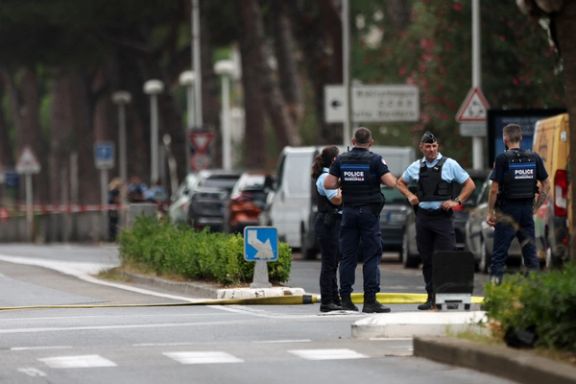
French police stand guard after cars were set on fire in front of the city's synagogue, in La Grande-Motte, France, August 24, 2024.

A police officer was injured during an apparent arson attack at a synagogue in La Grande-Motte, a town in southern France, amid escalating tensions between Iran and Israel.

The incident occurred on Saturday morning when a car, which had been set ablaze, exploded in the synagogue's car park. The explosion, which appears to have been deliberate, is being treated as a targeted antisemitic attack, prompting an increase in security measures at Jewish institutions across the country.

Jason Brodsky, the policy director for United Against Nuclear Iran (UANI), described the incident, stating on X that it had "shades of IRGC terrorists' arson attempts."

Since the assassination of Hamas leader Ismail Haniyeh in Tehran in July, Iran has vowed revenge. However, they have yet to take direct action, leading some to speculate that Iran may be considering targeting Israelis in other countries as a form of retaliation.

French Prime Minister Gabriel Attal has condemned the attack, describing it as an act of antisemitism. He stated, "Once more, our Jewish compatriots are targeted," and emphasized the government's commitment to not being intimidated by such acts of violence. The anti-terrorism prosecutor's office has taken charge of the investigation, and authorities are currently searching for the suspect responsible for the attack.

Local reports indicate that two cars were set on fire in the synagogue's parking area at approximately 8:30 a.m. local time. One of these vehicles contained at least one gas bottle, which exploded during the incident. The timing of the explosion, coinciding with the expected arrival of worshippers, suggests a deliberate attempt to cause harm to members of the Jewish community.

Yonathan Arfi, head of CRIF, an umbrella organization representing French Jewish groups, condemned the attack, stating, "Exploding a gas bottle in a car in front of the Grande Motte synagogue at the expected time of arrival of the faithful: it's not just attacking a place of worship, it's an attempt to kill Jews."

The injured police officer, who was at the scene, has been reported to be in stable condition, with no threat to their life. In response to the attack, Interior Minister Gerald Darmanin announced that police protection for synagogues, Jewish schools, and shops would be reinforced nationwide.

This incident unfolded against the backdrop of Israel's National Security Council issuing heightened safety guidelines for Israelis attending the Olympics last month, underscoring the persistent threat posed by Iran-backed terrorist organizations targeting Israeli and Jewish individuals. The NSC also cited recent arrests of French teenagers with ties to the Islamic State, further illustrating the complex security landscape.


Most Viewed

State media slam Araghchi's Hormuz tweet, say it let Trump claim victory
1

State media slam Araghchi's Hormuz tweet, say it let Trump claim victory

2
OPINION

The Hormuz get out of jail card turned to a grave

3
INSIGHT

How Tehran bends its own red lines to boost state rallies

4

Iran International says it won’t be silenced after London arson attack

5
VOICES FROM IRAN

Iran blackout cripples freelancer, small business incomes

Banner
Banner

Spotlight

  • Too early to tell who is winning Iran war, experts say
    PODCAST

    Too early to tell who is winning Iran war, experts say

  • How Tehran bends its own red lines to boost state rallies
    INSIGHT

    How Tehran bends its own red lines to boost state rallies

  • Iran blackout cripples freelancer, small business incomes
    VOICES FROM IRAN

    Iran blackout cripples freelancer, small business incomes

  • Ideology may be fading in Iran, but not in Kashmir's ‘Mini Iran'
    INSIGHT

    Ideology may be fading in Iran, but not in Kashmir's ‘Mini Iran'

  • US blockade enters murky phase as tankers spoof signals and buyers hesitate
    ANALYSIS

    US blockade enters murky phase as tankers spoof signals and buyers hesitate

  • Why the $100 billion Hormuz toll revenue is a myth
    ANALYSIS

    Why the $100 billion Hormuz toll revenue is a myth

•
•
•

More Stories

Iran renews threats to attack Israel as Gaza ceasefire talks stall

Aug 24, 2024, 22:50 GMT+1

The chief-commander of Iran's Revolutionary Guard (IRGC) hinted at an imminent retaliatory attack on Israel on Saturday, adding fuel to speculations that the long-awaited avenging of Hamas chief Ismail Haniyeh may take place in coming days.

Iranian officials have been outspoken in their vows to avenge Haniyeh's killing, which they blame on Israel. However, the daily headlines predicting an 'imminent attack' from Iran against Israel since the killing of Haniyeh haven't materialized yet.

"You will hear good news about Iran's revenge," IRGC Chief-Commander Hossein Salami told a crowd of people during a visit to a border area in western Iran, when asked about the promised retaliation.

Media reports and official remarks suggest that Iran may proceed with its promised retaliation following the end of Arba'een pilgrimage on Monday, with Israeli media anticipating an attack by Lebanon's Hezbollah "in coming days".

Israel estimates that Hezbollah's retaliation strike will come within the next few days and may be "rapid and immediate," Israel's Channel 12 reported.

IDF Spokesman Rear Adm. Daniel Hagari said Saturday Israel is ahead of "a significant week amid the ongoing negotiations in Cairo, the fighting in Gaza and [on] the northern border. Our readiness is very high in attack and defense."

Hagari also called on the public to continue to be alert, adding that the military will update on "any development immediately."

On August 13, Reuters quoted three Iranian officials as saying that only a ceasefire deal in Gaza stemming from the ongoing talks would hold Iran back from direct retaliation against Israel for the assassination of Haniyeh. However, Iranian authorities have publicly announced that the response to Israel is not related to the Gaza ceasefire, though Tehran may launch the attack in a way that would not harm the truce talks.

Iran's Foreign Minister Abbas Araghchi in a Saturday phone call with his Egyptian counterpart underscored the Islamic Republic's "legitimate right to respond" to Israel's killing of Haniyeh in Tehran.

As part of diplomatic efforts to prevent further destabilization, Egypt's Foreign Minister Badr Abdelatty in his conversation with Araghchi expressed hope that mediation efforts could "ease regional tensions and prevent a cycle of violence and escalation."

Top US general, General Charles Brown, began an unannounced visit to the Middle East on Saturday, signaling Washington's concern over the potential for a new escalation in tensions that could lead to a broader conflict.

Brown, the chairman of the Joint Chiefs of Staff, underscored the need to deter any type of broader escalation and ensure that appropriate steps are taken to avoid a larger conflict.

“As I talk to my counterparts, what are the things we can do to deter any type of broader escalation and ensure we're taking all the appropriate steps to [avoid]... a broader conflict," Brown told Reuters before landing in Jordan.

Brown's visit to the region, which includes stops in Jordan, Egypt, and Israel, comes at a critical time as the United States seeks to broker a ceasefire deal between Israel and Hamas.

The Saudi channel Al-Hadath reported Saturday that Hamas has rejected the American proposal and firmly opposes any Israeli presence along the Philadelphia Axis and the Netzarim corridor, further complicating the prospects of a truce.

The conflict, now in its 11th month, has already triggered border clashes between Israel and Lebanon's Iranian-backed Hezbollah. US troops have also come under attack by Iran-aligned militias in Syria, Iraq, and Jordan, further complicating the situation.

Iran hints at a foreign policy facelift

Aug 24, 2024, 14:15 GMT+1
•
Niloufar Goudarzi

In his first state TV interview as Foreign Minister, Abbas Araghchi on Friday hinted at a diplomatic shift, stating that ongoing tensions with the West shouldn't burden the Iranian nation.

"The overarching approach of the 14th administration's foreign policy reflects a nuanced balance between continuity and transformation," Araghchi said. He suggested that should Europe abandon its “aggressive” stance, "they will become Iran’s priority" once more—a position currently occupied by Russia and China.

The statement comes amid a backdrop of strained relations between the EU and Iran, with the bloc accusing Tehran of failing to curb its nuclear activities, supporting Palestinian militant group Hamas, backing Russia's aggression in Ukraine, and committing human rights violations.

Regarding relations with the US, Araghchi said that tensions exist between the two countries and that "In our foreign policy, it is our responsibility to minimize the costs of the [US] aggression to the greatest extent possible and to avert the formation of an international consensus against us," Araghchi said.

Although similar nuanced statements by Iranian officials in recent weeks are far from being a clear signal of a significant foreign policy shift, they could be attempts to explore the diplomatic environment prior to the US elections.

Additionally, Iran has so far refrained from retaliating against the killing of Hamas leader Ismail Haniyeh. With Europe and the US firmly backing Israel and labeling Iran as a regional sponsor of terrorism, any aggressive move could solidify Iran's position as the antagonist in the eyes of the international community. Moreover, with Iran's economy in dire straits, even the desire to respond might be overshadowed by the harsh realities of their financial limitations.

Meanwhile, Tehran appears intent on conveying that this restraint is not a sign of weakness but rather a deliberate display of strategic flexibility—or perhaps even an act of calculated magnanimity. Araghchi, after all, had earlier asserted that retaliation remains Iran's right, making it clear that any decision to withhold action is deliberate, not due to lack of resolve.

Araghchi already appears to be setting his diplomatic wheels in motion. On Thursday, he called for dialogue with the European Union to address bilateral issues following a conversation with the bloc’s top diplomat.

“The Islamic Republic of Iran welcomes the development of relations with the European Union in an environment based on mutual respect,” Araghchi stated late Thursday.

In a subtle move that could yet be another signal of a shift in tone, Iran extended congratulations to Ukraine on its Independence Day on Saturday. This gesture comes despite its ongoing support for Russia, including the supply of hundreds of Shahed drones since mid-2022, which have been used extensively to target civilian infrastructure and urban centers in Ukraine.

Whether this gesture signifies a significant change or a deft diplomatic maneuver remains uncertain, and Russia’s response to Iran’s potential diplomatic recalibration will undoubtedly draw keen attention.

Araghchi's Friday statements hinted at a nuanced recalibration in Iran's foreign policy, but he anchored every remark in the words of the Supreme Leader. He acknowledged a strategic pivot towards unity between the presidential administration and the "nezam" (regime) citing this as a key issue in the West's troubled relationship with Iran.

For many years, it has been evident that Tehran's officials often present a narrative to the West suggesting that Supreme Leader Khamenei must be persuaded to take any significant conciliatory steps. However, this tactic appears to have lost its impact, as the West increasingly sees any perceived divergence within the Iranian establishment—especially from Khamenei, the ultimate decision-maker—as largely inconsequential.

Araghchi also highlighted the Supreme Leader’s dual strategy: On one hand, there is the long-standing tactic of circumventing sanctions—a practice he subtly indicated falls outside the Foreign Ministry’s purview. On the other hand, the immediate and pressing priority is the removal of sanctions, primarily through negotiations with the West.

The practice of circumventing sanctions, often driven by the Revolutionary Guards, has not only failed to bolster the economy but has also exacerbated many of Iran's current challenges by fueling widespread corruption through illicit activities such as money laundering.

“During a meeting with members of Parliament, the Supreme Leader emphasized that sanctions can be lifted through honorable means, and it is the responsibility of the Ministry of Foreign Affairs to initiate and lead these efforts,” Araghchi said.

"If the opportunity arises to lift the sanctions, we will not hesitate for even an hour; our commitment to removing these sanctions—whether through negotiation or any other honorable and dignified means—will be unwavering and persistent," he added.

This tonal shift has subtly surfaced among Iran's leadership in recent days. On Friday, Iranian lawmaker Mojtaba Zonnour, once famously known for symbolically burning a copy of the 2015 nuclear deal in parliament, expressed support for the accord, provided broad consensus exists on its revival.

Even figures typically associated with more hardline rhetoric are signaling a change. Hassan Aboutorabi-Fard, Tehran's Interim Friday Prayer Imam, remarked that "the Islamic Republic has become a tangle of unresolved problems," cautioning that "if we neglect reform today, tomorrow may indeed be too late."

Israeli airstrikes target Iranian bases, proxies in Syria

Aug 24, 2024, 08:36 GMT+1

At least three Iran-affiliated fighters were killed, and ten others were injured in Israeli airstrikes on four military centers and weapons depots belonging to IRGC’s Quds Force and Iran-backed proxy forces in the outskirts of Homs and Hama on the night of Friday, August 23.

According to the UK-based Syrian Observatory for Human Rights, among the targets of these attacks were a weapons depot in northwestern Hama, the command center of Brigade 47, and an air defense facility in Mount Maraan, where members of the IRGC's Quds Force, along with Syrian and non-Syrian militants supported by Iran, are stationed.

Additionally, Israeli forces targeted fuel depots belonging to Syrian members of Hezbollah in the west of the Homs refinery, as well as another site south of Mount Maraan, which served as the command center for the Iran-backed Rapid Response Group.

The air defense system stationed at the Hama military airport responded to the attacks but was unsuccessful in intercepting the Israeli missiles. As a result, a weapons depot and fuel tanks were destroyed, causing thick smoke to rise from the targeted sites due to the ignition of the fuel depots.

SANA, Syria's state news agency, confirmed the Israeli airstrike and reported that "seven civilians were injured, and damage was caused."

23 IRGC officers killed in Israeli attacks on Syria in 8 months

Since 2013, Israel has conducted numerous attacks against the IRGC's Quds Force and Iran-backed proxy forces in Syria, primarily targeting their military bases, weapons depots, and infrastructure to prevent the transfer of advanced weapons and equipment to Iran's proxy groups or to reduce their presence in Syria. These attacks have become more frequent in recent years.

In early April, an air strike on a building in Iran’s diplomatic compound in Damascus, killed seven Revolutionary Guard officers, including two generals. The incident led the Iranian military to undertake an unprecedented retaliatory drone and missile strike against Israel on April 13. Almost all of the 350 projectiles were shot down by Israeli air defense and allied warplanes.

According to reports from the Syrian Observatory for Human Rights, Israel has conducted at least 60 air and missile strikes on targets in Syria since the beginning of 2024.

Reports indicate that these attacks, carried out in at least nine Syrian cities, have destroyed nearly 124 targets, including buildings, weapons and ammunition depots, centers, and vehicles belonging to the IRGC's Quds Force and Iran-backed proxy forces.

These strikes have resulted in the deaths of 181 military and militia personnel and injuries to 113 others.

Among those killed, at least 23 were Iranian officers of the IRGC's Quds Force, 116 were Lebanese, Syrian, and Iraqi members of Iran-backed proxy forces, and 42 were Syrian military personnel.

Iran still prepared to attack Israel, White House says

Aug 23, 2024, 16:02 GMT+1

The US believes Iran is still prepared to do something if they choose to, White House national security spokesman John Kirby told reporters on Friday, referring to Iran's promised attack against Israel.

"The US continues to monitor Iran, and is not taking anything for granted," Kirby added.

Kirby's comments came shortly after a phone call between US Secretary of Defense Lloyd Austin and his Israeli counterpart Yoav Gallant, during which they discussed "continued exchanges of fire on the Israel-Lebanon border and the risk of escalation from Iran, Lebanese Hezbollah, and Iran-backed terrorist groups across the Middle East.

"I confirmed the US commitment to Israel’s security and shared that the US is well postured across the region to defend Israel and protect US personnel and facilities," Austin said in a Friday tweet about his Thursday conversation with Gallant.

Grassroots group seeks public tips on Iran's agents in Canada

Aug 23, 2024, 14:52 GMT+1

A grassroots coalition of lawyers and concerned Iranians in Canada is urging the public to share any information they may have about individuals connected to the Islamic Revolutionary Guard Corps (IRGC) and the Islamic Republic.

This appeal follows Canada's official designation of Iran's Revolutionary Guard as a "terrorist entity" in June, underscoring the government's responsibility to act against such threats.

Established in 2022, StopIRGC is a British Columbia-based organization led by Iranian-Canadian lawyers and volunteers dedicated to investigating and identifying potential activities associated with the IRGC. Since the death of Mahsa Amini in the custody of Tehran's morality police in September 2022, the coalition has taken on the task of tracking the Islamic Republic’s agents operating on Canadian soil. These agents are believed to spy on Iranian diaspora activists and engage in activities such as money laundering and sanctions evasion.

In response to persistent appeals from the Iranian diaspora to bar regime-affiliated officials from entering Canada—particularly following the Iranian authorities' brutal crackdown on the nationwide "Woman, Life, Freedom" protests in 2022—the Canadian government has begun deporting individuals linked to the establishment. In July, reports emerged that Canadian immigration authorities had initiated deportation proceedings against five suspected senior Iranian government officials residing in the country. The Canada Border Services Agency (CBSA) has alleged that these individuals held senior positions within Iran’s government and has requested the Immigration and Refugee Board (IRB) to conduct hearings on their cases, as reported by Global News.

Although the Trudeau government imposed sanctions in November 2022 to bar individuals connected to the Iranian state from entering Canada, the first deportation order was issued in February 2024. According to Global News, this policy has already resulted in deportation orders against Majid Iranmanesh, a former science advisor, and Seyed Salman Samani, a former deputy interior minister.

Nevertheless, the influence of the Islamic Republic extends beyond the Iranian diaspora, encompassing anti-Israeli activities as well. In early August, Iran International exclusively reported that Iran was orchestrating anti-Israel protests at a Canadian university, aiming to weaken Western support for Israel and sow division within Canada.

Furthermore, in its annual report released in May, the Canadian Security Intelligence Service (CSIS) highlighted cyber-attacks originating from the Islamic Republic, specifically targeting Canada. A separate report on foreign interference, also published in May, identified Iran, alongside China, Russia, India, and Pakistan, as key threats to Canadian national security.