• العربية
  • فارسی
Brand
  • Iran Insight
  • Politics
  • Economy
  • Analysis
  • Special Report
  • Opinion
  • Podcast
  • Iran Insight
  • Politics
  • Economy
  • Analysis
  • Special Report
  • Opinion
  • Podcast
  • Theme
  • Language
    • العربية
    • فارسی
  • Iran Insight
  • Politics
  • Economy
  • Analysis
  • Special Report
  • Opinion
  • Podcast
All rights reserved for Volant Media UK Limited
volant media logo

Tehran responds as viral video of hijab enforcement sparks outrage
Aug 7, 2024, 14:26 GMT+1Updated: 16:12 GMT

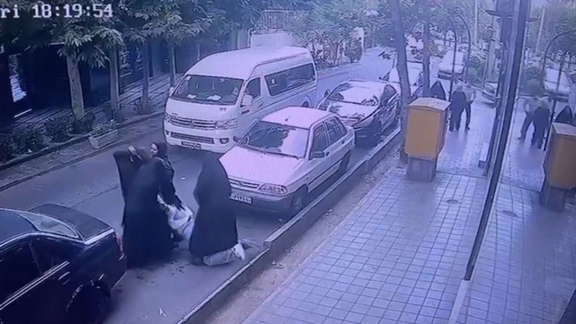
Iranian police have blamed a teenage girl for defying officers in a viral video showing her being violently arrested for not wearing a mandatory hijab.

Though they admitted their actions fell short of "standards", the social media backlash to the video was so intense that the Tehran Military Prosecutor also responded, stating that the video was meant solely for judicial purposes and should not have been released to the public.

He also said that the officers have been identified and legally summoned for their behaviour.

On Tuesday, the reformist website Ensaf News published the video which shows two unveiled teenage girls in a street in northern Tehran. A police van pulls up, and officers jump out, violently pulling the girls from the street and taking them to the van. One of the girls fervently tries to resist, but both are ultimately taken in.

The outlet noted that the video dates back to June and featured an interview with the mother of the 14-year-old girl who resisted the police. The mother described finding her daughter in a dire physical condition at the morality police detention center.

Ensaf News, quoting the mother, reported that "the officers slammed my daughter's head against a power box and, after forcibly placing her into the van, continued to beat her ... I found my daughter with a bruised face, swollen lips, a discolored neck, torn clothes, and she could barely speak".

"Her eyes were swollen shut from excessive crying," she recounted.

The report also revealed that the mother had considered filing a complaint since her daughter is under legal age. However, she was discouraged by warnings that doing so would involve the security and intelligence police and would be "costly."

The authorities also told her that two fingers of a female officer were "broken" and suggested that if she refrains from filing a complaint, they could request the officer not to press charges.

Reza Shafakhah, the lawyer representing the girls, wrote on X that he informed the judge that the officers had no legal grounds to detain his client for not adhering to the compulsory hijab.

The judge replied that it was not an arrest but an “invitation to the police station for administrative purposes.” Shafakhah posted a video stating, “The video below illustrates how the officers issue these so-called invitations.”

Mohammad Aghazadeh, a seasoned journalist in Iran, also wrote on X that the behavior only “plants the seeds of hatred that can only result in rebellion and rage.”

Journalist Aida Ghajar wrote on X that the violence against the teenager “transcends the issue of women's rights and compulsory hijab.”

She said that “it is imperative that child rights advocates and educators also engage with this matter. Nafas is, after all, a student."

Ensaf News reported that the arrest by the police was part of the Nour Plan initiative, which started in April. Iran's authorities have escalated physical efforts to enforce its strict hijab regulations in response to the plan, which has led to a surge in violent crackdowns targeting women on Iranian streets.

The enforcement of mandatory hijab was a significant topic in the election debates. While all presidential candidates concurred that violence is not an appropriate method for enforcing hijab regulations, it appears there has been no change in the conduct of Nour Plan officers towards women.

In July, the acting chief of police asserted that the same policies will persist under the new government. Ahmad Vahidi, the Interior Minister of the Islamic Republic, also defended the government's mandatory hijab policy. He reported that, over the past three years, 23,000 people have been mobilized to enforce the mandatory hijab on Iranian citizens.

This latest incident also comes nearly a month before the anniversary of Mahsa Amini’s death in police custody in 2022. Amini, 22, was arrested for allegedly wearing her hijab improperly, and her death triggered months-long protests across the country, challenging the authority of the Islamic Republic.


Most Viewed

Worst outcome is Islamic Republic’s survival, ex-CIA official says
1
PODCAST

Worst outcome is Islamic Republic’s survival, ex-CIA official says

2
ANALYSIS

Iran brings unusually broad team to US talks to blunt future blame

3
INSIGHT

Tehran sends tough message but keeps diplomacy door open

4

Zoroastrian religious figure arrested in Iran

Banner
Banner

Spotlight

  • What the US naval blockade would mean for Iran’s economy
    INSIGHT

    What the US naval blockade would mean for Iran’s economy

  • Tehran sends tough message but keeps diplomacy door open
    INSIGHT

    Tehran sends tough message but keeps diplomacy door open

  • Worst outcome is Islamic Republic’s survival, ex-CIA official says
    PODCAST

    Worst outcome is Islamic Republic’s survival, ex-CIA official says

  • Why the Iran-US truce is more likely to buy time than peace
    ANALYSIS

    Why the Iran-US truce is more likely to buy time than peace

  • Engaged but uncommitted: China watches Iran and US fight and talk
    ANALYSIS

    Engaged but uncommitted: China watches Iran and US fight and talk

  • A truce for the world, a reckoning for Iran’s economy
    ANALYSIS

    A truce for the world, a reckoning for Iran’s economy

•
•
•

More Stories

Man charged in alleged Iran 'murder-for-hire plot' targeting US politicians

Aug 7, 2024, 12:26 GMT+1

A Pakistani man with alleged ties to Iran has been charged in connection with a plot to assassinate US politicians and officials, potentially including former President Donald Trump.

Asif Merchant, 46, faces a charge of murder for hire after prosecutors say he paid $5,000 to an undercover FBI agent posing as a hitman.

Merchant, who frequently traveled to Iran, Syria, and Iraq and allegedly has a wife and children in Iran, reportedly discussed a complex plot targeting a political figure under heavy security. He was arrested in July and is currently being held in New York.

According to the Justice Department's indictment, Merchant arrived in the US from Pakistan in April following a two-week stay in Iran. Upon arrival, he contacted an individual he believed could facilitate the assassination plot. This contact, however, reported Merchant to the authorities.

The indictment describes how Merchant allegedly made a "finger gun" gesture when discussing his intentions and emphasized that the operation would not be a "one-time opportunity" and would be "ongoing", suggesting other plots may be afoot. He purportedly planned to leave the US before the targets were killed, maintaining communication through code words.

In June, the contact introduced Merchant to undercover FBI agents posing as hitmen. Merchant allegedly instructed them to steal documents from the home of a target, stage protests at political rallies, and assassinate a "political person." The targets were to be revealed in late August or early September.

While the indictment does not specify the targets, sources have indicated that Trump was one of them. The former president, who ordered the killing of Quds Force commander Qassem Soleimani in 2020, is already under increased security measures due to an Iranian plot against him, revealed in June. Iranian officials have repeatedly threatened revenge against Trump, former Secretary of State Mike Pompeo and former National Security Advisor John Bolton for Soleimani's targeted killing.

FBI Director Christopher Wray described the latest scheme as a "dangerous murder-for-hire plot straight out of the Iranian playbook." He stressed that any foreign-directed plot against a US official is a severe threat to national security and will be met with the full force of the FBI.

The plot is unrelated to a previous assassination attempt on Trump at a rally in Butler, Pennsylvania, on July 13, where a Secret Service sniper shot a 20-year-old assailant.

Pezeshkian criticized by media and activists over aide appointments

Aug 7, 2024, 08:18 GMT+1

Criticism of President Massoud Pezeshkian has started even before he introduces his cabinet to the Iranian parliament which is likely to take place next week.

The Iranian media and social media users have particularly accused the President of giving top jobs to two politicians, Hamid Pourmohamadi as head of the Planning and Budget Organization, and Shahram Dabiri as Vice President for Parliamentary Affairs.

According to Iranian media, Pourmohamadi was implicated in a financial corruption case as top suspect in 2011 and was jailed for some time for that. According to the official news agency IRNA, Dabiri was also implicated in a financial corruption case at the Tabriz Municipality and was arrested in 2020 by the IRGC Intelligence Organization. However, he was cleared of the charges later.

Pourmohamadi's supporters in the centrist daily Sazandegi have characterized him as an economic technocrat who has served Iran's previous governments.

Meanwhile, Tehran Municipality's daily newspaper Hamshari has said that Iranians are not happy about the appointments by Pezeshkian. According to Hamshahri, contrary to promises made by the President and his aides, most of those he has so far appointed are aging politicians.

The daily has also charged that Pezeshkian has selected his aides and ministers, who have not been officially named yet, from among his friends and politically likeminded groups. The daily claimed that the public's attitude toward the new appointees is negative.

According to Rouydad24website, Shahram Dabiri is one of several medical doctors Pezeshkian has appointed to executive positions. Dabiri is the owner of a sports club in Tabriz and has held positions at the city's local council and university and is a shareholder of a major hospital in Tabriz. He has studied in Iran, Japan and Russia in the area of nuclear medicine. As a young man, he fought in the war against Iraq in the 1980s alongside Pezeshkian.

Meanwhile, quoting reformist daily Shargh, the website has characterized Pourmohammadi as the shadow governor of Iran's Cenral Bank, and pointed out that he has worked with the governments of President Mahmoud Ahmadinejad and President Hassan Rouhani. Iranian media have said that he opposes the idea of merger of Iran's numerous government banks. He was once dismissed from the Iranian Central bank in 2008 for the same reason. He was jailed in 2011 for involvement in a financial corruption case but was released on bail after one month.

Accusations on social media sometimes go beyond charges of financial corruption. Some social media activists have charged that while Pezeshkian won the election by promising to improve relations with the West, on his first day in office he lashed out at the United States and strongly supported Hamas and similar groups in the Middle East. Another activist said that Pezeshkian has a limited mental capacity and keeps repeating himself.

Iranian journalist Farborz Kalantari wrote that Dabiri and his children run a commercial network in medicine and sports. Another journalist, Ali Gholhaki pointed out that Pezeshkian's political rivals have managed to block his choice for the post of Culture Minister and impose a hardline figure on the cabinet.

Meanwhile, several social media users posted a video of clashes at the Tabriz University in 2021 and accused Dabiri of instigating violence among the supporters of various candidates in the city's local Council election.

His selection of Mohamad Ja'far Ghaempanah as Vice President for Executive Affairs has faced criticism due to his two-decade absence from executive roles. However, many have praised Ghaempanah's courage for siding with protesters during the 2022 nationwide uprising.

Voices rise in Iran against radicals and threat of war with Israel

Aug 7, 2024, 02:30 GMT+1
•
Maryam Sinaiee

Iran's ultra-hardliners say the assassination of Ismail Haniyeh can only be avenged by a major missile attack on Israel, but others are cautioning against a response that may lead to a full-fledged war.

The international deputy of the Iranian Judiciary Kazem Gharibabadi in an interview with Lebanese Al-Mayadeen TV called for a response even “more decisive” than “Operation True Promise”, the missile and drone attack on Israel in April. Iran launched around 350 missiles and drones at Israel retaliation to an attack on the its embassy in Damascus.

“The aggressor should be punished, …, a punishment that conveys the message of deterrence and authority to the enemy,” the Revolutionary Guards (IRGC) linked Javan newspaper demanded in an editorial Tuesday.

Ayatollah Ali Saeedi, head of the Ideological-Political Bureau of the Supreme Leader’s Office, argued that in the “fight against the infidels,” there are only three options: war, surrender, or resistance. However, he stated that war against Israel and its allies is not "expedient," and surrender is unacceptable, leaving "active resistance" as the only viable path.

Although not made directly in the context of the current circumstances, Saeedi’s remarks Monday could indicate certain hesitations in the political establishment about a move that could be the start of a full-on war.

Supporters of ultra-hardliner politicians like Saeed Jalili accuse those advocating for self-restraint of cowardice. Their criticism is directed at 'reformist' media and politicians, such as Abbas Abdi and Sadegh Zibakalam, who have been calling for caution and a careful consideration of all options before making a decision that could potentially lead to war.

“A direct war with Israel is suicide,” Zibakalam said Monday in an interview with AbdiMedia.

“There are no chances of us negotiating with the United States and Israel. The world is prepared for the emergence of Mahdi and this big war after Mr. Haniyeh’s martyrdom shall be a turning point for the world,” an ultra-hardliner posted on X last week.

Some conservative politicians and media also appear to disdain rash calls to a war of the kind ultra-hardliners are demanding.

In an interview with the reformist Etemad newspaper Tuesday, Heshmatollah Falahatpisheh, a conservative former chairman of the Iranian Parliament’s National Security and Foreign Policy Committee, criticized hardliners for pushing hard for quick “revenge” as a matter of honor.

He alleged that infiltrators in Iran's intelligence agencies, who he blamed for the security failures that led to the incident, may also express radical views to push the country to war.

In an opinion piece in the conservative Khorasan newspaper Tuesday, foreign policy researcher Bardia Attaran contended that Iran's response should not involve missile or drone operations launched from inside Iranian borders.

The issue of missiles will turn into the focus of international pressure on Iran if it conveys the impression that missiles are the only means available to the country or results in a focus on newer technologies to neutralize these missiles, Attaran argued.

A response to the assassination, which he said is “inevitable”, would be the responsibility of the “region and Axis of Resistance” and can be in the form of an assassination at the same level as Israel’s assassination of the Hamas leader in Tel Aviv to make the city “unsafe”.

Speaking to Radio Farda, the Persian service of RFE/RL, on Monday, Sedigheh Vasmaghi, a prominent dissident female Islamic scholar, urged for the Islamic Republic’s self-restraint and warned about its involvement in any wars.

“Taking any steps, even small, towards war can be dangerous for the country and the nation because the other side will take the next step and we don't know what they are aiming at,” she said and argued that the Iranian people should not be made to pay the price for the intelligence and security shortcomings of the Islamic Republic which led to Haniyeh’s assassination in Tehran.

Putin asks restraint from Khamenei as regional tensions escalate

Aug 6, 2024, 17:41 GMT+1

In a diplomatic move, Russian President Vladimir Putin has reportedly urged Iran's Supreme Leader Ali Khamenei to exercise restraint following the assassination of Hamas leader Ismail Haniyeh, allegedly carried out by Israel.

According to two senior Iranian sources cited by Reuters, the plea for moderation was delivered by Sergei Shoigu, a key Putin ally, during a high-level meeting with Iranian officials in Tehran on Monday.

Shoigu's visit, as reported by Russia's state-run RIA news agency, highlighted Moscow's dual approach: condemning the assassination while advocating for a measured response from Iran. "The killing of Haniyeh is a very dangerous assassination," Shoigu allegedly stated.

The sources indicated that Shoigu’s visit was part of Russia's broader strategy to relay to Tehran the necessity of restraint, warning that a reckless response could lead to a major Middle Eastern war.

Iran's request for Russian military support

Despite the Kremlin's cautious approach, Tehran has not shied away from pressing its demands, including the acquisition of Russian-made Sukhoi Su-35 fighter jets. The two Iranian sources, who were privy to the discussions, disclosed to Reuters that this request was reiterated during Shoigu's visit, reflecting Iran's strategic ambitions amidst escalating tensions. Russia itself has lost hundreds of warplanes in its war on Ukraine and would be hard pressed to satisfy Iran's request.

An Israeli insider, who previously served as Commander of the Israel Air Defense Forces from 2015 to 2018, conveyed to Iran International that the current threat of war with Iran is notably different from the situation during Tehran's first direct attack on Israel in April. Brigadier General Zvika Haimovich indicated that Hezbollah is expected to play a pivotal role in Iran's anticipated retaliation this time. He expressed that he could not envision any outcome other than Iran responding to last week's killing, which Tehran has attributed to Israel.

"In the long term, I think we need to focus on the Iranian nuclear, wielding vision and capabilities, and build a strong and stable coalition led by the United States of America and also the Arab Sunni states against Iran," Haimovich stated.

International concerns and potential for conflict

The potential fallout from Iran's retaliation has alarmed international observers. An unnamed Biden administration official, speaking to Reuters, emphasized the risks of a significant regional conflict, stating, "The scale of Iran's and Hezbollah's response will be a key factor in determining the extent of a potential conflict." This sentiment is shared across Western capitals, where there is a palpable fear that Iran's aggressive posturing could spiral out of control, especially if coupled with Hezbollah's actions in Lebanon.

In Tehran, Ali Bagheri Kani, the acting head of the Foreign Ministry, reiterated Iran's stance, asserting that the assassination of Haniyeh was a "violation of international law" and that the Islamic Republic "has the right to take appropriate measures to defend and protect its national security and sovereignty." This rhetoric was echoed by Hezbollah, with a prominent Lebanese source close to the group telling Reuters, "A retaliatory strike is inevitable and diplomacy is no longer a viable option." The source added that while Iran seeks a severe response, it does not intend to spark a full-scale regional war.

In a separate discussion, former CIA director and US CENTCOM Commander David Petraeus, in an exclusive interview with Iran International, suggested that both Iran and Israel are likely to avoid an all-out war due to the catastrophic consequences it could entail for both nations.

“I think [the Iranians] have to respond,” Petraeus told Iran International's Marzia Hussaini, “this is an enormous blow to Iran's honor… It's a huge intelligence failure and… a security failure. So, they have to respond. But I don't think that Iran wants to get into a real direct back and forth war with Israel… And frankly, I don't think Israel wants to get in a real full-on war with Hezbollah or with Iran," he explained.

Israeli and US preparations for potential escalation

In response to these developments, Israel has been ramping up its military preparedness. Israeli Defense Minister Yoav Gallant warned that the nation must be ready for all scenarios, including "a swift transition to offense" should Iran or Hezbollah launch attacks.

According to sources familiar with recent Israeli assessments, the country's response to any aggression will be calibrated based on the damage incurred rather than the scale of the attack.

Meanwhile, US intelligence has briefed President Joe Biden and Vice President Kamala Harris on potential scenarios, including possible waves of attacks from Hezbollah and other Iranian proxies. Axios reported that the intelligence community believes Iran and Hezbollah's response is still a "work in progress," with both actors undecided on the exact nature of their retaliation.

Rising tensions and regional dynamics

The regional dynamics are further complicated by recent events. A Tuesday NOTAM (Notice to Airmen) posted on the US Federal Aviation Administration warned pilots that there is a risk of gun firing activities in western Iran on August 7 and 8. It has set the danger zone up to an altitude of 12,000 feet above mean sea level.

Concurrently, Israeli warplanes conducted a series of aggressive maneuvers over Beirut, breaking the sound barrier and causing widespread panic just before a scheduled speech by Hezbollah chief Sayyed Hassan Nasrallah. The IDF has also confirmed airstrikes in southern Lebanon, targeting Hezbollah's infrastructure, as reported by Hebrew media. Lebanese media say at least four people were killed in the strikes in southern Lebanon.

As noted by a senior US official focused on Middle Eastern affairs, "We are doing everything we can to dissuade all parties from going to a place they can’t get back from," urging other regional and European states to exert more influence to de-escalate tensions. A Qatari official also echoed this sentiment, indicating that Doha is in constant communication with Tehran to reduce the likelihood of a conflict.

Iran growing ever bolder about its nuclear capabilities, US warns

Aug 6, 2024, 15:22 GMT+1

The latest report from the US Office of the Director of National Intelligence accuses Iran of becoming ever bolder in boasting about its nuclear weapons as the chances of a return to the JCPOA nuclear deal look to be fading away.

"There has been a notable increase this year in Iranian public statements about nuclear weapons, suggesting the topic is becoming less taboo,” the report stated.

In May, Iranian MP Ahmad Bakhshayesh Ardestani said openly that Iran might already possess a nuclear weapon. It followed closely on the heels of remarks by Kamal Kharrazi, senior foreign policy advisor to Supreme Leader Ali Khamenei, who had said that Tehran will change its nuclear doctrine if its archenemy Israel were to attack its atomic facilities.

For years, the Islamic Republic has insisted that its nuclear program is entirely peaceful, despite enriching uranium to 60-percent purity, which can only have a weaponization purpose.

"Since 2020, Iran has repeatedly stated that it is no longer constrained by any Joint Comprehensive Plan of Action (JCPOA) limits, expanded its nuclear program, reduced International Atomic Energy Agency (IAEA) monitoring, and undertaken activities that better position it to produce a nuclear device, if it chooses to do so,” the US intelligence report noted.

However, it comes in stark contrast to the report released just last year in which it wrote that “Iran is not currently undertaking the key nuclear weapons-development activities that would be necessary to produce a testable nuclear device”.

That assessment rang hollow after it was revealed recently by the UN’s nuclear chief, Raphael Grossi, that Iran is “weeks not months” away from a nuclear weapon.

The latest report, under the Iran’s Nuclear Weapons Capability and Terrorism Monitoring Act of 2022, acknowledges the imminent threat the program poses as Iran continues to increase the size of its uranium stockpile, its enrichment capacity, and development, manufacturing, and operation of advanced centrifuges.

“Tehran has the infrastructure and experience to quickly produce weapons-grade uranium, at multiple facilities, if it chooses to do so,” the report noted.

The country’s nuclear capabilities have become a bargaining chip on the global stage, noted the report, which states that “Iran uses its nuclear program for negotiation leverage and to respond to perceived international pressure,” which has included hostage diplomacy with nations including Sweden and the US.

In line with UN inspectors, the report warns that “Iran probably will consider installing more advanced centrifuges, further increasing its enriched uranium stockpile, or enriching uranium up to 90 percent in response to additional sanctions, attacks, or censure against its nuclear program,” as global sanctions fail to stem the tide of armament.

It notes that Iran has the largest inventory of ballistic missiles in the region and the government continues to emphasize improving the accuracy, lethality, and reliability of these systems.

As the program continues, the unclassified report notes that “Iran probably is incorporating lessons learned from its missile and unmanned aerial vehicle attack against Israel in April”.

The first ever direct attack from Iran to Israel saw over 350 missiles and drones fired towards Israel, most of which were intercepted by Israel and a US-led coalition. It was in retaliation for an alleged Israeli strike on the Iranian consulate in Damascus in which two IRGC commanders were killed along with several other senior personnel.

But the intelligence suggests Iran’s armament development continues to gain pace in spite of global sanctions not only for Iran's nuclear program but for human rights abuses at home and its support of Russia's war on Ukraine. Iran has been supplying suicide drones to Russia used on civilian targets.

“Iran’s work on space-launch vehicles—including its Simorgh—probably would shorten the timeline to produce an intercontinental ballistic missile, if it decided to develop one, because the systems use similar technologies,” the report stated.