• العربية
  • فارسی
Brand
  • Iran Insight
  • Politics
  • Economy
  • Analysis
  • Special Report
  • Opinion
  • Podcast
  • Iran Insight
  • Politics
  • Economy
  • Analysis
  • Special Report
  • Opinion
  • Podcast
  • Theme
  • Language
    • العربية
    • فارسی
  • Iran Insight
  • Politics
  • Economy
  • Analysis
  • Special Report
  • Opinion
  • Podcast
All rights reserved for Volant Media UK Limited
volant media logo

Netanyahu, Pezeshkian exchange threats, raising tensions

Aug 4, 2024, 20:08 GMT+1Updated: 16:13 GMT+0
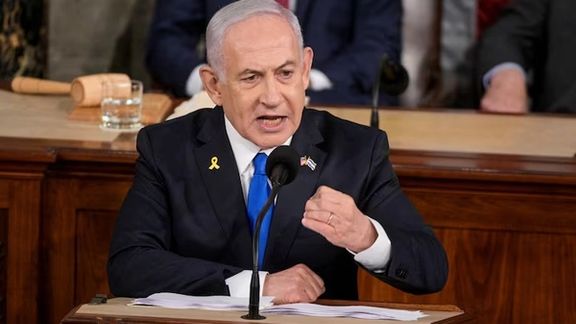
Israeli Prime Minister Benjamin Netanyahu addresses a joint meeting of Congress at the U.S. Capitol in Washington, U.S., July 24, 2024.

Israeli Prime Minister and Iran's President have exchanged threats, highlighting the deepening crisis between their nations. Benjamin Netanyahu vowed a firm response to any threats, while Masoud Pezeshkian pledged retaliation.

At a ceremony in Jerusalem, Israeli Prime Minister Benjamin Netanyahu addressed the nation with a resolute tone. Amid a backdrop of rising regional tensions, Netanyahu declared, “Anyone who harms our country will be held accountable. Iran and its proxies seek to surround us with a stranglehold of terror on seven fronts. Their visible aggression is insatiable, but Israel is not helpless. We are determined to stand against them on every front, in every arena, far and near. Anyone who murders our citizens, anyone who harms our country will be held accountable. He will pay a very heavy price.”

Netanyahu’s comments come in the wake of nearly ten months of conflict in Gaza and the recent assassinations of a senior Hezbollah commander in Lebanon and Hamas’ top political leader in Iran. The heightened hostilities have raised fears of further escalation and retaliation from Iran and its allies.

On his part, Iranian President Masoud Pezeshkian condemned the assassination of Hamas leader Ismail Haniyeh, calling it a violation of international law. “The assassination of a guest of the Islamic Republic of Iran was an act that violated all international laws,” Pezeshkian said. “It was a grave mistake by the Zionists. The audacity will not go unanswered.”

According to media reports, Iranian officials told Arab diplomats that Tehran does not care if an attack on Israel triggers a regional war. But this can also be part of a psychological war both sides have launched.

Israel's channel 12 said that Israel’s security establishment is considering the possibility of “preventive actions or attacks” it could initiate, “including in Lebanon or perhaps in other places as necessitated.”

Siamak Javadi, an economics professor and researcher at the University of Texas, told Iran International, “Aside from its military aspect, war is a full-scale economic project. You can’t wage war with an empty pocket.”
Comparing gross domestic product, per capita national income, and inflation and unemployment rates in Iran and Israel, he added that the Islamic Republic is financially and economically incapable of engaging in a full-scale war with Israel.

Hossein Aghaei, a researcher in international relations and strategic affairs, also told Iran International, “The Islamic Republic is caught in the strategic trap or chain reaction game set by Israel.”
He added that the Iranian government finds itself in a “difficult and enigmatic” situation and has no choice but to provide a “direct and proportionate response” to Israel in order to restore its deterrent power.
Aghaei warned that if the Islamic Republic engages in “a high-risk game” and initiates a “comprehensive and multi-front” conflict against Israel, the region could be drawn into a major military confrontation.

In Israel, the prospect of retaliation has prompted increased vigilance. Citizens are preparing bomb shelters, recalling an unprecedented direct military assault by Iran in April following a suspected Israeli strike that resulted in the deaths of two Iranian generals in Syria. Despite Israel intercepting nearly all incoming drones and missiles, the country remains on high alert.

Citing an Israeli official, NBC News also reported that Israel is bracing for a potential multiday attack by Iran and its proxies in retaliation for the assassination of two senior militant leaders last week.

“They’ll just try to wear us out,” the official said, adding that Israel fears waves of missiles and drones could be fired over several days.

Defense Minister Yoav Gallant sought to reassure the public of Israel’s preparedness. “We are highly prepared in terms of defense and we are ready for both a swift response or attack,” Gallant stated. “If they dare to attack us, they’ll pay a heavy price.”

Israeli President Isaac Herzog, also speaking at the memorial ceremony, emphasized the importance of national unity and resilience. He stressed the need for a swift agreement to return hostages held in Gaza and called for unity amidst internal divisions. “Our national resilience is being tested, and we all feel that internal tensions and polarization are growing,” Herzog said. “I call on public leaders to calm the situation, exercise restraint, refrain from crossing red lines, and protect our social fabric and solidarity.”

The international community is closely watching the situation, with the United States actively engaged in diplomatic efforts to manage the crisis. The US has signaled to Tehran that restraint could improve prospects for diplomatic engagement and warned that any significant strike on Israel would provoke a strong response. Reports suggest that the US has also urged Israel to de-escalate tensions.

The US asked European and other partner governments to convey a message to Iran not to escalate, warning any significant strike on Israel would draw a response, a report by the Wall Street Journal added, citing multiple sources.

Iran, however, remains defiant. In addition to President Pezeshkian’s remarks, Acting Foreign Minister Ali Bagheri Kani affirmed Iran’s right to defend its sovereignty and security. This stance reinforces Tehran’s resolve to respond forcefully to perceived aggression.

Meanwhile, the Israeli Alma Research and Education Center forecasts a significant and coordinated Iranian attack, involving ballistic and cruise missiles and UAVs from multiple sites in western Iran. The report suggests that such an attack could involve coordination with Iranian proxies, including Hezbollah, and might feature a combined launch of various weapon systems.

“In our estimation, this attack will be a combined launch of ballistic missiles, cruise missiles, and UAVs from many sites in western Iran, with both the IRGC and the Iranian Army taking part. We also assess that most of the launches will be carried out from open areas near the underground sites using mobile launchers,” Alma added.

Ghassan Ashour, a Middle East analyst, told Iran International that following the assassination of Ismail Haniyeh on Iranian soil, the Islamic Republic has no choice but to respond to Israel.

Ashour added that, nevertheless, Iranian officials know that "any war with Israel is not in Iran's interest, and any war would benefit Israel."

According to the analyst, a military confrontation would pose less risk to Israel because it would not be alone in this battle, and there is a possibility of US intervention in support of Israel.

Ashour further noted that, in the event of a war, regional countries will not allow the Islamic Republic to use their airspace.
Most Viewed

State media slam Araghchi's Hormuz tweet, say it let Trump claim victory
1

State media slam Araghchi's Hormuz tweet, say it let Trump claim victory

2
OPINION

The Hormuz get out of jail card turned to a grave

3
INSIGHT

How Tehran bends its own red lines to boost state rallies

4

Iran International says it won’t be silenced after London arson attack

5
VOICES FROM IRAN

Iran blackout cripples freelancer, small business incomes

Banner
Banner

Spotlight

  • Too early to tell who is winning Iran war, experts say
    PODCAST

    Too early to tell who is winning Iran war, experts say

  • How Tehran bends its own red lines to boost state rallies
    INSIGHT

    How Tehran bends its own red lines to boost state rallies

  • Iran blackout cripples freelancer, small business incomes
    VOICES FROM IRAN

    Iran blackout cripples freelancer, small business incomes

  • Ideology may be fading in Iran, but not in Kashmir's ‘Mini Iran'
    INSIGHT

    Ideology may be fading in Iran, but not in Kashmir's ‘Mini Iran'

  • US blockade enters murky phase as tankers spoof signals and buyers hesitate
    ANALYSIS

    US blockade enters murky phase as tankers spoof signals and buyers hesitate

  • Why the $100 billion Hormuz toll revenue is a myth
    ANALYSIS

    Why the $100 billion Hormuz toll revenue is a myth

•
•
•

More Stories

Young Iranian woman arrested for singing in public

Aug 4, 2024, 18:16 GMT+1

In the latest crackdown on artistic expression, Iranian security forces have arrested Zara Esmaeili, a young artist whose videos singing in public without hijab, in defiance of the Islamic Republic's rules, went viral.

Esmaeili, known for performing without the mandatory hijab in public spaces like the metro and parks, has been taken into custody, with no information available about her whereabouts or condition. The arrest has left her family in despair as they struggle to ascertain her fate.

A source close to the situation confirmed that “Zara's family has been unable to locate her".

The Islamic Republic prohibits women from singing or dancing in public, reflecting a broader repression against women's rights. These moves, enforced since the 1979 Islamic Revolution, are rooted in conservative interpretations of Islamic law that deem the female singing voice provocative and sexually suggestive.

Despite these restrictions, many women in Iran continue to resist, using social media to share their performances. However, such acts of defiance come with risks.

Faravaz Farvardin, the founder of the Berlin-based Right to Sing Campaign, condemned the arrest of Esmaeili, noting that “Iranian authorities often fabricate charges to justify their crackdown on female singers.”

In an interview with Iran International, Farvardin emphasized that “there is no legal basis for banning female singers,” indicating the Islamic Republic's broader strategy to suppress dissent and enforce gender segregation.

This incident is part of a broader pattern of escalating repression in Iran, particularly targeting women and artists.

Recent cases, such as the arrest of dissident rapper Toomaj Salehi and the imprisonment of Grammy Award-winning singer Shervin Hajipour, underscore the penalties faced by artists who challenge the Islamic system's strictures.

Salehi was initially arrested on September 13, 2021, following the release of his track Rat Hole. He faced arbitrary detention again on October 30, 2022, during the nationwide Women, Life, Freedom protests, accused of "corruption on earth," a charge for which he was sentenced to death in April 2024.

Despite being granted bail on November 18, 2023, Salehi was re-arrested within two weeks on new charges of "publishing falsehoods" and "propaganda against the state." These charges were related to a video he released detailing the torture he endured while in custody. He received a one-year prison sentence for the allegations.

Currently, Salehi is held at Dastgerd Prison in Esfahan, serving this sentence while awaiting the final legal resolution of the 2022 case, especially after his death sentence was overturned. However, with the new charges and the pending outcome of the 2022 case, his future remains uncertain, as he has been in prison for almost two years since his arrest in October 2022.

Hajipour, whose song "Baraye" became an anthem for the Women, Life, Freedom protests, has had his sentence upheld.

World nations scramble to avert all-out war in Mideast

Aug 4, 2024, 15:13 GMT+1

World powers are racing to de-escalate tensions and minimize the risk of a full-scale war as the threat of a large Iranian attack on Israel grows imminent.

As the crisis deepens, the international community is watching with growing alarm, citizens being urged to evacuate the region.

Fears of a wider conflict have escalated following the assassination of Hamas leader Ismail Haniyeh in Tehran on Wednesday, just a day after an Israeli strike killed Fuad Shukr, a senior military commander from Lebanese militant group Hezbollah, which like Hamas is backed by Iran.

The United States, along with several other countries such as France and Canada, is telling its citizens to leave the region, and is deploying more military might in the Middle East as preventative and defensive measures.

Jonathan Finer, White House National Security Council deputy adviser, said on Sunday, "Our goal is de-escalation, our goal is deterrence, our goal is defense of Israel."

On Saturday, US President Joe Biden expressed hope that Iran will back down from its vow to avenge the killing of Haniyeh. However, with Israel bracing for potential attacks from both Iran and Hezbollah as well as other Iran-backed militia groups, the situation remains highly volatile.

Asked by reporters whether Iran would stand down, Biden said on Saturday in response to a shouted question, "I hope so. I don't know."

The Centcom commander Michael Kurilla, who is in charge of US forces in the Middle East, has arrived in the region to assess the threat, which could come from multiple fronts and as early as Monday, according to a report by Axios. The Pentagon said on Friday it would deploy additional fighter jets and Navy warships to the region.

The Ynet news website similarly reported a round of security meetings in Israel over the weekend to prepare for an attack that could lead to a war on what it said could be “five fronts,” without elaborating.

According to Israeli media, the US is scrambling to revive a regional coalition that earlier this year succeeded in almost entirely thwarting the first ever direct Iranian attack on Israel, while Israeli officials reportedly believe that this time around there may be damage and casualties.

In April, hundreds of missiles and kamikaze drones were launched from Iran. Tehran had telegraphed that strike in advance giving Israel, the US and their allies enough time to prepare and shoot down all but two of the missiles -- which landed near a military base but left no casualties.

A single source report even claimed on Saturday that a high-level American security delegation, brokered by Oman, has secretly traveled to Tehran to deliver a 'calming and cautionary' message aimed at preventing a potential military conflict. Kuwait’s Al-Jarida newspaper cited an unnamed source in Iran's Supreme National Security Council as revealing to them that the American delegation, arriving on a private plane from Turkey, landed at Payam-e-Khorram Airport in Karaj on Thursday and held a two-hour meeting with Iranian officials before returning to Ankara. The US State Department rejected the report on Sunday.

Additionally, Jordan's Foreign Minister Ayman Safadi traveled to Tehran on Sunday in a rare visit for urgent talks about regional developments with Iran's Acting Foreign Minister Ali Bagheri Kani. 

Safadi's visit to Iran follows continued diplomatic contacts by the United States and its partners including France, Britain, Italy, and Egypt on Saturday.

Egypt's Foreign Minister Badr Abdelatty stressed in a phone call with Bagheri Kani that recent developments in the region were "unprecedented, very dangerous" and threatening to stability.

Haniyeh's death was one in a series of killings of senior figures of Iran’s proxy groups as the Gaza war nears its eleventh month.

Iran, Hamas and Hezbollah have all hyped the retaliation threat, but the Iranian media is also pursuing a strategic ambiguity regarding the timing but emphasizes that the forthcoming action will surpass the previous offensive in scale and impact.

Despite possibly being a strategic move, Iran's secrecy and delay in releasing official explanations about Haniyeh's assassination have sparked numerous speculations about the hit operation.

Iran’s Revolutionary Guards (IRGC) announced on Saturday that the Hamas leader was assassinated with a "short-range projectile with a warhead of approximately 7 kilograms."

This contradicts reports by The New York Times and The Telegraph, which claimed that the attack was carried out by planting a bomb in Haniyeh's room. If true, this latter scenario could have potentially allowed Iran to limit its retaliation to a similar bombing in Israel.

The Telegraph reported that Israel’s intelligence agency, Mossad, hired Iranian security agents to plant explosives in three separate rooms of a building where a Hamas leader was staying.

Israel’s Channel 12 said the killing of Hamas’s Haniyeh at an Islamic Revolutionary Guard Corps-run guesthouse in the heart of Tehran left the regime feeling “deeply penetrated” and “completely exposed” to Israeli intelligence.

Israel systematically eliminated top Iran proxy leaders

Aug 4, 2024, 13:00 GMT+1
•
Azadeh Akbari

In a series of targeted operations in less than two months, Israel has killed five high-ranking members of Iran-backed Hamas and Hezbollah militant groups, armed and financed by Iran.

The political leader of Hamas, Ismail Haniyeh, was among those targeted by Israel. Haniyeh was assassinated on Wednesday morning in Iran’s capital Tehran. He had traveled to Tehran to participate in the inauguration of Iranian President Masoud Pezeshkian on Tuesday.

While Israel did not claim responsibility, Iranian authorities and Hamas officials have blamed the Jewish state for the attack, vowing to retaliate.

Haniyeh, who has served as the senior political figure of Hamas, has been a central figure in the organization's leadership, a key bridge between Iran and Hamas since 2017. The New York Times reported that Haniyeh was killed by an explosive device hidden in a complex where he was known to stay. However, IRGC-affiliated Fars News denied the report stating that "the results of the experts' investigation indicate that Haniyeh was struck by a projectile."

Mohammed Al-Deif

Mohammed Al-Deif
100%
Mohammed Al-Deif

Another high-profile figure, Mohammad Al-Deif, head of Hamas' military wing was killed in an Israeli airstrike in Gaza last month. The Israeli military confirmed Al-Deif death on Thursday, a day after Ismail Haniyeh was killed in Tehran. Al-Deif was believed to have been one of the masterminds of Hamas' Oct. 7 attack on southern Israel, but Israel was not certain about his death after he was targeted.

"The IDF (Israel Defense Forces) announced that on July 13th, 2024, IDF fighter jets struck in the area of Khan Yunis, and following an intelligence assessment, it can be confirmed that Mohammed Deif was eliminated in the strike," the military said on Thursday.

Rafa'a Salameh

Rafa'a Salameh
100%
Rafa'a Salameh

Commander of the Khan Yunis Hamas unit, Rafa'a Salameh, was also targeted in the July 13 strike alongside Al-Deif. Salameh was responsible for overseeing activities in the Khan Yunis area, a key area in Gaza for Hamas' operations, and considered another mastermind behind Hamas’s missiles and drones attack on Israel in October.

The IDF announced the elimination of Salameh on July 14 stating: “Salameh was one of the masterminds behind the Oct. 7 massacre and commanded over plans for the development of tunnels in the Khan Yunis Brigade.”

Hezbollah Leadership

In addition to the Hamas figures, key members of Iran’s Lebanese proxy militant group Hezbollah have also been systematically targeted by Israel.

Fuad Shukr

Fuad Shukr
100%
Fuad Shukr

Fuad Shukr, the "right-hand man" of Hezbollah Secretary-General Hassan Nasrallah who served as his adviser for planning and directing wartime operations was killed in an Israeli airstrike in Beirut on Tuesday.

"Fuad Shukr has directed Hezbollah's attacks on the State of Israel since October 8th, and he was the commander responsible for the murder of the 12 children in Majdal Shams in northern Israel on Saturday evening, as well as the killing of numerous Israelis and foreign nationals over the years," the IDF said in a statement.

"As the Head of Hezbollah's Strategic Unit, Fuad was responsible for the majority of Hezbollah's most advanced weaponry, including precise-guided missiles, cruise missiles, anti-ship missiles, long-range rockets, and UAVs. He was responsible for force build-up, planning, and execution of terror attacks against the State of Israel," the statement added.

Mohammed Nasser

Mohammed Nasser
100%
Mohammed Nasser

Top Hezbollah commander Mohammed Nasser was killed in an Israeli strike near the city of Tyre in south Lebanon on July 3. The IDF confirmed it successfully eliminated Nasser, whom they identified as the commander responsible for firing at Israel from southwestern Lebanon.

A Hezbollah official told the Associated Press that Nasser who went by the name “Abu Naameh” was head of the group’s Aziz Unit, one of three regional divisions in southern Lebanon.

Taleb Sami Abdullah

Taleb Sami Abdullah
100%
Taleb Sami Abdullah

Top Hezbollah commander, Taleb Sami Abdullah known as Hajj Abu Taleb, was killed in an Israeli airstrike on June 11 ​​in the Jouaiyya area of southern Lebanon.

Abdullah was the most senior member of the group to be killed in eight months of hostilities with Israel, Reuters reported citing a security source.

Hezbollah vowed to intensify its attacks along the Lebanon-Israel border to avenge Abdullah’s killing.

“Our response after the martyrdom of Abu Taleb will be to intensify our operations in severity, strength, quantity, and quality,” senior Hezbollah official Hashem Saffieddine said during Abdullah’s funeral ceremony which was attended by hundreds of the militant groups' members.

Abdallah was also a close friend of former Iran’s Islamic Revolutionary Guards Corps commander Qasem Soleimani who was assassinated by the United States in 2020.

Iran's president picks top economists amid pressure to revive economy

Aug 4, 2024, 08:32 GMT+1

Iran’s new president, Masoud Pezeshkian, has appointed two experienced economists to key positions amid intense political pressure to address the country’s deep economic crisis.

On Sunday, Pezeshkian named Ali Tayyebnia, a long-time economic planner and manager, as his top economic advisor. Tayyebnia, who served as Minister of Economy during President Hassan Rouhani’s first term, earned a solid reputation before the United States reimposed economic sanctions in 2018.

Throughout Pezeshkian’s campaign and after his victory, many in Tehran believed Tayyebnia would be appointed First Vice President, a role that can carry significant influence depending on the officeholder. However, Tayyebnia announced in late July that he could not take on critical responsibilities due to personal reasons.

Pezeshkian’s second appointment on Sunday was Hamid Pourmohammadi, an economist and veteran manager in Iran’s predominantly state-controlled economy, as head of the Planning and Budget Organization. This organization is crucial for long-term economic planning and budget oversight.

Hamid Pourmohammadi, appointed as budget chief by President Pezeshkian. Undated
100%
Hamid Pourmohammadi, appointed as budget chief by President Pezeshkian

Like Tayyebnia, Pourmohammadi is seen as a reliable expert, who held managerial position with both Mahmoud Ahmadinejad's government and with other administrations. Tayyebnia is closer to Iran's so-called reformists rather than the hardliner “revolutionary forces” that held power until President Ebrahim Raisi’s death in a helicopter crash in May and the subsequent elections.

Iran’s economy has been in crisis since 2018, but the Raisi administration, which relied heavily on political appointments from among hardliners, worsened the situation. The national currency, the rial, lost 50% of its value under Raisi, contributing to a persistent annual inflation rate of around 50%. Even conservative politicians and media criticized Raisi’s administration for mismanagement, calling for significant changes. However, the hardliners did the opposite, purging universities and institutions of reputable educators and managers.

While Tayyebnia’s reputation is solid by the standards of Iran’s clerical government, Pourmohammadi was implicated in a major corruption case in 2011 involving corruption in clandestine efforts to circumvent UN oil export sanctions imposed due to Iran’s nuclear program. He was arrested as a main suspect but later released on bail, though the fate of nearly $3 billion remains unknown. Some others involved served lengthy prison terms or fled the country. In the Islamic Republic, legal cases involving well-connected insiders often disappear into obscurity without clear resolution.

Pezeshkian faces pressure to improve the economy, with Tehran hoping for renewed negotiations with the United States that could lead to reduced sanctions. However, the ultimate decision-maker on the nuclear program and foreign policy is Supreme Leader Ali Khamenei. The president’s ability to improve the economy is limited by the resources available, and a significant portion of oil revenues is allocated to the military, the nuclear program, and support for regional proxy forces across the Middle East—policies over which the president has no control.

Years of state control over the economy have also led to a deeply inefficient system plagued by corruption. Even without sanctions, creating a competitive global economy would be a significant challenge.

Revenge and infiltration dominate Iranian media after Haniyeh's death

Aug 4, 2024, 06:40 GMT+1

The most frequently used words in the Iranian media's coverage of the deadly attack on Hamas's Political Leader Ismail Haniyeh's residence in north Tehran were "revenge" and "infiltration."

The call for "revenge for Haniyeh's blood" was made by nearly all of Tehran's hardline media including the state television, the Kayhan newspaper close to Khamenei's office and Hamshahri, the mouthpiece of the Tehran Municipality.

Proreform media outlets, on the other hand, have mainly blamed infiltrators working for Israel for the attack and called on the intelligence agencies to identify and punish them.

The biggest headline on the state TV's daily newspaper Jam-e Jam on Thursday was "Order for taking revenge," which alluded to Supreme Leader Ali Khamenei's order demanding a direct attack on Israel.

Hamshahri's headline said that "All of Iran calls for revenge." The daily quoted Khamenei as saying that he sees taking revenge for Haniyeh as his responsibility.

The Kayhan, linked to to Khamenei's office said in a commentary that "Iran as the host should take revenge for its guest Haniyeh." Meanwhile, the daily's firebrand editor in chief Hossein Shariatmadari called on the Iran armed forces to launch attacks on the US base in Ain al-Asad in Iraq as well as on US vessels in the Persian Gulf and the Sea of Oman. Shariatmadari called on Iranian officials "not to cross out the United States' name from their revenge list," while also calling for immediate and hard revenge.

He further suggested that Iranian officials should not waste any time waiting for a decision by the UN Security Council, and instead, give a paralyzing blow to Israel. Furthermore, the Kayhan said that the main culprit behind the attack on Haniyeh was the United States and that Israel could have not made the decision to kill Haniyeh without US support. He concluded that the United States should be one of the main targets of the Islamic Republic's "hard revenge".

Shariatmadari further said: "Tens of US strategic and military centers are within the range of Iranian weapons. Ain al-Assad was only an example. The US 5th fleet in Bahrain as well as its vessels in the Persian Gulf and the Sea of Oman can be Ira's other targets.

Proreform Rouydad24 quoted Mansoor Hagqiqatpoor, a former lawmaker close to former Majles Speaker Ali Larijani and a former deputy to Qasem Soleimani the former commander of the IRGC Qods Force, called for the removal of some of Iran's political, military and security officials from their posts. He said, "from a security perspective, the attack on Haniyeh's residence in Tehran was unacceptable and an investigation needs to be launched into the matter."

Meanwhile, Haqiqatpoor criticized Iran's responses to previous Israeli attacks as insufficiently deterrent. He added that the assassination of Haniyeh, who was a guest of the government, reflects poorly on the performance of Iran's security organizations. He emphasized that no place in Israel should remain safe after this attack and called for coordinated missile strikes on Israel by all Muslim states.

Many Iranian proreform and moderate conservative media outlets pointed out the possibility of Israeli infiltration of the Iranian security and intelligence organizations. Foreign Policy analyst Hassan Beheshtipour wrote on Nameh News website that "the roots of infiltration should be identified and dealt with." Beheshtipour told Nameh News that Israeli infiltration in Iran is widespread.

He suggested that Iran should launch a surprise attack on Israel but cautioned against falling into Netanyahu's trap by escalating regional tensions. He emphasized that Iran can still pursue negotiations with the West to resolve its nuclear issues while simultaneously confronting Israel.