• العربية
  • فارسی
Brand
  • Iran Insight
  • Politics
  • Economy
  • Analysis
  • Special Report
  • Opinion
  • Podcast
  • Iran Insight
  • Politics
  • Economy
  • Analysis
  • Special Report
  • Opinion
  • Podcast
  • Theme
  • Language
    • العربية
    • فارسی
  • Iran Insight
  • Politics
  • Economy
  • Analysis
  • Special Report
  • Opinion
  • Podcast
All rights reserved for Volant Media UK Limited
volant media logo

Netanyahu urges Mideast anti-Iran alliance in Congressional speech
Jul 24, 2024, 20:29 GMT+1Updated: 16:19 GMT+0
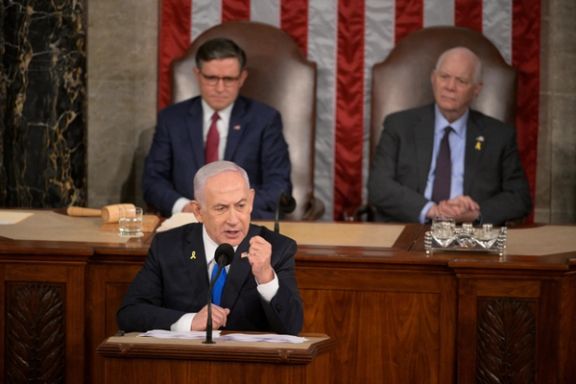
US House Speaker Mike Johnson (R-LA) and Senate Foreign Relations Chair, Senator Ben Cardin (D-MD), listen as Israeli Prime Minister Benjamin Netanyahu addresses a joint meeting of Congress at the US Capitol in Washington, July 24, 2024.

Israeli Prime Minister Benjamin Netanyahu tried to garner support for his country in Washington DC, proposing an anti-Iran alliance in the Middle East led by the US and Israel.

“All countries that are at peace with Israel and all those countries who will make peace with Israel should be invited to join this alliance,” Netanyahu said in a joint meeting of US Congress Wednesday afternoon. “We saw a glimpse of that potential alliance on April 14th. Led by the United States, more than half a dozen nations worked alongside Israel to help neutralize hundreds of missiles and drones launched by Iran against us.”

This was Netanyahu’s first address after the Hamas attack on October 7 and Israel’s retaliatory onslaught on Gaza, which has brought Tehran and Tel Aviv ever closer to an all-out war, with both countries targeting the other’s territory for the first time ever.

“For Iran, Israel is first, America is next,” Netanyahu said, “so when Israel fights Hamas, we're fighting Iran. When we fight Hezbollah, we're fighting Iran. When we fight the Houthis, we're fighting Iran. And when we fight Iran, we're fighting the most radical and murderous enemy of the United States of America.”

Netanyahu’s address was met by immediate reaction from Palestinian groups and Iran’s Supreme Leader Ali Khamenei, whose official X account posted in Hebrew as the Israeli prime minister delivered his speech to the US Congress, taunting both countries for ‘failing’ to defeat Hamas.

“The Resistance’s strength is more and more evident by the day,” the post on X read. “A huge system like the US, in all military, political and economic dimensions, stands behind the Zionists in the fight against Hamas, but they’ve been unable to bring it to its knees.”

In his hour-long address, Netanyahu seemed to be attempting to convince the US lawmakers and an increasingly doubtful American public that the conflicts in the Middle East, and the war on Gaza, in particular, were a war of good against evil, and that Israel was the only thing standing in the way of Iran “conquering” the region.

Many of those present in the Congress cheered Netanyahu, showing their support with standing ovations, as has become customary in these addresses. More notable than the support, however, was the absence of dozens of Democrats, including Vice President Kamala Harris, who leads the race to become her party’s nominee for 2024 presidential election in November.

Israeli Prime Minister Benjamin Netanyahu addresses a joint meeting of Congress at the US Capitol in Washington, US, July 24, 2024.
100%
Israeli Prime Minister Benjamin Netanyahu addresses a joint meeting of Congress at the US Capitol in Washington, US, July 24, 2024.

Netanyahu’s address to the US Congress this year was more contentious than ever, due to the ongoing war on Gaza, which has killed almost 40,000 civilians, according to the health ministry in Gaza. Thousands gathered near the Capitol building in Washington DC in protest against Israel’s prime minister.

The protests were not left unnoticed by Netanyahu. Quoting the US director of national intelligence, he said the anti-Israel protests in the US are funded by Iran. “I have a message for these protesters,” he said, “when the tyrants of Tehran who hang gays from cranes and murder women for not covering their hair are praising and promoting and funding you, you have officially become Iran's useful idiots.”

Earlier this month, Director of National Intelligence Avril Haines issued a warning that actors tied to Iran's government had posed as activists online, encouraged protests regarding the Israel-Hamas war in Gaza, and even provided demonstrators with financial support.

Protesters gathered in Washington during Netanyahu's address, July 24, 2024
100%
Protesters gathered in Washington during Netanyahu's address, July 24, 2024

In unveiling his new strategy against Iran and Hamas, amid the ongoing Israeli-Palestinian conflict, Netanyahu said that Israel’s defeat of Hamas, would be a powerful blow to Iran’s axis of terror. 

“Our fight is your fight. Our enemies are your enemies, and our victory will be your victory,” he said.

Referencing Iran's numerous proxies in the region, the Israeli leader framed the situation as a clash between "barbarism and civilization," emphasizing that "for the forces of civilization to triumph, America and Israel must stand together."

Elon Musk, Chief Executive Officer of SpaceX and Tesla, applauds as Israeli Prime Minister Benjamin Netanyahu addresses a joint meeting of Congress at the US Capitol in Washington, US, July 24, 2024.
100%
Elon Musk, Chief Executive Officer of SpaceX and Tesla, applauds as Israeli Prime Minister Benjamin Netanyahu addresses a joint meeting of Congress at the US Capitol in Washington, US, July 24, 2024.

Netanyahu also took time to thank President Joe Biden for his response to Hamas’ October 7 attacks on Israel, expressing gratitude for his assistance with the hostages and ongoing support following the attack.

Before his arrival in the US, the Israeli Prime Minister expressed his hope that his meeting with Biden would strengthen the two nations' efforts against the "terrorist axis of Iran" and its proxies.

The leader’s visit this week, however, was largely overshadowed by the absence of both President Biden and Vice President Harris and protests around Capitol Hill.

Dozens of Democratic senators and representatives were absent, with some reportedly citing disagreement with Netanyahu’s policies, while others mentioned scheduling conflicts. Dozens of lawmakers had also skipped the Israeli leader’s speech in 2015.

The vice president usually presides over joint addresses, but Harris was in Indianapolis on her presidential campaign which she launched Sunday, after President Biden dropped his re-election bid.

Biden, meanwhile, is set to deliver his first address to the nation since announcing his decision not to seek re-election, with some arguing that it will further distract attentions from Netanyahu’s visit.

Both Biden and Harris are slated to meet with the Israeli Prime Minister separately on Thursday.

Biden and Harris were also visibly absent to greet the Israeli leader and his wife upon arrival.

But Harris’ plans, according to an aide who spoke with Politico, “should not be interpreted as a change in her position with regard to Israel.”

David Friedman, who served as the US ambassador to Israel during the Trump administration, was a vocal critic of Harris’ absence, stating that it is not just an insult to Netanyahu but also to Israel.

Her refusal to preside over the joint address “tells you everything you need to know about where she stands on Israel. All the far left Jewish groups trying to justify this incredible insult are convincing no one,” Friedman posted on X.

Former President Donald Trump is set to meet Netanyahu on Friday at Mar-a-Lago, his luxury resort in Palm Beach, Florida.

The stakes for the Israeli leader are high, as he faces mounting criticism and pressure to strike a cease-fire deal that would end the fighting in Gaza following the Israeli offensive that came after Hamas’ attacks on October 7, 2023. Palestinian health officials say tens of thousands have reportedly been killed since the war began.

Upon landing on Tuesday, Netanyahu and his wife Sara met with representatives of the families of the Israeli-American hostages held by Hamas. Reports suggest that the families had already been onboard the flight with the Prime Minister.

Shortly after the meeting, Netanyahu said that any cessation in military actions against Hamas could potentially compromise Israel's security in the face of threats from Iran.

“I am not prepared in any way to give in on the victory over Hamas. If we give up on this, we will be in danger in the face of Iran's entire axis of evil,” he said after the meeting.

Netanyahu said he is doing everything in his power to combine the necessary humanitarian objective and the imperative to return the hostages, and at the same time, “preserve the existence of the State of Israel.”


Most Viewed

Iran International says it won’t be silenced after London arson attack
1

Iran International says it won’t be silenced after London arson attack

2
VOICES FROM IRAN

Hope and anger in Iran as fragile ceasefire persists

3

US sanctions oil network tied to Iranian tycoon Shamkhani

4

Iran halts petrochemical exports to supply domestic market

5
INSIGHT

How Tehran bends its own red lines to boost state rallies

Banner
Banner

Spotlight

  • Hardliners push Hormuz ‘red line’ as US blockade tests Iran’s leverage
    INSIGHT

    Hardliners push Hormuz ‘red line’ as US blockade tests Iran’s leverage

  • Ideology may be fading in Iran, but not in Kashmir's ‘Mini Iran'
    INSIGHT

    Ideology may be fading in Iran, but not in Kashmir's ‘Mini Iran'

  • War damage amounts to $3,000 per Iranian, with blockade set to add to losses
    INSIGHT

    War damage amounts to $3,000 per Iranian, with blockade set to add to losses

  • Why the $100 billion Hormuz toll revenue is a myth
    ANALYSIS

    Why the $100 billion Hormuz toll revenue is a myth

  • US blockade targets Iran oil boom amid regional disruption
    ANALYSIS

    US blockade targets Iran oil boom amid regional disruption

  • Iran's digital economy battered by prolonged blackout
    INSIGHT

    Iran's digital economy battered by prolonged blackout

•
•
•

More Stories

Kurdish activist sentenced to death in Iran

Jul 24, 2024, 18:04 GMT+1

Iranian Kurdish political prisoner Pakhshan Azizi has been condemned to death on charges of armed rebellion, according to rights groups.

She is the second woman recently sentenced to death for "armed rebellion" just a month after labor activist Sharifeh Mohammadi faced similar allegations.

The Hengaw Human Rights Organization, a Kurdish advocacy group, also reported that Azizi had received a four-year prison term for membership in opposition groups. Her lawyers were notified of the sentence on Tuesday.

Azizi was arrested in Tehran last year and Hengaw reported that several of her family members were also detained but released after a few days.

The court issued the death sentence for Azizi while depriving her of access to legal counsel and family visits for several months, denying her fair and transparent legal proceedings, according to the rights group.

Hengaw recently published a letter from Azizi in which she recounted enduring repeated instances of torture and hanging during her detention. Furthermore, authorities have denied her the right to meet or contact her family for the past two weeks.

Previously, Azizi was arrested in 2009 during a protest by Kurdish students at Tehran University against the execution of political prisoners. After four months in detention, she was released on bail.

Human rights organizations have repeatedly condemned the severe torture inflicted on prisoners and the coerced confessions extracted from them.

The minority Kurds in Iran have faced extensive persecution since the establishment of the Islamic Republic. According to the rights group Hengaw, at least 266 prisoners were executed across Iran during the first half of 2024 as the country's execution spree continues. Among those executed were 72 Kurds.

Iran and Armenia  sign secret $500 million arms deal

Jul 24, 2024, 17:10 GMT+1
•
Negar Mojtahedi

Iran and Armenia have signed a major arms deal worth $500 million, a source familiar with the situation told Iran International, in a move that could anger Azerbaijan as Tehran supplies Yerevan its infamous suicide drones.

Armenia and Azerbaijan have fought two major wars since the collapse of Soviet rule in the early 1990s, with Azerbaijan retaking large chunks of its territory in 2020. Its forces last year captured the region of Nagorno-Karabakh, the chief focus of the long-running conflict.

Iran has repeatedly warned that it will not tolerate any changes to international borders in the region.

The reported agreement has been broken up into several contracts and was signed in the past few months, according to the source, who is a senior military official in the Middle East. Iran International has not identified them for their protection.

Iran International has obtained an exclusive list of the military items Iran is set to supply Armenia. That includes drones such as Shahed 136, Shahed 129, Shahed 197, Mohajer, and air defense missile systems like 3rd Khordad, Majid, 15th Khordad, and Arman.

This deal has not been reported before. The foreign and defense ministries of Iran and Armenia did not respond to Iran International’s separate requests for comments.

Update: After the publication, Armenia's Ministry of Foreign Affairs did not deny the deal, in an official email response to Iran International. "Armenia is currently diversifying its security relations within the framework of international law. We don't have any further comment on this," said a spokesperson for the Ministry of Foreign Affairs of the Republic of Armenia.

Armenia's Foreign Affairs Ministry sent another email after that, referring Iran International to an article written in a local Armenian publication, where the country's Ministry of Defense dismissed our reporting as fictitious and false. Iran International reached out to Armenia's Defense Ministry and never received a response.

Farzin Nadimi, an arms expert from the Washington Institute, said a deal of this scale is substantial for the Caucasus nation.

“Iran has sold Armenia drones [before] for example, and some other arms, but nothing at this scale,” said Nadimi.

Armenia’s Ministry of Finance reported that defense spending in 2024 increased by 81% as compared to 2020. Armenia’s defense budget in 2024 was about $1.4 billion, so the amount being allocated to Iran through this deal is about a third of that budget. It is not known how Armenia can afford this, but some analysts believe loan payments could be an option.

The Iran-Armenia arms deal goes beyond supplying suicide drones and air defense missiles. It also involves intelligence cooperation, close military relations, training, and the establishment of bases on Armenian soil, the source has revealed to Iran International.

“I don’t think the region will be happy. I don’t think the United States will be happy,” said Nadimi.

The source said that security cooperation between the two countries, including advancing arms deals, had been discussed during the visits of high-level delegations and technical teams from Iran in recent months.

Iran-Armenia ties have not come without some controversy.

During an interview with Armenian radio on June 28, Mehdi Sobhani, the Ambassador of the Islamic Republic of Iran in Armenia sent a bold message to the United States, stating “my message is that they [Americans] should not interfere unnecessarily in the relations between Iran and Armenia.”

Safeguard from Azerbaijan: lessons learned from the war 

Alex Vatanka, the Middle East Institute’s Iran Program director, said Armenians are looking elsewhere, to France, India, the US and Iran for their security needs.

“Armenia is not in a good place militarily. The last few years have not been good for them. They've lost in two major campaigns to their historic nemesis, Azerbaijan. And they have lost confidence in their historic protector Russia,” said Vatanka.

An arms deal between Iran and Armenia would help Tehran to remain relevant in the Caucasus, said Vatanka.

A service member of the Russian peacekeeping troops stands next to a tank near the border with Armenia, following the signing of a deal to end the military conflict between Azerbaijan and ethnic Armenian forces, in the region of Nagorno-Karabakh, November 10, 2020.
100%
A service member of the Russian peacekeeping troops stands next to a tank near the border with Armenia, following the signing of a deal to end the military conflict between Azerbaijan and ethnic Armenian forces, in the region of Nagorno-Karabakh, November 10, 2020.

In 2020, after decades of intermittent skirmishes, Azerbaijan launched a 44-day military operation that became known as the ‘Second Karabakh War.’ Several thousand people were killed on both sides.

Military analysts attribute Azerbaijan’s victory, breaking through Armenian defenses, to drones acquired from Turkey and Israel.

From 2016 to 2020, Israel accounted for 69 percent of Azerbaijan’s imports of major arms, according to the Stockholm International Peace Research Institute.

Turkey made up 2.9 percent of Azerbaijan’s imports of major arms, including missiles and armed UAVs, from 2011-2020.

“Armenia wants to catch up on that front. If Iran can provide drones, why not?,” said Vatanka.

The arms deal between Iran and Armenia would go beyond the two nations and impact Iran-Azerbaijan relations especially after Iran elected an ethnic Turkish speaking as president.

“Azerbaijan will be very, very angry about his deal. But Iran wants to show its dissatisfaction with Azerbaijan, as well, because Azerbaijan is a major customer of Israeli weapons. Azerbaijan and Israel have had strategic relationships. I think Iran will use these deals to show Azerbaijan that its relations with Israel would further move Iran toward Armenia,” said Nadimi.

Armenian security analysts, who are in direct contact with the government, declined Iran International for an interview, citing that they don’t believe that a deal of such magnitude exists. Those experts said Armenia is moving closer to the West and wouldn’t risk its relations with the US, for example, over Iran and sanctions violations, believing that to do so would be a public relations disaster for the tiny nation. One Armenian analysts said he heard that Iran is pushing the deal, but that Armenia declined. 

The experts were referring to the Armenian government's efforts to expand ties with the West since Russia became entangled in the Ukraine quagmire. Yerevan has forged military cooperation with France and the United States, including nine days of joint military drills with US forces in July.

The Russian Equation and the War in Ukraine? 

Military expert Frederic Labarre from the Royal Military College of Canada said the massive deal could happen for several reasons. He said it signifies a ‘necessity’ for Armenia to defend itself against Azerbaijan, but it could also be a way for Russia to acquire arms through Armenia.

“It could be a way in which Armenia can still endear itself to Russia by being the go between Iran and Russia, especially in the provision of drones and, such equipment, in such a way that. It will be difficult for Western powers or other powers to pressure Armenia,” he said.

Labarre, who specializes in Russia and Ukraine defense and military, hypothesizes that Armenia may be transferring weapons on behalf of Russia.

US criticized over inaction on Iran's Mahsa Act sanctions

Jul 24, 2024, 17:03 GMT+1

The US has been criticized for a lack of enforcement of the Mahsa Amini Human Rights and Security Accountability Act (MAHSA Act) three months after it was passed, sanctioning Iran's leadership.

Despite the MAHSA Act being signed into law in April, the US administration has yet to submit the required report outlining potential sanctions on the key Iranian entities and officials it was aimed to target, including the Supreme Leader.

As the 90-day deadline is set to pass, Jason Brodsky, Policy Director at United Against Nuclear Iran, wrote on X, "Today a determination was due by the Biden administration for sanctions under the MAHSA Act which the president signed into law in April. I haven't seen any. Where is it?"

The National Union for Democracy in Iran (NUFDI), a lobbying group for Iranian-Americans, said, "Its timely implementation is crucial to addressing ongoing human rights violations and ensuring that those responsible are held accountable."

The MAHSA Act, a bipartisan piece of human rights and anti-terrorism legislation, marked the first time the United States imposed sanctions specifically targeting the Iranian leadership for domestic suppression, crimes against humanity, and international terrorism.

The legislation was named after Mahsa Amini, a 22-year-old Iranian-Kurdish woman arrested in Tehran for improperly wearing her compulsory hijab and who died in police custody after collapsing in court. Her death has become a symbol of the Woman Life Freedom uprising.

NUFDI called on the Biden administration to "promptly address the issue" as rights abuses continue. Last year, Iran executed over 850 people, record numbers, while in the wake of the 2022 uprising, tens of thousands of political prisoners have been jailed.

Over 550 Iranians were killed in the wake of Amini's death as the government cracked down on the country's biggest threat to its legitimacy since the founding of the Islamic Republic in 1979.

US House passing Mahsa Act
100%
US House passing Mahsa Act

Sarah Raviani, a visiting fellow at NUFDI highlighted the bill's "overwhelming bipartisan support".

"We urge the Biden administration to make this determination and sanction the Islamic Republic leaders who are responsible for gross human rights abuses and for supporting terrorism that wreaks havoc across the entire Middle East," she said.

The MAHSA Act mandates sanctions on Iran’s Supreme Leader Ali Khamenei, his Office, his appointees, Iran’s president, and several entities affiliated with Khamenei. It also requires the US President to report to Congress annually on whether these officials should remain under existing sanctions, making it more challenging for current and future administrations to lift the sanctions unilaterally.

Human rights groups file complaint to UN over continued detention of Iranian rapper

Jul 24, 2024, 14:43 GMT+1

Doughty Street Chambers, Index on Censorship, and the Human Rights Foundation have jointly submitted a complaint to the United Nations Working Group on Arbitrary Detention (UNWGAD) regarding the ongoing detention and mistreatment of Iranian rapper Toomaj Salehi.

The complaint, submitted on behalf of Salehi's family, accuses the Iranian government of a disregard for international legal obligations and basic human rights.

Since his initial arrest in October 2022, Salehi has faced continuous harassment and shifting charges due to his outspoken music supporting the uprising of Iranian women in the Woman, Life, Freedom movement, and calling for greater freedoms.

"The authorities are abusing judicial procedures to attempt to silence him and keep him locked away," stated Caoilfhionn Gallagher KC, international counsel for Salehi’s family, Index on Censorship, and the Human Rights Foundation.

"Salehi’s continuing detention is arbitrary and unlawful. He should be immediately and unconditionally released."

Salehi has suffered physical torture, including a broken arm and leg, and has been held incommunicado for nearly 300 days without access to family or legal representation. Despite his brief release on bail in November 2023, he was rearrested shortly after and denied medical treatment for his injuries.

In April 2024, Salehi was sentenced to death for "corruption on earth," a charge stemming from his vocal criticism of the government after the death in morality police custody of Mahsa Amini. She was arrested for not wearing “proper” mandatory hijab.

Although the death sentence was overturned by Iran's Supreme Court on June 22, Salehi remains imprisoned, facing new charges of “propaganda against the system and insulting sacred values.”

The Iranian government’s use of arbitrary detention, torture, and executions to silence dissent is well-documented. Salehi's cousin, Arezou Eghbali Babadi, condemned the authorities' tactics.

"Despite the overturning of Toomaj's death sentence, authorities aim to keep him imprisoned long-term," he said. "These actions are part of an ongoing strategy of targeting the innocent lives of all Iranians fighting for democracy and justice."

Toomaj Salehi (Undated)
100%
Toomaj Salehi

Negin Niknaam, Salehi's friend and social media manager, accused the government of "fabricating cases and making baseless charges" against the musician.

"Since the Islamic Republic was unable to execute him [Salehi] following global outrage, it is now attempting to keep him in prison or pressuring him into silence," he said.

Jemimah Steinfeld, CEO of Index on Censorship, appealed to Iran's new president, positioned as a moderate, to act: "The ongoing persecution of Toomaj Salehi is a stain on Iran. These new charges and the ill treatment he has received are an affront to basic human rights. We implore him to free Toomaj Salehi and indeed all others wrongfully imprisoned for exercising their free speech rights."

Legal experts have highlighted the crackdowns on freedom of expression since the uprising began in 2022, which has included the arrest of artists from musicians, actors and film makers, in addition to a plethora of other professionals and activists.

"Art is a human right, and supporting gender equality is not a crime," said Claudia Bennett, a legal and programs officer at the Human Rights Foundation.

An icon of the protest movement which has seen tens of thousands of dissidents jailed and last year alone, over 850 executions, she said Salehi has been made an example of amid the uprising.

"The Iranian regime knows the impact he has on the Iranian people and is willing to do whatever it takes to keep him in detention. But enough is enough," she added.

The complaint to the UNWGAD follows an Urgent Appeal filed with two United Nations Special Rapporteurs on behalf of Salehi's family.

Iran's Ahmadinejad escaped assassination attempt

Jul 24, 2024, 12:50 GMT+1
•
Shahed Alavi

Iran’s former president, Mahmoud Ahmadinejad, narrowly escaped an assassination attempt last week after his vehicle was sabotaged, according to Iran International sources familiar with the incident.

On the evening of Monday, July 15, Ahmadinejad and his entourage prepared to travel to Zanjan for the Muharram religious mourning ceremony. Following a routine procedure, his chief security officer inspected Ahmadinejad's primary vehicle, a Toyota Land Cruiser, and complained about the still-malfunctioning air conditioner, requesting Ahmadinejad to use another car.

According to Iran International sources, approximately a quarter of the way along the Karaj-Qazvin Highway, the driver of the Toyota Land Cruiser carrying Ahmadinejad's associates and bodyguards suddenly lost control of both the steering and brakes.

The out-of-control Toyota spun three times in high-speed traffic, veered left and right twice, hit the central barrier, and collided with another vehicle in Ahmadinejad's convoy. It then struck the barrier again before stopping after hitting a Peugeot car.

A passenger in the Peugeot sustained injuries and was transported to the hospital. Fortunately, the injuries were minor, and the individual was discharged after outpatient treatment.

Two days before the trip, Ahmadinejad's security team had submitted his primary vehicle, the Toyota Land Cruiser, to the relevant unit within the presidential institution for repairs due to a malfunctioning air conditioner.

A photo released by Dolat Bahar of former Iranian president Mahmoud Ahmadinejad during a trip to Zanjan for the Muharram mourning, 15 July 2024.
100%
A photo released by Dolat Bahar of former Iranian president Mahmoud Ahmadinejad during a trip to Zanjan for the Muharram mourning, 15 July 2024.

According to Iran International sources, after being handed over to the presidential institution, Ahmadinejad's Toyota Land Cruiser was seized by "special security agents" and taken to an undisclosed location instead of the usual repair shop.

Sources told Iran International that the vehicle was sabotaged before being returned to Ahmadinejad's security team, with the false claim that the air conditioner had been repaired.

Security team members protecting high-ranking officials, including Ahmadinejad, are a unit within the IRGC, known as the Ansar-al-Mahdi Protection Corps. This corps is a subset of the IRGC Intelligence Protection Organization, currently led by Brigadier General Fathollah Jomeiri, who also commands the Ansar-al-Mahdi Protection Corps.

Iran International sources did not specify which organization the "special security agents" who took the car away belonged to. However, given the organizational structure, high-ranking members of one of three IRGC subdivisions—the IRGC Intelligence Organization, the IRGC Protection and Intelligence Organization, or the IRGC Vali-e-Amr Corps—have the authority to retrieve Ahmadinejad's vehicle from the presidential repair unit without coordinating with the Ansar Protection Corps and without raising security concerns, enabling them to carry out the alleged sabotage.

Ahmadinejad registered to run in this year's presidential election, but the Guardian Council, an unelected body, disqualified him. He did not support any candidates.

Reports from Iranian websites, including Ahmadinejad’s affiliated Dolat Bahar, show that he traveled to Zanjan in July, with numerous images documenting his presence during the mourning sessions. He can be seen in a white Toyota Land Cruiser, which differs from the primary vehicle involved in the accident.

According to Iran International’s sources, five days after the failed assassination attempt, Ahmadinejad's office notified the "responsible authorities" about the incident and lodged complaints regarding previous attacks.

There have been prior indications of attempts on his life.

Last year, Dolat Bahar's Telegram channel reported that Ahmadinejad’s office had sent a letter to senior military and security officials, warning of concerning activities targeting him and requesting protective measures and action against those responsible.

In 2023, Ahmad Alirezabeigi, a lawmaker from Tabriz, revealed to Didban Iran (Iran Monitor) website in Tehran that members of former President Ahmadinejad's office have persistently maintained a heightened state of vigilance concerning potential threats against him.

In March 2021, domestic media reported that Ahmadinejad, in response to a query, declared, "The threat of my assassination is genuine. They would orchestrate my death, conduct the mourning rituals, and subsequently blame others. I have documented my information and secured it in several safe locations."