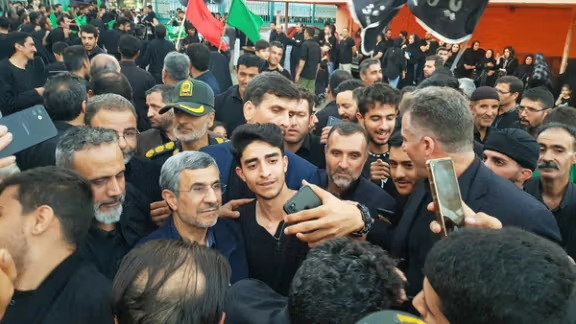
Former Iranian President Mahmoud Ahmadinejad during his trip to Zanjan for Muharram mourning, 15 July 2024.
Iran’s former president, Mahmoud Ahmadinejad, narrowly escaped an assassination attempt last week after his vehicle was sabotaged, according to Iran International sources familiar with the incident.
On the evening of Monday, July 15, Ahmadinejad and his entourage prepared to travel to Zanjan for the Muharram religious mourning ceremony. Following a routine procedure, his chief security officer inspected Ahmadinejad's primary vehicle, a Toyota Land Cruiser, and complained about the still-malfunctioning air conditioner, requesting Ahmadinejad to use another car.
According to Iran International sources, approximately a quarter of the way along the Karaj-Qazvin Highway, the driver of the Toyota Land Cruiser carrying Ahmadinejad's associates and bodyguards suddenly lost control of both the steering and brakes.
The out-of-control Toyota spun three times in high-speed traffic, veered left and right twice, hit the central barrier, and collided with another vehicle in Ahmadinejad's convoy. It then struck the barrier again before stopping after hitting a Peugeot car.
A passenger in the Peugeot sustained injuries and was transported to the hospital. Fortunately, the injuries were minor, and the individual was discharged after outpatient treatment.
Two days before the trip, Ahmadinejad's security team had submitted his primary vehicle, the Toyota Land Cruiser, to the relevant unit within the presidential institution for repairs due to a malfunctioning air conditioner.
A photo released by Dolat Bahar of former Iranian president Mahmoud Ahmadinejad during a trip to Zanjan for the Muharram mourning, 15 July 2024.
According to Iran International sources, after being handed over to the presidential institution, Ahmadinejad's Toyota Land Cruiser was seized by "special security agents" and taken to an undisclosed location instead of the usual repair shop.
Sources told Iran International that the vehicle was sabotaged before being returned to Ahmadinejad's security team, with the false claim that the air conditioner had been repaired.
Security team members protecting high-ranking officials, including Ahmadinejad, are a unit within the IRGC, known as the Ansar-al-Mahdi Protection Corps. This corps is a subset of the IRGC Intelligence Protection Organization, currently led by Brigadier General Fathollah Jomeiri, who also commands the Ansar-al-Mahdi Protection Corps.
Iran International sources did not specify which organization the "special security agents" who took the car away belonged to. However, given the organizational structure, high-ranking members of one of three IRGC subdivisions—the IRGC Intelligence Organization, the IRGC Protection and Intelligence Organization, or the IRGC Vali-e-Amr Corps—have the authority to retrieve Ahmadinejad's vehicle from the presidential repair unit without coordinating with the Ansar Protection Corps and without raising security concerns, enabling them to carry out the alleged sabotage.
Ahmadinejad registered to run in this year's presidential election, but the Guardian Council, an unelected body, disqualified him. He did not support any candidates.
Reports from Iranian websites, including Ahmadinejad’s affiliated Dolat Bahar, show that he traveled to Zanjan in July, with numerous images documenting his presence during the mourning sessions. He can be seen in a white Toyota Land Cruiser, which differs from the primary vehicle involved in the accident.
According to Iran International’s sources, five days after the failed assassination attempt, Ahmadinejad's office notified the "responsible authorities" about the incident and lodged complaints regarding previous attacks.
There have been prior indications of attempts on his life.
Last year, Dolat Bahar's Telegram channel reported that Ahmadinejad’s office had sent a letter to senior military and security officials, warning of concerning activities targeting him and requesting protective measures and action against those responsible.
In 2023, Ahmad Alirezabeigi, a lawmaker from Tabriz, revealed to Didban Iran (Iran Monitor) website in Tehran that members of former President Ahmadinejad's office have persistently maintained a heightened state of vigilance concerning potential threats against him.
In March 2021, domestic media reported that Ahmadinejad, in response to a query, declared, "The threat of my assassination is genuine. They would orchestrate my death, conduct the mourning rituals, and subsequently blame others. I have documented my information and secured it in several safe locations."
British Royal Marines servicemen hold Union Jack after the UK-led Joint Expeditionary Force (JEF) military exercise Baltic Protector 2019 in the former Soviet military town near Skrunda, Latvia July 2, 2019.
The chief of Britain’s army has warned that within three years, its forces must be ready to confront an "axis of upheaval" formed by Russia, China, Iran, and North Korea.
General Roly Walker has identified three primary threats including China's preparations to potentially invade Taiwan. Referencing US intelligence, he said there are indications that China’s President Xi Jinping has directed the country’s military to prepare for a potential invasion of Taiwan by 2027.
Iran's possible pursuit of nuclear weapons and Russia's ongoing militarization exemplified by its actions in Ukraine are additional threats.
He expressed concerns that Iran might seek to violate the nuclear agreement designed to prevent it from developing atomic weapons, all while the conflict in Ukraine continues.
The British general explained that these nations are cultivating a mutual alliance characterized by exchanging weapons and technologies and warned that this convergence of threats could reach a critical juncture by 2027.
While emphasizing that conflict is not unavoidable, Walker forewarned that Russian President Vladimir Putin would likely emerge from the invasion of Ukraine as "very, very dangerous" and "seeking retribution" against nations such as the UK that supported Ukrainian forces, regardless of the war's outcome.
Both Iran and North Korea have bolstered Russia's efforts in the Ukraine conflict. Since mid-2022, Iran has supplied Russia with over a thousand Shahed UAVs which have been extensively deployed to target civilian infrastructure and urban areas in Ukraine.
In 2019, Iran commenced annual trilateral naval exercises with Russia and China in the Arabian Sea, with the latest occurring in March. Furthermore, in 2021, Iran and China formalized a 25-year cooperation agreement wherein Beijing committed $400 billion (£309 billion) to invigorate Iran's economy by developing its energy, transportation, and manufacturing sectors in return for discounted Iranian oil.
German police officers walk towards the Islamic Center Hamburg, during a raid, due to suspicion of members acting against a constitutional order and supporting the militant group Hezbollah in Hamburg, Germany.
Germany's interior ministry said on Wednesday it has banned the Islamic Centre Hamburg (IZH) association and its subsidiary organizations, saying it pursues radical Islamist goals. The entity is controlled by Tehran.
The ministry said in a statement that 53 of the organization’s premises had been searched by authorities in eight German states early on Wednesday, acting on a court order.
Germany's federal police had raided the Islamic Center on suspicions of support for the Lebanese militant group Hezbollah, accused of terrorism, in November 2023. Germany banned Hezbollah activities in 2020.
The interior ministry said at the time that the Khamenei-controlled IZH activities are “aimed at spreading the revolutionary concept of the Supreme (Iranian) leaders,” and that the center allegedly undermines Germany’s “constitutional order.”
In addition to the Hamburg-based IZH, which includes one of the oldest mosques in Germany known for its turquoise exterior, its subgroups in Frankfurt, Munich and Berlin were also banned.
As a result, four Shiite mosques will be closed, said the ministry. Some German politicians issued statements expressing satisfaction that the government finally acted against IZH.
The IZH was not available for comment by phone on Wednesday morning, Reuters said, and its website was not accessible to the public.
The IZH has been a hotbed of pro-Hezbollah activism and support for Qasem Soleimani, the former commander of IRGC's Quds Force. In January 2020, after the US killed Soleimani in a drone strike in Iraq, a group of 600 pro-Iran regime Islamists attended a memorial service at the Hamburg center to mourn his death. The Islamists praised him as a “heroic martyr.”
In early 2023, the German Federal Administrative Court ruled that the IZH (and its affiliated Blue Mosque are an "extremist Islamic organization."
Evidence from the earlier search of 55 properties conducted in November provided the basis for Wednesday's ban of the IZH, known in German as Islamisches Zentrum Hamburg, said the ministry.
"Today, we banned the Islamisches Zentrum Hamburg, which promotes an Islamist-extremist, totalitarian ideology in Germany," said Interior Minister Nancy Faeser.
"This Islamist ideology is opposed to human dignity, women's rights, an independent judiciary and our democratic government."
She said she wanted to make clear that "this ban absolutely does not apply to the peaceful practice of the Shiite religion."
The ministry said the IZH acted as a direct representative of Iran's Supreme Leader and sought to bring about an Islamic revolution in Germany that would create theocratic rule.
In addition, IZH promotes anti-Semitism and the Iran-backed militant group Hezbollah, which is also banned, it said.
In the final days of Ebrahim Raisi's administration, an announcement was made that promised to revolutionize the Iranian car market when the cabinet approved a plan to lift the ban on the import of used foreign cars.
The government spokesperson declared last week that Iranian citizens could now import used foreign cars without any restrictions, sparking initial excitement among the media and the public. However, as the details of the plan unfolded, the enthusiasm quickly dissipated.
Stringent restrictions undermine the policy
The regulations accompanying the plan revealed a series of restrictions that cast doubt on the feasibility of the new policy. Among them were stipulations that the cars must be between 3 to 5 years old, have an engine capacity limited to 2500 cc, and must not be imported from the United States. Additionally, imported cars could not be sold for five years. Most critically, the foreign currency used for the purchases had to come from "profits from exports or foreign investment."
Economic realities and ‘hypocrisy’
Currently, the cheapest domestic car costs between $7,500 to $10,000, while the majority of imported cars are low-quality Chinese models priced as high as European or Japanese cars. For instance, a Cherry Tiggo 8 Pro Max SUV costs $50,000. Other Chinese cars, like the Lamari EAMA produced by Dongfeng Liuzhou Motor, assembled in Iran, sell for $31,000. Brands like Great Wall Motors, Baic, FAW, and JAC also import parts for assembly, with prices ranging from $20,000 to $40,000.
An ad for Chinese vehicle Cherry Tiggo 8 for almost 52000 USD in Iran on July 20. 2024
Farhad, a Tehran resident, speaking to Iran International, said the move would not benefit Iranians. We cannot reveal his full name due to security reasons. "We cannot say this move benefits the people. Due to sanctions, they [government] can't access oil money from China, forcing them to import Chinese cars. This new policy will not benefit individuals and is hypocritical.”
Impractical requirements for foreign currency
Ahmad Aghaei, the Deputy Minister of Transportation, clarified that the currency needed for purchasing the cars must originate from abroad and be approved by the Central Bank, limiting those with access to benefit from the new policy.
"The importer must have a foreign currency account or currency outside the country to buy the car. Those who have their currency within the country will face restrictions from the Central Bank for sending the currency out of the country," he added. This requirement further limits the average Iranian's ability to benefit from the policy highlighting the plan's impracticality.
A car sales showroom in Iran
Public outcry and media criticism
In conversations with Iran International, many Iranians dismissed the plan as deceptive. “It is a lie. If you want to import a car, you have to export goods. How many people have the ability to export in order to afford a car?” said Mahmoud from Karaj.
The Iranian news agency Tabnak also pointed out the “deceptive” nature of the plan, stating that the regulations only benefit a small group of exporters, reinforcing the monopolistic market of state-owned car manufacturers.
Financial struggles of domestic manufacturers
In February, the Minister of Industry, Mine, and Trade, Abbas Aliabadi, called for more funds for the country’s two main government-controlled automakers: Iran Khodro and SAIPA. These companies face financial difficulties due to high inflation, and despite government claims, car prices have risen in the market over the past year.
A production line in Saipa car factory
Iranian auto industry experts report that state-owned carmakers are incurring daily losses of $3.7 million, totaling over one billion dollars annually, a direct result of government interventions in the auto industry. The quality of domestically produced cars is also a significant concern, with majority of road deaths in Iran involving drivers of these low-quality vehicles.
According to economic journalist Arash Hassan-Nia, Iran Khodro and Saipa are nearly bankrupt, with around $2.5 billion in accumulated losses. “Due to their managerial and ownership structures, they are unable to improve the quality of their current products,” he earlier told Iran International.
The car mafia and election politics
Ali Khosravani, vice president of the Tehran Automobile Dealers Union, previously highlighted the role of the "car mafia" in Iran, which he described as the main obstacle to new entrants in the car market. This shadowy group maintains a tight grip on the market, further complicating any genuine reform efforts.
During the presidential election debates, president-elect Masoud Pezeshkian questioned why Iranians should be forced to drive substandard cars under the guise of supporting national production.
His rival, Saeed Jalili, made a controversial claim in response saying that “People in Russia wait six months in queues for the Iranian-made Samand vehicle,” a claim ridiculed on social media.
Many now say that the recent decision to import second-hand cars is another “propaganda efforts in the final days of the Raisi government, adding one more item to their list of achievements.”
A slogan with no substance
The new car import regulations in Iran, while initially promising, reveal a complex web of restrictions and inconsistencies that ultimately leave the monopolistic market of state-owned car manufacturers intact. The majority of Iranian citizens remain unable to benefit from the changes, highlighting the gap between government promises and the harsh economic realities on the ground.
Observers believe that the promotion of "one car import for every single Iranian" is clearly a “populist” slogan, as few people have the financial means to import a car, leaving the public disillusioned once again.
The flags of the US and the Islamic Republic of Iran
The Islamic Republic is prepared for nuclear negotiations with world powers to have sanctions lifted, Iran's president-elect said, a couple of weeks after the White House made it clear that there is no diplomatic path ahead to curb Iran's move toward acquiring a nuclear weapon.
White House National Security spokesman John Kirby told Iran International on July 11 the Biden administration is committed to making sure Tehran would never develop nuclear weapons. "We'd love to be able to do that through diplomacy. But right now, there's not a path, a diplomatic path ahead of us."
Still, Iran's president-elect Masoud Pezeshkian said on Monday, "The Islamic Republic of Iran has always been and remains ready for any kind of dialogue" on the removal of sanctions imposed against the country, even though "it was the US that first withdrew from the JCPOA and then imposed the harshest sanctions on the Iranian nation."
Former US President Donald Trump in 2018 imposed crippling sanctions against the Islamic Republic after withdrawing from the Obama-era Joint Comprehensive Plan of Action (JCPOA), a nuclear deal that had curbed Tehran's nuclear program in return for some sanctions relief.
Various sanctions have since been enforced against Iran because of its nuclear weapons program and support for terrorist groups, but Supreme Leader Ali Khamenei and his loyalists have been reluctant to acknowledge the strain caused to the economy. Instead, they claim the sanctions are opportunities for growth and development and could foster national unity.
Now Iran is apparently hopeful that with the election of Pezeshkian, presented as a “reformist,” nuclear talks would resume leading to some reduction in US sanctions that have crippled the economy.
Pezeshkian made the comments in a phone conversation with Japanese Prime Minister Fumio Kishida, whose country tried to mediate between Tehran and Washington in 2019 during former prime minister Shinzo Abe's trip to Iran.
The Monday phone call may suggest a renewed interest on Tokyo's side to act as a mediator.
The Japanese foreign ministry's readout of Kishida's phone call with Pezeshkian confirms the two leaders have exchanged views on Iran's nuclear program, but only says, "The two leaders discussed the situation regarding the Iran nuclear issue and agreed to maintain communication."
However, Iranian state-run media claim that the Japanese prime minister "expressed his country’s readiness to mediate between Iran and the US in the talks on the revival of the 2015 nuclear deal."
Iran's acting foreign minister Ali Bagheri-Kani in a visit to New York earlier this month lauded the purported new foreign policy direction under President-elect Pezeshkian.
"We believe that now it is the turn and time of the other side to prove this honesty for interaction and, of course, to open a new chapter," Bagheri Kani said in an interview with Newsweek, fueling speculations that Pezeshkian's election victory might be part of the Islamic Republic's plan to restore the 2015 nuclear deal and end the crippling sanctions that have plagued the country for years.
In his interview with Newsweek, Bagheri Kani said that Tehran remained open to resuming negotiations with Washington toward restoring mutual participation in a nuclear deal.
He made the comments one week after claiming that nuclear talks with the US are ongoing through indirect negotiations mediated by Oman. The claim was categorically rejected by the White House national security spokesman.
"I won't speak or can't speak to channels of communication with Iran one way or the other, but there are no active negotiations going on to restore the nuclear deal. The reason for that is because Iran was killing its own people in protests activity. Iran was continuing to spin centrifuges. Iran was continuing to support terrorist groups. And in the early stages of the negotiations, Iran was making unnecessary demands that made it impossible for us to do that. They weren't negotiating in good faith," Kirby told Iran International.
Last month, the International Atomic Energy Agency (IAEA) warned about Iran’s nuclear activities, raising concerns about the program's peacefulness. The IAEA reported that Iran has stockpiled large amounts of highly enriched uranium, with Raphael Grossi saying that Iran is "weeks not months" from a nuclear weapon.
A new report has highlighted an alarming trend of increasing femicide cases amid an ongoing pattern of violence against women and girls in Iran.
According to the report by Etemad Daily, in the first three months of the Iranian calendar in 2024 alone (March 20 to June 21), at least 35 women and girls were murdered by their close male relatives, particularly their husbands.
The number is a 25 percent increase from the 28 recorded during the same period in 2023 and a 59% rise from the 22 deaths in 2022.
A massive 85 percent of the murders were committed by the victims' husbands and cases were spread across the country. In 2022, 16 women were killed by their husbands, followed by 15 in 2023, with a sharp increase to 27 in 2024 amid the climate of state crackdowns on women and girls.
Rights activists point to Iran’s laws and patriarchal society based on Islamic law as the primary cause of femicide which has worsened since 2022.
Conditions for women have become so bad that the United Nations branded Iran's policy as "gender apartheid" as state policy legitimizes violence against women.
Honor killings can be carried out for as little as not wearing the mandatory hijab, bringing shame on the family.
UN Women says these gender-related killings are the “most brutal and extreme manifestation of violence against women and girls. According to the latest UN Women report, globally on average, more than 133 women or girls are killed every day by someone in their own family.
Speaking to Iran International, Iranian feminist and human rights activist, Mina Khani, highlighted the lack of accurate statistics in Iran amid heavy censorship and corruption, and the state's own involvement in committing femicide.
Official figures suggest numbers even lower than Germany, she said, with massive discrepancies in both the reporting and recording of such crimes.
"In this context, human rights statistics are crucial," she said. "Organizations like Hengaw report femicide statistics in Iran based on the cases they document, as there is no official statistical reference for human rights organizations to rely on,” Khani stated.
Norway-based rights organization, Hengaw, identified that "at least 50 cases of femicide have been recorded in various cities of Iran since the beginning of 2024.
Khani noted "the state's failure to take legal measures to protect women from domestic violence".
She said, "Instead, the regime has legalized violence attributed to honor and gender-based violence against women, and it also engages in state-sponsored femicides".
High profile cases such as Mahsa Amini and Armita Geravand, who both died in morality police custody, exemplify the role of the state, she said, which "has never been held accountable".
Soraya Fallah, an Iranian researcher and women’s rights activist touched on the surge and prevalence of femicide in Iran adding that the situation highlights an “urgent need for serious measures to change laws and address cultural issues in Iran.”
Fallah echoed Khani’s statements, blaming Iran's discriminatory laws for fueling the femicide crisis.
“The Islamic government of Iran has institutionalized unequal laws and their implementation, enabling crimes like honor killings. These laws, such as Article 630, provide legal grounds for such acts, fueling patriarchal violence," she said.
Article 630 of the Islamic Penal Code allows a man to kill his wife and her partner if he catches them in the act of consensual adultery, without facing any punishment. This law exclusively targets women. Additionally, a father or paternal grandfather who kills their child is exempt from the retribution sentence, known as Qesas.
"The Islamic Republic uses these laws to maintain power and perpetuate these issues within society. Comprehensive legal and cultural changes are crucial to address these deep-rooted problems and protect women's rights in Iran," she added.
Amnesty International last year said, "The Iranian authorities’ oppressive methods of policing women and girls and punishes those who dare to stand up for their rights".
"To this day, not a single Iranian official has been held accountable for ordering, planning and committing widespread and systematic human rights violations against women and girls through the implementation of compulsory veiling," it added.