• العربية
  • فارسی
Brand
  • Iran Insight
  • Politics
  • Economy
  • Analysis
  • Special Report
  • Opinion
  • Podcast
  • Iran Insight
  • Politics
  • Economy
  • Analysis
  • Special Report
  • Opinion
  • Podcast
  • Theme
  • Language
    • العربية
    • فارسی
  • Iran Insight
  • Politics
  • Economy
  • Analysis
  • Special Report
  • Opinion
  • Podcast
All rights reserved for Volant Media UK Limited
volant media logo

Iran's president-elect faced challenges from day one
Jul 6, 2024, 22:48 GMT+1Updated: 16:26 GMT+0
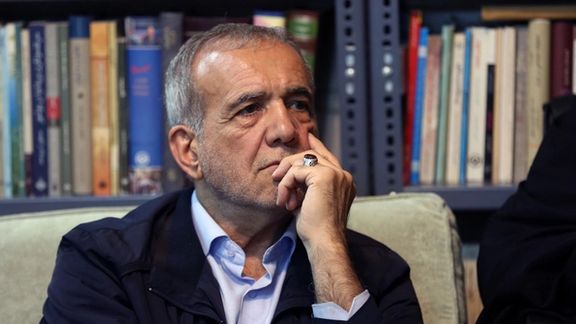
Iran's President-Elect Masoud Pezeshkian

Iran's President-Elect Massoud Pezeshkian began his challenging journey to the presidency just one day after his comfortable victory in the July 5 runoff election.

The Iranian parliament (Majles), which must approve his cabinet appointments, went on a 10-day holiday for the Shiite mourning month of Muharram, which began on Saturday.

An Iranian parliamentarian said that after the ten days of mourning, the lawmakers will go on summer holiday and Pezeshkian's introduction to the Majles and his swearing-in ceremony will take place sometime in August. ‌ Before that, he needs to officially resign as a member of parliament.

This delay might not be entirely detrimental for Pezeshkian, who previously stated he has no plans or list of cabinet ministers. He now has over a month to formulate a plan and compile a list. So far, none of his campaign advisers, primarily from the centrist Executives of Construction Party and the Development and Moderation Party, seem to have provided him with any plan or list.

In the meantime, it is not clear yet, whether Supreme Leader Ali Khamenei will endorse Pezeshkian's credentials before the mourning period which could well extend to two weeks, or he is going to do it regardless of religious rituals.

On the other hand, on his first day as President-Elect, a news conference with Iranian and foreign reporters planned for Saturday afternoon was cancelled. The news conference was first re-located from a conference center in northern Tehran to an auditorium in south Tehran without giving any reason to the reporters.

Pezeshkian praying with former foreign minister Javad Zarif and former deputy foreign minister Abbas Araqchi. July 6, 2024
100%
Pezeshkian praying with former foreign minister Javad Zarif and former deputy foreign minister Abbas Araqchi.

While the reporters were making their way from one venue to another, it was announced without giving a reason that the news conference was cancelled. It is not yet clear who arranged the news conference and who cancelled it as Pezeshkian has no staff and chief of staff yet. However, later during the day, pro-reform Emtedad News said that it was cancelled because Pezeshkian had to go to a meeting with Khamenei.

State television reporter Mohammad Hossein Ranjbaran was quoted by Iranian media as saying that during the meeting, Khamenei offered suggestions to the President-Elect. These suggestions may have included advice on addressing questions about foreign policy, including relations with the United States and Europe, and Iran's role in the Middle East.

Some Iranian reporters suspect that the cancellation of the news conference was an attempt to prevent surprises during the meeting with foreign reporters. They believe that those who hastily arranged the news conference intended to throw the inexperienced politician to the media wolves.

During the televised debates, Pezeshkian and other candidates evaded such questions when posed by their rivals. The TV presenters were aware that these topics were off-limits for the candidates, as only Khamenei has the final say in these matters.

Khamenei has assured foreign entities that the new president's tenure will not bring any changes in foreign policy or unexpected surprises for international players. He reiterated in his felicitation message on Saturday that Pezeshkian's mandate is "to continue President Raisi's path" with literally translates into taking no initiative of his own.

Even before the election, the US Department of State said that a change of presidents in Iran will not lead to a change in the country's foreign policy. The DOS reiterated after the elections that “We have no expectation these elections will lead to fundamental change in Iran’s direction or more respect for the human rights of its citizens. As the candidates themselves have said, Iranian policy is set by the Supreme Leader.”

During the weekend, the head of the caretaker government in Iran, Mohammad Mokhber who was visiting Kazakhstan, reassured Russian President Vladimir Putin that no change will occur in Iran's foreign policy as a new president takes office in Tehran.

With all those assurances, Khamenei is likely arranging a series of briefings and introductions for the newly elected president before he dives into the deep end of Iranian politics.


Most Viewed

Iran International says it won’t be silenced after London arson attack
1

Iran International says it won’t be silenced after London arson attack

2
VOICES FROM IRAN

Hope and anger in Iran as fragile ceasefire persists

3
INSIGHT

How Tehran bends its own red lines to boost state rallies

4

Iran halts petrochemical exports to supply domestic market

5

US arrests Iranian national over alleged Basij-linked visa fraud

Banner
Banner

Spotlight

  • Too early to tell who is winning Iran war, experts say
    PODCAST

    Too early to tell who is winning Iran war, experts say

  • How Tehran bends its own red lines to boost state rallies
    INSIGHT

    How Tehran bends its own red lines to boost state rallies

  • Iran blackout cripples freelancer, small business incomes
    VOICES FROM IRAN

    Iran blackout cripples freelancer, small business incomes

  • Ideology may be fading in Iran, but not in Kashmir's ‘Mini Iran'
    INSIGHT

    Ideology may be fading in Iran, but not in Kashmir's ‘Mini Iran'

  • US blockade enters murky phase as tankers spoof signals and buyers hesitate
    ANALYSIS

    US blockade enters murky phase as tankers spoof signals and buyers hesitate

  • Why the $100 billion Hormuz toll revenue is a myth
    ANALYSIS

    Why the $100 billion Hormuz toll revenue is a myth

•
•
•

More Stories

Election losers congratulate Iran's new president

Jul 6, 2024, 22:15 GMT+1

As Masoud Pezeshkian was named Iran's next president, his presidential rivals sent messages of congratulations as the Supreme Leader called for government unity.

Presidential runner-up, Saeed Jalili, Iran's former nuclear negotiator and the ultraconservative contender, congratulated the incoming president. “As before, I consider it my duty to support the new government in overcoming challenges and achieving the nation's development goals,” Jalili stated.

Alireza Zakani, another former contender and Tehran Mayor also congratulated Pezeshkian and recognized the significance of the election as a “testament to religious democracy,” echoing Jalili’s comments and overall state line.

Zakani, who had earlier withdrawn from the race, urged government unity as news of the new cabinet awaits. He stated, "Now, I present all my plans, which have been written with the support of a large group of elites, to the elected president, and knowing the heavy burden of the government, it is expected that the elected president will choose a strong and capable cabinet."

Additionally, former President Hassan Rouhani, a notable supporter of Pezeshkian, extended his congratulations to the first reformist president to be elected in two decades. Rouhani underscored that the people's vote reflected a clear mandate for constructive engagement with the international community and a revival of the 2015 nuclear deal, formally known as the Joint Comprehensive Plan of Action (JCPOA), which was signed during Rouhani’s tenure.

He emphasized that the new administration "is not a continuation of previous administrations", refuting claims by other candidates that Pezeshkian’s government would simply continue his policies. He also highlighted the importance of addressing the concerns of those who abstained from voting, urging the new administration to work inclusively.

As Pezeshkian prepares to take office, he now faces the challenges of a nation grappling with an inflation rate of around 50% with its national currency, the rial, having depreciated 15-fold since 2018 driving millions of Iranians into poverty.

With sanctions causing around $1.2 trillion in damages from 2011 to 2023, experts argue another critical challenge for the newly elected president will be making strategic foreign policy decisions to lift US sanctions.

Amid widespread anti-Islamic Republic sentiment following Iran's 2022 nationwide Woman, Life, Freedom protests sparked by the death of Mahsa Amini in morality police custody, Pezeshkian must now address the country's human rights issues.

This is especially critical given the intensified crackdown on women's rights and mandatory hijab laws, directed by Supreme Leader Ali Khamenei, to whom Pezeshkian has consistently declared loyalty throughout his campaign.

Despite the significant role of the president, the ultimate power in Iran rests with Khamenei who holds authority over all branches of government, including the military and judiciary. Regardless of the president, his influence shapes the direction of the country’s domestic and foreign policies.

PODCAST - Eye for Iran: Hezbollah's big win and Iranians’ election boycott

Jul 6, 2024, 20:05 GMT+1

In Episode 5 of 'Eye for Iran', we discuss the Arab League’s decision to remove Hezbollah from its terror list and also the record-low voter turnout in the first round of Iran's presidential election.

Why did the Arab League’s decision come on the heels of a potential war between Israel and Southern Lebanon? And does the low voter turnout in Iran's recent election signify a distrust in the ruling system?

Host Negar Mojtahedi speaks with Roya Boroumand, the Co-founder of the Abdorrahman Boroumand Center and Dr. Walid Phares, a foreign policy expert on those topics.

When it comes to the Arab league's decision, Phares, who has has advised US presidential candidates, said Washington and the Iran lobby have a big role to play, in his view.

"It's all about the weakness that Washington is showing in international relations," said Phares on 'Eye for Iran.'

Phares believes that stems from influence by the Iran lobby in D.C.

"Those who are forming the Abraham Accord and the Arab coalition are telling the Israelis, look, guys, I mean, we cannot sustain this if the US administration is not even helping you. What do you want us to do? So that's one part. Another part of the Arab League, like the Syrian Assad regime or the Iraqis, who are very close to the Iranian regime or even the Lebanese government under the influence of Hezbollah. Yeah, they're saying we are winning."

In terms of Iran's internal politics, the historically low voter turnout in the first round of the country's presidential elections, signifies a "vote of distrust" according to human rights advocate Roya Boroumand.

"The low turnout means that people don't believe in the legitimacy of the elections. And that is a good analysis because people are much more informed now that they used to be 20 years ago or 30 years ago," said Boroumand.

You can watch the entire episode on Iran's International's YouTube Page or listen to it on Spotify, Apple or Amazon.

Iranian people 'losing their patience', top Sunni cleric warns Pezeshkian

Jul 6, 2024, 19:45 GMT+1

Iran's top Sunni cleric Mowlavi Abdolhamid has warned president-elect Masoud Pezeshkian that Iranians are "exhausted" and are losing patience with the country's ongoing issues.

Mowlavi Abdolhamid, who abstained from voting in Iran's presidential election this year, highlighted the "disgust" among the public, demonstrated by the record-low turnout in the first round of the votes.

The June 28 presidential election saw a voter turnout of 39.92%, the lowest in the history of the Islamic Republic. In the runoff votes held on July 5, the official figures showed a 10-percent rise in the number of voters, but still over 50 percent of eligible voters boycotted the election.

This significant absence signals a stark "discontent" with unbalanced and inconsistent governmental policies, Abdulhamid said, according to a readout of his speech published by Halvash human rights organization.

The top Sunni cleric said the nation, "overwhelmed" by political, economic, and social pressures, and where the lower classes feel "crushed," will persist in its demands for "justice" and "freedom."

Abdolhamid, expressing deep concern over the political stalemate and lack of representation for the Sunni and Baluch communities, described the situation as a "deadlock," underscoring the need for a profound shift in public sentiment away from traditional conservative and reformist politics. Despite his reservations, he acknowledged Pezeshkian's “victory.”

Known for his forthright opposition to the government, especially after the crackdown in Zahedan on September 30, 2022, Abdolhamid has faced risks and criticism for his stance against the Supreme Leader's policies, especially regarding the treatment of protestors.

His advocacy for ending executions and harsh decrees has positioned him as a contentious figure, facing accusations from conservative factions of aiding the "enemies" of Iran.

Exiled prince warns Western powers against appeasing Khamenei's new 'lackey'

Jul 6, 2024, 18:40 GMT+1

Iran’s exiled prince has warned Western powers against appeasing the Islamic Republic's new president, saying the Iranian people would view it as a betrayal of their struggle for freedom.

"The people of Iran will view any attempts to appease this new lackey (Masoud Pezeshkian) as a treacherous offense to their ongoing movement for liberation and a shameful abdication of moral leadership," Prince Reza Pahlavi said in a post on his X account on Saturday.

Masoud Pezeshkian won the July 5th runoff election with a turnout of less than 50%. In his first post-election speech, he thanked Supreme Leader Ali Khamenei, saying, "If it wasn't for him, I don't think my name would have easily come out of these (ballot) boxes."

Prince Reza Pahlavi referred to the election as a "fraudulent" attempt to legitimize a dictatorship, highlighting the Iranian nation’s rejection of the process.

He said Khamenei’s choice of Pezeshkian as the president and "chief functionary" would not save the Islamic Republic from its "inevitable" collapse and the Iranian people's "certain" victory.

Pahlavi also praised Iranian people for boycotting the election, calling it a "historic" display of national unity and solidarity and a "watershed moment" in the Iranian nation's movement.

He noted that this was the largest display of "nonviolent, civil resistance" against the Islamic Republic in 45 years and emphasized that this is just the beginning of their path to national liberation.

The first round of Iran's snap presidential election saw a voter turnout of 39.92%, the lowest in the history of the Islamic Republic. In the runoff votes, the official figures show a 10-percent rise in the number of voters, but still over 50 percent of eligible voters boycotted the election.

Iranian Nobel laureate Ebadi criticizes Iran’s new ‘reformist’ president

Jul 6, 2024, 13:50 GMT+1

In the aftermath of Iran’s July 5 presidential runoff and 'reformist' candidate Masoud Pezeshkian's ascent to the presidency, Nobel Peace Prize laureate Shirin Ebadi has voiced strong criticism of 'reformists' in general and the newly elected president.

“Masoud Pezeshkian, a candidate close to reformists, became the President in an election where the majority of people did not participate,” she wrote in a post on Instagram on Saturday, highlighting the historically low voter turnout.

Ebadi asserted that Pezeshkian has assumed office amid a backdrop of political and security puzzles following the death of hardliner President Ebrahim Raisi in a helicopter crash on May 19. She added that Pezeshkian’s presidency is “another step for a third defeat of reformists,” referring to the failures of the two previous 'reformist' presidents, Mohammad Khatami and Hassan Rouhani, to address the country's woes.

She questioned whether the 'reformists' will now address the concerns of Iranians. Ebadi raised issues such as whether internet restrictions would be lifted or further tightened, and addressed the dire working conditions of workers across multiple sectors in Iran struggling to make ends meet. She further asked whether the quality of life, particularly for impoverished ethnic minorities in Iran's eastern Sistan-Baluchestan province and Kurdistan province in the northwest, would improve, and if the country's resources would be better managed to ensure adequate water in southwestern Khuzestan province are addressed.

"The reformists and moderates entered the political arena to salvage the regime," Ebadi concluded underscoring that without fundamental changes, “the will of the people” could become a powerful force that challenges and potentially dismantles the Islamic Republic.





