• العربية
  • فارسی
Brand
  • Iran Insight
  • Politics
  • Economy
  • Analysis
  • Special Report
  • Opinion
  • Podcast
  • Iran Insight
  • Politics
  • Economy
  • Analysis
  • Special Report
  • Opinion
  • Podcast
  • Theme
  • Language
    • العربية
    • فارسی
  • Iran Insight
  • Politics
  • Economy
  • Analysis
  • Special Report
  • Opinion
  • Podcast
All rights reserved for Volant Media UK Limited
volant media logo

Ukraine Exposes Destruction of Russian Base Training Cadets with Iranian Drones
Jun 24, 2024, 08:50 GMT+1Updated: 10:08 GMT+1
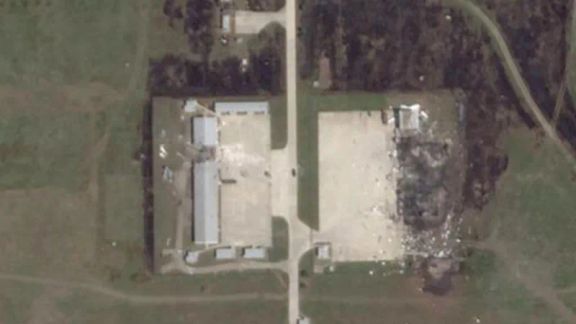
Satellite image released on June 23, showing the aftermath of an attack on a Russian warehouse, used for launching Iranian-made drones and training military cadets.

Ukraine's Navy has revealed satellite imagery showing the destruction of a Russian warehouse used for launching Iranian-made drones and training military cadets.

A Facebook post by the Ukrainian Navy detailed, "New satellite images confirm the destruction on the night of June 21 of the Shahed-136/Geran-2 storage and preparation facilities, training buildings, control, and communication points of these UAVs located in the Krasnodar Territory."

Additional images shared on social media depicted the devastation with one warehouse entirely demolished and another significantly damaged. The assault coincides with Russia's claim of downing 114 Ukrainian drones targeting oil refineries and military installations in southern Russia, which purportedly resulted in one civilian casualty from falling debris.

Kyiv's naval officials reported that the strike, which occurred late Friday night, killed several trainers and cadets learning to operate the Iranian Shahed drones which have been used on Ukrainian civilian sites since the war in 2022.

The operation was orchestrated in collaboration with Ukrainian intelligence, highlighting a military response against threats posed by the collaboration between Russia and Iran in utilizing drone technology against Ukraine.

Data from Planet Labs, a US-based satellite company, pinpointed the facility directly across the Sea of Azov from the occupied Ukrainian city of Mariupol.

Russia annexed Crimea in 2014, an action not recognized by the majority of the international community.

Iran has been a key ally to Russia in its conflict with Ukraine. Since mid-2022, Iran has provided Russia with hundreds of Shahed kamikaze drones, which have been widely used to attack civilian infrastructure and urban areas in Ukraine.


Most Viewed

Ghalibaf defends Iran-US talks amid hardline backlash
1
INSIGHT

Ghalibaf defends Iran-US talks amid hardline backlash

2
ANALYSIS

From instability to influence: Pakistan’s pivotal role in US-Iran diplomacy

3
ANALYSIS

100 days on: why Iran’s January protests spread across social classes

4

War-hit homeowners feel abandoned as Iran’s reconstruction aid fades

5

Iran says no decision yet on talks as Pakistan prepares to host US team

Banner
Banner

Spotlight

  • Iran diplomacy wobbles as factions compete to avoid looking soft on US
    INSIGHT

    Iran diplomacy wobbles as factions compete to avoid looking soft on US

  • The politics of pink: how Iran uses cuteness to rebrand violence
    ANALYSIS

    The politics of pink: how Iran uses cuteness to rebrand violence

  • Bread shortages, soaring prices strain households in Iran, residents say
    VOICES FROM IRAN

    Bread shortages, soaring prices strain households in Iran, residents say

  • 100 days on: the anatomy of Iran’s January crackdown
    INSIGHT

    100 days on: the anatomy of Iran’s January crackdown

  • Ghalibaf defends Iran-US talks amid hardline backlash
    INSIGHT

    Ghalibaf defends Iran-US talks amid hardline backlash

  • From instability to influence: Pakistan’s pivotal role in US-Iran diplomacy
    ANALYSIS

    From instability to influence: Pakistan’s pivotal role in US-Iran diplomacy

•
•
•

More Stories

Iran Says to Maintain Naval Presence on High Seas to 'Secure Shipping'

Jun 23, 2024, 22:13 GMT+1

Shahram Irani, the commander of Iran’s Navy, announced that it is a “permanent plan” of Iran's army to maintain a presence on all high seas of the world.

“Currently, the Islamic Republic's naval fleet is present in the Gulf of Aden to support the security of shipping," Irani said Sunday, without referring to the fact that Tehran-backed Houthis have been attacking commercial vessels in the Red Sea and the Gulf of Aden since November.

Irani said that the Iranian Navy also assists ships from other countries in distress.

However, a recent incident highlighted a contradiction in Iran’s stated mission of aiding ships in distress. The United States Central Command (CENTCOM) reported on June 16 that the Iranian frigate IRIN Jamaran ignored distress calls from the Palauan-flagged, Ukrainian-owned bulk cargo carrier M/V Verbena after it was hit by two separate missile attacks by the Houthis.

“The Iranian frigate IRIN Jamaran was eight nautical miles from M/V Verbena and did not respond to the distress call.”

CENTCOM condemned the inaction of the Iranian vessel while referring to a pattern of "malign and reckless behavior" by the Iranian-backed Houthis, asserting that such actions "threaten regional stability and endanger mariners' lives across the Red Sea and Gulf of Aden."

In his Sunday remarks, Irani also referred to the presence of "enemy ships" in the area, saying it "does not advance their cause, and the damage inflicted on gigantic ships by the small group of Yemeni Houthis proves this point."

The statement comes amid an ongoing US-led multinational coalition military operation, initiated in December 2023, responding to Houthi aggression.

As proxies of Iran, the Houthis started targeting maritime commercial traffic in mid-November, following a call from Iran’s Supreme Leader Ali Khamenei for Muslim countries to blockade Israel. Initially confined to the Red Sea, these attacks subsequently extended into the Indian Ocean.

Bahraini Foreign Minister Visits Tehran for Second Time in 30 Days

Jun 23, 2024, 21:41 GMT+1

Bahrain's foreign minister Abdullatif bin Rashid Al Zayani visited Tehran on Sunday for the second time in a month, as the two countries prepare to resume their diplomatic ties after an eight-year hiatus.

The Bahraini top diplomat, who is in Tehran to participate in the Asian Cooperation Dialogue summit, met his Iranian counterpart Ali Bagheri Kani to discuss resumption of bilateral relations, eight years after Manama severed its ties with Tehran.

Bahrain's foreign minister and his Iranian counterpart agreed to establish "the mechanisms required for initiating talks aimed at resuming political relations between the two countries" during their meeting in Tehran, a joint statement released by the two countries reads.

The Bahraini foreign minister visited Tehran last month to attend a farewell ceremony held for Iran's President Ebrahim Raisi after he was killed in a helicopter crash.

Now his second visit to Tehran comes one month after Bahrain's king expressed a tentative willingness to resume diplomatic ties with Iran despite historical tensions and accusations against Tehran for inciting unrest within Bahrain’s Shi'ite majority.

Tiny but geopolitically significant Bahrain, hosting the US Navy's Fifth Fleet, has repeatedly accused Iran of destabilizing efforts by fueling dissent among its Shi'ite population against the ruling Sunni monarchy. The 2011 protests, a part of the broader Arab Spring movement, were suppressed by the government, with Iran being partly blamed for the upheaval—a charge Iran has consistently denied.

The kingdom has a long-standing alignment with US and UK interests, notably highlighted by its sole Persian Gulf state endorsement of the strikes against the Iran-aligned Houthis in Yemen following their Red Sea confrontations earlier this year.

Tehran Accuses Canada of Violating Iranians' Right to Cast Absentee Votes

Jun 23, 2024, 20:39 GMT+1

Iran says Canada is violating the human rights of Iranian expatriates by not allowing them to cast absentee votes in the upcoming presidential elections slated for June 28.

Kazem Gharibabadi, the Secretary of Iran's High Council for Human Rights, said Sunday that it is a “violation of human rights” to leave many Iranians without possibility to cast their ballots in Canada.

"After Canada severed diplomatic relations with Iran, we no longer have any political representation in Canada, and a vast number of Iranians there are deprived of consular services. How are Iranians supposed to participate in the presidential elections there? Is Canada's action against human rights or not?" he said.

While Canada has not provided absentee voting for Iranian expatriates, the Biden administration has permitted Iran's government to establish absentee ballot stations across the US for the upcoming presidential votes.

The decision has sparked outrage among critics who view it as legitimizing the Islamic Republic’s "authoritarian rule".

The Presidential Election Headquarters of the Islamic Republic of Iran in the United States and Canada, which is run by Iran's Interests Section in Washington DC, recently said in a statement that "consultations are underway regarding the establishment of polling stations and the feasibility of absentee and postal voting" to facilitate voting "for fellow Iranian compatriots residing in the United States and Canada."

Since 2012, Canada and Iran have not maintained formal diplomatic relations. In the absence of direct diplomatic presence, Italy serves as the protecting power for Canada in Iran, while Switzerland fulfills this role for Iran in Canada.

Canada cut off diplomatic relations with Iran and shut down its embassy in Tehran due to several concerns including Iran's support for the Assad regime amid the Syrian civil war, failure to adhere to UN resolutions on its nuclear activities, ongoing threats against Israel, and concerns for the safety of Canadian diplomats, especially after attacks on the British embassy in Iran.

Furthermore, Canada designated the Iranian government as a state sponsor of terrorism under the Justice for Victims of Terrorism Act and the Canadian Department of Foreign Affairs and International Trade discouraged all travel to Iran by Canadian citizens.

Further straining bilateral relationships with Tehran, Canada on Wednesday designated Iran's Revolutionary Guards Corps (IRGC) as a terrorist organization. The move, supported by the families of the victims of Ukraine International Airlines Flight PS752—which was shot down by the IRGC in January 2020—marks a significant escalation in Canada's stance against Iran.

In response, Gharibabadi called the move by Canada "hostile" and defended the IRGC as a key element of Iran's national security apparatus responsible for countering terrorism in the region.

The official designation of the IRGC as a terrorist organization aligns Canada with other nations taking a firm stance against Iran's aggressive activities.

18-Year-Old Girl Fatally Shot by Iran's Police During Arbitrary Raid

Jun 23, 2024, 19:30 GMT+1

An 18-year-old Iranian girl was fatally shot by Iran’s police forces on Thursday during a raid on her family home in a village in Lorestan province, western Iran.

Police forces entered her family home without presenting a court order, according to rights group Kurdistan Human Rights Network (KHRN).

"On Thursday, June 20, police forces from the Cheshmeh Sefid police station in the town of Noorabad, Lorestan Province, raided the home of Shokr Reza Rahmani in the village of Goijeh under the pretext of conducting a search for illicit drugs," KHRN write.

"During the raid, the family’s 18-year-old daughter, Razieh Rahmani, was fatally shot in the head," it added.

A source close to the family told KHRN that a verbal altercation ensued between a family member and a police officer, during which the officer fired a shot, striking Razieh in the head and resulting in her death.

Over 1,300 Pilgrims Die During Hajj Amid Extreme Heat

Jun 23, 2024, 18:55 GMT+1

Over 1,300 pilgrims died during this year's Hajj in Saudi Arabia, more than five times the number reported last year, the Saudi government announced, as heatwaves spread across the world.

The majority of the deceased were Egyptians, accounting for 672 deaths, while 236 were Indonesians, Reuters reported.

According to India's External Affairs agency, 98 Indian citizens also died during this year’s Hajj.

Additional fatalities were reported from Tunisia, Jordan, Iran, and Senegal, bringing the total death toll to 1,301, according to the Saudi Hajj Ministry.

The Iranian death toll reached 17 on Saturday, with an additional 26 pilgrims hospitalized, as confirmed by the Iranian authorities.

In Egypt, where the majority of the deceased pilgrims were from, Reuters reported that a crisis unit has suspended the licenses of 16 tourism companies and referred them to the public prosecutor.

These companies are accused of being responsible for the deaths, primarily among unregistered pilgrims. The unit also confirmed that 31 officially registered pilgrims died due to chronic illnesses.

To combat the mass of yearly deaths that occur, Saudi officials have implemented several safety measures, such as climate-controlled environments and extensive medical services, mitigating the health dangers associated with the extreme heat.

Last year, the pilgrimage saw as many as 240 deaths, with temperatures soaring to about 48 degrees Celsius.





