• العربية
  • فارسی
Brand
  • Iran Insight
  • Politics
  • Economy
  • Analysis
  • Special Report
  • Opinion
  • Podcast
  • Iran Insight
  • Politics
  • Economy
  • Analysis
  • Special Report
  • Opinion
  • Podcast
  • Theme
  • Language
    • العربية
    • فارسی
  • Iran Insight
  • Politics
  • Economy
  • Analysis
  • Special Report
  • Opinion
  • Podcast
All rights reserved for Volant Media UK Limited
volant media logo

Bahrain's King Considers Reviving Ties with Iran

Iran International Newsroom
May 23, 2024, 20:00 GMT+1
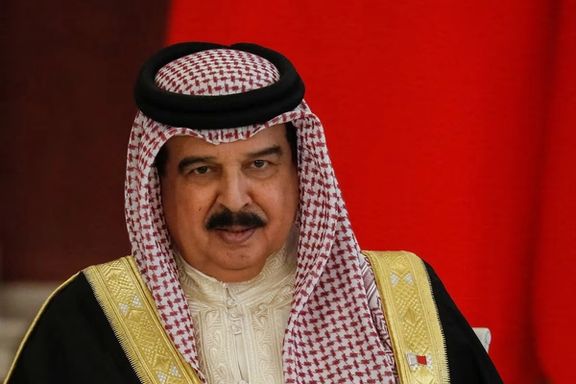
King of Bahrain, Hamad bin Isa Al Khalifa attends a sign docs ceremony during his meeting with Russian President Vladimir Putin at the Kremlin in Moscow, Russia, 23 May 2024.

Bahrain's king has expressed a tentative willingness to resume diplomatic ties with Iran despite historical tensions and accusations against Tehran for inciting unrest within Bahrain’s Shi'ite majority.

The revelations were made during a dialogue with Russian President Vladimir Putin, King Hamad bin Isa Al Khalifa opening the door to ties in the wake of both United Arab Emirates and Saudi's thawing tensions.

Tiny but geopolitically significant Bahrain, hosting the US Navy's Fifth Fleet, has repeatedly accused Iran of destabilizing efforts by fueling dissent among its Shi'ite population against the ruling Sunni monarchy. The 2011 protests, a part of the broader Arab Spring movement, were suppressed by the government, with Iran being partly blamed for the upheaval—a charge Iran has consistently denied.

The kingdom has a long-standing alignment with US and UK interests, notably highlighted by its sole Persian Gulf state endorsement of the strikes against the Iran-aligned Houthis in Yemen following their Red Sea confrontations earlier this year.

The recent thaw in relations was marked by an Iranian parliamentary delegation's visit to Bahrain last year for the International Inter-Parliamentary Union Assembly, the first official Iranian presence in Bahrain in seven years after Manama’s severance of ties with Tehran in 2015, closely mirroring Saudi Arabia’s diplomatic break-off.

The tentative diplomatic rapprochement comes on the heels of a landmark agreement between Iran and Saudi Arabia, brokered by China last year, which ended a seven-year standoff by agreeing to reopen embassies and diplomatic missions.

In the previous year, ties had also mended between Iran and the United Arab Emirates, known as the region's 'little Sparta' for the power it wields relative to its size.

Most Viewed

Ghalibaf defends Iran-US talks amid hardline backlash
1
INSIGHT

Ghalibaf defends Iran-US talks amid hardline backlash

2
ANALYSIS

From instability to influence: Pakistan’s pivotal role in US-Iran diplomacy

3
ANALYSIS

100 days on: why Iran’s January protests spread across social classes

4

War-hit homeowners feel abandoned as Iran’s reconstruction aid fades

5
INSIGHT

100 days on: the anatomy of Iran’s January crackdown

Banner
Banner

Spotlight

  • Bread shortages, soaring prices strain households in Iran, residents say
    VOICES FROM IRAN

    Bread shortages, soaring prices strain households in Iran, residents say

  • War-hit homeowners feel abandoned as Iran’s reconstruction aid fades

    War-hit homeowners feel abandoned as Iran’s reconstruction aid fades

  • 100 days on: the anatomy of Iran’s January crackdown
    INSIGHT

    100 days on: the anatomy of Iran’s January crackdown

  • Ghalibaf defends Iran-US talks amid hardline backlash
    INSIGHT

    Ghalibaf defends Iran-US talks amid hardline backlash

  • 100 days on: why Iran’s January protests spread across social classes
    ANALYSIS

    100 days on: why Iran’s January protests spread across social classes

  • From instability to influence: Pakistan’s pivotal role in US-Iran diplomacy
    ANALYSIS

    From instability to influence: Pakistan’s pivotal role in US-Iran diplomacy

•
•
•

More Stories

Astrologer's Prediction of Raisi's Death Stirs Controversy

May 23, 2024, 18:34 GMT+1
•
Iran International Newsroom

Turkish astrologer İlayda Aşkın's prediction of the helicopter crash that killed Iranian President Ebrahim Raisi has sparked a social media sensation.

Aşkın, known for her accurate forecasts including plane crashes and political outcomes, had foretold major upheavals for Iran, pinpointing the exact date of the late President's death as a significant date. 

On April 13, 2024, just over a month before the incident, Aşkın tweeted, "The curtain will open for Iran after April 29, especially around May 19. The real agenda is then."

This prediction turned prophetic when President Raisi and his Foreign Minister, Hossein Amir-Abdollahian, died in a helicopter crash exactly on the day of the predicted upheaval, May 19.

The accuracy of her prediction, particularly the specificity of the dates involved, has fueled intense discussion and further propelled Aşkın's reputation as a seer amidst her followers and skeptics alike. Her previous predictions, which have included the outcomes of the 2023 Presidential elections in Turkey, added layers of credibility to her recent forecasts.


Challenges Facing Khamenei; Succession and Lack of Public Trust

May 23, 2024, 18:34 GMT+1

Khamenei's biggest challenge is winning the nation's trust. Nearly nine out of ten social media comments about former President Ebrahim Raisi's death blame Khamenei or his political system for the loss.

This presents a dual challenge for Khamenei: first, regaining the trust of the general public, and second, reassuring political players, including his obedient supporters, that he values their well-being and contributions. His comments about Raisi were notably unappreciative, clearly stating that his absence would not change anything.

President Raisi’s death in a helicopter crash brought the Islamic Republic’s weaknesses to the fore. Hours after the incident, the government could not locate the crash site. Khamenei's government also seemed to lack a news dissemination and gatekeeping mechanism in place. The chaos in news dissemination about he helicopter crash alerted even regime insiders. Former presidential adviser and top security and intelligence expert Hesamoddin Ashna begged the core of the regime to conduct a serious investigation and not to rule out any possibility.

Hardline conservative member of the Iranian parliament, Mostafa Mirsalim said Raisi's loss was a catastrophe for the regime and called on Acting President Mohammad Mokhber to investigate all the flaws in the system that led to Raisi's death.

In the days after the incident, the only response by the government has been to bar the media from analyzing the possible reasons and scenarios that contributed to the death of the country's president, foreign minister and several other officials.

The next challenge is security. Even while the nation awaited news about the former President's fate, a gunman in Tehran killed three police officers, including two colonels. The IRGC's Telegram channel downplayed the incident, describing the gunman as "an evil man" and incorrectly stating that only one officer was a captain and the other two were non-commissioned officers. However, social media users pointed out, based on photos, that two of the victims were indeed colonels.

Another indication of security concerns was the widespread rumor in Tehran that Police Chief General Radan had been assassinated. A pro-government social media activist and former state TV producer urged the government to inform the public about the police chief's whereabouts and safety to restore a sense of security and reassurance.

Nothing has been done after three days.

Meanwhile, tight security measures around Khamenei during the funeral ceremony for Raisi was eye-catching. Many pointed that out on social media as bodyguards separated him even from the first row of Iranian dignitaries who are usually trusted insiders.

A more existential challenge facing Khamenei is the uncertainty that will most certainly lead to more economic problems for the people and the government. The issue of succession is one of the biggest reasons for the general uncertainty about what the future will bring. In the absence of a mechanism like choosing a crown prince in monarchies, no one can be sure that the succession will be smooth.

The suspicious death of Khomeini’s son, who was a serious contender to succeed the Islamic Republic's first supreme leader, clearly indicates that after the leader is dead there is no guarantee that his son would be taken care of by those who were loyal to him before his demise.

Meanwhile, in the short run, the June presidential election poses a threat to the coherence of the system, if not its strength. There are dozens of contestants who are uncertain of Khamenei's true support, with most believing he already knows who will succeed Raisi. Pundits suggest that the public is unlikely to welcome the election for this very reason.

Nonetheless, the rivalry among the contestants is already so fierce that it frightens the nation. Some hardliners accuse one of the most likely contenders, Mehrdad Bazrpash, of possibly being involved in a conspiracy to eliminate Raisi. Others, such as former President Ahmadinejad and former Majles Speaker Larijani, who have previously been disqualified, are almost certain that Khamenei is unlikely to forgive their past mistakes—Ahmadinejad for not being sufficiently obedient and Larijani for allegedly conspiring with Rouhani to share power in a post-Khamenei government.
Secret US-Iran Talks Derailed by Raisi's Sudden Death

May 23, 2024, 17:33 GMT+1
•
Iran International Newsroom

Secret negotiations between Iran and the United States have been disrupted by the unexpected death of Iranian President Ebrahim Raisi.

Sources revealed to Middle East Eye, that the talks, held in Oman, where crucial discussions previously paved the way for the 2015 nuclear agreement, faced a sudden halt following the helicopter crash on Sunday that claimed the lives of several top Iranian officials.

Brett McGurk, President Joe Biden's senior Middle East adviser, and Ali Bagheri Kani, Iran’s lead negotiator, had been making progress in the first talks since January.

The discussions, which took place against a backdrop of escalating regional tensions, focused on several critical issues, including a mutual interest in altering the Israeli government, ending the Israeli military actions in Gaza, and preventing the conflict from spreading further in the Middle East. Analysts close to the Iranian regime suggested the talks might have also touched on a potential ceasefire between the US and Iran’s allies.

With the sudden leadership vacuum in Tehran, and with Iran poised to conduct presidential elections on June 28, the future of the high-stakes negotiations remains uncertain. The United States is also approaching its presidential elections in November, adding to the diplomatic standstill.

Sources also hinted that discussions might have extended to Iran's nuclear ambitions and the potential easing of oil sanctions, echoing elements of the previous nuclear deal, which the Trump administration abandoned in 2018. Despite a temporary agreement last year involving a prisoner exchange and the return of confiscated Iranian oil revenues, broader negotiations remain fraught with political challenges.

Chaos at Funeral of Raisi Delegate Highlights Disarray in Iranian Military

May 23, 2024, 16:00 GMT+1

A recently released video from the funeral procession of Mohammad-Ali Ale-Hashem, the Friday Imam of Tabriz who died in the helicopter crash which killed President Ebrahim Raisi, showcased disorder within the ranks of the Iranian army.

The footage from the event, which took place on Wednesday morning in Tabriz, was one of a series of events this week which has revealed the military's incompetencies as they struggled to maintain formation while carrying Ale-Hashem's coffin to the cemetery where he was buried.

The video has ignited a firestorm of controversy and mockery online, with many users critiquing the Islamic Republic for its inability to manage a straightforward military parade, despite its frequent displays of military prowess.

Adding to the embarrassment, during a live broadcast of a separate funeral held in Tehran for Ebrahim Raisi and his companions on Wednesday, another mishap occurred when an Iranian Army honor guard accidentally ripped his pants while carrying the coffin of Iran's Foreign Minister Hossein Amir-Abdolahian, who also died in the crash.

One social media user sarcastically suggested that former Foreign Minister Mohammad Javad Zarif might blame the low-quality pants on sanctions after Zarif pointed fingers at American sanctions for impacting Iran's aviation capabilities, attributing the helicopter crash to the United States.

Lavish Burial Site of Iranian President Sparks Outrage

May 23, 2024, 14:55 GMT+1
•
Iran International Newsroom

The late Iranian President, Ebrahim Raisi, is set to be buried in a grave surrounded by precious gold, marble, and a historic crystal chandelier, causing fury among a population now beset by poverty amid the worst economic crisis in decades.

According to reports from IRNA, the Islamic Republic's official state media, the designated site, located in the Dar al-Salam portico of Imam Reza's shrine in Mashhad, starkly contrasts the economic struggles faced by many Iranians.

The burial site boasts a marble floor and a door crafted from "precious gold," elements that highlight the regime's penchant for grandiosity. Adding to the splendor, a massive crystal chandelier, over 200 years old, with 144 branches and weighing approximately two tons, hangs above, symbolizing the official's disconnect from the populace.

Despite Raisi's supporters dubbing him the "Man of the Deprived," the lavishness of his final resting place paints a different picture. No official data on the cost of Raisi's grave is available, but graves in similar porticos reportedly sell for hundreds of billion rials, with some nearing ten billion rials (about $20,000).

Such extravagance comes at a time when at least one third of Iranians are now living below the poverty line, the crisis exacerbated by sanctions and government mismanagement. The Astan Quds Razavi website, which also notes that Raisi will be buried near Hashem Najafabadi, the maternal grandfather of Supreme Leader Ali Khamenei, further ties the lavish burial site to the entangled webs of power within Iran's political elite.

The opulent interment not only underscores the hypocrisy within the ranks of Iran's leadership but also fuels the growing discontent among its citizens who see a regime increasingly out of touch with the people it claims to serve.