• العربية
  • فارسی
Brand
  • Iran Insight
  • Politics
  • Economy
  • Analysis
  • Special Report
  • Opinion
  • Podcast
  • Iran Insight
  • Politics
  • Economy
  • Analysis
  • Special Report
  • Opinion
  • Podcast
  • Theme
  • Language
    • العربية
    • فارسی
  • Iran Insight
  • Politics
  • Economy
  • Analysis
  • Special Report
  • Opinion
  • Podcast
All rights reserved for Volant Media UK Limited
volant media logo

Car Bombing in Syria Targets Iran-Backed Fighters
Jun 8, 2024, 15:49 GMT+1
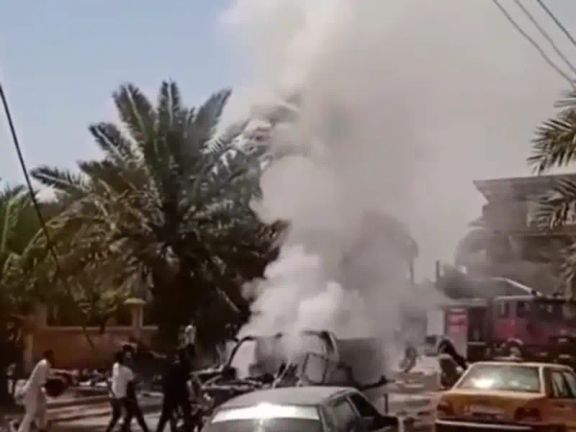
A photo allegedly showing the car bombing on June 8, 2024

A car bombing struck the eastern Syrian city of Deir Ezzor on Saturday, resulting in the deaths of two fighters aligned with Iran.

According to the Syrian Observatory for Human Rights, the attack occurred near an Iranian cultural center when an explosive device detonated inside an SUV, potentially intensifying the ongoing conflict within the region.

The Syrian Observatory for Human Rights, a UK-based watchdog with extensive networks inside Syria, confirmed that the vehicle, packed with explosives, was identified as belonging to militias supported by Iran, and the blast not only killed two individuals but also injured several others.

Following the explosion, Syrian government forces and Iran-backed groups quickly established a security cordon around the impacted site, signaling the importance of the area and Iran's deep-rooted presence there.

Deir Ezzor, recognized as a stronghold for Tehran, hosts numerous Iranian, as well as proxy forces and institutions.

The responsibility for the bombing remains unclaimed, and it adds to the ongoing turmoil in a region marred by frequent attacks.

Earlier this week, an attack attributed to Israel in northern Syria near Aleppo resulted in the deaths of 12 people in an area where forces allied with the Iranian government were present.

On April 1, an intense airstrike demolished a building within the Iranian diplomatic compound in Damascus, killing two senior Revolutionary Guard generals and five other officers. These individuals were reportedly engaged in planning operations to escalate attacks against Israel. In response, Iran launched a significant missile and drone strike against Israel on April 13, which resulted in minimal damage as most of the projectiles were intercepted.


Most Viewed

Iran negotiators ordered to return after internal rift over Islamabad talks
1
EXCLUSIVE

Iran negotiators ordered to return after internal rift over Islamabad talks

2
ANALYSIS

US blockade enters murky phase as tankers spoof signals and buyers hesitate

3
ANALYSIS

Why the $100 billion Hormuz toll revenue is a myth

4

US tightens financial squeeze on Iran, warns banks over oil money flows

5
ANALYSIS

US blockade targets Iran oil boom amid regional disruption

Banner
Banner

Spotlight

  • Hardliners push Hormuz ‘red line’ as US blockade tests Iran’s leverage
    INSIGHT

    Hardliners push Hormuz ‘red line’ as US blockade tests Iran’s leverage

  • Ideology may be fading in Iran, but not in Kashmir's ‘Mini Iran'
    INSIGHT

    Ideology may be fading in Iran, but not in Kashmir's ‘Mini Iran'

  • War damage amounts to $3,000 per Iranian, with blockade set to add to losses
    INSIGHT

    War damage amounts to $3,000 per Iranian, with blockade set to add to losses

  • Why the $100 billion Hormuz toll revenue is a myth
    ANALYSIS

    Why the $100 billion Hormuz toll revenue is a myth

  • US blockade targets Iran oil boom amid regional disruption
    ANALYSIS

    US blockade targets Iran oil boom amid regional disruption

  • Iran's digital economy battered by prolonged blackout
    INSIGHT

    Iran's digital economy battered by prolonged blackout

•
•
•

More Stories

Iran Claims Self-Sufficiency in Persian Gulf Bridge Project Amidst Tensions with China

Jun 8, 2024, 15:44 GMT+1

Abdolreza Abed, the commander of the IRGC's construction wing, Khatam al-Anbiya, has declared that foreign companies, including Chinese firms, are not needed for the Persian Gulf bridge project.

The 2.4 km bridge, which is set to connect Iran's Qeshm Island with its port city Bandar Abbas, is an infrastructure project aimed at enhancing the country's transportation network.

Despite the groundbreaking ceremony in 2011 under then-President Mahmoud Ahmadinejad, progress has been sluggish with only about 30% completion so far. Abed claimed that with adequate government funding, the project could be finished within the next two years.

The IRGC general claimed that Khatam al-Anbiya construction conglomerate can manage the financing and contributions required.

His comments come a few days after Iran's foreign ministry summoned the Chinese ambassador to protest a joint statement between China and the UAE, which included language supporting the UAE's claim to three islands in the Persian Gulf, currently controlled by Iran but also claimed by the UAE.

The UAE, a key ally of the United States, became independent from Britain just before Iran took control of the islands during the monarchy in 1971.

Over the past decade, China has emerged as one of Iran's largest trading partners.


Reform Front's Akhoundi Challenges Iran's Guardian Council Over Qualifications

Jun 8, 2024, 13:31 GMT+1

Abbas Akhoundi, a candidate from the Reform Front, has publicly urged Iran’s Guardian Council to engage directly with him and his fellow candidates regarding their qualifications for the upcoming snap presidential election on June 28.

Akhoundi said, "I am confident that all of us (candidates from the Reform Front) meet the qualifications stipulated in the constitution, and there is no reason to disqualify any of us."

The plea comes in the wake of the announcement by Javad Emam, spokesperson for the Reform Front, which revealed that Abbas Akhoundi, Masoud Pezeshkian, and Es'haq Jahangiri have been selected as the Front’s candidates for the government-controlled election to choose a successor to Ebrahim Raisi, who died in a helicopter crash last month.

Former President Mohammad Khatami has declared that he will endorse the election only if at least one candidate from the Reform Front is allowed to participate.

The Guardian Council, a 12-member body closely aligned with Supreme Leader Ali Khamenei, has been systematically blocking 'reformist' candidates from participating in elections. The practice has been a major point of contention, reinforcing the stronghold of conservative and hardline groups within Iran’s political system. The trend of disqualifying potential 'reformist' and non-hardline candidates has been particularly noticeable since 2020, impacting both parliamentary and presidential races.

As the election approaches, the international community and domestic observers are closely watching the Guardian Council’s actions, which are seen as pivotal in determining the direction of Iran's future political landscape.


Facing Threats from Russia, China and Iran, US May Expand Nuclear Arsenal

Jun 8, 2024, 13:16 GMT+1

The US may reverse its long-held policy and expand its nuclear arsenal, a senior White House official said Friday, aiming to bolster deterrence against Russia and prevent Iran from developing a nuclear bomb at all costs.

“We are prepared to use all elements of power to prevent Iran from obtaining nuclear weapons,” US top National Security Council arms control official Parnay Vaddi said, stressing that “dealing” with Iran’s nuclear ambitions is not easy, and that the US must also set the conditions for future diplomacy with Tehran.

Vaddi’s intervention comes at a time of increased pressure on Iran to come clean with its nuclear program. Less than a day before his speech at the Arms Control Association (ACA) conference in Washington DC, three European powers (France, Germany and the UK), known as the E3, wrote to the UN Security Council, detailing Iran's violations of its 2015 nuclear deal.

The letter is based on the most recent report by the International Atomic Energy Agency (IAEA), and seems to be an attempt by the E3 to pressure the authorities in Iran to resolve the issue diplomatically and avoid UN sanctions.

Iran has rejected the E3 advance, arguing that it has the right to expand its nuclear work since the US withdrew from the Joint Comprehensive Plan of Action or the JCPOA in 2018.

Earlier in the week, the E3 managed to push a resolution critical of Iran at the IAEA board meeting, despite reservations from the Biden administration, which fears that Iran could retaliate by accelerating its nuclear activity or by encouraging its proxies to resume or ramp up attacks on American forces across the Middle East.

In a notable policy shift Friday, Vaddi indicated that the United States might need to deploy more strategic nuclear weapons in the coming years to deter threats from "adversaries," mentioning Russia, China, North Korea and Iran.

"Absent a change in adversary arsenals, we may reach a point in the coming years where an increase from current deployed numbers is required,” Vaddi told the Arms Control Association, outlining a more “competitive” approach. “We need to be fully prepared to execute if the president makes that decision,"

Only a year ago, the US National Security Adviser Jake Sullivan told the same group that there was no need to increase US strategic nuclear arms deployments to counter the arsenals of Russia and China, offering talks "without preconditions."

The US currently observes a limit of 1,550 deployed strategic nuclear warheads, as set by the 2010 New START treaty with Russia, despite the latter suspending its participation last year in response to US support for Ukraine

Vaddi on Friday also highlighted increased cooperation among Russia, China, Iran, and North Korea, which the US officials say threatens global peace and stability. This collaboration includes sharing advanced missile and drone technology, as evidenced by Russia's use of Iranian drones and North Korean artillery in Ukraine and Chinese support for Russia's defense industries.

US nuclear doctrine, Vaddi explained, reserves nuclear weapons for deterring attacks by adversaries on the US and its allies and partners. However, if adversaries continue to increase their reliance on nuclear weapons, the US. will have no choice but to adjust its posture and capabilities to preserve deterrence and stability.

The Biden administration has been trying to modernize the US arsenal while remaining committed to international arms control. President Biden has pledged continued compliance with the deployment limits set by the New START treaty as long as Russia observes them.

Islamic Scholar Slams Iranian Authorities for Prosecuting Activists Exposing Abuse

Jun 8, 2024, 11:51 GMT+1

Iranian writer and Islamic scholar Sedigheh Vasmaghi is calling for a shift in the Islamic Republic's judicial approach, urging that agents accused of assaulting detained women be prosecuted.

She slammed the judiciary for prosecuting whistleblowers like jailed Nobel laureate Narges Mohammadi who expose such abuses.

Mohammadi, a prominent human rights detained activist, faces charges for the fourth time over her efforts to bring light to the sexual assault of imprisoned women, including journalist Dina Ghalibaf.

Vasmaghi, herself previously jailed for opposing Iran's mandatory hijab, has taken a bold stance by using her Instagram platform to share her experiences and those of others like Ghalibaf who suffered under the hands of the morality police.

According to Vasmaghi, during her time in Evin prison, she witnessed firsthand the aftermath of the abuses, particularly when Ghalibaf was detained and subjected to violence and sexual harassment by officers.

Adding to the outcry, Mohammadi requested a public trial in her recent court appearance, seeking the presence of independent journalists, human rights activists, and legal representation. The move follows a similar call from 36 imprisoned political women, demanding transparency and the inclusion of independent media in Mohammadi's trial to ensure fairness and accountability.


IRGC General Alleges Foreign Conspiracy to Limit Iran’s Population Growth

Jun 8, 2024, 11:28 GMT+1

Mohammad Reza Naqdi, the Deputy Coordinator of the Revolutionary Guards, has claimed that foreign powers have orchestrated a plot to stunt population growth in Iran.

According to Naqdi, the strategy is motivated by fears of Iran's potential threat to superpower status of big powers.

"The enemy has planned to prevent the population increase in Iran due to the threat it poses to the superpowers," he stated.

In Iranian government's rhetoric, "enemy" usually refers to the United States.

He warned about the irreversible consequences of the country's declining birth rate, noting that if the trend persists, Iran is on track to become the world's third oldest country by 2041. He cautioned, "With the aging population, we are losing one of the elements of national security."

Naghdi added that 20% of Iranian couples are unable to conceive, primarily due to the rising age of marriage.

The fertility rate in Iran has dramatically dropped to a mere 0.6% from 1.23% in 2021, marking a steep downward trend from the 4.21% in 1984, shortly after the Islamic Revolution.

Iran's population has doubled since the early 1980s, growing from 40 million to 84 million. However, Supreme Leader Ali Khamenei has expressed concerns, urging that the nation's population should reach at least 150 million by 2050 to prevent an aged demographic profile.






