• العربية
  • فارسی
Brand
  • Iran Insight
  • Politics
  • Economy
  • Analysis
  • Special Report
  • Opinion
  • Podcast
  • Iran Insight
  • Politics
  • Economy
  • Analysis
  • Special Report
  • Opinion
  • Podcast
  • Theme
  • Language
    • العربية
    • فارسی
  • Iran Insight
  • Politics
  • Economy
  • Analysis
  • Special Report
  • Opinion
  • Podcast
All rights reserved for Volant Media UK Limited
volant media logo

Facing Threats from Russia, China and Iran, US May Expand Nuclear Arsenal

Jun 8, 2024, 13:16 GMT+1Updated: 16:38 GMT+0
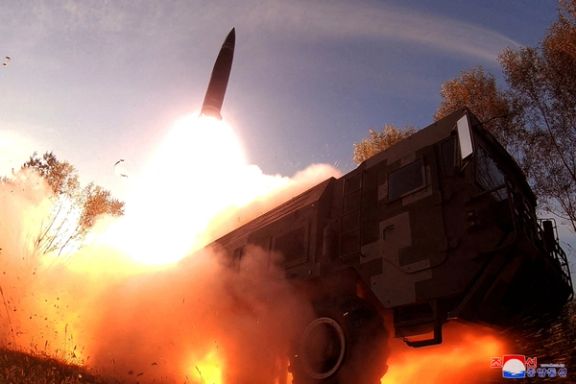
A missile launch is seen at an undisclosed location in North Korea, in this undated photo released on October 10, 2022

The US may reverse its long-held policy and expand its nuclear arsenal, a senior White House official said Friday, aiming to bolster deterrence against Russia and prevent Iran from developing a nuclear bomb at all costs.

“We are prepared to use all elements of power to prevent Iran from obtaining nuclear weapons,” US top National Security Council arms control official Parnay Vaddi said, stressing that “dealing” with Iran’s nuclear ambitions is not easy, and that the US must also set the conditions for future diplomacy with Tehran.

Vaddi’s intervention comes at a time of increased pressure on Iran to come clean with its nuclear program. Less than a day before his speech at the Arms Control Association (ACA) conference in Washington DC, three European powers (France, Germany and the UK), known as the E3, wrote to the UN Security Council, detailing Iran's violations of its 2015 nuclear deal.

The letter is based on the most recent report by the International Atomic Energy Agency (IAEA), and seems to be an attempt by the E3 to pressure the authorities in Iran to resolve the issue diplomatically and avoid UN sanctions.

Iran has rejected the E3 advance, arguing that it has the right to expand its nuclear work since the US withdrew from the Joint Comprehensive Plan of Action or the JCPOA in 2018.

Earlier in the week, the E3 managed to push a resolution critical of Iran at the IAEA board meeting, despite reservations from the Biden administration, which fears that Iran could retaliate by accelerating its nuclear activity or by encouraging its proxies to resume or ramp up attacks on American forces across the Middle East.

In a notable policy shift Friday, Vaddi indicated that the United States might need to deploy more strategic nuclear weapons in the coming years to deter threats from "adversaries," mentioning Russia, China, North Korea and Iran.

"Absent a change in adversary arsenals, we may reach a point in the coming years where an increase from current deployed numbers is required,” Vaddi told the Arms Control Association, outlining a more “competitive” approach. “We need to be fully prepared to execute if the president makes that decision,"

Only a year ago, the US National Security Adviser Jake Sullivan told the same group that there was no need to increase US strategic nuclear arms deployments to counter the arsenals of Russia and China, offering talks "without preconditions."

The US currently observes a limit of 1,550 deployed strategic nuclear warheads, as set by the 2010 New START treaty with Russia, despite the latter suspending its participation last year in response to US support for Ukraine

Vaddi on Friday also highlighted increased cooperation among Russia, China, Iran, and North Korea, which the US officials say threatens global peace and stability. This collaboration includes sharing advanced missile and drone technology, as evidenced by Russia's use of Iranian drones and North Korean artillery in Ukraine and Chinese support for Russia's defense industries.

US nuclear doctrine, Vaddi explained, reserves nuclear weapons for deterring attacks by adversaries on the US and its allies and partners. However, if adversaries continue to increase their reliance on nuclear weapons, the US. will have no choice but to adjust its posture and capabilities to preserve deterrence and stability.

The Biden administration has been trying to modernize the US arsenal while remaining committed to international arms control. President Biden has pledged continued compliance with the deployment limits set by the New START treaty as long as Russia observes them.
Most Viewed

Iran negotiators ordered to return after internal rift over Islamabad talks
1
EXCLUSIVE

Iran negotiators ordered to return after internal rift over Islamabad talks

2
ANALYSIS

US blockade enters murky phase as tankers spoof signals and buyers hesitate

3
ANALYSIS

Why the $100 billion Hormuz toll revenue is a myth

4

US tightens financial squeeze on Iran, warns banks over oil money flows

5
ANALYSIS

US blockade targets Iran oil boom amid regional disruption

Banner
Banner

Spotlight

  • Hardliners push Hormuz ‘red line’ as US blockade tests Iran’s leverage
    INSIGHT

    Hardliners push Hormuz ‘red line’ as US blockade tests Iran’s leverage

  • Ideology may be fading in Iran, but not in Kashmir's ‘Mini Iran'
    INSIGHT

    Ideology may be fading in Iran, but not in Kashmir's ‘Mini Iran'

  • War damage amounts to $3,000 per Iranian, with blockade set to add to losses
    INSIGHT

    War damage amounts to $3,000 per Iranian, with blockade set to add to losses

  • Why the $100 billion Hormuz toll revenue is a myth
    ANALYSIS

    Why the $100 billion Hormuz toll revenue is a myth

  • US blockade targets Iran oil boom amid regional disruption
    ANALYSIS

    US blockade targets Iran oil boom amid regional disruption

  • Iran's digital economy battered by prolonged blackout
    INSIGHT

    Iran's digital economy battered by prolonged blackout

•
•
•

More Stories

Islamic Scholar Slams Iranian Authorities for Prosecuting Activists Exposing Abuse

Jun 8, 2024, 11:51 GMT+1

Iranian writer and Islamic scholar Sedigheh Vasmaghi is calling for a shift in the Islamic Republic's judicial approach, urging that agents accused of assaulting detained women be prosecuted.

She slammed the judiciary for prosecuting whistleblowers like jailed Nobel laureate Narges Mohammadi who expose such abuses.

Mohammadi, a prominent human rights detained activist, faces charges for the fourth time over her efforts to bring light to the sexual assault of imprisoned women, including journalist Dina Ghalibaf.

Vasmaghi, herself previously jailed for opposing Iran's mandatory hijab, has taken a bold stance by using her Instagram platform to share her experiences and those of others like Ghalibaf who suffered under the hands of the morality police.

According to Vasmaghi, during her time in Evin prison, she witnessed firsthand the aftermath of the abuses, particularly when Ghalibaf was detained and subjected to violence and sexual harassment by officers.

Adding to the outcry, Mohammadi requested a public trial in her recent court appearance, seeking the presence of independent journalists, human rights activists, and legal representation. The move follows a similar call from 36 imprisoned political women, demanding transparency and the inclusion of independent media in Mohammadi's trial to ensure fairness and accountability.


IRGC General Alleges Foreign Conspiracy to Limit Iran’s Population Growth

Jun 8, 2024, 11:28 GMT+1

Mohammad Reza Naqdi, the Deputy Coordinator of the Revolutionary Guards, has claimed that foreign powers have orchestrated a plot to stunt population growth in Iran.

According to Naqdi, the strategy is motivated by fears of Iran's potential threat to superpower status of big powers.

"The enemy has planned to prevent the population increase in Iran due to the threat it poses to the superpowers," he stated.

In Iranian government's rhetoric, "enemy" usually refers to the United States.

He warned about the irreversible consequences of the country's declining birth rate, noting that if the trend persists, Iran is on track to become the world's third oldest country by 2041. He cautioned, "With the aging population, we are losing one of the elements of national security."

Naghdi added that 20% of Iranian couples are unable to conceive, primarily due to the rising age of marriage.

The fertility rate in Iran has dramatically dropped to a mere 0.6% from 1.23% in 2021, marking a steep downward trend from the 4.21% in 1984, shortly after the Islamic Revolution.

Iran's population has doubled since the early 1980s, growing from 40 million to 84 million. However, Supreme Leader Ali Khamenei has expressed concerns, urging that the nation's population should reach at least 150 million by 2050 to prevent an aged demographic profile.

Former Iran State TV Official to Be Deported from France

Jun 8, 2024, 10:52 GMT+1

Bashir Biazar, a former managing director of the Islamic Republic of Iran Broadcasting (IRIB), has been detained in France and is awaiting deportation, according to Iran International's Paris correspondent.

Biazar, who was in charge of the state TV’s music office, is currently in administrative detention—a procedure utilized for urgent deportation cases under French law, Niloufar Pourebrahim reported late Friday.

Sources informed Iran International on Friday that the deportation process for Biazar is in progress following his detention. While Iranian officials assert that his arrest is linked to his anti-Israel activities, sources have disclosed to Iran International that he is facing multiple security-related charges.

The nature of these charges are not clear, although in the past similar cases Iranian diplomats and government employees abroad were found to have had links with Tehran's security and intelligence organs.

Iran’s Acting Minister of Foreign Affairs, Ali Bagheri-Kani, and the head of the Judiciary's Human Rights Headquarters, Kazem Gharibabadi, have called for Biazar’s immediate release. On Thursday, Bagheri-Kani instructed Iran's ambassador in Paris to urgently address Biazar’s case.

The Iranian Embassy in Paris has yet to respond to Iran International’s inquiries regarding Biazar’s detention.

Earlier, the state-affiliated Mehr News Agency described Biazar as an activist, noting that he was summoned by the French police and subsequently arrested without explanation.

This incident occurs amidst the ongoing imprisonment of several French citizens in Iran, including Cécile Kohler, Jacques Paris, and Louis Arnaud.

Biazar has resided in France since 2022 on a long-term family visa due to his wife’s residency. Prior to his arrest, he posted a video of his speech at the UN Human Rights Council last November, in which he criticized Israel and the sanctions imposed on Iran.

Previously living in London, Biazar identified himself as the secretary of the Iran-backed Islamic Student Association of London in interviews with Iran’s state-run outlets such as the IRGC's Tasnim News Agency.

In an interview with Tasnim, Biazar stated: "After obtaining a bachelor's degree in political science from Allameh Tabatabai University and a master's degree in international relations from a university in Hyderabad, India, I went to London. There, I began studying filmmaking at Kingston University, and after the 2009 elections, I joined the Islamic Society."

Austrian Lawmaker Advocates for Tougher Stance Against Iran's IRGC

Jun 8, 2024, 10:28 GMT+1

Helmut Brandstätter, a member of the Austrian parliament, has reiterated his commitment to exert "maximum pressure on the Iranian regime" and to support the democratic revolution movement within Iran.

Brandstätter's stance includes pushing for the designation of Iran's Islamic Revolutionary Guard Corps (IRGC) as a terrorist organization, a label he believes will impact Iran’s operational capabilities.

Last month, Brandstätter urged the European Union to implement sanctions against the IRGC, reflecting growing concerns within the EU about Iran’s role in global security threats.

The IRGC, known for its substantial role in quashing dissent through its regular forces and the Basij militia, has been instrumental in suppressing protests and public activities within Iran.

The United States officially designated the IRGC as a foreign terrorist organization in 2019, based on its involvement in terrorist operations globally. Following suit, the United Kingdom last year acknowledged Iran, with its active IRGC components, as one of the country's most significant foreign threats, having thwarted multiple IRGC-led plots on British soil, especially on Iran International journalists.

The potential classification of the IRGC as a terrorist entity by the EU could alter European-Iranian trade dynamics, given that the IRGC is estimated to control over 50% of Iran's economy.

Iran Election Update: Candidate Withdraws Amidst Vetting

Jun 8, 2024, 09:14 GMT+1

Davood Manzoor, head of the Planning and Budget Organization, announced his withdrawal from the June 28 presidential race in Iran, a week after registering to run.

The announcement was made through a social media post on X, where Manzoor cited the overwhelming presence of Revolutionary Front hardliner candidates and the presence of more suitable options as his reasons for stepping back.

The development comes in the wake of the death of President Ebrahim Raisi in a helicopter crash, which has led to the announcement of a snap election on June 28.

The practice of announcing candidacies only to withdraw later is seen as a move by many in Iran to garner visibility and influence in the political arena. It is anticipated that many of the 80 candidates who registered to run will also soon withdraw in hope of getting their share in the next administration.

While the Guardian Council, a 12-member body under the control of Supreme Leader Ali Khamenei, has initiated vetting the hopefuls to announce the final candidates, Ezzatollah Zarghami, the Minister of Cultural Heritage and Tourism, in an interview on Saturday, expressed hopes that the council will be more generous in approving a varied list of candidates than in previous years.

However, Hadi Tahhan Nazif, spokesperson for the council, denied any allegations of election engineering in an interview, claiming that the Council impartially assesses the qualifications of all candidates, irrespective of their political affiliations.

The council has disqualified hundreds of candidates in both parliamentary and presidential elections over recent years, particularly since 2020.