• العربية
  • فارسی
Brand
  • Iran Insight
  • Politics
  • Economy
  • Analysis
  • Special Report
  • Opinion
  • Podcast
  • Iran Insight
  • Politics
  • Economy
  • Analysis
  • Special Report
  • Opinion
  • Podcast
  • Theme
  • Language
    • العربية
    • فارسی
  • Iran Insight
  • Politics
  • Economy
  • Analysis
  • Special Report
  • Opinion
  • Podcast
All rights reserved for Volant Media UK Limited
volant media logo

Israel 'Will Pay' for Killing of IRGC Officer in Syria, Commander Warns
Jun 5, 2024, 13:55 GMT+1Updated: 16:39 GMT

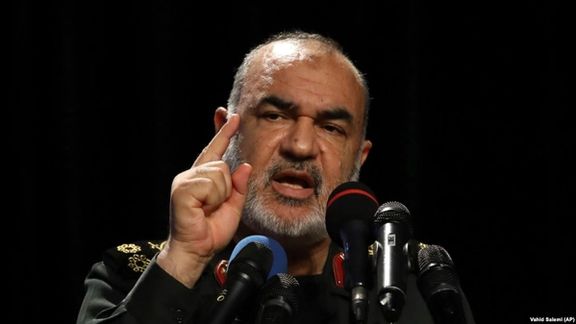
The IRGC Commander-in-Chief has warned that Israel will "pay the price" for an airstrike in Syria that killed Iranian Revolutionary Guard officer Saeid Abiar early Monday.

Hossein Salami in a condolence message for the killing of Abiar, said that Israel should “expect a response” for the attack which SANA, Syria's news agency, said killed several 'martyrs' in the attack overnight Monday along with causing 'material damage'.

Israel usually does not comment on attacks in Syria but it has been accused of striking Iranian military targets in Syria since 2011. Iran's presence in Syria grew in the wake of the civil war in a bid to keep President Bashar Assad in power, using Syria as a base to coordinate its proxies in the region and transfer weapons to the likes of Hezbollah in Lebanon.

The Britain-based Syria Observatory for Human Rights reported that the casualties included members of Lebanon's Hezbollah, a copper factory and a weapons warehouse, the intended targets of the strike. 

On Tuesday, Salami attended a funeral service for Abiar, who was a senior member of the IRGC's Quds Force and had been stationed in Syria since 2012, believed to be an advisor coordinating Iran's proxy activities.

It is the second such strike within a week and a continuation of escalating tensions between Iran and its archenemy, Israel. In April, an alleged Israeli airstrike killed two IRGC generals and multiple senior officials at the Iranian consulate in Damascus. It was followed by the first ever direct attack from Iran towards Israel on April 13, involving 350 missiles and drones, mostly intercepted by Israel and a US-led coalition.

A period of relative calm prevailed since mid-April, but apparently Israel resumed strikes against Iranian targets in Syria.

Iranian military commanders and officials often issue threats against Israel and it is not clear if Salami's threat means an imminent retaliation against Israel.

Iran has deployed thousands of Afghan militia and fighters from Iraq and elsewhere to fight against government opponents and take position near the Israeli border. The Israeli attacks have aimed to destroy Iranian weapons shipments to the Lebanese Hezbollah and stop Iran's entrenchment in Syria.


Most Viewed

Worst outcome is Islamic Republic’s survival, ex-CIA official says
1
PODCAST

Worst outcome is Islamic Republic’s survival, ex-CIA official says

2
ANALYSIS

Iran brings unusually broad team to US talks to blunt future blame

3
INSIGHT

Tehran sends tough message but keeps diplomacy door open

4

Zoroastrian religious figure arrested in Iran

Banner
Banner

Spotlight

  • What the US naval blockade would mean for Iran’s economy
    INSIGHT

    What the US naval blockade would mean for Iran’s economy

  • Tehran sends tough message but keeps diplomacy door open
    INSIGHT

    Tehran sends tough message but keeps diplomacy door open

  • Worst outcome is Islamic Republic’s survival, ex-CIA official says
    PODCAST

    Worst outcome is Islamic Republic’s survival, ex-CIA official says

  • Why the Iran-US truce is more likely to buy time than peace
    ANALYSIS

    Why the Iran-US truce is more likely to buy time than peace

  • Engaged but uncommitted: China watches Iran and US fight and talk
    ANALYSIS

    Engaged but uncommitted: China watches Iran and US fight and talk

  • A truce for the world, a reckoning for Iran’s economy
    ANALYSIS

    A truce for the world, a reckoning for Iran’s economy

•
•
•

More Stories

Iran Warns IAEA Against Issuing New Resolution

Jun 5, 2024, 11:32 GMT+1

Iran’s acting foreign minister issued a warning regarding the looming possibility of a new IAEA resolution targeting Iran, accusing the international nuclear watchdog of succumbing to political influence.

Ali Bagheri Kani said, "The non-constructive approach of some member countries in using the agency's capacity for their political goals will undoubtedly harm the identity and role-playing of the agency," after the E3 nations, comprising Britain, France, and Germany, jointly submitted a resolution to the United Nations nuclear watchdog’s Board of Governors on Monday. 

The resolution highlighted Iran's non-cooperation with the agency, expressing concerns over its pursuit of nuclear weapons amid rapid enrichment. The group also demands answers to undeclared sites.

A recent confidential report from the International Atomic Energy Agency (IAEA), highlights Iran's ongoing enrichment of uranium to levels nearing those required for weapons-grade material. Uranium enriched to 60 percent, as indicated in the report, brings Iran's enrichment capabilities dangerously close to the 90 percent threshold necessary for the production of atomic weapons.

Rafael Grossi, head of the IAEA, said Iran is "weeks not months" away from a nuclear weapon. Iran has consistently refuted the allegations, asserting that its nuclear activities are solely intended for peaceful purposes.


Nobel Laureate's Campaign Targets Iran's Sexual Assault on Dissidents

Jun 5, 2024, 11:18 GMT+1
•
Niloufar Goudarzi

Imprisoned human rights activist and Nobel Peace Prize laureate Narges Mohammadi has launched a campaign to raise awareness and end state-led sexual harassment of protesters.

Mohammadi is urging people to join the inaugural campaign, "One Voice Against Sexual Assault and Harassment," by sharing their personal stories to create awareness among others.

“Some political regimes use rape and sexual assault of any kind as a weapon against anyone who is deemed to be different from them,” the statement of the campaign published on Mohammadi’s Instagram account read. “The contemporary history of Iran testifies to such a horrific abuse.”

“In the 1980s and during the Kahrizak disaster, even some officials of the Islamic Republic of Iran admitted to sexually abusing prisoners and detainees,” the statement added.

Kahrizak Prison, located in southern Tehran, gained notoriety for the alleged torture and rape of detainees following the June 2009 post-election protests. Among the victims was the son of Abdolhossein Rouhalamini, a longtime member of Iran's Basij paramilitary force and a Member of Parliament, who died in the prison due to mistreatment and neglect.

At the time, Amnesty International called for the full disclosure of the investigation into the abuses committed at Kahrizak.

Iranian authorities executed and tortured thousands of prisoners during the 1980s purge of prisoners. While the exact number of those executed is unknown, Amnesty International estimates that between July and September 1988, authorities "forcibly disappeared" and "extrajudicially executed" around 5,000 people.

Mohammadi’s social media post said that while “the leaders and perpetrators of such human tragedies are tried in front of the Iranian people, the narrators and whistleblowers of sexual harassment have always been tried and punished.”

Mohammadi has been convicted by the Islamic Republic’s non-independent courts three times following statements on the state’s abuse of dissidents. She faces a fourth trial on June 8.

In a letter published on Monday, 36 women political prisoners demanded Mohammadi’s trial be held publicly with witnesses and survivors of sexual harassment and assault, as well as independent media coverage.

The outspoken activist, currently serving a 6.5-year sentence for her human rights work, has been imprisoned multiple times.

She was most recently arrested in 2022 amid nationwide protests following the death of 22-year-old Mahsa Jina Amini in custody of the so-called morality police, for allegedly defying the state’s hijab rule. A UN Fact-Finding Mission has since said that the Iranian state is responsible for the physical violence that led to Amini’s death.

Jordan Announces Drug Bust Linked to Iran-Backed Networks in Syria

Jun 5, 2024, 11:04 GMT+1

Jordanian authorities have announced their largest drug bust in years at a border crossing with Saudi Arabia, tracing the origin to Iran-linked networks in Syria.

According to officials, the Jordanian army has intensified its efforts to combat drug smuggling, especially after recent clashes with individuals suspected of affiliations with pro-Iranian militias. 

In January, Jordanian jets conducted four strikes inside Syria targeting suspected farms and hideouts of Iran-linked drug smugglers.

Jordan and its Western allies have attributed the surge in smuggling to Lebanon-based, Iran-backed Hezbollah and other pro-Iranian militias controlling significant portions of southern Syria. 

To bolster security measures, Jordan has been promised US military aid, with approximately $1 billion already allocated for establishing border posts since the onset of the Syrian conflict in 2011, as confirmed by Jordanian officials.

Experts from the United Nations, the United States, and Europe have underscored how the illicit drug trade funds pro-Iranian militia and pro-government paramilitary forces in Syria, which have emerged during more than a decade of conflict.

Syria has emerged as the primary hub for a multi-billion-dollar drug trade in the region, with Jordan serving as a crucial transit route to oil-rich Persian Gulf states for a Syrian-produced amphetamine known as captagon, according to US and Western anti-narcotics officials.


Iran's Houthis Launch Ballistic Missiles Into Red Sea

Jun 5, 2024, 10:05 GMT+1

The Iranian-backed Houthis launched two anti-ship ballistic missiles (ASBM) from Houthi-controlled areas of Yemen into the Red Sea over the past 24 hours.

The US military, CENTCOM, called the attack "continued malign and reckless behavior" by the group designated terrorists by countries including the US, claiming the ongoing offensive threatens regional stability and endangers the lives of mariners across the Red Sea and Gulf of Aden. No injuries or damage was reported by US, coalition, or commercial ships. 

The Houthis began a blockade of the Red Sea region in mid-November in support of Iran-backed Hamas's war in Gaza following Iran’s Supreme Leader Ali Khamenei's call on Muslim countries to blockade Israel and Israeli-linked ships. However, since the US and UK launched direct attacks on Houthi targets, the Yemeni proxy said they are also targets of the blockade.

Dozens of hostages unrelated to Israel have been taken hostage on ships unrelated to the Jewish state since the blockade began. Claiming to be in allegiance with Hamas in Gaza amid the war sparked by the terror group's invasion of Israel of October 7, in which 1,200 mostly civilians were killed and 250 hostages taken to the strip, the blockade has since extended to the Indian Ocean. It has had a major impact on international shipping through the Red Sea, the shortest route between Asia and Europe.


Netanyahu Vows 'Strong Action' Against Hezbollah

Jun 5, 2024, 10:04 GMT+1

Israeli Prime Minister Benjamin Netanyahu toured the country's northern border with Lebanon on Wednesday and said Israel was prepared for strong action in the north against Iran-backed Hezbollah.

Israeli towns near the border, many of which have been evacuated, have been a frequent target of rocket and drone launches from Lebanese militant group Hezbollah. The rockets set off massive wild fires this week, burning swathes of land across northern Israel.

"Whoever thinks that they can harm us and we will sit idly by is making a big mistake. We are prepared for a very strong action in the north. In one way or another we will restore security to the north," Netanyahu said.

In recent days, there have been more reports citing Israeli officials of a possible military push against the heavily armed Hezbollah that controls Lebanon's border region with Israel.

Iran-backed Hezbollah and Israel have been exchanging fire for the past eight months in parallel with the Gaza war, raising concerns that an even wider conflict could break out between the heavily armed adversaries.

The hostilities between Israel and Hezbollah have been their worst since they waged war in 2006, and tens of thousands of people on both sides of the border have been forced to flee their homes.

Reporting by Reuters





