• العربية
  • فارسی
Brand
  • Iran Insight
  • Politics
  • Economy
  • Analysis
  • Special Report
  • Opinion
  • Podcast
  • Iran Insight
  • Politics
  • Economy
  • Analysis
  • Special Report
  • Opinion
  • Podcast
  • Theme
  • Language
    • العربية
    • فارسی
  • Iran Insight
  • Politics
  • Economy
  • Analysis
  • Special Report
  • Opinion
  • Podcast
All rights reserved for Volant Media UK Limited
volant media logo

Iran and Niger Cement Alliance With Secret ‘Yellowcake’ Uranium Deal
Banafsheh Zand

Contributor

Jun 1, 2024, 06:00 GMT+1Updated: 16:41 GMT+0
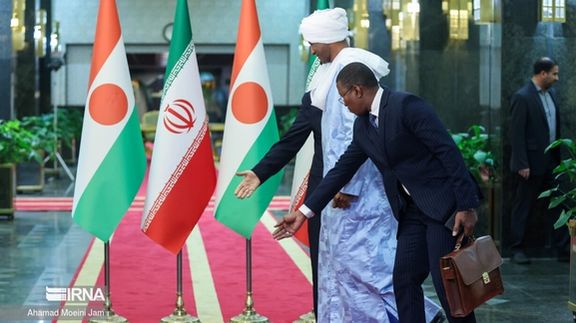
Nigerien Prime Minister Ali Lamine Zeine (left) during a visit to Tehran (January 2024)

Recent reporting suggests that after covert negotiations, Iran and Niger have agreed on a $56 million deal to see Tehran acquire 300 tons of refined uranium.

First reported by the France-based media outlet Africa Intelligence in late April, it was revealed that Niger's military junta had engaged in "secret negotiations" with Iran for the delivery of 300 tons of yellowcake in exchange for drones and surface-to-air missiles.

Yellowcake is a concentrated form of uranium oxide, appearing as a yellowish powder. It is produced from uranium ore and serves as an intermediate step in making nuclear fuel or weapons.

French newspaper Le Monde has since corroborated the clandestine negotiations – and reports that the specific type of uranium is produced in the mines belonging to a French company.

Uranium, Le Monde reported, is Niger's most important export product and comes from mines that have been exploited since 1971 by the French group Orano in Arlit, located in north-central Niger.

Niger's Junta government has denied the secret negotiations and agreement.

According to Africa Intelligence, as part of the agreement, Tehran would provide large-capacity generators to Niamey to address Niger's energy deficit and support agricultural conversion efforts. These initiatives were launched by the new government, which came to power in a coup d'état on July 26, 2023.

The outlet's sources also said that a covert meeting between Iranian representatives and the Nigerien prime minister, Ali Lamine Zeine, occurred in August 2023 in Bamako, Mali. General Salifou Modi, the second in command of the Nigerien military junta, was also present. Iranian representatives are said to have also met with delegations of "pan-African" activists serving the juntas of Mali, Niger and Burkina Faso.

This deal would not only challenge the numerous sanctions and agreements designed to prevent Iran from proliferating nuclear weapons, but simultaneously raises concerns in Washington and Paris. If Tehran acquires more uranium, it could expedite its nuclear capabilities, escalating international tension.

The reported amount of uranium is roughly equivalent to Iran's 2019 domestic output.

This move also has the potential to create tensions between Niger and Western countries, which have been outspoken in expressing their concerns against the sale of uranium to the Islamic rulers in Iran, bolstering Iran’s nuclear program.

This could lead to economic sanctions and political isolation for Niger, which would further undermine security in the region.

Other experts believe that Niger’s Junta is using this deal strategically, attempting to leverage their extensive uranium reserves to yield political and economic concessions from other international powers.

Shifting Alliances and Geopolitical Tensions in the Sahel

In July 2023, Niger’s President Mohamed Bazoum was overthrown by a military junta known as the National Council for the Safeguarding of the Homeland (CNSP). This marked the sixth military takeover in Africa’s Sahel region since 2020.

The series of coups began in Mali in 2020, followed by Guinea, Chad, and Sudan in 2021, and Burkina Faso in 2022. Guinea, Burkina Faso, and Mali have all shown strong support for Niger’s CNSP, opposing external efforts to reinstate Bazoum.

Since taking control, Niger's junta has expelled French, other European, and now American forces, while seeking support from Russia. In March of this year, Niger's junta demanded the withdrawal of US forces after a meeting with American officials. During the meeting, senior US officials expressed concerns about the arrival of Russian troops and accused Niger's military government of planning a uranium agreement with Iran.

Responding to these accusations, CNSP spokesperson Abdramane criticized the US delegation for allegedly trying to deny Niger's sovereignty and threatening retaliation. He emphasized Niger’s right to choose its partners to effectively combat terrorism.

The US had previously established a significant military presence in Niger, including two bases as part of a 2012 counterterrorism agreement. One of these, Air Base 201, cost over $100 million and has been used since 2018 to target Islamic State terrorists and Jama'at Nusrat al-Islam wal Muslimeen (JNIM).

Former Iranian President Mahmoud Ahmadinejad’s visit to Niger over a decade ago, was aimed at purchasing uranium before the 2015 JCPOA agreement. Germany-based Middle East researcher Hamid Talebian suggests that access to Niger’s uranium could be a reward for Iran’s military assistance to Russia.

In response to the Le Monde article about the rumor of the purchase of “yellowcake” by the Islamic Republic of Iran from Niger, Mohammad Eslami, head of the Atomic Energy Organization of Iran, told journalists: “You must consider the source of the news. For the first time ever, we announced the news of the Islamic Republic’s modest nuclear program to the ears of people in all corners of the world in a completely professional manner.”



Most Viewed

Iran diplomacy wobbles as factions compete to avoid looking soft on US
1
INSIGHT

Iran diplomacy wobbles as factions compete to avoid looking soft on US

2
ANALYSIS

The politics of pink: how Iran uses cuteness to rebrand violence

3

Scam messages seek crypto for ships’ safe passage through Hormuz, firm warns

4
EXCLUSIVE

Family told missing teen was alive, then received his body 60 days later

5
INSIGHT

Is Iran entering its Gorbachev moment?

Banner
Banner

Spotlight

  • Diplomacy tolls at Hormuz as conflict returns to its doorstep
    OPINION

    Diplomacy tolls at Hormuz as conflict returns to its doorstep

  • Opposition to US talks grows in Tehran as ceasefire deadline nears
    INSIGHT

    Opposition to US talks grows in Tehran as ceasefire deadline nears

  • Tehran moderates see ‘no deal–no war’ limbo as worst outcome
    INSIGHT

    Tehran moderates see ‘no deal–no war’ limbo as worst outcome

  • The future has been switched off here
    TEHRAN INSIDER

    The future has been switched off here

  • Lights out, then gunfire: Witnesses recount Mashhad protest crackdown
    VOICES FROM IRAN

    Lights out, then gunfire: Witnesses recount Mashhad protest crackdown

  • Is Iran entering its Gorbachev moment?
    INSIGHT

    Is Iran entering its Gorbachev moment?

•
•
•

More Stories

Does Larijani’s Presidential Candidacy Signal a Shift in Iran?

May 31, 2024, 21:18 GMT+1
•
Maryam Sinaiee

Former Speaker Ali Larijani’s registration to run for the presidency has sparked much speculation about whether Iran’s Supreme Leader has assured him that he will not be disqualified and will be allowed to run.

Some political analysts in Iran have welcomed Larijani’s decision to run, expecting that he may be able to improve the country’s international relations.

“It would be foolish for Larijani to enter the arena without any guarantees that the Guardian Council would approve him this time,” UK-based Iranian political analyst Shahir Shahidsaless tweeted.

Shahidsaless maintained that the question now is whether the political establishment, that is the Supreme Leader and his men, have prepared "to work with him" if he is elected or, on the contrary, it is Larijani who has promised to work with them.

Whether or not such guarantees have been made carries significant consequences. Mostafa Faghihi, chief editor of the conservative Entekhab news website in Tehran, believes that Larijani’s registration—and the possibility that he has received assurances from Khamenei has emboldened other moderates and reformists to register as well.

The Reforms Front led by former President Mohammad Khatami, however, says it will not support any candidate, presumably including Larijani, who does not hail from the reformist camp.

According to Shahidsaless, Larijani’s candidacy is “another game by the ruling establishment” for many Iranians. Khamenei and the Revolutionary Guard, they believe, are the main players who aim to increase voter turnout as a means of proving the Islamic Republic is a legitimate political system.

Other Iranians, he argues, believe voting for Larijani is the only way to prevent the hardliner Saeed Jalili from becoming president.

Larijani’s tweet Thursday can be interpreted in various ways

Larijani posted a tweet Thursday evening that can be interpreted in various ways. The only text in the tweet which has been viewed nearly two million times in less than 24 hours is “Without you we will not reach our destination”. “You” in this tweet can be interpreted as referring to Supreme Leader Ali Khamenei or the voters.

The tweet includes a google maps screenshot with the area where Supreme Leader Ali Khamenei’s office is located marked as the “starting point” of a car journey to the interior ministry, where registration takes place, and back to the area where the presidential office is also located marked as “destination”.

This may also be a suggestion that Larijani has received, or expects to receive, guarantees from Khamenei that he will not be disqualified, as he was in the 2021 elections.

Moderate conservative Larijani’s ultra-hardliner rival Saeed Jalili’s most viewed tweet in recent days has received around 260k views during the same time.

Larijani and Jalili’s divergence dates to September 2007 when the disagreements between populist Mahmoud Ahmadinejad and Larijani over a nuclear agreement with the West led to the latter’s resignation. Ahmadinejad then appointed Saeed Jalili as the secretary of the Supreme National Security Council.

At a brief press briefing after registration, Larijani emphasized that his government’s strategy would be security and power for “the whole region”. “[Iran's] military and defense capability not only guarantees Iran's security, but also supports the security of the region,” he said. He also maintained that his government will be inclusive of all political groups.

Many believe Larijani’s views and his approach to governance are very close to Hassan Rouhani’s whom Larijani has praised on various occasions.

Larijani’s statement, said expatriate political analyst Ali Afshari in a tweet, was a “clichéd imitation of Hasan Rouhani’s in 2012”. But this time, assuming that Larijani will pass the barrier of the Guardian Council, it will be extremely hard for him to “seduce” those Iranians who do not support the political right and are determined to overthrow the Islamic Republic.

But some Iranians may be influenced by Larijani’s emphasis on improving Iran’s foreign relations. “I’m pleased that Dr. Larijani spoke openly about ‘solving the sanctions issue’ as a foreign policy priority. For a long time, some people in the country have practically turned ‘solving the sanctions issue’ into a taboo and interpret it as giving up the country's security and independence,” Reza Nasri, an international relations expert in Iran, stated in a tweet. 


Iran's Post-Raisi Politics: Sanctification, Routinization, and Repression

May 31, 2024, 18:03 GMT+1
•
Majid Mohammadi

The sudden death of President Ebrahim Raisi and his companions in a helicopter crash on May 19, have revealed or accentuated some trends in Iranian politics.

Discussions about the Supreme Leader’s looming succession issue, primarily driven by speculation, have been sidelined for now as new issues come to the forefront – with three key trends emerging.

Sanctification 

The Iranian state propaganda machine consistently pushes narratives that are 180 degrees opposite of what many Iranians say in public and how they act. For example, as many increasingly distance themselves from religious sanctity in public life, the government places even greater emphasis on it. Following Raisi’s death, videos were circulated of people kissing his coffin, and high-ranking clerics sharing stories about the first Shia imam “speaking” to him.

In another sanctification of Raisi, the governor of Neyshabur shared a “vision” reported by someone at the funeral – and allegedly connected to the Hidden Imam, the 12th Imam in Shia Islam, believed to be alive but hidden and expected to reappear at the end of times. This supposed vision, seen on the night of the helicopter crash, depicted the Hidden Imam at the crash site. He was said to be anxiously moving near the crash site but ultimately decided not to perform a miracle.

The frequent presence of clerics in Shia mausoleums and cemeteries has revived old beliefs about their connection to Shia saints. The Islamic Republic’s propaganda apparatus promotes these superstitions, presenting them to the relatives of the deceased as if they were true.

Routinization 

Ali Khamenei has demonstrated that he does not want any change in the ruling class. The vote of about two-thirds of the parliament members for Mohammad Bagher Ghalibaf as speaker reflects the Leader's desire for continuity and stability. Despite the faction currently controlling both the parliament and the executive branch not presenting any plan to address the country's problems, it will remain in power. Khamenei is disregarding the many corruption allegations against Ghalibaf.

Following Khamenei’s advice, the government is attempting to portray a sense of normalcy. To this end, they have invited Mohammad Bin Salman to visit Iran. It is interesting that the Islamic Republic is using the invitation to bolster claims of normalcy while they have routinely called Saudi Arabia the “worst state in the world”.

Domestically, they are creating an illusion of participation and competition by including figures like former Parliament Speaker Ali Larijani, potentially Mahmoud Ahmadinejad and dozens of others in the presidential elections, despite these individuals having been previously purged from the political scene. This move is presented as if it can revitalize the political landscape.

A new wave of arrests and intimidation 

Due to widespread public opposition to the government, arrests of dissidents have been ongoing. However, the specific targets and directions of these arrests shift according to circumstances and events.

In the post-Raisi era, the widespread arrests and clampdown have focused on individuals celebrating, mocking, or ridiculing the regime in connection with the helicopter crash.

Before the arrests began, the country's Attorney General warned and threatened the public. "It is necessary to take necessary measures against those who misuse cyberspace about this incident to disturb the mental security of the society and disturb the public mind by publishing false content, lies, and insults; according to the regulations, a quick, effective, and deterrent action will be taken, and the result will be announced to this prosecutor's office,” he said.

In its announcement regarding the unexpected incident involving the president and the accompanying delegation, the Cyber Police stated that, in fulfilling its inherent duties and assigned missions, it carefully monitors cyberspace. Users are advised not to pay attention to rumors and false news.

The semi-official news agency ISNA, quoting Kerman province’s public prosecutor, reported that 288 social network users were identified as "virtual activists and leaders." In addition to "phone warning and guidance" to 254 people, "eight were summoned" to the judicial authorities.

US Slaps Sanctions on Enablers of Iran's Drone Production

May 31, 2024, 17:41 GMT+1

The US on Friday issued sanctions targeting entities for enabling Iran's drone program, in Washington's latest action seeking to disrupt the production and proliferation of UAVs used by Russia against Ukraine.

“Today’s action reinforces our commitment to disrupt Iran’s production and proliferation of deadly UAVs that continue to be used by Russia against Ukraine and by regional terrorist proxies against our troops,” US Treasury Department Under Secretary for Terrorism and Financial Intelligence, Brian Nelson, said in a statement.

“Treasury will continue to impose costs on those who seek to procure the components Iran needs for its UAV programs and enable the shipment of these weapons to destabilizing actors around the world.”

Iran has supplied thousands of Shahed kamikaze drones to Russia throughout its invasion of Ukraine launched in February 2022. They have been used to exhaust Ukrainian air defences and hit infrastructure far from the front lines.

The Treasury said it imposed sanctions on four entities that have procured critical parts for Iran's drone program as well as an executive of Iran Aviation Industries Organization (IAIO), a subsidiary of Iran’s Ministry of Defense and Armed Forces Logistics (MODAFL).

The Treasury said Afshin Khajeh Fard, the chief of IAIO, oversees its efforts to produce drones and missiles.

Friday's action freezes any of their US assets and generally bars Americans from dealing with them. Those that engage in certain transactions with them also risk being hit with sanctions.

EU Council Announces Further Sanctions Over Iran’s UAV Program

May 31, 2024, 15:45 GMT+1

The EU Council has sanctioned six Iranian people and three entities for involvement in Tehran’s UAV program,supplying Russia for its invasion of Ukraine or armed groups in the Middle East and Red Sea region.

Sanctioned individuals include Iran’s Defense Minister Mohammad-Reza Gharaei Ashtiani; Commander of Revolutionary Guards' extraterritorial Qods Force Esmail Qaani; Afshin Khaji Fard, who heads the Iranian Aviation Industries Organization (IAIO); Kavan Electronics Behrad LLC CEO Mehdi Dehghani Mohammadabadi;its board chair Hossein Hatefi Ardakani; and Gholam Ali Rashid, the commander of the Khatam al-Anbiya Central Headquarters.

The entities listed in the new measure are the IRGC Navy, IRGC’s Khatam al-Anbiya Central Headquarters, and Kavan Electronics Behrad LLC, which procures and sells components for manufacturing UAVs.

The European Council also strongly and unequivocally condemned the Iranian attack on Israel and affirmed its full solidarity with the people of Israel and commitment to Israel's security and to regional stability.

The Council also called on Iran and its proxies to cease all attacks that have escalated following Hamas October 7 attack on Israel that sparked the current Middle East conflict.

“The European Council stated that Russia’s access to sensitive items and technologies with battlefield relevance must be restricted to the maximum extent possible, including by targeting entities in third countries enabling the circumvention of sanctions.”

The European Council also called on the High Representative of the Union for Foreign Affairs and Security Policy and on the Commission “to prepare further sanctions, notably on Iran.”

Iran's Former Chief Banker Registers Bid for Presidency

May 31, 2024, 14:55 GMT+1

Abdolnasser Hemmati, the former governor of the Central Bank of Iran and a so-called ‘reformist’ politician, registered to run for president in Iran’s June 28 snap election in his second attempt.

After registration at the Iranian Interior Ministry headquarters in Tehran on Friday, he told reporters that despite the challenges Iran faces, “I remain optimistic about the future.” "My hope is reinforced every day when I witness the passion of our educated youth and the aspirations of Iranian women and men for a brighter future for themselves and their children."

In 2021 elections, Hemmati finished third with less than 10 percent of the votes, after late president Ebrahim Raisi and Mohsen Rezaei, a former Revolutionary Guards commander who served as Raisi’s vice president for economic affairs.

Hemmati is known for his harsh criticism of the economic policies of the hardliner government of Raisi, blaming his administration for the worsening economic crisis in the country.

In March, he accused the government of creating three-digit inflation of food prices and the impoverishment of tens of millions of people “while Iran has the biggest combined oil and gas reserves in the world.” Hemmati believes that Raisi’s policies led to higher inflation and more corruption, by offering economic privileges to insiders.

Earlier on Friday, former Iranian parliament speaker Ali Larijani officially registered to run in the snap election. In addition to Larijani, conservative MP Mahmoud Ahmadi-Bighash, former governor of Khorasan Province under President Mahmoud Ahmadinejad, also registered to run for office.

“So far, 6 people have definitively registered,” said Mohsen Eslami, spokesperson for Iran's Election Headquarters, on Friday, confirming Larijani and Ahmadi-Bighash’s registration.

Eslami emphasized, “Three women applied for registration, but they did not meet the requirements.”

Confirmed known registrants so far also include ‘reformist’ Mostafa Kavakebian and conservative figure Saeed Jalili.




