• العربية
  • فارسی
Brand
  • Iran Insight
  • Politics
  • Economy
  • Analysis
  • Special Report
  • Opinion
  • Podcast
  • Iran Insight
  • Politics
  • Economy
  • Analysis
  • Special Report
  • Opinion
  • Podcast
  • Theme
  • Language
    • العربية
    • فارسی
  • Iran Insight
  • Politics
  • Economy
  • Analysis
  • Special Report
  • Opinion
  • Podcast
All rights reserved for Volant Media UK Limited
volant media logo

Islamic Republic's Loyalists Attack Iranian Protesters in London

Negar Mojtahedi
Negar Mojtahedi

Iran International

May 24, 2024, 22:56 GMT+1Updated: 16:44 GMT+0
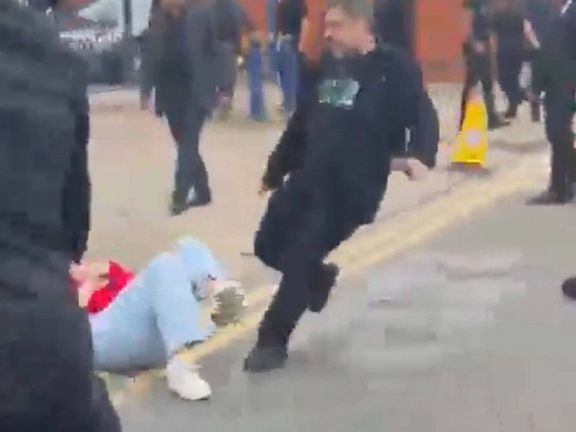
An Iranian woman is seen being beaten to the ground by a man seemingly loyal to the Islamic Republic of Iran during a gathering of Iranian dissidents in London on May 24, 2024

The Islamic Republic's loyalists on Friday violently attacked a group of Iranian dissidents who were celebrating Ebrahim Raisi's death in London, injuring at least four people.

Images of an Iranian woman beaten to the ground by a man seemingly loyal to the Islamic Republic of Iran is going viral on social media, and the alleged incident didn't take place in Iran.

It happened in the Western world: London, UK.

A memorial ceremony to honor late Iranian president Raisi and his entourage who died in a helicopter crash near the Azerbaijan border took place at Dewan Al-Kafeel Community Center in Wembley, London, on Friday.

The opponents of Iran's authoritarian government were standing outside to protest when they were attacked by the loyalists. Confrontations ensued and then screams are heard from a woman yelling for 'help' in Persian as several men dressed in black beat up protestors who were waving Iran's pre-Islamic Revolutionary flag, the Lion and the Sun.

The injured woman goes on to yell the name 'Nika Shakarami' referring to the 16-year-old Iranian girl, who according to a BBC World report, was violently sexually assaulted and killed by the Islamic Republic's security forces amid the 2022 uprising sparked by the death of Mahsa Jina Amini.

The Met Police in London responded to Iran International in an email, saying "four people were injured and were treated by paramedics. Their injuries are not believed to be either life threatening or life changing."

The Met police said one person has been arrested but did not identify if he was an Islamic Republic loyalist or not.

"One man was arrested on suspicion of violent disorder. Further enquiries will now follow to establish what further offences took place and to identify those involved."

Their investigation will include “an examination of footage shared on social media," the Met police spokesperson said in the email.

Iran expert: Friday's attack in UK is "a wake-up call" to the West

Gabriel Noronha, who worked on Iran at the US State Department, said the West has a serious problem.

"It's really grotesque, I think, and it's a wake-up call for those governments that they need to be more serious about eroding freedoms in their own country and the unchecked power of governments like those around you," said Noronha to Iran International.

Noronha said the infiltration of those loyal to the authoritarian government in Iran is a real threat to the West.

"If you don't push back on foreign repression activities, they're only going to get more emboldened and more violent here on our soil," he added.

The violence that played out in the streets of London Friday represents a much wider issue of Iran building networks of influence in the Western world according to Noronha.

"Islamic Republic has spent an inordinate amount of financial resources, and pressure and planning to build networks in foreign countries, to advance its interests. The things we are seeing are just the public facing ones. Underneath them are networks of proliferation for the regime's ballistic missile, drone and nuclear programs. It's money laundering, for the regime's terrorism. And ultimately, at the worst, it's, actual assassin operatives who are there to be able to kill the regime's critics, or at least bully, intimidate them, to be able to get their critics silenced, both literally and figuratively," he said.

Counter terrorism police in the UK revealed in Feb. 2023 that they foiled 15 plots by Iran to either kidnap or kill British or UK-based individuals it considers "enemies of the regime."

2023 Sydney Peace Prize laureate, human rights advocate and actress Nazanin Boniadi told Iran International, "I am horrified by the recent, brutal attack by Islamic Republic supporters on its opponents in the UK. The Metropolitan police must immediately investigate and bring the perpetrators to justice."

Boniadi who is a British citizen said she and her parents faced a hostile environment outside the Iranian embassy in London in the 1980s when she would attend protests against the regime outside the compound.

"These often included verbal insults and threats such as 'you’ll pay for betraying the Islamic Revolution' and 'we know where you live' — implying that the regime will find and harm its opponents," said Boniadi.

She said there is a "four-decade history of transnational repression by the Islamic Republic in the UK."

Boniadi described a deadly incident involving her family friend decades ago where she had felt the long reach of the Iranian regime in her new home, the UK.

"I was seven when a video shop we frequented in Kensington — owned by a prominent dissident and friend of my parents, Reza Fazeli — was bombed. His 22-year-old son Bijan, who worked at the shop, was killed in the blast. It was the first time I truly felt the regime’s long arm of repression. Less than a year later, dissident Mohammad Ali Tavakoli and his son were shot to death in their home in Wembley," said Boniadi who also brought up the example of the stabbing of Iran International journalist Pouria Zeraati.

The Washington-based NGO, Freedom House, urged British authorities to investigate Zeraati's attack as a possible act of transnational repression.

In 2023, UK's ITV revealed that the IRGC was plotting to assassinate two Iran International television anchors in London in 2022. The targets were former anchor Sima Sabet and host Fardad Farahzad.

In January, the US Department of the Treasury's Office of Foreign Assets Control (OFAC) and the United Kingdom took joint action against a network of individuals that targeted Iranian dissidents for assassination, they said, at the direction of the Iranian regime. The statement said the network is led by Iranian narcotics trafficker Naji Ebrahim Sharifi-Zindshti, operating at the behest of Iran's Ministry of Intelligence and Security (MOIS).

Boniadi said "45 years of providing a haven for the regime in the UK has increased the risk to its freedom-seeking opponents — often also British citizens. Instead, it is in the UK’s national and foreign policy interests to stand unequivocally on the side of pro-democracy Iranians who are risking everything for freedom, provide them with a safe haven and empower Iranian civil society towards self-determination, while disempowering a regime that is the number-one global sponsor of terrorism."

She said to achieve that goal, the UK needs to adopt the Universal Jurisdiction (Extension) Bill and enlist the Islamic Revolutionary Guard Corps (IRGC) as a terrorist entity.

UK-born Jonathan Harounoff, an Israel and Iran journalist and analyst said seeing images of Friday's attack on anti-regime protestors on British soil is disturbing.

"Footage of brave Iranian women inside Iran being harassed, beaten, arrested by regime forces often elicits strong condemnations from Western observers. Seeing instances of the same thing happening in London is deeply concerning," Harounoff told Iran International.

Harounoff said those protestors left Iran to escape the regime, and yet those loyal to the very system activists left behind, have found their way, destroying any kind of safety they once felt.

"Safety, freedom of assembly and speech are among the reasons why some Iranians in the diaspora settled in London. British police authorities must ensure these attacks don’t happen — it cannot become a regular occurrence," he said.

Iran's long reach goes beyond its borders

It's not just a problem in the UK, it applies to the rest of Europe, Canada and the United States, said Gabriel Noronha.

A recent Global news investigation found that upwards of 700 Iran regime-linked affiliates are operating on Canadian soil and threatening the lives of Iranian-Canadians.

As fireworks were set off in Iran by those happy to see their president's demise, in the US, a ceremony to honor the late President, known as the 'Butcher of Tehran' for his alleged role in the 1988 massacre, was held in Dearborn, Michigan.

Iranian-American activist Emily Sharif said she was disgusted to see the event on US soil.

"When I saw that US citizens were mourning the death of Ebrahim Raisi, I was not only disappointed, but also appalled. You would think that people who left Iran to seek a better life in the United States would not bring the radical ideology of the Islamic Republic in Iran with them," said Sharif.

She tweeted out a photo of the ceremony poster to X, telling Iran International that "those who attended the ceremonies in the US to “honor” and mourn Ebrahim Raisi, are the same individuals who remained silent or even celebrated the death of innocent Iranians killed by the regime in Iran. It’s disgusting and shameful."

Analyst and journalist Jonathan Harounoff said he's not surprised to see this event in Dearborn.

"Perhaps it’s not surprising after all that Dearborn, where chants of “Death to America” and “Death to Israel” are heard regularly, is also where inhabitants mourn over Raisi’s death. I don’t recall seeing mass protests held in Dearborn in support of the ‘Woman, Life, Freedom’ protesters."

Gabriel Noronha: The West treats Iran differently than Russia and China

Iran expert and Iran International contributor Gabriel Noronha believes Islamic Republic loyalists feel emboldened in the West, and part of the problem he said, is the West treats Iran with a different standard than Russia and China.

"When the Russian government tried to assassinate Sergei Skripal and his daughter in Salisbury, England, several years ago, the United States evicted 60 Russian diplomats and European and British countries evicted another 60 to 90 diplomats here [the US], where you've had Iranian assassin operatives multiple times try to kill British and other citizens, you've seen zero, diplomats expelled. You've seen zero embassies closed, you've seen zero sanctions implemented. And so there's a complete double standard when it comes to assassination intimidation efforts from the Iranians and from the Russians or Chinese," said Noronha.

He said while the issue of Iranian regime infiltration is impacting all Western countries, he believes it's an even bigger problem in Europe due to "fewer visa restrictions."

"There's a greater sense of entitlement and, freedom for these people to go in and conduct their agenda, unchecked, to the point that they feel entitled to go in and beat up protesters in UK soil," Noronha added.

In a statement to Iran International, Met police in the UK said they are encouraging anyone with footage that may aid in their investigation to come forward.

Most Viewed

Iran negotiators ordered to return after internal rift over Islamabad talks
1
EXCLUSIVE

Iran negotiators ordered to return after internal rift over Islamabad talks

2
ANALYSIS

US blockade enters murky phase as tankers spoof signals and buyers hesitate

3
ANALYSIS

Why the $100 billion Hormuz toll revenue is a myth

4

US tightens financial squeeze on Iran, warns banks over oil money flows

5
ANALYSIS

US blockade targets Iran oil boom amid regional disruption

Banner
Banner

Spotlight

  • Hardliners push Hormuz ‘red line’ as US blockade tests Iran’s leverage
    INSIGHT

    Hardliners push Hormuz ‘red line’ as US blockade tests Iran’s leverage

  • Ideology may be fading in Iran, but not in Kashmir's ‘Mini Iran'
    INSIGHT

    Ideology may be fading in Iran, but not in Kashmir's ‘Mini Iran'

  • War damage amounts to $3,000 per Iranian, with blockade set to add to losses
    INSIGHT

    War damage amounts to $3,000 per Iranian, with blockade set to add to losses

  • Why the $100 billion Hormuz toll revenue is a myth
    ANALYSIS

    Why the $100 billion Hormuz toll revenue is a myth

  • US blockade targets Iran oil boom amid regional disruption
    ANALYSIS

    US blockade targets Iran oil boom amid regional disruption

  • Iran's digital economy battered by prolonged blackout
    INSIGHT

    Iran's digital economy battered by prolonged blackout

•
•
•

More Stories

Famed Iranian Director and Actress Debut Cannes Film Post-Iran Escape

May 24, 2024, 21:12 GMT+1

After fleeing their native country, prominent Iranian filmmaker Mohammad Rasoulof and dissident actress Setareh Maleki attended the Cannes Film Festival for the premiere of their movie.

Rasoulof was greeted with a long-standing ovation on Friday as he displayed photos of the cast at the premiere of his latest film, "The Seed of the Sacred Fig," which is competing for the prestigious Palme d'Or award at the festival.

The dissident filmmaker fled Iran by foot through rugged mountainous terrain after receiving an eight-year prison sentence, a flogging, a fine, and property confiscation for “the signing of statements and the making of films and documentaries,” which the regime claimed are “collusion to commit a crime against the country's security.”

On the red carpet, Rasulof and actress Golshifteh Farahani showcased images of the film's actresses, Soheila Golestani and Misagh Zareh, who could not attend the event.

Maleki was forced to flee Iran following her appearance without the mandated hijab in an underground film, examining Iran's nationwide protest movement in 2022 following the death of Mahsa Jina Amini.

According to the UN, the Iranian regime is responsible for the violence that led to Amini's death - after she was reportedly detained and beaten by "morality police" for wearing her hijab improperly. The months-long protests, often dubbed the “Women Life Freedom” protests, saw security forces kill at least 550 and detain tens of thousands.

Iran's Culture Minister Mohammad Mehdi Esmaeili condemned the production and distribution of his film, calling it "illegal."

Maleki gained prominence before appearing in Rasoulof's film when she posted a video on Instagram in which she visited the grave of her father, who died of COVID-19, and vehemently criticized Supreme Leader Ali Khamenei for leading the "biggest dictatorship in history" as a "ruthless murderer."

A team of medical experts revealed in a report last year that over 75,000 Covid deaths could have been prevented in Iran if the Supreme Leader had not banned vaccines produced by American and British companies.

Prisoners in Iran Expose 'Secret Cells' in Urmia Leading to Suicides

May 24, 2024, 18:05 GMT+1

Dozens of prisoners in northwest Iran are warning about the existence of secret prison cells with severe conditions that have driven some to commit suicide, according to The Kurdistan Human Rights Network.

The prisoners, who are detained in the covert prison cells at Urmia Central Prison in West Azerbaijan Province, say they were "illegally" transferred to these cells as a form of "punishment."

In a letter addressed to the head of the Iran Prisons Organization and international human rights groups, they describe the cells as so overcrowded that it is impossible for them to sleep.

About 20 prisoners from the “regular” ward and 19 prisoners from the “hidden” prison ward collaborated to write the letter.

Some prisoners have reportedly been confined in these cramped 30-square-meter blocks for six months, with their families uninformed about their conditions and no officials visiting these wards.

The letter also stated that prisoners who protest their conditions are "tortured" and denied medical treatment. The prisoners demanded a visit from an official and expressed their deep despair, stating, "We are disappointed with life and even see our comfort in death."

In February, over 800 prisoners at Urmia Central Prison called for the removal of the prison's chief, alleging mistreatment had contributed to the increase in suicide incidents.

According to Amnesty International, prisoners in Iran are “subjected to cruel and inhuman conditions, including extreme overcrowding, unsanitary conditions, poor ventilation, infestation with mice or insects, and poor or no access to bedding, toilet and washing facilities.”

Often, prison officials and prosecution authorities intentionally deny prisoners adequate medical treatment, including for injuries sustained during torture.

In 2021, a hacktivist group calling itself Edalat-e Ali (Ali's Justice) leaked videos and confidential documents allegedly exposing the systematic mistreatment of inmates in Iranian prisons.

Iranian Nobel Laureate Slams UN General Assembly Memorial for Raisi

May 24, 2024, 17:48 GMT+1

Iranian Nobel Peace Prize laureate Shirin Ebadi has called on the UN General Assembly (UNGA) to cancel a planned tribute honoring Iranian President Ebrahim Raisi, who died last weekend in a helicopter crash along with other officials.

In an Instagram post, Ebadi wrote that the homage is being held despite the UN fact-finding mission recently categorizing the violence committed by the Islamic Republic as a "crime against humanity."

The UN Special Rapporteur on Human Rights has also reported widespread violations of human rights in Iran for years.

Ebadi, a former judge who won the 2003 Nobel Peace Prize for her pioneering human rights work in Iran, asked UN chiefs to call Raisi by the same term that "Iranians call him: Butcher of Tehran."

She contended that the UN's assertion that the ceremony follows protocol is incorrect, as Raisi is not Iran's highest political official.

"Ali Khamenei is the highest political and military official in the Islamic Republic. When he dies, the UN can hold a quadruple memorial ceremony for him along with Saddam Hussein, Muammar Gaddafi, and Hitler," she added.

In March, a UN fact-finding mission determined that the Iranian regime had committed crimes against humanity in its crackdown on 2022 protests, which included killings, imprisonment, torture, and sexual violence.

The UN Human Rights Council established the Fact-Finding Mission (FFM) in November 2022, two months after the Woman, Life, Freedom protests swept the country following the death of 22-year-old Mahsa Amini in custody, during which over 550 porters were killed and thousands were detained.

"The Islamic Republic's record is too tarnished and disgraceful for its officials to be honored in a venue that upholds principles of justice, fairness, and conscience," Ebadi further said.

Western leaders' condolence messages following the deaths of President Raisi and Foreign Minister Abdollahian have sparked immediate and harsh criticism among Iranians – and others.

Critics believe that offering condolences to such a regime implicitly legitimizes its actions, which encompass suppressing dissent, supporting terrorism, and committing ongoing human rights violations.

During the 1980s, Ebrahim Raisi served on a "Death Panel" that oversaw the execution of at least two thousand Iranian political prisoners.

On Monday, a minute of silence was observed at the UN Security Council meeting for Raisi and his delegation, and the UN flag was flown at half-mast at its New York headquarters.

Israel's ambassador to the UN, Gilad Erdan, condemned the observance and asked the council, “What's next? Will there be a vigil for Hitler? We wouldn’t be surprised.”

US Republican Senator Ted Cruz also criticized the Biden administration's condolence message and the UN's decision to fly its flag at half-mast.

Iran Armed Forces Appear to Reject Foul Play in Raisi Helicopter Crash

May 24, 2024, 17:03 GMT+1

The General Staff of Iran's Armed Forces released a preliminary report on the investigation into the President’s helicopter crash, stating that it collided with the mountain terrain and caught fire.

The statement, published on Thursday, claimed that the helicopter was on its designated flight path at the time of the accident and that "no bullet marks or similar damage" were found on the aircraft parts found at the crash site.

The helicopter carrying President Raisi and seven others, including Foreign Minister Hossein Amir-Abdollahian, crashed in heavy fog while crossing mountainous terrain near the border with Azerbaijan last Sunday, resulting in the deaths of all on board.

The report mentioned that the flight's pilot communicated with the two accompanying helicopters "about a minute and a half before the crash" but did not specify the nature of the call. No suspicious activity was allegedly detected in the communications between the control tower and the flight group.

Notably, the report also mentioned that the Iranian public should not pay attention to what he referred to as “unverified and speculative comments”, especially those spread by “foreign media on social media.”

Broadcasting from Iran is controlled by the Islamic Republic and reflects its official ideology. While opinions step out of those bonds online sometimes, the authorities often target and jail those who step out of line with the regime’s narratives, making Iran one of the world's most repressive countries for journalists.

In the immediate aftermath of the crash, state media presented numerous conflicting reports of what happened. That, combined with the apparent disregard for protocols, namely allowing a permit to be issued during a weather amber warning, and Raisi’s profile role as the next potential next Supreme Leader, has raised doubts and mystery around whether this was an accident.

The authorities face intensive scrutiny, including from domestic politicians, and the media inside Iran, who demand clear explanations and transparency regarding the cause of the crash.

Iranian Activist Put in Solitary for Exposing Bedbugs at Tehran Prison

May 24, 2024, 16:09 GMT+1

Zia Nabavi, a student activist and political detainee, has been moved to solitary confinement after raising concerns about bed bug infestations in Tehran’s Evin prison, his lawyer Amir Raeisian reported on Thursday.

Speaking with the Emtedad outlet, Raeisian said Nabavi “has not been able to communicate with his family members for days, so we cannot be certain about his condition."

This news follows Nabavi's open letter two weeks ago, in which he detailed the severe conditions caused by the infestation, including prolonged periods without sleep.

In response to the accusations, the Mizan news agency, which is affiliated with the judiciary, denied the presence of bedbugs in Evin Prison, describing the facility as one of the nation's "cleanest and most orderly prisons."

Human rights groups have long documented a history of severe human rights abuses at the notorious prison in the nation’s capital. Inmates endure beatings, sexual harassment, and deliberate neglect when in need of medical care. The prison suffers from chronic overcrowding and routinely employs solitary confinement.

Last week, Tehran's Taleghani Hospital announced that it would no longer accept dialysis patients from Evin Prison, citing the presence of bed bugs brought in by the inmates.

In a post on X, former political prisoner Mehdi Mahmoudian said that the hospital had sent the head of Evin's medical department a sample canister of bedbugs to substantiate the allegation.

Nabavi, who has long been targeted by authorities, was imprisoned last March for his role in a protest against chemical attacks and serial poisoning of female students across the country. The attacks affected thousands of young students, with hundreds requiring medical attention.