• العربية
  • فارسی
Brand
  • Iran Insight
  • Politics
  • Economy
  • Analysis
  • Special Report
  • Opinion
  • Podcast
  • Iran Insight
  • Politics
  • Economy
  • Analysis
  • Special Report
  • Opinion
  • Podcast
  • Theme
  • Language
    • العربية
    • فارسی
  • Iran Insight
  • Politics
  • Economy
  • Analysis
  • Special Report
  • Opinion
  • Podcast
All rights reserved for Volant Media UK Limited
volant media logo

Old Guard Cleric Takes Over Iran’s Succession Body Under Looming Uncertainty

Iran International Newsroom
May 21, 2024, 15:00 GMT+1Updated: 16:45 GMT+0
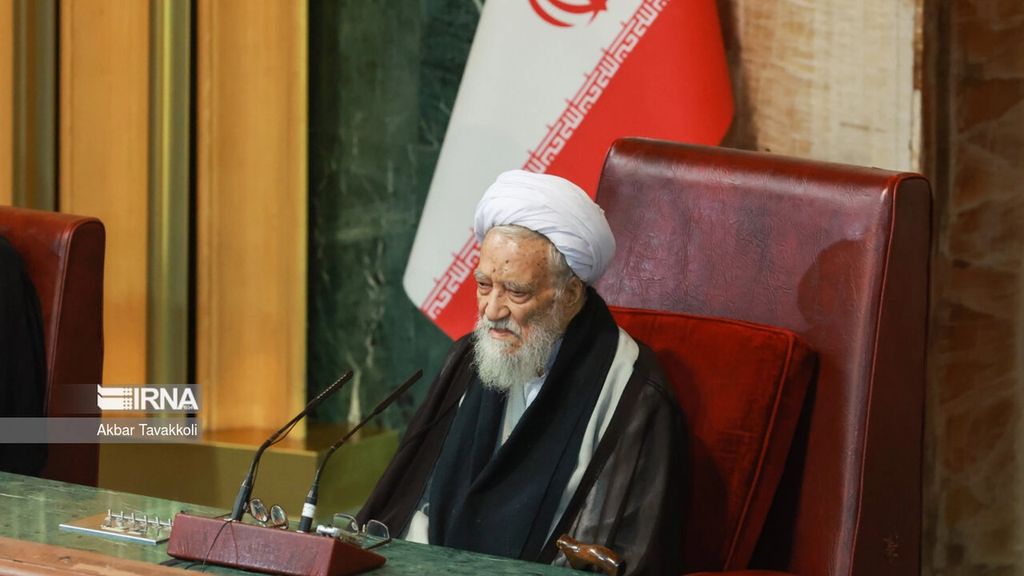
Ayatollah Mohammad Ali Movahedi Kermani, the chairman of the Assembly of Experts, during the opening session of the assembly in Tehran, May 21, 2024

Members of the Assembly of Experts, a body tasked with choosing the Islamic Republic's next supreme leader elected senior cleric Ayatollah Mohammad Ali Movahedi Kermani as the Assembly's chairman on Tuesday.

Before his death in a helicopter crash on Sunday, former President Ebrahim Raisi was the most likely candidate for the post.

Following his death, the Assembly, and in fact Supreme Leader Ali Khamenei were in difficulty to choose someone trustworthy from among the elderly clerics at the Assembly. There is no absolute guarantee that they chose the right person for one of the most sensitive periods in the Islamic Republic's history, although they did choose one of the most capable.

Iranian politicians and analysts agree that the new session of the Assembly of Experts is particularly significant, as it may be the one tasked with deciding Khamenei's succession. Some former members, such as Hassan Rouhani, have spoken bitterly about the inevitability of this decision, given Khamenei's age and illness. Ironically, however, Khamenei is about ten years younger than both the previous and the new chairmen of the Assembly.

‌Born in 1931, Movahedi Kermani is 93 years old, but looks relatively fit compared to other aging and ailing members of the Assembly.

Movahedi Kermani, an old guard figure in the Islamic Republic, is essentially the candidate they wanted, despite not having maintained a high profile in the Assembly before. Seyyed Hashem Hosseini Bushehri and Alireza Erafi, the head of Iran's seminaries, have been elected as deputy chairmen. Erafi who is also trusted by Khamenei, might have been a better choice for the position in terms of leadership capabilities.

The Assembly's previous chairman Ayatollah Ahmad Jannati is past 100 and too old to be able to walk, talk, and take care of himself independently. He did not run for the election on Tuesday, although he still keeps his powerful position at the Guardian Council where he determines who can and who cannot run for Parliament or Presidency, albeit based on Khamenei's suggestions.

Movahedi Kermani is a right-wing conservative with a background in the Militant Clerics Society and the former Islamic Republic Society. He was elected to the Majles five times and has been a member of the AoE since the very beginning. He is also a member of the Expediency Council.

He has taken tough stances on certain cultural issues, including declaring the messaging service Telegram as haram (religiously prohibited). However, it is possible that he has little understanding of what Telegram actually is and made the statement as a formulaic pronouncement.

Movahedi Kermani was close to the IRGC during the first years of the Islamic Republic but his links to the new generation of the Revolutionary Guard officers are not clear.

Of the 86 members of the Assembly, 83 were present at Tuesday's meeting, some with assistance from male nurses. Movahedi Kermani received 55 votes and will chair the Assembly's meetings for the next two years. Managing meetings where over 30 percent of the attendees do not support his leadership could prove challenging.

Unless all decisions are prearranged and the stage is set by Khamenei himself by naming his successor(s), the new chairman of the Assembly may struggle to achieve consensus on succession when the Islamic Republic needs it most. This uncertainty leaves the future unclear for many, insecure for some, and unstable for others.

Most Viewed

US blockade enters murky phase as tankers spoof signals and buyers hesitate
1
ANALYSIS

US blockade enters murky phase as tankers spoof signals and buyers hesitate

2

US tightens financial squeeze on Iran, warns banks over oil money flows

3
INSIGHT

Ideology may be fading in Iran, but not in Kashmir's ‘Mini Iran'

4
INSIGHT

Hardliners push Hormuz ‘red line’ as US blockade tests Iran’s leverage

5
VOICES FROM IRAN

Hope and anger in Iran as fragile ceasefire persists

Banner
Banner

Spotlight

  • Hardliners push Hormuz ‘red line’ as US blockade tests Iran’s leverage
    INSIGHT

    Hardliners push Hormuz ‘red line’ as US blockade tests Iran’s leverage

  • Ideology may be fading in Iran, but not in Kashmir's ‘Mini Iran'
    INSIGHT

    Ideology may be fading in Iran, but not in Kashmir's ‘Mini Iran'

  • War damage amounts to $3,000 per Iranian, with blockade set to add to losses
    INSIGHT

    War damage amounts to $3,000 per Iranian, with blockade set to add to losses

  • Why the $100 billion Hormuz toll revenue is a myth
    ANALYSIS

    Why the $100 billion Hormuz toll revenue is a myth

  • US blockade targets Iran oil boom amid regional disruption
    ANALYSIS

    US blockade targets Iran oil boom amid regional disruption

  • Iran's digital economy battered by prolonged blackout
    INSIGHT

    Iran's digital economy battered by prolonged blackout

•
•
•

More Stories

Iranian President’s Helicopter ‘Completely Exploded’, Search Team Says

May 21, 2024, 13:44 GMT+1
•
Iran International Newsroom

A team of search and rescue motorcyclists from the operation to find Iranian President Ebrahim Raisi, have revealed that the wreckage of the helicopter was "completely exploded and everything was burned." 

They also reported finding the bodies of Raisi and foreign minister Hossein Amir-Abdollahian close together but were barred from publishing any videos for "security reasons."

The search operation, which lasted over 15 hours, only concluded successfully with the aid of a night-vision drone provided by Turkey. The long delay in locating the helicopter, which also carried six others, intensified criticism of the Iranian government's efficiency, even in handling crises involving its top leaders.

Speculation about the cause of the crash is rampant, with theories ranging from an outlandish plot by Israel to more credible possibilities such as severe weather conditions.

Mohammad Javad Zarif, Iran's former foreign minister, controversially attributed the crash to US sanctions that restrict Iran’s access to essential aviation parts. In a Monday interview, Zarif stated, "One of the culprits behind the tragedy is the United States."

The helicopter, a 1970s-era US Bell chopper, had been in service since the monarchy, later confiscated by the government for official use. Observers point out that despite Iran's strong ties with nations like Russia and China, the regime has failed to modernize or adequately maintain its aviation fleet, raising questions about the true state of its domestic military and governmental transport capabilities.

The issue comes while Iran continues to fund billions of dollars to proxies around the region including arming and training Yemen’s Houthis and Lebanon’s Hezbollah with state-of-the-art missiles.

Iran’s Raisi Axed as Successor to Khamenei Months Before Death

May 21, 2024, 11:06 GMT+1
•
Iran International Newsroom

Ebrahim Raisi was reportedly stripped of his potential successor status to Iran's Supreme Leader, Ali Khamenei, months before his sudden death in a helicopter crash Sunday.

According to reports from Reuters, the Assembly of Experts decided six months ago to remove Raisi from the list of potential successors to Supreme Leader Ali Khamenei amid concerns over Raisi's waning popularity, compounded by Iran's deepening economic crisis and international isolation.

His removal signifies a significant shift within the opaque corridors of power in Tehran, reflecting the complexities and secretive nature of Iran's theocratic leadership succession with Khamenei’s favored son among the favorites to succeed.

Vali Nasr, a professor at John Hopkins School of Advanced International Studies, said: "Now they don't have a candidate, and that opens the door for other factions or other figures to emerge as serious contenders."

Raisi's presidency, which was initially seen as a stepping stone to the country's highest religious and political office, has instead culminated in a dramatic fall from grace. Critics and insiders alike noted that Raisi was a stalwart executor of Khamenei's hardline policies, particularly in suppressing dissent and tightening the regime's grip amid domestic and international pressures.

However, his inability to mitigate the economic hardships fueled by US sanctions and internal mismanagement eroded his standing.

Alex Vatanka, director of the Iran Program at the Middle East Institute in Washington, said Raisi’s death “could result in internal infighting in the regime unlike anything we have seen since the early 1980s."

Such instability could further expose the vulnerabilities of a regime already struggling with legitimacy issues, as evidenced by the historically low voter turnout in the last parliamentary elections. Official numbers claimed a roughly 40 percent turnout while others showed numbers as low as eight percent, reflective of the record lows seen in the 2021 presidential elections which ushered Raisi into power.

Iran's Conservatives Bolstered as Assembly of Experts Head Elected

May 21, 2024, 09:48 GMT+1

Politician and cleric Mohammad Ali Movahedi Kermani has been elected as head of the Assembly of Experts, deepening the control of hard-line conservative rule in Iran.

The election occurred during the inaugural ceremony of the assembly's sixth term, attended by 83 members, 55 of whom voted for Kermani, signaling a clear continuity of hardline governance.

Known for his role as Tehran’s Friday Prayer Ephemeral Imam and former secretary-general of the Combatant Clergy Association, he succeeds Ahmad Jannati, a centenarian cleric.

The election for the body which appoints the supreme leader comes at a critical juncture as 84-year-old Ali Khamenei's health prompts speculations about his succession.

With the sudden death of Iran's president Ebrahim Raisi in a helicopter crash on Sunday, the role of the Assembly of Experts, responsible for selecting the next Supreme Leader, gains critical importance as Raisi was viewed by many as a likely successor.

However, the integrity of the electoral process is under scrutiny due to recent electoral manipulations that saw a sharp reduction in candidate eligibility.

In a move that has raised eyebrows internationally, key political figures with potentially sensitive insider information were barred from running. Former President Hassan Rouhani and three former intelligence ministers, Ali Fallahian, Haider Moslehi, and Mahmoud Alavi were disqualified.

Such exclusions by the Guardian Council, which also disqualified 366 out of 510 clerical candidates, have sparked accusations of engineered election outcomes aimed at ensuring a hardliner succession that could further tighten the ideological grip on Iran.

Critics argue that such actions depict a regime fearful of any potential dissent or deviation from the supreme doctrinal line, especially at a time when public discontent is simmering over the economic crisis and brutal social restrictions.

Anger and Disbelief at US 'Official' Condolences for Raisi

May 21, 2024, 09:39 GMT+1
•
Iran International Newsroom

The Biden administration’s message of sympathy for the death of Ebrahim Raisi sparked harsh criticism from US lawmakers and some Iranian-American activists who called the gesture a “slap” on the face of the late-president’s victims.

In a brief statement delivered by the State Department’s spokesman Matthew Miller Monday afternoon, the US government expressed “official condolences” for Raisi’s death alongside his foreign minister Hossein Amir-Abdollahian.

Raisi, who died in a helicopter crash in northwestern Iran on Sunday, was all but crowned President in an unfair and unfree election three years ago. Before that, he spent the entirety of his political life in the Islamic Republic’s judiciary, starting as a local prosecutor and making his way up to the top with absolute loyalty to the regime –and crucially, signing off thousands of summary executions in 1988.

Following his death –confirmed officially Monday– many Iranians let out their contentment despite threats of arrest and punishment by the authorities. The Biden administration, however, chose to go down the “diplomatic” path, while acknowledging that Raisi was not just any President.

“No question this was a man who had a lot of blood on his hands,” US National Security Council spokesman John Kirby told reporters Monday afternoon. “That said, as we would in any other case, we certainly regret in general the loss of life, and offered official condolences as appropriate.”

The “appropriate” measure angered US lawmakers and Iranian-American activists.

“I think it is disappointing for the Biden administration expressing condolences for the man who’s known as the Butcher of Tehran,” Senator Tom Cotton (R-AR) told Fox News. “The people of Iran are probably pretty pleased that the Butcher of Tehran is no longer there to torment them.”

Senator Cotton’s description seems to be accurate, as far as it can be gauged from Iranians’ expressions of jubilation in public. The US condolences, therefore, was seen as a blow by many activists, and yet another sign that the Biden administration did not care enough about their wishes and desires. This was accentuated by the images from the UN Security Council, where representatives, including the US deputy ambassador, stood in silence for a minute to mark Raisi’s death.

“When I saw one minute of silence at the United Nations… it was a slap on the face of Iranian women who got killed simply for showing their hair,” Iranian-American activist Masih Alinejad told ABC News. “It’s a slap on the face of men getting executed simply for protesting.”

The US government and the UN Security Council were not the only major institutions to draw harsh criticism for their diplomatic approach. The EU Commission and NATO, among others, were also lambasted when their top officials or spokespeople expressed sympathy with “the people of Iran,” misjudging –if not ignoring– the public mood in the country.

“I am flabbergasted by this tweet,” former NATO Assistant Secretary General Marshall S. Billingslea posted on X, quoting the NATO spokeswoman's post offering condolences for the death of Iran’s president and foreign minister. “This is completely inappropriate on so many levels,” Billingslea wrote.

The controversy is likely to continue at least until Wednesday when the official ceremony and funeral is planned to be held in Iran. Speculations have already started about foreign representatives that may attend. So much so that reporters asked Kirby about the US position and the possibility of the Biden administration sending a “delegation” to the ceremony.

“I don’t have anything on a delegation for a funeral to speak to today,” Kirby said, deciding not to offer a clear response, even though any US representation in an Iranian official ceremony seems highly unlikely.

Calls for Accountability in Wake of Iranian President Death

May 21, 2024, 09:26 GMT+1
•
Iran International Newsroom

Following the helicopter crash that killed Iran's President Ebrahim Raisi, Iranian groups have called for accountability for his crimes.

Hengaw Human Rights Organization, a Kurdish advocacy group, has urged other human rights organizations and civil society groups in Iran to persist in "registering and documenting the various aspects of the crimes of the Islamic Republic” including Raisi, dubbed The Butcher of Tehran.

In 1984, at the age of 25, Raisi became the deputy head of the Revolutionary Court. By 1988, serving as the deputy prosecutor of Tehran, he was a member of the "Death Committee," which was responsible for the mass execution of thousands of dissidents between August and September of that year.

Since the uprising of 2022, over 500 protesters were murdered under his watch and over 800 more executed last year alone in a record wave of killings.

Echoing Hengaw’s sentiments, the Coordinating Council of Iranian Teacher Trade Associations also commented on Raisi's death, expressing hope that those responsible for child killings, particularly in Iran, would "face the consequences of their actions in a public and fair trial."

The council criticized Raisi's tenure as head of state, highlighting severe setbacks in the education sector and severe human rights abuses under his rule.