• العربية
  • فارسی
Brand
  • Iran Insight
  • Politics
  • Economy
  • Analysis
  • Special Report
  • Opinion
  • Podcast
  • Iran Insight
  • Politics
  • Economy
  • Analysis
  • Special Report
  • Opinion
  • Podcast
  • Theme
  • Language
    • العربية
    • فارسی
  • Iran Insight
  • Politics
  • Economy
  • Analysis
  • Special Report
  • Opinion
  • Podcast
All rights reserved for Volant Media UK Limited
volant media logo
OPINION

The Iranian Regime’s New Reckless Calculus on Israel

Saeid GolkarKasra Aarabi
Saeid Golkar,
Kasra Aarabi
May 4, 2024, 11:55 GMT+1Updated: 17:00 GMT+0
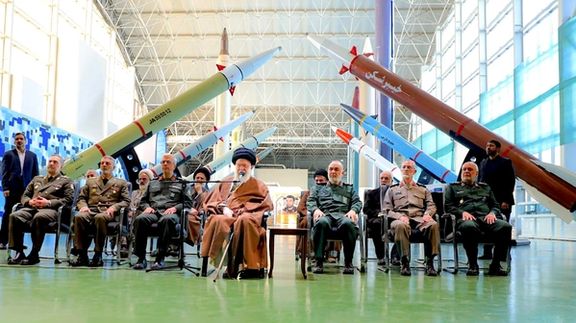
Iran's Supreme Leader Ali Khamenei during his visit to the IRGC Aerospace Force achievements exhibition in Tehran, November 19, 2023

Just over two weeks have passed since Israel conducted its surgical strike against the regime in Iran in retaliation for its unprecedented direct attack on Israeli territory.

Once the strike was over, policymakers, experts and commentators rushed to announce the end of the tit-for-tat escalation between the Islamic Republic and Israel.

But if you think things are “settling down”, then think again – all the signs indicate the next ten months of the US election cycle will produce extreme volatility and once again bring the region to the brink.

When the Islamic Revolutionary Guard Corps (IRGC) – the Iranian regime’s ideological military and paramilitary organization – pulled the trigger, which included 170 drones, 110 ballistic missiles and 30 cruise missiles, it did so knowing full well that Israel would retaliate.

For its part, Israel’s response was very limited, firing 3 missiles from outside of Israeli territory, but successfully penetrating the Islamic Republic’s air defense system.And while US officials announced that the strike was precisely limited as Israel intended to showcase its capabilities but de-escalate, the Islamic Republic will certainly not view it in this light. Instead, the regime in Iran views the Israeli retaliatory strike a fortnight ago as just the beginning of Prime Minister Benjamin Netanyahu’s response.

Knowing this, the Islamic Republic has started a new propaganda campaign to spin the narrative and push the propaganda line that it is showing “restraint” and depict Israel as the “aggressor.” It is noteworthy that its apologists abroad almost immediately circulated this line after Israel strike, claiming that Tehran’s downplaying of Tel Aviv’s retaliation shows the Islamic Republic was the “more rational and retrained party.”

Meanwhile, beyond simply propaganda, the IRGC has closely been observing and testing the Biden administration’s support for Israel’s retaliatory strike. If it perceives this support as weak, this will shape the IRGC’s calculus moving forward, and we should expect greater escalation on all fronts – not least its nuclear program and terrorism – in the next nine months prior to a potential new US administration in the White House.

Biden’s failure to impose direct consequences on IRGC despite consistent acts of aggression—including killing 3 US soldiers in more than more than 170 proxy attacks on US forces since October 7 – in part shaped the IRGC calculus for direct strikes on Israel as it believes it can get away with such escalation without facing repercussions from US.

But the loss of US deterrence alone is not the only factor that shaped the Islamic Republic’s calculus in conducting its unprecedented direct attack on Israel.

The newfound recklessness and aggression in clerical regime’s foreign policy is also a direct symptom of the internal changes in personnel Khamenei has been spearheading – changes the West has been completely oblivious to.

As part of his 2019 manifesto, the “Second Phase of the Islamic Revolution”, Khamenei has, in the past 5 years, launched a “purification” project – a process that has replaced the old guard with a new generation of inexperienced ideological radicals.This “purification” process was designed by Khamenei to finally complete his personalization of power and ensure his ideological absolutists are installed all pillars of the regime: from the political leadership to military command and bureaucratic managers. In doing so, the 85-year-old supreme leader seeks to ensure his hardline Islamist ideology outlives him and guarantee a smooth succession process.

The university is regarded as one of the universities in Iran that has played a prime role in recruiting politicians and other prime figures in the Islamic Republic of Iran
100%
The university is regarded as one of the universities in Iran that has played a prime role in recruiting politicians and other prime figures in the Islamic Republic of Iran

To achieve this, in the past five years – much to the West’s ignorance and obliviousness – Khamenei has been operationalizing these key internal changes, installing a new generation of young ideological absolutists across key political, military and bureaucratic postings. The de facto appointment of Ebrahim Raisi as president, the IRGC’s consolidation of key political positions, the takeover of all supreme councils by young Khamenei zealots and the rise of “the Imam Sadeghis” – indoctrinated technocrats – across the bureaucracy are all products of the “Second Phase” manifesto.

In June 2023 the appointment of IRGC commander Ali Akbar Ahmadian as secretary of the Supreme National Security Council one of the final steps towards completing Khamenei’s “purification” project.

The appointment of the ideologically zealous Ahmadian –a military commander with no political or diplomatic experience – to the most important policymaking body for foreign affairs exemplifies the broader trend of “purification”: the removal experienced experts for inexperienced ideological zealous.

In other words, purification has removed the final traces of meritocracy in the regime and given absolute precedence to promoting radical ideologues with less qualifications – a process that has produced the “dumbifcation” of the regime (ahmaghtar shodan-e nezam, in Farsi).

The newfound recklessness and increased ideological aggression in the regime’s foreign policy is precisely a consequence of the “dumbifcation” of the regime.

The rise of an inexperienced, incapable and ideological leadership class has decapitated the regime’s ability to appropriately read and respond to the rules of the international order. Of course, Khamenei, who rules with absolute authority, is still the ultimate decisionmaker in the system (nezam), or what is essentially the regime. But in calling the shots and providing sign-off for major decisions, the now-turned 85-year-old ayatollah relies extensively on his key political, military and bureaucratic aides. Today, the “purification” of the regime has ensured that the Supreme Leader is surrounded by a new generation of Khamenei absolutist “yes men” who are highly ideologically motivated and deeply inexperienced – what has already proven to be a lethal combination.

This has produced a foreign policy guided by careless ideological recklessness, aggression and irrationality, producing back-to-back strategic errors that have resulted in actions many in the West have found incomprehensible to understand.

In just the past year this has materialized through reckless support for Putin’s war in Ukraine (and even providing ballistic missiles to Russia) to orchestrating more than 170 proxy attacks on US forces, including killing three US troops, and now conducting a direct attack on Israel.

The combination of failed US deterrence and the irrational “dumbification” of the regime has produced a toxically dangerous landscape moving forward.

If the belief that the Biden has zero appetite to impose direct consequences on the regime is reinforced through perceived weak support for Israel’s retaliation – which already appears to have happened – it’ll pump more air into this new ideological cohort’s already overinflated sense of confidence, increasing its recklessness across the board.

Indeed, there is lots of open chatter among this new elite that the next 9 months could be the best opportunity for nuclear weaponization before a potential new president in the White House.

As for Israel, its response a fortnight ago likely marks the beginning—rather than end—of its targeted retaliation to IRGC’s unprecedented direct strike. This response will be targeted and likely surface overtime with a strong element of surprise.

The Israeli strikes also mark the start of a new phase in Israel’s psychological warfare operation against the regime. The goal will be to increase Khamenei and IRGC’s angst and keep them second guessing as to when and where the next strike will be.

The reaction and response of the Iranian people is also a key dimension here – something that has been completely absent in discussion about the trajectory of escalation between the Islamic Republic and Israel.

Anti-regime sentiment in Iran is at unprecedented levels.

All structural factors that led to 2022 nationwide protests have only got worse in past 12 months. This itself is a product of the “dumbification” of the regime with an incapable and ideological cohort only flaring up Iran’s domestic crises: from speeding-up Iran’s economic collapse to rampant corruption and increasing political suppression.

As conflict with Israel and the US seriously looms, instead of attempting to alleviate pressure on the Iranian population so as to rally them, the new elite have decided to speed-up Khamenei’s domestic Islamization through doubling-down on Islamic morality policing – a decision that seems entirely illogical given the context. The “dumbifcation” of the regime is in full swing. As a consequence, nationwide anti-regime protests in Iran are a serious possibility in the coming months.

Against this backdrop, Israel’s two operations combined – namely its military response and its new psychological warfare operation – will be used to measure Iranian people’s support for targeted Israeli action against IRGC and the regime more broadly.

So far, there is noteworthy evidence that indicates noticeable support for such Israeli operations against the IRGC in Iran – so much so that the IRGC issued a warning stating it will punish those who express support for Israel’s operations.

The prospect of simultaneous Israeli targeted strikes on IRGC and nationwide anti-regime unrest in Iran is a scenario Khamenei will want to avoid at all costs. It would, for the first time, completely overstretch IRGC between its external and internal commitments. And this could bring the regime to total collapse.

In short, while in the immediate period there’s talk of things “settling down”, don’t expect this to last very long, not least if the IRGC perceives Biden’s support for Israel’s retaliation to be weak. Buckle up for serious volatility in next nine months, if so. In other words, the worst may be yet to come.

Opinions expressed by the authors are not necessarily the views of Iran International.

Most Viewed

Iran International says it won’t be silenced after London arson attack
1

Iran International says it won’t be silenced after London arson attack

2
VOICES FROM IRAN

Hope and anger in Iran as fragile ceasefire persists

3

US sanctions oil network tied to Iranian tycoon Shamkhani

4

Iran halts petrochemical exports to supply domestic market

5
INSIGHT

How Tehran bends its own red lines to boost state rallies

Banner
Banner

Spotlight

  • Hardliners push Hormuz ‘red line’ as US blockade tests Iran’s leverage
    INSIGHT

    Hardliners push Hormuz ‘red line’ as US blockade tests Iran’s leverage

  • Ideology may be fading in Iran, but not in Kashmir's ‘Mini Iran'
    INSIGHT

    Ideology may be fading in Iran, but not in Kashmir's ‘Mini Iran'

  • War damage amounts to $3,000 per Iranian, with blockade set to add to losses
    INSIGHT

    War damage amounts to $3,000 per Iranian, with blockade set to add to losses

  • Why the $100 billion Hormuz toll revenue is a myth
    ANALYSIS

    Why the $100 billion Hormuz toll revenue is a myth

  • US blockade targets Iran oil boom amid regional disruption
    ANALYSIS

    US blockade targets Iran oil boom amid regional disruption

  • Iran's digital economy battered by prolonged blackout
    INSIGHT

    Iran's digital economy battered by prolonged blackout

•
•
•

More Stories

Iranian Security Forces Shoot Teenage Border Porter

May 4, 2024, 10:40 GMT+1
•
Iran International Newsroom

A 17-year-old cross-border porter was shot on Friday by Iran's border guards on the Iraqi border, suffering severe injuries to his face and eyes.

According to the Hengaw Organization for Human Rights, the young boy was taken to hospital for treatment, the latest in a long line of poverty-stricken Kurds resorting to the work as 'kolbars' as a way out of the abject conditions they live in in Iran's West Azarbaijan province.

Kolbar News reports that between March 2023 and March 2024, 444 Kolbars were killed or injured along the border areas and interprovincial routes between West Azarbaijan, Kurdistan, and Kermanshah provinces due to factors such as direct shooting by regime military forces, avalanches, frostbite, stepping on mines, falling from mountains and heights, among others.

The direct shooting by military forces accounted for 373 out of the 444 who were killed or injured. Often the kolbars are smuggling the likes of illegal fuel, among other goods, in one of Iran's poorest provinces, many of whom are under the age of 18.

UK Defense Secretary Dismisses Iranian Sanctions

May 4, 2024, 10:12 GMT+1
•
Iran International Newsroom

UK Defense Secretary Grant Shapps has branded recent sanctions imposed on him by Iran as a misguided attempt at intimidation.

He said of Thursday's announcement by the Iranian foreign ministry of 25 US and UK individuals and entities, "If Iran thinks that these latest sanctions will intimidate anyone then they’re completely misguided ... Iran is responsible for much regional instability through their illegal network of terror proxies: Hamas, Hezbollah, Houthis, Iran-linked militias and their direct attacks."

According to the Iranian Foreign Ministry, the American targets were sanctioned due to their “support and financing” of Israel’s “terrorist acts”, referring to the war in Gaza, sparked by Iran-backed Hamas's invasion of Israel on October 7. Iran also claimed it was for and “gross human rights violations” against the Palestinian people in the Gaza Strip, as Israel's relentless response to the atrocities of October 7, in which 1,200 mostly civilians were murdered, has left much of Gaza razed.

Among the sanctioned US entities are defense firms such as Lockheed Martin, General Dynamics Corporation, and Skydio. Notably, the sanctions also targeted individuals including Jason Brodsky, Policy Director of United Against Nuclear Iran, and US Army General Bryan P. Fenton.

Iran, branded the world's number one state sponsor of terror by the US last year, claimed the British individuals and entities faced sanctions for their "deliberate support and facilitation of the Israel regime’s actions..."

The British entities include defense companies Elbit Systems and Parker Meggitt, while the individuals include British Defense Secretary Grant Shapps, Commander of the British Army Strategic Command James Hockenhull, and Chief of Defense Intelligence Adrian Bird.

US to Pressure Malaysia to Stop Iran Accessing Funds

May 4, 2024, 10:12 GMT+1
•
Iran International Newsroom

High-ranking officials from the US treasury will travel to Singapore and Malaysia next week to urge the two Asian commerce hubs to do more to stop flow of funds to Iran and its affiliated armed groups.

The US treasury has noticed that more money is getting to the regime in Tehran through the Malaysian financial system, Reuters reported Friday, quoting an unnamed source.

The Iranian regime has in recent years made the most of its friendly relations with Malaysia. Large amounts of US-sanctioned Iranian oil sold to China have been branded as Malaysian oil, passed along by middlemen and transferred ship to ship in international waters, according to tanker tracking companies, with little resistance by Malaysian authorities.

Ship-to-ship transfers are Iran’s favorite method of trying to hide its oil shipments, with cargos rebranded as oil from other countries and sold mostly to smaller refineries in China.

In their visit to Malaysia next week, Neil MacBride and Brian Nelson, the US Treasury's general counsel and under-secretary for terrorism and financial intelligence, are expected to convey to Malaysian authorities that helping Iran get around oil sanctions and access funds may result in sanctions for individuals or entities involved in such business.

Iranian officials pride themselves on their ability to circumvent sanctions –with shell companies, layers of intermediaries, and at high cost, involving hefty payments to intermediaries arranging shipments and laundering money.

Last year, the US treasury sanctioned Hossein Hatefi Ardakani for overseeing a “transnational procurement network” spanning the Middle East and East Asia. Ardekani was accused of procuring “servomotors, inertial navigation equipment, and other items” for Iran’s drone program through front companies in Malaysia, Hong Kong and others.

Their endeavor has been markedly helped in the last few years by the Biden administration’s reluctance to antagonize Iran’s rulers. However, that tendency seems to have waned more recently – after October 7th, in particular.

Last December, the US treasury imposed sanctions on four Malaysia-based companies it accused of helping Iran's production of drones. A number of new sanctions have also been introduced to sever the financial flows towards Iran, which US officials say fuels instability in the Middle East.

Critics of the Biden administration say abandoning Donald Trump’s “maximum pressure” policy has not only emboldened the Iranian regime to adopt a clearly more aggressive foreign (and nuclear) policy, but has enabled the Revolutionary Guards (IRGC) to implement those policies with more money in their coffers.

Biden officials have rejected the accusations many times, stating that the administration has sanctioned “over 600 individuals and entities”, including Iran. Hamas, Hezbollah, the Houthis, and Kataib Hezbollah.” Biden says his treasury department will “impose sanctions that further degrade Iran's military industries."

In response, the president's opponents and critics point out that sanctions are effective only when (and if) they are enforced rigorously –and across the board. Iran’s biggest trade partner and main buyer of oil is China. Many experts say it’s hard, if not impossible, for any US administration to sanction China. And without China, no sanction regime would impact the Iranian regime in a meaningful way.

Iran-Iraq War Veterans Urge Government to Spare Rapper's Life

May 4, 2024, 00:53 GMT+1
•
Iran International Newsroom

Hundreds of the Iran-Iraq war veterans and their families have launched an appeal to the leaders of the Islamic Republic, urging them not to execute Toomaj Salehi, a protest song rapper.

An open letter, signed by over 460 individuals, criticized the Iranian government's lack of accountability and its tendency to suppress dissent through intimidation and terror, highlighting the "shameful death sentence for a young protesting artist."

The signatories also made a plea to the government to halt its oppressive treatment of Iranian women forced to comply with mandatory hijab and to refrain from further threatening and intimidating the nation's youth.

Salehi, a vocal figure in the 2022 protests ignited by the death of Mahsa Amini in morality police custody, has been a supporter of protesters, detainees, and political activists. Arrested shortly after the protests began, Salehi faced an initial sentence of over six years in prison. However, in a move by a judge in Isfahan, his sentence was escalated to the death penalty, bypassing the usual legal procedures expected to reduce his term upon appeal.

Salehi's death sentence has triggered a global outcry, continuing to draw international attention and protest.

In a recent development, scores of French and Iranian artists, writers, athletes, and activists have reached out to French President Emmanuel Macron, soliciting his influence to help overturn the execution order. The collective voice of the diverse groups underscores a significant global concern over human rights practices in Iran, particularly regarding freedom of expression and the treatment of political dissidents.

Israel Builds 'Cyber Dome' to Counter Attacks from Iran and Proxies

May 3, 2024, 22:59 GMT+1
•
Iran International Newsroom

Israel is building a "cyber dome" to counter online threats, in particular those originating from Iran and its proxies, an Israeli official told AFP on Thursday.

While Israel's Iron Dome defense system has been protecting it from incoming rocket attacks for years, it is now trying to beef up its cyber security by building a system to ward off increasing threats from hackers.

"It is a silent war, one which is not visible," Aviram Atzaba, the Israeli National Cyber Directorate's head of international cooperation told AFP.

Since Israel launched its war on Hamas in Gaza, following the militant group’s attack on October 7 last year, the country has experienced a notable surge in cyberattacks from Iran and its allies, Atzaba said.

Since the war began, around 800 major cyber-attacks have reportedly been foiled.

Among the targets were government organizations, military infrastructure, and civil infrastructure; some, including hospitals in the cities of Haifa and Safedsome, could not be stopped.

Without going into details, Atzaba told AFP that for the past two years, the directorate has been attempting to develop a centralized, real-time system that proactively protects all Israeli cyberspace – emphasizing the project's collaboration with Israel's allies.

"It takes a network to fight a network," he said.

According to experts speaking to AFP, Iran's investment in cyberwarfare was spurred by two pivotal incidents. Firstly, the use of the internet by anti-government protesters to garner support for a post-election uprising in 2009. These protests erupted following the announcement of Mahmoud Ahmadinejad's victory in the presidential election, amid widespread allegations of irregularities.

Iran's investment in cyberwarfare was also prompted by a cyberattack in 2010 that inflicted physical damage on Iran's nuclear program. Tehran attributed this attack to Israel and the US.

But, Israel is not the sole target of Iranian cyber attacks, with Iranian hackers belonging to the Islamic Revolutionary Guards’ (IRGC) hacking US governmental and private organizations.

In April the US Treasury Department imposed sanctions on individuals and companies accused of conducting cyber-attacks for the benefit of the IRGC’s Cyber-Electronic Command (IRGC-CEC).

“Iranian malicious cyber actors continue to target US companies and government entities in a coordinated, multi-pronged campaign intended to destabilize our critical infrastructure and cause harm to our citizens,” said Under Secretary of the Treasury for Terrorism and Financial Intelligence Brian E. Nelson in April.

The US Justice Department and FBI also unveiled an indictment in April against Iranian individuals, accusing them of taking part in a coordinated hacking initiative from 2016 through April 2021.

Intelligence agencies in both the US and Canada also warned in February that Iranian state-sponsored hackers might interfere with their respective country’s elections.