• العربية
  • فارسی
Brand
  • Iran Insight
  • Politics
  • Economy
  • Analysis
  • Special Report
  • Opinion
  • Podcast
  • Iran Insight
  • Politics
  • Economy
  • Analysis
  • Special Report
  • Opinion
  • Podcast
  • Theme
  • Language
    • العربية
    • فارسی
  • Iran Insight
  • Politics
  • Economy
  • Analysis
  • Special Report
  • Opinion
  • Podcast
All rights reserved for Volant Media UK Limited
volant media logo

Israel Builds 'Cyber Dome' to Counter Attacks from Iran and Proxies
Iran International Newsroom
May 3, 2024, 22:59 GMT+1Updated: 17:00 GMT+0
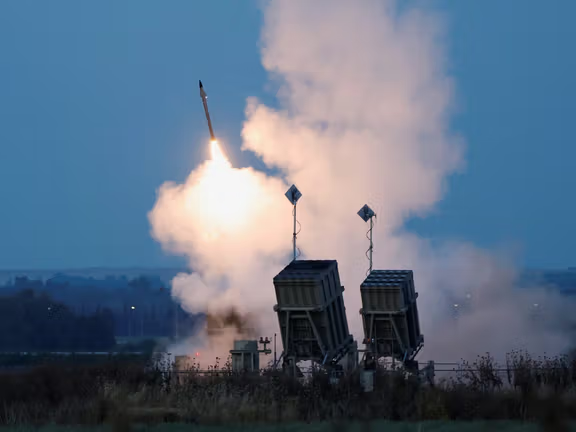
An Iron Dome launcher fires an interceptor missile as rockets are fired from Gaza, in Sderot, Israel, 2023

Israel is building a "cyber dome" to counter online threats, in particular those originating from Iran and its proxies, an Israeli official told AFP on Thursday.

While Israel's Iron Dome defense system has been protecting it from incoming rocket attacks for years, it is now trying to beef up its cyber security by building a system to ward off increasing threats from hackers.

"It is a silent war, one which is not visible," Aviram Atzaba, the Israeli National Cyber Directorate's head of international cooperation told AFP.

Since Israel launched its war on Hamas in Gaza, following the militant group’s attack on October 7 last year, the country has experienced a notable surge in cyberattacks from Iran and its allies, Atzaba said.

Since the war began, around 800 major cyber-attacks have reportedly been foiled.

Among the targets were government organizations, military infrastructure, and civil infrastructure; some, including hospitals in the cities of Haifa and Safedsome, could not be stopped.

Without going into details, Atzaba told AFP that for the past two years, the directorate has been attempting to develop a centralized, real-time system that proactively protects all Israeli cyberspace – emphasizing the project's collaboration with Israel's allies.

"It takes a network to fight a network," he said.

According to experts speaking to AFP, Iran's investment in cyberwarfare was spurred by two pivotal incidents. Firstly, the use of the internet by anti-government protesters to garner support for a post-election uprising in 2009. These protests erupted following the announcement of Mahmoud Ahmadinejad's victory in the presidential election, amid widespread allegations of irregularities.

Iran's investment in cyberwarfare was also prompted by a cyberattack in 2010 that inflicted physical damage on Iran's nuclear program. Tehran attributed this attack to Israel and the US.

But, Israel is not the sole target of Iranian cyber attacks, with Iranian hackers belonging to the Islamic Revolutionary Guards’ (IRGC) hacking US governmental and private organizations.

In April the US Treasury Department imposed sanctions on individuals and companies accused of conducting cyber-attacks for the benefit of the IRGC’s Cyber-Electronic Command (IRGC-CEC).

“Iranian malicious cyber actors continue to target US companies and government entities in a coordinated, multi-pronged campaign intended to destabilize our critical infrastructure and cause harm to our citizens,” said Under Secretary of the Treasury for Terrorism and Financial Intelligence Brian E. Nelson in April.

The US Justice Department and FBI also unveiled an indictment in April against Iranian individuals, accusing them of taking part in a coordinated hacking initiative from 2016 through April 2021.

Intelligence agencies in both the US and Canada also warned in February that Iranian state-sponsored hackers might interfere with their respective country’s elections.


Most Viewed

Iran negotiators ordered to return after internal rift over Islamabad talks
1
EXCLUSIVE

Iran negotiators ordered to return after internal rift over Islamabad talks

2
ANALYSIS

US blockade enters murky phase as tankers spoof signals and buyers hesitate

3

US tightens financial squeeze on Iran, warns banks over oil money flows

4
INSIGHT

Ideology may be fading in Iran, but not in Kashmir's ‘Mini Iran'

5
INSIGHT

Hardliners push Hormuz ‘red line’ as US blockade tests Iran’s leverage

Banner
Banner

Spotlight

  • Hardliners push Hormuz ‘red line’ as US blockade tests Iran’s leverage
    INSIGHT

    Hardliners push Hormuz ‘red line’ as US blockade tests Iran’s leverage

  • Ideology may be fading in Iran, but not in Kashmir's ‘Mini Iran'
    INSIGHT

    Ideology may be fading in Iran, but not in Kashmir's ‘Mini Iran'

  • War damage amounts to $3,000 per Iranian, with blockade set to add to losses
    INSIGHT

    War damage amounts to $3,000 per Iranian, with blockade set to add to losses

  • Why the $100 billion Hormuz toll revenue is a myth
    ANALYSIS

    Why the $100 billion Hormuz toll revenue is a myth

  • US blockade targets Iran oil boom amid regional disruption
    ANALYSIS

    US blockade targets Iran oil boom amid regional disruption

  • Iran's digital economy battered by prolonged blackout
    INSIGHT

    Iran's digital economy battered by prolonged blackout

•
•
•

More Stories

Iranian Athletes Make Up Nearly Half of 2024 Refugee Olympic Squad

May 3, 2024, 20:14 GMT+1

Nearly half of the athletes selected for the 2024 Refugee Olympic Team hail from Iran, as announced by the president of the International Olympic Committee (IOC) during the unveiling of the team lineup for the upcoming Paris Olympics.

Out of the 36 athletes from 11 countries selected, 14—or almost 40%—are Iranian.

The considerable presence of Iranian refugees on the team follows a surge in the emigration of athletes, artists, and skilled workers from Iran, driven by ongoing anti-regime protests and increasing economic and political pressures over the past few years.

The 14 Iranian athletes, comprising 10 men and 4 women, have found new bases across Europe, including notable names such as Omid Ahmadisafa (Germany) in boxing, Matin Balsini (Britain) in swimming, and Mahboubeh Barbari Zharfi (Germany) in judo.

The mass defections come in the wake of at least 30 Iranian athletes seeking asylum in recent years, escaping not only the political repression in Iran, but also specific challenges within the sports sector.

Issues cited by athletes include corruption within sports federations, the enforced policy of not competing against Israeli athletes, and for women, the mandatory wearing of the hijab during competition.

The Islamic Republic’s policy of prohibiting its Olympic athletes from competing against Israelis stems from its longstanding enmity towards the country, after 1979.

Athletes are often pressured by the government-controlled sports federation officials to intentionally lose matches, forfeit, or cite injuries to avoid competitions against Israeli opponents.

Why Islamist Rulers in Iran Turned Civil Mosques to State Mosques

May 3, 2024, 18:51 GMT+1
•
Majid Mohammadi

Despite recent public outcry and opposition to the construction of a mosque in one of Tehran’s public parks, the head of the city council definitely said: "We should build prayer rooms and mosques in all parks."

Tehran’s citizens swiftly demanded the municipality stop the building of the mosque with a petition that circulated on social networks, garnering over 147,000 signatures within just a few days.

But, this all transcends the mere building of a mosque in Qaytariyeh Park in the north of Tehran.

Since 1979, the Islamist regime has escalated the count of mosques in Iran from approximately 25,000 to roughly 75,000 presently. Yet, as stated by a senior cleric within the regime, around 50,000 of these mosques remain shuttered, devoid of congregants for prayer.

Various polls converge on a singular explanation: the remarkable and rapid transformation of the Iranian populace towards irreligiosity and apathy towards religious rituals over the past four decades.

Last year, in a government study titled the National Attitude Survey of Iranians, respondents were asked about the change in the level of religiosity among the people compared to five years prior. 85% of respondents stated that, based on their observations, the level of religiosity among Iranians had decreased, while only 7% reported an increase.

File photo of the Grand Mosalla Mosque of Tehran under construction
100%
File photo of the Grand Mosalla Mosque of Tehran under construction

So, why does the Islamist regime insist on building mosques that are likely to remain empty?

First: New mosques are constructed in areas where Basij bases and repression centers are absent or few, and the government uses the mosques as cover to expand its social and political control.

The Basij, which plays a significant role in quelling dissent, is a paramilitary volunteer militia force that operates under the Islamic Revolutionary Guards (IRGC).

In the past, the country's mosques have indeed been used to mobilize forces during street protests, and protesters have even been shot by Basiji snipers from rooftops. The government also seeks to establish a surveillance and information-gathering infrastructure within neighborhoods, without paying the price associated with public intimidation.

Second: The mosques are a base for gathering and recruiting for the regime's repression organizations. Today, the Islamist regime is desperately seeking to expand the network of Basiji forces and its plainclothes forces. In the past, these forces were the ones who assassinated the opposition figures. There were mosques with Imams such as Mojtaba Tehrani and Azizullah Khushvaght who were accused of issuing fatwas for killing dissidents and writers.

The attendees of their mosques were mostly working for the Iranian security agencies. The assassin who shot Saeed Hajjarian, an advisor to former President Mohammad Khatami, in the head, was affiliated with one of the politicized mosques.

Supreme Leader Ali Khamenei has filled his security, military, and paramilitary apparatus with worshipers of the same type of mosques.

Third: The state-controlled mosques have become centers of brainwashing and political propaganda. These mosques host kindergartens and indoctrination classes that propagate anti-Semitism, anti-Westernism, anti-Americanism, and political Islam.

All of the aforementioned objectives are centered around security and political agendas.

The objective of attaining complete state control over mosques in matters of religion and religiosity entails direct intervention by governmental institutions in the organization and execution of religious ceremonies. This is achieved through: the appropriation of public spaces by advocating Sharia as a way of life, and by substituting religious teachings with governmental directives.

Prior to the establishment of the Islamist regime in 1979, Iranian mosques served as civil institutions for worship and congregation, with ownership being shared. The Imam of the congregation was selected by the local community, and management was overseen by a board of trustees elected by the locals, with minimal political involvement. Every class and group of Muslims could claim the local mosque as their own.

A mosque in Iran (file photo)
100%

However, the Islamist regime usurped the mosques by establishing Basij bases, appointing Imams, and constructing new and additional mosques. Following the usurpation, it treated the public domain as its conquered property.

Over the past 45 years, any Imam who has made a critical statement against the government has been dismissed from their position. Sunnis are unable to have even a single mosque in major cities like Tehran, Mashhad, Kerman, and Shiraz.

The country's mosques underwent governmentalization through three specific processes.

The first involved the formation of the Headquarters of Imams and Congregations to appoint and control mosque imams. This institution was established in every province and operates under the supervision of the Leader’s office.

The second process entailed the establishment of Basij bases in mosques as the initial government institution installed there.

The third process involved setting up "cultural centers" within mosques, managed by the Supreme Headquarters of the Cultural and Artistic Centers of the country's mosques, aimed at countering the "cultural invasion of the enemy" as mandated by the Supreme Council of the Cultural Revolution in 1992.

This way, the Islamist regime turned mosques that the Iranian people voluntarily built with their own hands and funds, into government institutions.

The regime transferred religious institutions such as seminaries, mosques, endowments, and mausoleums from civil institutions into completely state-owned entities.


Iran’s FM: Crew of Seized Israel-Linked Vessel Released

May 3, 2024, 17:41 GMT+1

The Iranian government says it has released the crew of a seized Portuguese-flagged ship linked to Israel, though it continues to hold the vessel itself seized last month.

The country’s foreign minister, Hossein Amir-Abdollahian, said the crew of the Portuguese-flagged container ship MSC Aries can return to their respective home countries.

The minister claimed the release of the crew of 25 was a “humanitarian act”, while the ship itself remains under “judicial detention.”

The MSC Aries was seized by the Islamic Revolutionary Guards (IRGC) in the strategic Strait of Hormuz on April 13, shortly after Iran threatened to close the vital shipping route in retaliation for a widely-believed Israeli airstrike on its purported consulate in Damascus.

According to Amir-Abdollahian, the vessel was detained because it "turned off its radar in Iran's territorial waters and jeopardized the security of navigation," the foreign ministry explained in a statement posted on X late Thursday night.

The regime has seized several vessels since 2019 in what some say is a way for Tehran to show its naval might – and to keep pressure on different governments.

The foreign ministry previously cited "violations of maritime laws" as the reason for the Aries' seizure and emphasized its links to Israel. The MSC leases the Aries from Gortal Shipping, an affiliate of Zodiac Maritime, partially owned by Israeli businessman Eyal Ofer.

The seize of the vessel is part of a broader pattern of maritime disruptions, including recent attacks on merchant shipping in the Red Sea and the Gulf of Aden by Yemen’s Iran-backed Houthi rebels.

The attacks, which were reportedly conducted in solidarity with Palestinians amidst Israel's war on Hamas in Gaza, are contributing to significant perturbations in global shipping operations.


‘Iran Must Not Execute Toomaj,’ Says Business Magnate Richard Branson

May 3, 2024, 16:41 GMT+1

British billionaire and Virgin Group founder Richard Branson is adding his voice to high-profile figures condemning the death sentence handed down to Iranian dissident rapper Toomaj Salehi.

In a statement on the Virgin website, Branson expressed support for human rights activists advocating for Salehi’s release and the freedom of all prisoners in Iran.

"Toomaj and so many others must be freed," Branson wrote, emphasizing the importance of artistic freedom, stating that "open artistic expression should be welcomed and celebrated; it gives us opportunities to contemplate, reflect and debate. And it should never be persecuted – in Iran or elsewhere."

Salehi, one of Iran's most prominent rappers and a vocal and long-time critic of the regime, was sentenced to death last week by a non-independent Islamic Revolutionary Court under the charge of "corruption on earth."

The government’s intelligence ministry, which usually takes charge of sentencing dissidents, has historically exploited the vague term to target and silence them.

Salehi's years-long dissent took center stage during the nationwide 2022 anti-regime protests, where his outspokenness positioned him as one of the most prominent icons. For years, his music has resonated with many, particularly the youth who feel oppressed and silenced by the ruling authorities.

Branson’s statement also highlighted the ongoing human rights abuses in Iran, including the recent revelation that Nika Shakarami, a 16-year-old protester, was sexually assaulted and killed by Iranian security forces, contrary to official claims of her suicide.

The billionaire condemned the Iranian regime's continued violence and suppression, emphasizing the devastating impact on the nation's populace.

Branson's commentary also sheds light on the continued use of executions in Iran as a means to stifle dissent – with authorities having executed at least 853 people in 2023, many of whom were non-violent offenders or protesters.

Iran Imposes Harsh Punishment on ‘Protest Leaders’

May 3, 2024, 15:29 GMT+1
•
Maryam Sinaiee

Since the Mahsa protests, Iran's courts have prosecuted dozens of individuals, issuing harsh sentences for alleged leadership of protests and labor strikes, without any basis in existing laws.

Iranian authorities and state media invariably refer to anti-government protests as “riots”, so the accused are always dubbed as “leader of riots” or “leader of strikes”.

Informed sources in Iran say those who are accused of “leadership of riots” are usually held incommunicado for long periods in solitary confinement and are deprived of the right to have legal counsel or phone calls to their families.

In most cases, the accusation of leadership is based solely on participation in anti-government protests, lacking concrete evidence of any unlawful organized activity. Often, the only evidence presented is social media posts calling for peaceful protests on platforms like Instagram.

Earlier this week the BBC published a report about teenage protester Nika Shakarami. The report confirmed allegations that the she was molested by security forces during her arrest and was killed by them.

The report relies on a leaked document purportedly authored by security agents. This document referenced suspicions of the teenage girl being a "leader" of the protests. According to the leaked document cited by the BBC, the arresting team deployed one of its operatives disguised as a protester to confirm Nika's alleged leadership role within the demonstration.

A report by the IRGC-linked Fars News Agency in October 2023, for instance, claimed that journalist Elaheh Mohammadi had “confessed to leadership of street riots”. Fars has close ties with security bodies and access to court documents unavailable to other media.

Niloufar Hamedi and Elahe Mohammadi, journalists accused of reporting on Mahsa Amini (file photo)
100%
Niloufar Hamedi and Elahe Mohammadi, journalists accused of reporting on Mahsa Amini

Mohammadi who was arrested a few days after the protests began in September 2022 for her role in reporting on Mahsa Amini’s death in the custody of the morality police, was accused of collaboration with foreign services including the CIA and “anti-revolutionaries”.

Fars published a wiretapped conversation, acquired from security bodies, between Mohammadi and a friend. In the conversation, Mohammadi mentioned encouraging people to chant "Woman, Life, Freedom" during a protest and discussed making calls to protest with other activists. However, there was no indication of any incitement to riot or engage in armed activity.

“Participation in peaceful protests is not a crime and therefore being a leader in peaceful protests is also not a crime,” Musa Barzin, a Turkey-based human rights lawyer, told Iran International.

Arshia Takdastan, an 18-year-old protester from Nowshahr in northern Iran who was sentenced to death for “war against God” and “corruption on earth” was also dubbed as a “leader of riots” by another IRGC-linked news agency.

Authorities alleged that Takdastan and two others, Javad Rouhi and Mehdi Mohammadifard, had acted as “leaders” and “incited riots” by dancing, clapping, chanting slogans, and burning headscarves of the female protesters for them. The three young men were all sentenced to death. “The activities [of the accused] resulted in the gathering of about 3,000 people” at a protest rally at one of the squares of the city, the court ruling in Takdastan’s case said.

Rouhi who had been subjected to extensive physical and psychological tortures died in suspicious circumstances in prison in August 2023. His lawyer maintained that Rouhi had only danced at a protest gathering and burned the headscarves of some female protesters for them and had no role in organizing protesters.

Any contact with foreign-based Persian language media such as Iran International has also been cited as evidence of being “leader of riots”.

In January 2023, the Public and Revolutionary Prosecutor of Tehran Ali Salehi said one of the “leaders of riots”, a member of the underground United Youth of Iran (UYI), had confessed to “continuous contact” with Iran International TV and foreign intelligence services and alleged that he had been paid money in the form of cryptocurrency to incite riots. The name of the accused was not mentioned and there has been no further reference to the case.

“Leadership” of labor strikes is also considered a crime. “Eight leaders who had a direct role in organizing labor strikes in South Pars and Asalouyeh [gas fields] through social media and their activities have been arrested,” Akbar Pourat, the political-security deputy governor of Bushehr Province, told the media on May 14, 2023.

Iranian authorities claim they have been able to identify “leaders” of protests even outside Iran by conducting extensive surveillance of expatriate Iranians’ rallies in various countries.

Unlike charges of “corruption on earth”, “war against God” and “propaganda against the Islamic government” which have been brought against numerous political prisoners and have clear definitions in the Islamic Penal Code of Iran, there is no reference to “leadership of riots” in the laws.

“Judicial authorities use this vague term to make the crimes allegedly committed by the accused look weighty and significant so they can meet out heavier sentences to them,” Barzin said.

“The term ‘leader of riots’ entered the jargon of courts from security bodies’ reports and is now being routinely used in the rulings of Revolutionary Courts across the country,” he added.

The use of terms like "leader of riots" and "leader of strikes" by Revolutionary Courts was uncommon before the anti-government protests of December 2017-January 2018. These courts were established after the Islamic Revolution of 1979 to handle political, security-related cases, blasphemy, as well as other crimes like drug trafficking and large-scale financial corruption.

On November 30, 2019, the head of the Justice Department of Lorestan Province, Mohammad Razm, told the media that those arrested in the protests were divided into “leaders” as well as, disruptors of public order and those with possible connections with foreign intelligence services. “Severe legal punishments is awaiting the leaders of recent riots,” he said.






