• العربية
  • فارسی
Brand
  • Iran Insight
  • Politics
  • Economy
  • Analysis
  • Special Report
  • Opinion
  • Podcast
  • Iran Insight
  • Politics
  • Economy
  • Analysis
  • Special Report
  • Opinion
  • Podcast
  • Theme
  • Language
    • العربية
    • فارسی
  • Iran Insight
  • Politics
  • Economy
  • Analysis
  • Special Report
  • Opinion
  • Podcast
All rights reserved for Volant Media UK Limited
volant media logo
ANALYSIS

Ahmadinejad Comes Under Attack For Comment On Iran – Israel War

Iran International Newsroom
Apr 22, 2024, 12:48 GMT+1Updated: 17:06 GMT+0
Former Iranian president Mahmoud Ahmadinejad

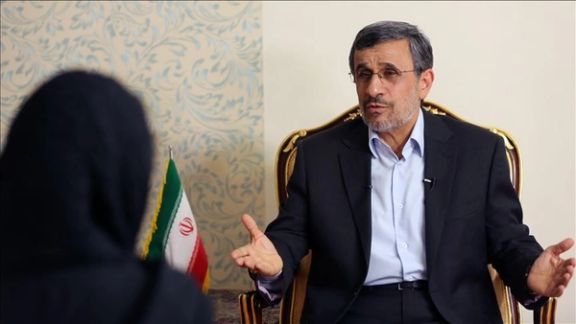
He is an attention seeker, always trying to grab attention, sometimes by making too much noise and at other times by keeping silent. Former populist Iranian President Mahmoud Ahmadinejad is currently in the latter mode.

Even when he is silent, his political rivals want to make him say something, hoping that he might shoot himself in the foot by making an odd or controversial comment that would put an end to his turbulent political career.

Conservative journalist Afifeh Abedi in an April 17 tweet quoted Ahmadinejad as having said on social media that "Any country which illegally attacks another should be responded to. That is a right for the country whose territory has been violated." This was clearly a reference to Iran’s April 13 massive missile and drone attack on Israel in response to an airstrike earlier in the month that destroyed a building within the compound of Tehran’s embassy in Damascus.

Abedi charged that "Ahmadinejad's remark reflected his ambitions in Iran's domestic politics rather than being aimed at foreign audiences." Nonetheless, Abdi criticized Ahmadinejad for acknowledging that Israel is a state.

This is one of those controversial comments that everyone in Iran can interpret to serve their political interests. Some, like Ms. Abedi, might believe Ahmadinejad was referring to Iran's unlawful attack on Israel, while others might take it as support for Iran after Israel attacked the Iranian Consulate in Damascus on April 1, and Iran's attack was a retaliation for that.

Even Ahmadinejad's former aide Abdolreza Davari was not quite clear about what Ahmadinejad meant. He asked in a tweet: "Did he condemn Iran or Israel?" On the other hand, conservative journalist Amir Seyediin said in a tweet that "No President anywhere in the world has served Israel’s interests the way Ahmadinejad has done."

Some hardliner social media users lashed out at the former President for failing to condemn Israel for attacking Iran's Consulate in Damascus in the first place and charged that Ahmadinejad had created big problems for Iranians for denying the holocaust during his presidency.

However, some foreign-based media quoted Ahmadinejad as having said in his Telegram channel that "attacking Israel was a right for Iran," possibly to avoid Khamenei’s wrath.

In a tweet on April 16 reformist cleric Rahmatollah Bigdeli called for Ahmadinejad's dismissal from the Expediency Council, a sort of higher parliamentary chamber with members appointed by the Supreme Leader, who intervene in Iran's domestic political and economic issues where the parliament and the government cannot reach a final agreement on an issue.

Bigdeli wrote: "It is essential to remove Ahmadinejad from the Expediency Council as there is an open case against him at the court about oil swap with other countries," that allegedly happened during his presidency. Bigdeli further questioned the way he was elected President in 2005 and 2009 and charged that his slogan about wiping Israel off the map created too many problems for Iran.

Bigdeli further charged that Ahmadinejad has not condemned the Israeli attack on the Iranian Consulate that killed seven top IRGC officers, and has refused to support Iran's attack on Israel. "How can such a creature be a member of the Expediency Council?" Bigdeli asked. He also called on Judiciary Chief Gholamhossein Mohseni Ejei to start Ahmadinejad's trial as he has repeatedly promised in the past.

Many other Iranian politicians have been calling for Ahmadinejad’s trial and his removal from the Expediency Council after he openly criticized Khamenei in 2018. Nonetheless, he somehow managed to keep his seat at the influential council.

However, Twitter users posted a photo that showed Ahmadinejad at the Expediency Council meeting on April 17.

Most Viewed

Iran diplomacy wobbles as factions compete to avoid looking soft on US
1
INSIGHT

Iran diplomacy wobbles as factions compete to avoid looking soft on US

2
VOICES FROM IRAN

Bread shortages, soaring prices strain households in Iran, residents say

3
ANALYSIS

The politics of pink: how Iran uses cuteness to rebrand violence

4

Scam messages seek crypto for ships’ safe passage through Hormuz, firm warns

5
EXCLUSIVE

Family told missing teen was alive, then received his body 60 days later

Banner
Banner

Spotlight

  • Diplomacy tolls at Hormuz as conflict returns to its doorstep
    OPINION

    Diplomacy tolls at Hormuz as conflict returns to its doorstep

  • Opposition to US talks grows in Tehran as ceasefire deadline nears
    INSIGHT

    Opposition to US talks grows in Tehran as ceasefire deadline nears

  • Tehran moderates see ‘no deal–no war’ limbo as worst outcome
    INSIGHT

    Tehran moderates see ‘no deal–no war’ limbo as worst outcome

  • The future has been switched off here
    TEHRAN INSIDER

    The future has been switched off here

  • Lights out, then gunfire: Witnesses recount Mashhad protest crackdown
    VOICES FROM IRAN

    Lights out, then gunfire: Witnesses recount Mashhad protest crackdown

  • Is Iran entering its Gorbachev moment?
    INSIGHT

    Is Iran entering its Gorbachev moment?

•
•
•

More Stories

Iranian Lawmaker Slams Central Bank as Currency Crisis Deepens

Apr 22, 2024, 11:46 GMT+1

Criticism of Iran’s Central Bank is continuing as one lawmaker takes aim at its failure to provide necessary foreign currency for raw material imports, exacerbating the country’s currency crisis.

"The Central Bank tells producers that it has no currency," Sodeif Badri, a conservative politician and former Mayor of Ardabil said shedding some light on shortages impacting the nation's industrial sectors.

Commenting on the Iranian currency’s continued depreciation, Badri said "the currency market is currently in complete disarray."

The lawmakers’ concerns highlight the broader issues stemming from the country's economic policies amid decades-long internal mismanagement and the weight of international sanctions.

On the surface, the Iranian government has attempted to manage the devaluation of its currency by providing foreign currency at cheaper exchange rates to importers of essential goods.

Last month, the country’s Expediency Discernment Council gave authorization for the state and its management apparatuses, including the Central Bank, to spend 13.6 billion euros at a preferential exchange rate.

In an effort to mitigate the severe economic pressures facing the country, this allocation is earmarked for the import of basic items such as agricultural products, medicine and its raw materials as well as medical equipment.

The policy appears to be aimed at protecting Iranian consumers from potential spikes in prices due to currency fluctuation.

But, the disparity between the official exchange rate of 285,000 rials per US dollar and the open market rate of approximately 650,000 rials per dollar underlines the deepening economic disparity.

Recent scandals, notably the case involving Debsh Tea company, have further fueled existing distrust in the system.

The Debsh company reportedly misappropriated a significant portion of subsidized currency meant for tea and machinery imports.

The embezzlement, estimated at $3.5 billion, involves officials from both the current and the previous presidential administrations -- including ministers of agriculture, industry as well as the governors of the Central Bank of Iran and the chiefs of Iranian Customs Administration.

"It is unclear what the Central Bank is doing; the Central Bank must answer to the people," Badri remarked, further demanding actions from the nation's financial regulators.

Gaps In Residency Positions Deepen Healthcare Worker Shortage

Apr 22, 2024, 10:37 GMT+1

The chairman of Iran's Medical Council has warned about the state of healthcare in the country as significant gaps in critical residency positions threaten the already battered sector.

Mohammad Rais-Zadeh said on Sunday that the gaps are mostly seen within some of the most vital medical specializations like pediatrics, anesthesiologists, and emergency medicine.

The problem has been deepening since 2022 with a growing shortage of doctors, specialists, and dentists across Iran. A huge migration trend has seen medical practitioners looking for jobs abroad seeking better economic conditions amid Iran's worst economic crisis since the establishment of the Islamic Republic. The 2022 uprising has also led many to seek a life outside of Iran's increasingly oppressive social conditions.

So bad has the exodus become, that in December, there were calls by officials to ban doctors from migrating abroad. A report released by Iran Open Data (IOD) revealed that the number of doctors who leave Iran to work in more prosperous countries outweighs the number of new doctors by 30 percent on an annual basis.

The exodus of physicians has been seen with midwives and nurses leaving the sector massively under staffed. In May 2022, Iraj Fazel, the president of the Iranian Society of Surgeons, warned that specialties like children's surgery and heart surgery do not have even a single candidate.

Complicating matters, in March 2023, the Medical Council reported that the exodus of many specialists in pediatric cardiology had left hundreds of children vulnerable, waiting for years to get necessary surgeries. Most healthcare practitioners in Iran live on petty monthly incomes ranging from $200 to $300, which prohibits them from even the most basic requirements, including housing and education for children.

Further, the medical community in Iran is undergoing grave mental health issues. Reports are suggesting an increasing trend in suicide rates, especially among medical residents, as working conditions continue to decline.

In February, the head of the Iranian Psychiatric Association reported 16 suicides in the past year alone, with research indicating that suicide rates in the medical community have risen by 3.1 to 5 times over recent years, leading to the announcement of an investigation into the trend last month. 

Calm In Iraq And Syria May Be Nearing Its End

Apr 22, 2024, 10:25 GMT+1
•
Iran International Newsroom

Conflicting reports from sources affiliated with Iran and its proxies have raised questions about their intentions, as a US base in Syria was targeted on Sunday for the first time in more than two months.

On January 30, following several months of sustained attacks against American troops in Iraq and Syria, the Shiite militia group Kataeb Hezbollah announced they would halt their strikes to “prevent embarrassment of the Iraqi government.” That announcement came after large US retaliatory air strikes targeting Iranian proxy forces in the region.

Sunday's attack was reportedly followed by at least one armed drone launched at the Ain al-Asad air base that hosting US troops in the western Iraqi province of Anbar, a US official told Reuters on Monday.

That January statement about halting attacks had withstood the test of time until Sunday night when five rockets were launched from Iraq's town of Zummar towards a US military base in northeastern Syria.

Shortly after the attack, a post appeared on the Telegram group affiliated with Kataeb Hezbollah, seemingly alluding to Sunday night’s rocket attacks, and stating that the armed groups’ in Iraq had decided to resume attacks because they felt the Iraqi government had failed to deliver a deal to end the US military presence in the country.

“Iraqi resistance gave Iraq’s prime minister three months to negotiate with the American forces to come up with a specific timetable for their removal from Iraq,” the post on the Kataeb-affiliated Telegram channel. “But now… It’s become clear that some political parties were lying: there is no foreign intention to leave Iraq.” Hence the decision “to resume military action.”

The “military action” (and the Telegram statement) came only one day after Iraq’s prime minister Mohammad Shia al-Sudani returned from Washington, where he had met President Joe Biden and other US officials to advance the plans for the Americans’ withdrawal from Iraq.

Not long after, Sabereen News, another popular Telegram group affiliated by Iran and its proxies, issued a statement denying that Kataeb Hezbollah had released a statement. Another Iran-affiliated outlet, Al Mayadeen, seconded the denial.

“The news attributed to the Islamic Resistance in Iraq regarding the resumption of its operations against US forces is false,” Al Mayadeen quoted its Baghdad correspondent. ”Iraqi Kataib Hezbollah Brigades has not issued any statement regarding this matter.” In another statement issued on the Telegram messaging app, the group said the resumption of attacks is "fabricated news".

It’s hard to tell with certainty which statement is true. Perhaps both. The difference could be intentional to create confusion, or it could be a sign of real clash within the groups’ rank and file.

Iran may also have a hand in all this: nudging its proxies to resume attacks on American forces in Iraq and Syria in order to pressure President Biden to dissuade the Israeli government from targeting Iran-backed militias in Syria and Iraq.

On Saturday –less than a day after the Israeli airstrike against Iran’s S-300 defense system near Isfahan– another round of airstrikes hit the headquarters and a major base of Iran-backed militias Hashd al-Shaabi (Popular Mobilization Forces) in Babylon, south of Baghdad.

No one claimed responsibility for the overnight attack on Hashd al-Shaabi US military rejected claims that it had a part in the operation. Citing an unnamed Israeli official, CNN reported that Israel also denied involvement in the incident.

Not enough is known about the incident to help draw definite conclusions about its source. One thing can be said with a reasonable degree of certainty, however: that “a vast network of hybrid warfare is currently underway between Israel and Iran and its proxies in the region,” according to UAE-based analyst Masoud Aflak.

Updated at 15:00 GMT, April 22
Iranian President Arrives In Pakistan To Mend Ties

Apr 22, 2024, 10:11 GMT+1
•
Iran International Newsroom

Iranian President Ebrahim Raisi arrived in Islamabad on Monday on a three-day official visit, his first after unprecedented tit-for-tat military strikes this year.

The visit comes as the two Muslim neighbors seek to mend ties about three months after Pakistan launched airstrikes against several locations in southeastern Iran following Iran’s Revolutionary Guards hitting targets inside the Pakistani territory.

Both sides emphasized that the attacks were meant to target “terrorist hideouts” and not the civilians. Several children and women were killed in both attacks. Iran’s IRGC claimed their missiles and suicide drones targeted two bases of the Sunni militant group Jaish al-Adl while Pakistan claimed the operation was against “Sarmachar,” a term that means insurgents or rebels in general. Iranian officials have rejected Islamabad’s allegations about the presence of Pakistani terrorists in the city where the attack took place.

The cross-border attacks have escalated tensions between Iran and Pakistan although both countries insist that Baloch separatist factions were the main target of the strikes. Earlier in April, the insurgent Sunni Baluch group launched simultaneous attacks against military posts in southeastern Iran, which left at least 11 security forces dead.

"The Iranian president is accompanied by his spouse and a high-level delegation," Pakistan's foreign ministry said in a statement, adding that the group also included the foreign minister, other cabinet members and senior officials.

Raisi is scheduled to hold meetings with Prime Minister Shehbaz Sharif and several other officials, besides visiting the eastern city of Lahore and southern port city of Karachi, it added.

Major highways in Islamabad were blocked as part of the security measures for Raisi's arrival, while the government declared a public holiday in Karachi.

Pakistan's Prime Minister Shehbaz Sharif greets Iranian President Ebrahim Raisi on his three-day official visit in Islamabad, Pakistan April 22, 2024.
100%
Pakistan's Prime Minister Shehbaz Sharif greets Iranian President Ebrahim Raisi on his three-day official visit in Islamabad, Pakistan April 22, 2024.

Raisi's visit is a key step towards normalizing ties with Islamabad, but Iran's supreme Leader Ali Khamenei, not the president, has the last say on state matters, such as nuclear policy.

Tension is also high in the Middle East after Iran launched an unprecedented attack on Israel a week ago, saying the attack was in retaliation to an airstrike on its consulate in Damascus. Several IRGC men, including a high-ranking general was killed. A few days after Iran’s attack against Israel, central Iran in turn suffered what sources said was an Israeli attack on Friday. Radar systems and S300 defense missile systems were targeted at a military base near Isfahan (Esfahan).

Pakistan and Iran have had a history of rocky relations despite a number of commercial pacts, with Islamabad being historically closer to Saudi Arabia and the United States.

Their highest profile agreement is a stalled gas supply deal signed in 2010 to build a pipeline from Iran's South Fars gas field to Pakistan's southern provinces of Balochistan and Sindh.

Despite Pakistan's dire need of gas, Islamabad has yet to begin construction of its part of the pipeline, citing fears over US sanctions.

Pakistan said it would seek waivers from the US, but Washington has said it does not support the project and warned of the risk of sanctions in doing business with Tehran.

Faced with the possibility of contract breach penalties running into the billions of dollars, Islamabad recently gave the go-ahead for construction of an 80-km (50-mile) stretch of the pipeline.

Flash Floods In Iran’s Sistan-Baluchestan Leave Region In Despair

Apr 22, 2024, 09:35 GMT+1

Recent floods have devastated the southeastern province of Sistan-Baluchestan, causing massive infrastructural damage leaving hundreds of thousands of residents without critical supplies.

According to Moeineddin Saeedi, the lawmaker representing Chabahar in the Iranian parliament, the floods have "broken the back of the people," with the death toll rising and critical damage to the region's infrastructure, including roads, electricity, and water systems.

He said "transit and rural roads in some districts have been destroyed up to 70 percent, and water has entered many homes." On the ground, activists have reported a higher toll than the government is currently reporting, with at least 18 deaths due to the flash floods, the government announcing around 10.

The situation is worsening as Hossein Zafari, spokesperson for the Crisis Management Organization, disclosed that approximately 300 villages in the south are now cut off, with significant disruptions to their water supply and risk of displacement on the rise. Just last month, over half a million were displaced from the region due to devastating floods. Farmland has been flooded and livestock submerged by the rains battering the area, further jeopardizing the already impoverished population.

Reports from locals and various social media posts have highlighted a delay in government-led rescue operations, with essential aid reaching the affected areas slowly, if at all. This lack of support has led to shortages of water and food, exacerbating the difficulties for those already suffering from the impacts of the second major flood in recent months.

Adding to the dire situation, escaped short-snouted crocodiles from local ponds now pose new threats to the safety of the flood-affected communities.

Critics are blaming the recurring devastation on chronic neglect of infrastructure maintenance, including insufficient river dredging and failing urban water systems in the region which is Iran's poorest and home to nearly million people.

Home to a largely Sunni minority, the Shia government has long neglected the province which has borders with Afghanistan and Pakistan.