• العربية
  • فارسی
Brand
  • Iran Insight
  • Politics
  • Economy
  • Analysis
  • Special Report
  • Opinion
  • Podcast
  • Iran Insight
  • Politics
  • Economy
  • Analysis
  • Special Report
  • Opinion
  • Podcast
  • Theme
  • Language
    • العربية
    • فارسی
  • Iran Insight
  • Politics
  • Economy
  • Analysis
  • Special Report
  • Opinion
  • Podcast
All rights reserved for Volant Media UK Limited
volant media logo

London And Washington Sync New Sanctions Against Iran
Apr 18, 2024, 16:32 GMT+1Updated: 17:34 GMT+1
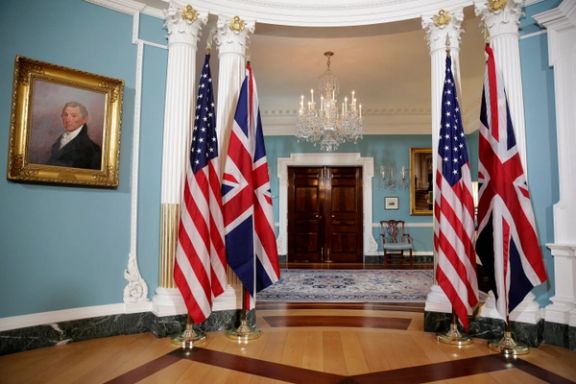
The flags of the United States and the United Kingdom (file photo)

The United States and Britain on Thursday announced new sanctions on Iran targeting its military and unarmed aerial vehicle production after its attack on Israel.

US President Joe Biden also announced that G7 leaders were committed to acting together to increase economic pressure on Tehran.

Biden said the United States and its allies had helped Israel beat back the April 13 missile and drone strike and were now holding Iran accountable with the new sanctions and export controls.

"The sanctions target leaders and entities connected to the Islamic Revolutionary Guard Corps, Iran’s Defense Ministry, and the Iranian government’s missile and drone program that enabled this brazen assault," Biden said in a statement.

"And our allies and partners have or will issue additional sanctions and measures to restrict Iran’s destabilizing military programs," Biden said.

Britain also announced sanctions on military figures and entities in a coordinated move with the United States. The sanctions, which include asset freezes and travel bans, target Iran's defense minister and other military figures and organizations including the Armed Forces General Staff and the Islamic Revolutionary Guards Corps (IRGC) Navy.

A US Treasury Department statement said the US measures targeted 16 individuals and two entities enabling Iran’s UAV production, including engine types that power Iran’s Shahed variant UAVs, which were used in the April 13 attack.

Treasury said it was also designating five companies in multiple jurisdictions providing component materials for steel production to Iran’s Khuzestan Steel Company (KSC), one of Iran’s largest steel producers, or purchasing KSC’s finished steel products.

Also targeted were three subsidiaries of Iranian automaker Bahman Group, which it said had materially supported Iran's Islamic Revolutionary Guard Corps.

The statement said the US Commerce Department was also imposing new controls to restrict Iran’s access to technologies, such as basic commercial grade microelectronics.

Tehran says it carried out the April 13 attack in retaliation for a presumed Israeli strike on the Iranian consulate in Damascus which killed two generals and several others on April 1. Israel has said it will retaliate, while a senior Iranian Revolutionary Guards commander said on Thursday Iran could review its "nuclear doctrine" following Israeli threats

Treasury said that concurrent with its action, Britain was imposing sanctions targeting several Iranian military organizations, individuals and entities involved in Iran’s UAV and ballistic missile industries.

Britain said these sanctions included the General Staff of the Armed Forces and the Islamic Revolutionary Guard Corps (IRGC) Navy, according to an official notice.

"We’re using Treasury’s economic tools to degrade and disrupt key aspects of Iran’s malign activity, including its UAV program and the revenue the regime generates to support its terrorism," U.S. Treasury Secretary Janet Yellen said in the statement.

"We will continue to deploy our sanctions authority to counter Iran with further actions in the days and weeks ahead."

The US statement came after finance ministers and central bank governors of the Group of Seven industrial democracies said after a meeting in Wednesday they would "ensure close coordination of any future measure to diminish Iran's ability to acquire, produce, or transfer weapons to support destabilizing regional activities."

European Union leaders also decided on Wednesday to step up sanctions against Iran after Tehran's attack on Israel raised concerns about a wider conflict in the Middle East.


Most Viewed

US blockade enters murky phase as tankers spoof signals and buyers hesitate
1
ANALYSIS

US blockade enters murky phase as tankers spoof signals and buyers hesitate

2

US tightens financial squeeze on Iran, warns banks over oil money flows

3
INSIGHT

Ideology may be fading in Iran, but not in Kashmir's ‘Mini Iran'

4
INSIGHT

Hardliners push Hormuz ‘red line’ as US blockade tests Iran’s leverage

5
VOICES FROM IRAN

Hope and anger in Iran as fragile ceasefire persists

Banner
Banner

Spotlight

  • Hardliners push Hormuz ‘red line’ as US blockade tests Iran’s leverage
    INSIGHT

    Hardliners push Hormuz ‘red line’ as US blockade tests Iran’s leverage

  • Ideology may be fading in Iran, but not in Kashmir's ‘Mini Iran'
    INSIGHT

    Ideology may be fading in Iran, but not in Kashmir's ‘Mini Iran'

  • War damage amounts to $3,000 per Iranian, with blockade set to add to losses
    INSIGHT

    War damage amounts to $3,000 per Iranian, with blockade set to add to losses

  • Why the $100 billion Hormuz toll revenue is a myth
    ANALYSIS

    Why the $100 billion Hormuz toll revenue is a myth

  • US blockade targets Iran oil boom amid regional disruption
    ANALYSIS

    US blockade targets Iran oil boom amid regional disruption

  • Iran's digital economy battered by prolonged blackout
    INSIGHT

    Iran's digital economy battered by prolonged blackout

•
•
•

More Stories

Amid Criticism, IRGC Commander Claims Israel Attack Deployed Old Weapons

Apr 18, 2024, 16:04 GMT+1

The commander of the Aerospace Force of the IRGC has claimed the aerial attack on Israel was carried out with old weapons and minimal military strength amid backlash over the operation’s ineffectiveness.

Amir Ali Hajizadeh stated on Thursday that IRGC’s limited resources exceeded "the maximum capacity of both Hebrew and Western powers with minimal strength,” Tasnim, a news outlet affiliated with the IRGC, reported.

While Iran launched an unprecedented drone and missile barrage against Israel over the weekend, the effectiveness of the attack has been criticized and ridiculed online.

The attack, which was in retaliation for Israel's April 1 air strike on the Iranian consulate in Damascus, was almost entirely intercepted by the Israeli Defense Forces and its allies.

The Iranian authorities attempted to silence all criticism, including that of journalists and citizens inside the country, within hours of the attack.

Several news outlets and journalists who were critical of the regime's portrayal of a powerful attack were arrested and prosecuted. The IRGC's Intelligence Unit and judiciary have also threatened to prosecute anyone who ridicules or criticizes the military establishment.

In spite of attempts by the regime to save face, researchers interviewed by the Washington Post about Iran's arsenal claim Iran "threw everything it had that could reach Israeli territory."

n his Thursday remarks, Hajizadeh named a few "powerful" missiles to boast that they were not used, like Sejjil-1. However, experts say they may no longer be produced as they are too costly. Additionally, Hajiazdeh claims that the Kheibar Shekan missile was not used, a claim the Washington Post analysts refute. 

IRGC Breaks Protocol, Summons Swiss Ambassador Amid Attack On Israel

Apr 18, 2024, 13:45 GMT+1

The Iranian Revolutionary Guard Corps (IRGC) summoned the Swiss ambassador during the attack on Israel, a New York Times report on Wednesday confirmed.

Mojtaba Abtahi, an adviser to the Iranian Interior Minister, previously claimed that the Swiss Ambassador was summoned to the IRGC instead of the Foreign Ministry at 3 a.m. during Iran's first ever direct attack on Israel.

Tehran launched 350 or more missiles and combat drones on Saturday night in retaliation for Israel's April 1 air strike on the Iranian consulate in Damascus, killing a senior IRGC-Quds Force commander and several IRGC personnel.

Israeli forces, backed by the US and other allies, stated that approximately 99% of the incoming threats were destroyed, while the few that survived caused only minor damage. As tensions in the region mount, Iran is preparing for possible retaliatory attacks either on its territories or its proxies.

Speaking to Swiss Ambassador Nadine Lozano, the IRGC apparently broke protocol and warned her that "The IRGC would destroy the entire region if the US took even the slightest action", showing the true political force of the IRGC in Tehran.

Since 1980 following the attack on the US embassy in Iran, Switzerland has played a crucial role in representing US interests in Iran. It serves as a go-between for US interests in Iran during escalating tensions. However, summoning an ambassador to a military base, a clear violation of diplomatic protocols, is a highly unusual event. As of now, Switzerland and the US have yet to respond to this breach of diplomatic norms.

Mojtaba Abtahi, who also holds the title of Secretary-General of the International Conference on Supporting Palestine Intifada, referred to the action of IRGC as simply "military diplomacy."

In recent years, the IRGC has developed a more significant influence within the Iranian government and has broadened its influence outside the military to include other fields, such as economics.

Mahsa Act To Be Incorporated Into White House Aid Bill To Weaken Iran

Apr 18, 2024, 13:20 GMT+1
•
Iran International Newsroom

The Mahsa Act looks set to be incorporated into a wide scale aid package in Washington on Saturday, aiming to weaken Iran and its allies.

It has been packaged along with a raft of sanctions to crack down on Iran’s missile program, human rights abuses and support to its terror proxies in Palestine. As a measure tightening the grip on Iran, it is dubbed, the “21st Century Peace Through Strength Act”.

House Foreign Affairs Committee Chairman Michael McCaul introduced the legislation which he said was a means of confronting Iran and its allies China and Russia through a series of new sanctions as the three continue to destabilize global geopolitics.

“In order to truly confront the generational threat posed by the unholy alliance of Russia, China, and Iran, we need to make substantive policy changes in addition to providing critical security assistance to our partners and investing in our defense industrial base,” he said.

“I’m proud the ’21st Century Peace through Strength Act’ includes the most comprehensive sanctions against Iran Congress has passed in years; the bipartisan, bicameral REPO Act; and protects Americans from the malign influence of the CCP-controlled TikTok. The time to pass this is now – we cannot wait anymore.”

The bills have to pass a full Senate vote and be signed by the President to become law but it has finally overcome the Senate Foreign Relations Committee (SFRC) hurdle.

The Mahsa pillar will be called the Mahsa Amini Human rights and Security Accountability Act or simply the MAHSA Act, and will see the imposition of sanctions on Iran’s supreme leader’s office, its appointees and anyone affiliated with the office and its work.

It is a huge nod to the impact that the 22-year-old’s death has had globally since September 2022. Killed in morality-police custody after her arrest for not wearing her hijab properly, her tragic death sparked a nationwide uprising in which hundreds of Iranians were murdered in the hands of security forces.

Crackdowns on women defying the hijab continue to worsen, this week the Noor project seeing scores of morality police patrols back on the streets of Tehran.

The MAHSA Act had held back from the committee for a long time after it passed the House and was said to be heavily ‘diluted’ before being sent to the floor for vote.

The bill, titled the Mahsa Amini Human Rights and Security Accountability Act, was first introduced to the US Congress in January 2023, four months after the start of nationwide protests in Iran.

In its original version, the Mahsa Act required the US government to impose applicable sanctions on Iran’s Supreme Leader Ali Khamenei, his Office and his appointees, Iran’s president and a number of entities affiliated with Khamenei.

It also required the US President to report to Congress every year whether those officials should remain under existing sanctions, making it much harder for the current and future administrations to unilaterally lift the sanctions.

The new legislation package now includes provisions pulled from multiple pieces of legislation from the House Foreign Affairs Committee Republicans, including giving the executive branch the power to transfer frozen Russian sovereign assets to Ukraine to help Ukraine stay in the war and eventually rebuild.

Mandatory sanctions will be levied against Iran-backed Hamas which on October 7 waged war on Israel, sparking the current region-wide conflict led by Iran and its proxies. That will extend to fellow Iran-backed militias in Palestine, Palestinian Islamic Jihad, Al-Asqa Martyr’s Brigade, the Lion’s Den, and other Palestinian terrorist groups and their supporters.

There will also be sanctions on ports and refineries that receive and process Iranian oil and measures to further restrict "the export or re-export of US-origin goods and technology to Iran, including those used to manufacture missiles and drones attacking our forces across the Middle East and by Vladimir Putin against Ukraine”, it said.

Since the Gaza war broke out on October 7 alone, over 200 attacks were launched by Iranian proxies against US forces and facilities. Iran continues to work with Russia to manufacture drones for the use in the war on Ukraine.

Anyone involved in activity covered under the UN missile embargo on Iran that lapsed in October 2023 will be sanctioned in addition to anyone involved in the supply, sale, or transfer of, or support for, Iran’s missiles and drones program.

The bill will call to fully enforce human rights sanctions on Iran as human rights abuses continue. Just last year, almost 900 executions took place in a record year for the regime. Minorities continue to be persecuted and the likes of internet freedoms continue to be restricted. According to Freedom House, Iran is one of the least free countries in the world. Over 70 journalists last year alone were arrested for writing dissenting views.

As Iran’s biggest consumer of oil, the law “requires the president to periodically determine whether a Chinese financial institution has engaged in the purchase of petroleum or petroleum products from Iran” in a bid to weaken the mechanisms Iran is using to bypass sanctions.

It will also require the president to “brief Congress on the finances of Iranian leadership and require financial institutions to close accounts connected to these individuals” as economic restrictions remain a key tool to strangle Tehran’s grip.

Amid the war in Gaza, waged by Hamas, killing 1,200 mostly civilians on October 7 and taking 250 more hostage, the bill also aims to disrupt “the ability of Hamas to fund terrorism, and makes it harder for state sponsors of terrorism to abuse International Monetary Fund resources to finance terrorist organizations, including Hamas, Palestinian Islamic Jihad, and Hezbollah”.

The war in Gaza has brought to light the power of Iran which The Times recently revealed paid £200m ($250m) towards its war effort in addition to training and arming the militias.

Former Iran advisor to the State Department, Gabriel Noronha, said the new bill is “a strong bill that imposes sanctions on anyone involved in Iran's missile/drone program and forces the administration to answer tough questions”.

G7 Ministers Condemn Iran Attack On Israel, Vow Further Sanctions

Apr 18, 2024, 10:08 GMT+1
•
Iran International Newsroom

The finance ministers of the Group of Seven (G-7) condemned Iran’s “unprecedented attack” against Israeli territory, vowing close cooperation to impose new sanctions on Tehran.

“We will ensure close coordination of any future measure to diminish Iran’s ability to acquire, produce, or transfer weapons to support its destabilizing regional activities,” read the statement released Wednesday by G-7 finance ministers following negotiations on the sidelines of the International Monetary Fund and World Bank Group Spring Meetings in Washington, DC.

The ministers also warned against any regional escalation and its concomitant economic risks, particularly those to international shipping.

Italian Foreign Minister Antonio Tajani, who hosts this round of G7 summit, said Thursday that the foreign ministers of the group “will address the most sensitive issues on the agenda.” He elaborated, “We will certainly discuss the Middle East issue. We are friends of Israel, and we support Israel, but we want de-escalation in that area. We will also have to address how to sanction Iran in some way for the attack with hundreds of missiles and drones against Israel.”

“We will also have to deal with the other situation in the Middle East, and the maritime traffic through Suez and the Red Sea, an issue that involves all our countries since the merchant traffic is threatened by the Houthis,” he added.

Since November, Iran-backed Yemeni Houthis have been engaged in a blockade in the Red Sea, the Gulf of Aden, and the Bab el-Mandeb Strait in a bid to force a ceasefire on Israel. The group launched its campaign to attack Israeli vessels but it has since expanded to all global shipping.

On Saturday, Iran's Revolutionary Guard seized a Portuguese-flagged cargo ship that they said was "affiliated with" Israel near the Strait of Hormuz.

Meanwhile, European Union leaders pledged more sanctions against Iran, urging the regime and its proxies to put an end to their attacks in the region.

The EU “will take further restrictive measures against Iran, notably in relation to unmanned aerial vehicles and missiles,” said the statement issued Wednesday after the first day of the bloc leaders’ summit in Brussels.

On Saturday night, Iran launched its first ever direct offensive against Israeli territory with more than 350 drones and cruise and ballistic missiles.

French President Emanuel Macron stressed that the new sanctions should target “those who are helping to produce the missiles and drones that were used” in Iran’s offensive.

Israeli Foreign Minister Israel Katz welcomed the EU's decision to ramp up Iran’s sanctions, calling it “an important step on the way to defanging the snake.” According to Katz, “Iran must be stopped now before it is too late.”

Amid a wave of international condemnation, the Permanent Representatives of 48 countries at the United Nations condemned Iran’s attack on Israeli territory in a joint statement on Wednesday.

“We unequivocally condemn the April 13 attacks by the Islamic Republic of Iran and its militant partners on the State of Israel, which involved launching several hundred ballistic missiles, cruise missiles and attack drones against multiple targets, and note this large-scale attack could have caused significant damage and loss of life,” read the statement.

They also lambasted Iran’s move to “violate” the airspace of several regional countries such as Jordan which helped intercept the barrage, noting that it endangered the lives of innocent people.


US Could Be Drawn Into War With Iran, Biden Warns

Apr 18, 2024, 06:57 GMT+1

The United States could get into war with Iran if Tehran launches a major attack on Israel, Joe Biden has said, amid a cacophony of threats and counter-threats from officials in Tehran and Jerusalem.

In an op-ed for Wall Street Journal Wednesday, President Biden called on the US Congress to pass military aid for Israel to ensure that it’s “fully stocked and ready” to defend herself.

“If Iran succeeds in significantly escalating its assault on Israel, the US could be drawn in,” Biden warned. “Israel is our strongest partner in the Middle East; it’s unthinkable that we would stand by if its defenses were weakened and Iran was able to carry out the destruction it intended this weekend.”

President Biden has been trying hard since October 7 to avert a full-scale war in the Middle East, exhausting overt and covert diplomatic channels to restrain Israel and Iran. His job has become much more difficult since April 13, when the Iranian regime launched more than 300 drones and missiles towards Israel in response to the bombing of one of its buildings in the Damascus embassy, which killed the IRGC’s top commander in Syria and his deputy.

In the past few days, officials in both Israel and Iran have hardened their rhetoric, uttering threats that seem to get more severe by the day.

On Wednesday, Israel’s finance minister Bezalel Smotrich said that Israel’s response to Iran’s attack should inflict a “disproportionate toll” and “rock Tehran” so that the leaders of the country “regret the moment they even thought about firing”.

Smotrich is the leader of the far-right Religious Zionism party, He is not a member of the war cabinet, but wields considerable power because a ‘coalition deal’ means he is technically also a minister in Israel’s defense ministry. Speaking to Israel’s Army Radio (GLZ), he called for an Israeli retaliation that would make the Iranian regime “realize they shouldn’t mess with” Israel. “This is the language spoken in the Middle East,” he said.

In Tehran, President Ebrahim Raisi proved that this was indeed the language spoken in the Middle East. Even the “tiniest” Israeli attack on Iran, he said at a military parade, would bring “a severe and harsh response.” The IRGC commander in charge of missiles and drones, Amir Ali Hajizadeh, seconded the president. Asked by a reporter if they would strike Israel again if they retaliate against Iran's attack, he said “one-hundred percent.”

But this wasn’t the end. There were more threats to come from Israel.

Former director of intelligence at Mossad, Zohar Palti, suggested in an interview that targeting nuclear facilities can be an option. “Everything is on the table right now,” he told the British broadcaster Sky News. Asked whether that included targeting nuclear facilities, he said, “including everything.”

Palti is not an Israeli official. But Smotrich is. So are Raisi and Hajizadeh and many more voices on both sides calling for severe measures to establish ‘deterrence.’

The Biden administration –and other world leaders to a lesser extent– will have a difficult task de-escalating a situation that seems to be getting more tense by the day.

The US and the EU have announced their intention to impose more sanctions related to Iran, targeting those individuals and entities that help Tehran's destabilizing activities. However, that the effective way to exert pressure is to enforce the oil export sanctions already in place that the Biden administration has not pursued vigorously.