• العربية
  • فارسی
Brand
  • Iran Insight
  • Politics
  • Economy
  • Analysis
  • Special Report
  • Opinion
  • Podcast
  • Iran Insight
  • Politics
  • Economy
  • Analysis
  • Special Report
  • Opinion
  • Podcast
  • Theme
  • Language
    • العربية
    • فارسی
  • Iran Insight
  • Politics
  • Economy
  • Analysis
  • Special Report
  • Opinion
  • Podcast
All rights reserved for Volant Media UK Limited
volant media logo

Biden Criticized As Hamas Declares Israel's ‘Isolation’ in Tehran

Iran International Newsroom
Mar 27, 2024, 08:47 GMT+0Updated: 10:52 GMT+0
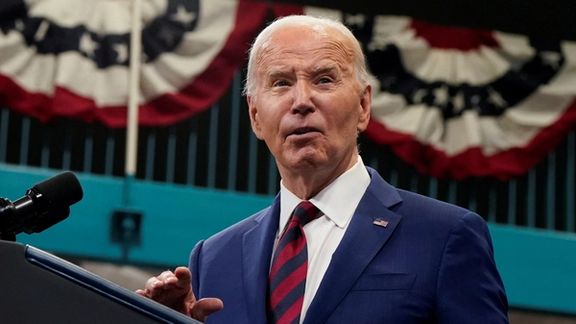
US President Joe Biden delivers remarks at the Chavis Community Center in Raleigh, North Carolina, March 26, 2024.

US President Joe Biden faced criticism on Tuesday as the Hamas chief visited Tehran and praised Israel’s “political isolation” – just a day after the UN Security Council voted for a ceasefire Israel opposed.

The Biden administration abstained from using its veto power Monday as members of the UN’s most powerful body voted to demand an immediate ceasefire in Gaza. The decision enraged the Israeli government and its supporters in Washington, who felt their government had “betrayed” Israel and sided with Hamas.

That sentiment only intensified when the Hamas leader traveled to Iran in what some critics of Joe Biden called “a victory lap”. The red carpet was ceremoniously laid out to welcome him, a carefully choreographed spectacle aimed at unnerving adversaries and, crucially, to bolster the Islamic Republic's image as the unwavering defender of the Palestinian cause.

“Iran stands at the forefront of supporting the cause and people of Palestine,” Haniyeh said. “I extend special thanks to the Supreme Leader of the Islamic Revolution of Iran, the President of Iran, and the people of Iran.”

Critics of the Biden administration, predominantly from the Republican side, interpret this as the epitome of a failing foreign policy, particularly concerning the Middle East and the regime in Tehran.

“Biden's confused, contradictory policies regarding Israel's struggle against Hamas and Iran are dangerous,” former US national security advisor John Bolton wrote in the Hill. “America should flatly reject the concept of Hamas having a "terrorist veto" over Israel's right to self-defense. If we don't, Israel and our anti-terrorism efforts globally will be significantly weakened.”

The war in Gaza, and the US response to it, has become yet another wedge, widening and deepening the partisan divide in American politics. The unbridgeable rift places President Biden in an exceedingly challenging position, where any decision he makes is susceptible to criticism from both sides simultaneously.

“Today the Biden Admin betrayed Israel and sided w/ Iran-backed Hamas terrorists who continue to hold US hostages,” Senator Bill Hagerty (R-TN) commented on X. “The Admin is so desperate to appease the pro-Hamas left that it is willing to advocate against the interests of our ally & our own citizens still held hostage.”

This, naturally, is not how Democrats, particularly those labeled by Hagerty as the “pro-Hamas left,” perceive the situation or the President's role. In their eyes, Biden has not gone far enough in confronting the Israeli government and halting what nearly every international and aid organization has termed a humanitarian crisis.

“To pretend that Israel is not violating international law or interfering with US humanitarian aid is absurd on its face,” Senator Bernie Sanders (D-VT) said Tuesday after a spokesperson for the Department of State told reporters that there were no reasons to dispute Israeli assurances that it was complying with humanitarian law in Gaza.

“The state department’s position makes a mockery of US law and assurances provided to Congress,” Sanders continued.

Jeremy Konyndyk, a former senior Biden official who now heads Refugees International, also accused Washington of not doing enough to pressure Israel.

“You can't fight famine by half-measures, and that seems to be all the Biden administration can muster right now,” Konyndyk posted on X. “Until Biden is ready to impose real policy consequences on Netanyahu's government, the famine will continue.”

Given the fervor and intensity of stances on both sides of the aisle, make it difficult to anticipate the Biden administration's course of action in the days and weeks ahead.

The potential invasion of Rafah by Israeli forces threatens to escalate the already strained relationship between the US and Israel to its breaking point. US Vice President Kamala Harris recently called it a “huge mistake” that could have “consequences” for Israel. 

These developments are viewed from Tehran with triumph and glee. The Iranian regime has no doubt increased its influence since the October 7th attack on Israel. Israel’s image, meanwhile, has been seriously challenged, if not tarnished. Meanwhile, the Islamic Revolutionary Guards (IRGC) and its armed proxy groups across the region have grown in cohesion and confidence.

Iran's Supreme Leader Ali Khamenei now likely wields greater leverage in managing relations with the US and regional adversaries, particularly concerning its domestic matters such as freedom and human rights – often considered secondary to regional security by global powers.

This new-found position has come at high price, albeit not for the Iranian regime.
Most Viewed

Ideology may be fading in Iran, but not in Kashmir's ‘Mini Iran'
1
INSIGHT

Ideology may be fading in Iran, but not in Kashmir's ‘Mini Iran'

2
INSIGHT

Hardliners push Hormuz ‘red line’ as US blockade tests Iran’s leverage

3
VOICES FROM IRAN

Hope and anger in Iran as fragile ceasefire persists

4

US sanctions oil network tied to Iranian tycoon Shamkhani

5

Iran International says it won’t be silenced after London arson attack

Banner
Banner

Spotlight

  • Hardliners push Hormuz ‘red line’ as US blockade tests Iran’s leverage
    INSIGHT

    Hardliners push Hormuz ‘red line’ as US blockade tests Iran’s leverage

  • Ideology may be fading in Iran, but not in Kashmir's ‘Mini Iran'
    INSIGHT

    Ideology may be fading in Iran, but not in Kashmir's ‘Mini Iran'

  • War damage amounts to $3,000 per Iranian, with blockade set to add to losses
    INSIGHT

    War damage amounts to $3,000 per Iranian, with blockade set to add to losses

  • Why the $100 billion Hormuz toll revenue is a myth
    ANALYSIS

    Why the $100 billion Hormuz toll revenue is a myth

  • US blockade targets Iran oil boom amid regional disruption
    ANALYSIS

    US blockade targets Iran oil boom amid regional disruption

  • Iran's digital economy battered by prolonged blackout
    INSIGHT

    Iran's digital economy battered by prolonged blackout

Tweet unavailable

•
•
•

More Stories

Iran Politician: Government Plagued By Infiltration, Inefficiency

Mar 27, 2024, 04:31 GMT+0
•
Iran International Newsroom

A member of the Iranian parliament's National Security and Foreign Relations Committee has said that the current "weak government" is the result of the presence of "a corrupt deviant group".

Morteza Mahmoudvand, a parliament member from Khorram Abad, informed reporters that most of Iran's problems stem from this corrupt faction within the government. He pledged to substantiate this claim with documents and evidence for the public.

He emphasized, "Despite the efforts of the current parliament to assist the government, certain deviant elements within the Raisi administration obstructed constructive measures, leading to a feeble government." He reiterated his statement as a seasoned political and security expert.

Mahmoudvand accused this deviant group of having connections to foreign entities, although he refrained from disclosing the identities of these individuals or the involved foreign countries. He asserted that these infiltrators have permeated the government and are responsible for the failures of the Raisi administration.

He revealed that he had informed President Ebrahim Raisi multiple times about these infiltrators but observed no action taken by the Iranian president. Mahmoudvand added that when Raisi formed his government, he lacked a cohesive team, allowing foreign-backed infiltrators to join his administration, potentially leading to a significant crisis for the nation.

Morteza Mahmoudvand, a member of the Iranian parliament's National Security and Foreign Relations Committee (undated)
100%
Morteza Mahmoudvand, a member of the Iranian parliament's National Security and Foreign Relations Committee

Similarly, former lawmaker Gholam Ali Jafarzadeh Imanabadi told reporters on Monday that individuals like Economy Minister Ehsan Khandouzi, lacking prior administrative experience, were suddenly promoted to cabinet positions. He expressed regret, saying, "I wish Raisi had never become Iran's President."

Imanabadi lamented the loss of the European market due to the inefficiency of government ministers and officials. He criticized the parliament, citing members who lack understanding of the country's realities and economic illiteracy.

He remarked, "There isn't a single economist among the members of the new parliament." He criticized the prevalence of populist radicals in the current parliament.

Iranian hardliners loyal to Supreme Leader Ali Khamenei barred hundreds of candidates from running for the March 1 parliamentary elections, paving the way for a relatively small circle of ultraconservatives to win many seats amid a low-turnout event.

Imanabadi said: "I am not happy about the government's failure. It is regrettable that as a result of the government's inefficiency the rate of exchange for the US dollar is now more than 600,000 rials. In the meantime, we have lost the European market as the government has shown more interest in transactions with regional countries. Our trade balance for the first nine months of the Iranian Year (late March to late December 2023) has been negative.”

He pointed out: "We have lost so many of our military men in Syria, but we hold only four percent of that country's market” This comes while more than 70 percent of the Syrian market belongs to Turkey, he said and added, "At the same time, the International Monetary Fund has acknowledged the sharp drop in the value of Iranian currency. This is the outcome of assigning big jobs to radical populists who do not understand the realities.

Pointing out the weakness of the parliament, Imanabadi said that only 7 percent of legislation by the current parliament have something to do with the country's economic situation.

The former commander of the IRGC's Khatamolanbia Headquarters Saeed Mohammad has in a recent interview highlighted the lack of coordination among the members of Raisi's economic team as one of the reasons for his administration’s economic failures. He asked: "Why the government does not ask itself for what reasons its economic slogans have not materialized?"

He questioned the administration's failure to fulfill its economic promises despite Khamenei's repeated emphasis on production growth.

Ex-Iranian Diplomat Urges Change In Foreign Policy

Mar 26, 2024, 22:37 GMT+0

Ali Majedi, former Iranian Ambassador to Germany, has called for accepting conditions set by the Financial Action Task Force (FATF) and resolving foreign policy issues in the new Iranian year.

Speaking at a forum on international relations, Majedi stated that the FATF issue transcends geopolitics, emphasizing, "It's not about the US; it's about international regulations."

He pointed out that Iran's inclusion on the FATF blacklist poses hurdles to its economic activities and international relations.

FATF is a Paris-based inter-state financial watchdog that has penalized Iran for not adhering to international conventions on money laundering and financing of terrorism. In 2017, Iran's presidential administration proposed legislation to address FATF's concerns but hardliners have blocked its approval.

Regarding Iran's foreign policy challenges, Majedi cautioned against ineffective diplomatic approaches. He was referring to the dispute over Iran's nuclear program and relations with the West.

He criticized the current government's foreign policy team, labeling it as one of the weakest in history. Drawing parallels with past administrations, he highlighted the need for a technocratic approach to effectively advance Iran's foreign policy goals. Majedi emphasized the need for a competent negotiation team and strategic diplomatic maneuvering.

Iran finds itself increasingly isolated in the international arena due to a combination of factors, including its strained relations with the West, ongoing regional conflicts, and concerns over its nuclear program.

Despite efforts to engage diplomatically, Tehran's confrontational rhetoric and actions have exacerbated tensions with Western countries and Persian Gulf Arab states alike. The reimposition of sanctions by the United States, coupled with Iran's defiance, have further isolated the country economically and diplomatically.

Additionally, Iran's support for militant groups in the Middle East has fueled regional instability, leading to growing distrust and apprehension among its neighbors and the broader international community.

Clashes In Iran’s Baluchestan Province Result In Baby’s Death

Mar 26, 2024, 20:19 GMT+0

A confrontation between armed men and law enforcement forces along the route from Iranshahr to Khash in Sistan-Baluchestan province has led to casualties.

Among the victims are a one-year-old baby and a law enforcement officer, with three civilians sustaining injuries.

The Baluch Activists Campaign reported that armed men initiated gunfire at two law enforcement vehicles on Monday evening, resulting in the death of a law enforcement officer.

“In response, military forces retaliated by firing at the car of a Baluch citizen, resulting in the death of one-year-old Fatemeh Bameri and injuries to three others,” it added.

The Sistan-Baluchestan Law Enforcement Information Center presented the child's death as a consequence of armed men targeting her family's vehicle and identified the officer as Mohammad Zakhireh.

The incident adds to a concerning trend of increased armed attacks leading to deaths among regime forces in the largely Sunni province. Just a day prior, Iranian media reported the killing of border guard Mohammad Mehdi Nejatinia by unidentified assailants.

Furthermore, the event echoes past instances where innocent children have lost their lives due to direct fire from regime forces.

Kian Pirfalak, a nine-year-old child, was fatally shot by government forces during nationwide protests on November 16, 2022 highlighting the impact of such confrontations on civilian lives.

Exclusive: Iran’s Censoring Tech Firm To Be Removed From EU Sanctions

Mar 26, 2024, 19:46 GMT+0
•
Iran International Newsroom

The European Union is set to remove ArvanCloud from its list of human rights sanctions, according to a source close to European diplomats. The firm was sanctioned in 2022 for its role in Iran's Internet censorship.

Following this action, ArvanCloud filed a complaint with the European Court of Justice and simultaneously pressured European governments through political channels to revoke this decision.

At the same time, ArvanCloud announced the termination of its contract with the Ministry of Communications and Information Technology of the Islamic Republic of Iran.

A source close to European authorities informed Iran International that ArvanCloud's overseas supporters claimed to have played a significant role in providing millions of Iranian citizens with access to a free internet during the Woman, Life Freedom protests in 2022-2023. This claim appears to be one of the reasons for the EU's decision to lift sanctions on ArvanCloud.

Iran has been blocking tens of thousands of websites since 2002, and as social media emerged, it began also blocking platforms such as Facebook, Twitter (X) and You Tube. Traditional media is also heavily censored, as are books and films, both from the perspective of Islamic beliefs and political content.

The European Union and ArvanCloud have not responded to Iran International's request for clarification about this information at the time of publication.

The European Union annually reviews its list of individuals and entities violating human rights in Iran and decides whether to renew the sanctions or not. The outcome of this decision is announced in the official EU newspaper one or two days later.

In June 2023, the US Treasury Department labeled ArvanCloud as a key partner of the Ministry of Communications and Information Technology of the Islamic Republic of Iran in developing the national information network and disconnecting Iranians from the global internet, based on which, two founders of this company were sanctioned along with one of its branches in the UAE.

A source close to decision makers in the EU told Iran International: "The 'Anonymous' hacking group previously exposed documents from the Islamic Republic's internet filtering committee server, showing that ArvanCloud had blocked various websites at the committee's request."

In one case, ArvanCloud officials went beyond the given orders and not only blocked a website but also its server's IP address.

Issa Zarepour, Iran's Minister of Information and Communications Technology   (undated)
100%
Issa Zarepour, Iran's Minister of Information and Communications Technology

Documents released by Nariman Gharib, an internet researcher, in 2022 also showed that Issa Zarepour, the Minister of Communications, had asked President Ebrahim Raisi to take action through the Ministry of Foreign Affairs in cooperation with the European countries to remove ArvanCloud from the sanctions list.

In the same letter, Raisi was asked to agree that law firms associated with the embassies of the Islamic Republic undertake the defense of ArvanCloud at the government's expense.

ArvanCloud controls 49% of Iran's cloud space market and continues to host many of the Islamic Republic's most important websites, including the Presidency, IRNA news agency, and the Ministry of Islamic Guidance.

One of the information centers of this company is installed at Payam Airport, belonging to the Ministry of Communications.

US Imposes Sanctions On Iran-Linked Terror Backers

Mar 26, 2024, 18:50 GMT+0

The US announced counter-terrorism sanctions targeting facilitators aiding Yemen's Houthis, Iran's Quds Force, and the Lebanese group Hezbollah.

With Iran's longstanding support, the Houthis have fortified their position in Yemen's decade-long civil conflict, seizing control over vast territories with extensive financial and military backing.

Most recently the group has imposed a blockade on one of the world’s primary sea trade and logistics routes. Multiple attacks have been carried out on global shipping including multiple deaths of seamen earlier this month.

The latest sanctions, imposed on six entities, one individual, and two tankers spanning Liberia, India, Vietnam, Lebanon, and Kuwait, aim to disrupt illicit commodity shipments and financial transactions, according to the US Treasury Department.

State Department spokesperson Matthew Miller said, "We will continue to use the tools at our disposal to target those who ship illicit cargo to benefit terrorist groups."

However, as Iran’s proxy activity continues, many in Washington say sanctions are failing, not least in deterring Iran’s nuclear program which has continued to grow beyond peaceful limits.

In a parallel move, the Treasury Department sanctioned 11 individuals and entities accused of bolstering Syrian President Bashar Al-Assad's regime through illicit financial transfers and drug trafficking.

Iran's extensive backing extends beyond the Houthis, encompassing several other designated terrorist organizations in the region including Hamas in Gaza which waged war on Israel in October 7.