• العربية
  • فارسی
Brand
  • Iran Insight
  • Politics
  • Economy
  • Analysis
  • Special Report
  • Opinion
  • Podcast
  • Iran Insight
  • Politics
  • Economy
  • Analysis
  • Special Report
  • Opinion
  • Podcast
  • Theme
  • Language
    • العربية
    • فارسی
  • Iran Insight
  • Politics
  • Economy
  • Analysis
  • Special Report
  • Opinion
  • Podcast
All rights reserved for Volant Media UK Limited
volant media logo

Houthis Hit Chinese-Owned Oil Tanker In Spite Of Iran's Reassurances
Mar 24, 2024, 09:13 GMT+0
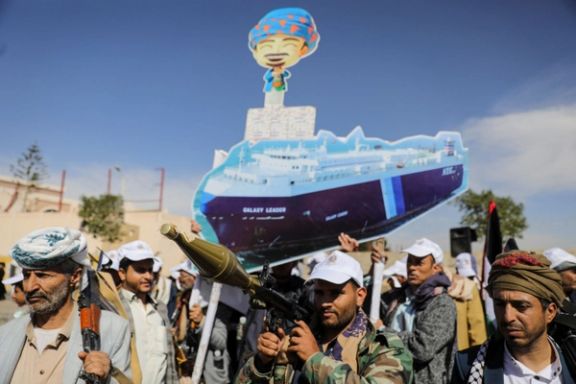
Houthi followers hold a cutout banner, portraying the Galaxy Leader cargo ship which was seized by Houthis, Sanaa, Yemen, February 7, 2024.

The Iran-backed Houthi rebels launched a missile attack on a Chinese-owned oil tanker on Sunday in spite of reassurances from Tehran that its vessels would be protected.

"The Houthis attacked the MV Huang despite previously stating they would not attack Chinese vessels," the US Central Command stated on X.

Four anti-ship ballistic missiles were fired at the vessel, followed by a fifth missile. No casualties have as yet been reported.

The strike is the latest amidst a blockade initiated by Iran's Supreme Leader in which the Yemeni militia has targeted ships supporting Hamas in Gaza in its war against Israel. While the blockade was only begun with the intention to target Israeli vessels, it has since become global, no vessels safe from the onslaught.

Just last week, Iran promised two of its main allies, Russia and China, that their ships would be safe amidst the blockade, with the latest incident threatening relations. China, as Iran's primary consumer of Iranian oil, remains a key partner economically and militarily and as such, the attack risks relations.

Bloomberg reported that Russian and Chinese diplomats met with Mohammed Abdul-Salam, a senior Houthi official and the group’s spokesperson to secure a deal to protect ships on the key trade route in the Red Sea and surrounding area.

It is understood that Moscow and Beijing would, as a result, provide the Houthis with political support, which according to Bloomberg can include “blocking more resolutions” against the Yemeni terror group in the UN Security Council.

Following the missile attack on Sunday, a swarm of one-way attack drones ensued. Of these drones, five were intercepted and subsequently crashed after engagement by the USS Carney, while a sixth flew further into Houthi-controlled regions of Yemen.

Iran has supported the Houthis for several years, providing extensive financial, military, and training support to their forces, enabling them to take control of swathes of Yemen in the civil war which is nearing a decade of fighting.


Most Viewed

State media slam Araghchi's Hormuz tweet, say it let Trump claim victory
1

State media slam Araghchi's Hormuz tweet, say it let Trump claim victory

2

Iran International says it won’t be silenced after London arson attack

3
INSIGHT

How Tehran bends its own red lines to boost state rallies

4
OPINION

The Hormuz get out of jail card turned to a grave

5

Iran halts petrochemical exports to supply domestic market

Banner
Banner

Spotlight

  • Too early to tell who is winning Iran war, experts say
    PODCAST

    Too early to tell who is winning Iran war, experts say

  • How Tehran bends its own red lines to boost state rallies
    INSIGHT

    How Tehran bends its own red lines to boost state rallies

  • Iran blackout cripples freelancer, small business incomes
    VOICES FROM IRAN

    Iran blackout cripples freelancer, small business incomes

  • Ideology may be fading in Iran, but not in Kashmir's ‘Mini Iran'
    INSIGHT

    Ideology may be fading in Iran, but not in Kashmir's ‘Mini Iran'

  • US blockade enters murky phase as tankers spoof signals and buyers hesitate
    ANALYSIS

    US blockade enters murky phase as tankers spoof signals and buyers hesitate

  • Why the $100 billion Hormuz toll revenue is a myth
    ANALYSIS

    Why the $100 billion Hormuz toll revenue is a myth

•
•
•

More Stories

US Conducts 'Self-Defense Strikes' Against Houthi Facilities

Mar 23, 2024, 10:50 GMT+0
•
Iran International Newsroom

US forces conducted self-defense strikes against three Houthi underground weapons storage facilities in Houthi-controlled areas of Yemen, US Central Command (CENTCOM) said on Friday.

The strikes targeted capabilities used by the Houthis to threaten and attack naval and merchant vessels in the region, it posted in a statement on X.

CENTCOM also said its forces had destroyed four unmanned aerial vehicles (UAVs) in Houthi-controlled areas of Yemen in self-defense.

Attacks by Yemen's Houthis in the Red Sea region, which the Iran-aligned militants say are in solidarity with Palestinians in Gaza, have disrupted global shipping, forcing firms to take longer and more expensive journeys around southern Africa. The attacks began in mid-November after Iran's Supreme Leader Ali Khamenei called on Muslims to blockade Israel. Houthis are supported by Iran's weapons supplies.

The head of the Houthi supreme revolutionary committee, Muhammad Ali Al-Houthi, said earlier there had been "reckless" US-British attacks on Yemen. The Houthi-run Saba News Agency said US and British aircraft had launched five raids on Hodeidah, the area where Yemen's main port is located.

CENTCOM said that during the time frame of the US attacks on the UAVs, Houthi militants had fired four anti-ship ballistic missiles from Houthi-controlled areas of Yemen toward the Red Sea.

"There were no injuries or damage reported by US, coalition, or commercial ships," it said.

CENTCOM said its strikes on the storage facilities were "actions are necessary to protect our forces, ensure freedom of navigation, and make international waters safer and more secure for US, coalition, and merchant vessels."

Critics of the Biden administration have said that US military measures have so far been limited and defensive in nature, failing to deter the Houthis or their main supporter, the Iranian regime.

With reporting by Reuters

Repeating Iran's Mistake, Putin Dismissed US Warnings Of Terror Attack

Mar 23, 2024, 09:15 GMT+0
•
Iran International Newsroom

Just three days before the Friday night massacre in Moscow, Russian President Vladimir Putin disregarded US intelligence warnings regarding the possibility of a terrorist attack in Moscow.

Over the past weeks, US intelligence agencies had obtained alarming information about the rising threats of the Afghanistan-based cell of the Islamic State in Russia. The terrorist group is commonly known as ISIS-Khorasan or ISIS-K.

On March 7, the US embassy in Russia issued a security alert, saying it “is monitoring reports that extremists have imminent plans to target large gatherings in Moscow, to include concerts, and U.S. citizens should be advised to avoid large gatherings over the next 48 hours.”

However, Putin's decision to disregard the warning is similar to what took place in Iran recently. More than one week before a double bombing in the Iranian city of Kerman which killed more than 90 people on January 3, the US provided the Iranian government with a private warning about terrorist threats. The warning was ignored by Tehran.

Adrienne Watson, spokesperson for the White House National Security Council, confirmed that the information was shared with Russian officials in accordance with Washington’s “duty to warn” policy.

However, Putin dismissed the warnings as provocative. “All this resembles outright blackmail and the intention to intimidate and destabilize our society,” the Russian president was quoted as saying on March 19.

At least four armed assailants stormed the Crocus City Hall, a popular concert hall, on Moscow’s western edge. The attack claimed the lives of at least 60 people and left 145 injured.

ISIS claimed responsibility for the deadly assault. Following the incident, Mykhailo Podolyak, a top adviser to Ukraine’s presidential office, stressed that Kyiv “has absolutely nothing to do” with the massacre.

Citing Kremlin officials, Interfax news agency reported Saturday that 11 people have been arrested in connection with the attack, including four who were directly involved in it.

Iran Alerted US Before Soleimani Revenge Strike, Zarif Affirms

Mar 23, 2024, 07:07 GMT+0
•
Iran International Newsroom

Iran’s former foreign minister Mohammad Javad Zarif has confirmed that Tehran informed the US before launching missiles at an Iraqi base housing American forces in January 2020.

The ballistic missile attack came as retaliation days after the United States killed IRGC's Quds Force commander Qasem Soleimani in a drone strike in Baghdad. Zarif also claims that he and then-President Hassan Rouhani heard about the missile attack after the Americans were informed through Iraqi officials.

In his new book, Mohammad Javad Zarif explains the buildup to the attack on Ain al-Asad Base in January 8, 2020, codenamed Operation Martyr Soleimani. Ten days after the publication of the book, social media circulated a photo of one of the pages of the memoir that detailed the moment when Zarif was informed of the attack.

“The last decision I heard [after Soleimani's killing] was that there is no rush for a response, and the most efficient method was thought to be the one pursued by Hezbollah in Lebanon, creating condition to exhaust the enemy,” Zarif says in the book, a memoir of the eight years (2013-2021) he served as foreign minister.

He added that he received the message about the missile attack from Abbas Araghchi, another senior Iranian diplomat, hours after Iran had fired over a dozen ballistic missiles at the base. This was the biggest ballistic attack against the US forces in recent history.

“Apparently, Americans were informed of the attack before Iran’s President and Foreign Minister by the Iraqi Prime Minister Adil Abdul-Mahdi,” who had informed them of the operation in the evening, hours before the attack. Reuters reported at the time that Iraq's prime minister had received an oral message from Iran that the retaliatory attack would begin and that it would target locations where American forces were deployed.

At 11 pm on January 7, US Lt. Col. Antoinette Chase, responsible for emergency response at Ain al-Asad Base, gave the order for American troops to go on lockdown and take cover in bunkers. The first missiles landed sometime after 1:35 a.m. on January 8 and the barrage continued for nearly two hours. “Worst case scenario — we were told was it’s probably going to be a missile attack. So we were informed of that,” she told reporters touring the base later.

Zarif commends the “appropriate and correct” decision to give the heads-up to the US before the attack but questions why President Hassan Rouhani and himself were not aware of the attack, laying bare a point of contention in the Islamic Republic’s politics: The Revolutionary Guards do not coordinate their moves with the government.

Iran's coordination with the US regarding the attack suggests that Supreme Leader Ali Khamenei and his IRGC aimed to project strength but were wary of the potential escalation resulting from any American casualties. Nevertheless, Iran was on alert for a possible US retaliatory strike and hours later mistakenly shot down a Ukrainian airliner thinking it was an American aircraft, killing 176 innocent people.

Zarif revealed that he and his team were preparing messages to the security council and other parties to explain the Ain al-Asad attack before he learned of the downing of the Ukrainian plane soon after its takeoff from Tehran.

It is not the first time Zarif talked about Iran’s the circumstances surrounding the killing of Soleimani and Tehran’s coordination for the surprise revenge attack and other developments of that week in January 2020. In a voice recording leaked in March 2021, Zarif could be heard saying that officials knew about the circumstances of the downing soon after it happened, but they had concealed the information from him, and continued to mislead the world about why the airliner had crashed.

Former US president Donald Trump, who ordered the killing of Soleimani, said on several occasions that Iranians informed him that they would hit a military base with ballistic missiles.

On February 5, former secretary of the Supreme National Security Council Ali Shamkhani dismissed claims by Trump that he had received an Iranian message before the attack. However, he chose his words very carefully, saying there were no contacts between the Iranians and Americans before the attack on Ain al-Asad. He was right. The IRGC informed the Iraqi premier, who later relayed the message.

The Iranian attack was the most direct Iranian assault on America since the 1979 seizure of the US Embassy in Tehran. Iran and the United States went to the brink of war three times during the Presidency of Donald Trump, Iran’s former president Rouhani said in January. 

Codepink Evades Questions About Alleged Links With Iranian Regime

Mar 22, 2024, 22:31 GMT+0

Codepink’s co-founder dodged questions on alleged ties to the Iranian regime during a conversation with Iran International's correspondent in Washington DC.

The confrontation unfolded during a heated exchange with Iran International's Arash Alaie, where Medea Benjamin deflected scrutiny by asserting, "We're not on the side of any government anywhere. We support people."

Codepink has come under fire for its alleged connections to the Iranian regime, primarily from critics who perceive the government in Tehran as oppressive and authoritarian. Detractors argue that by maintaining affiliations with or expressing solidarity towards the Iranian leadership, Codepink legitimizes a regime accused of egregious human rights violations, crackdowns on dissent, and alleged support for terrorist entities.

The movement's critics further contend that Codepink's stance may inadvertently whitewash the Iranian government's track record of arbitrary arrests, torture, and executions targeting political dissidents, journalists, and minority groups. Some also accuse Codepink of disproportionately scrutinizing Western governments, particularly the United States, while downplaying or disregarding the actions of non-Western regimes such as Iran.

There are concerns among critics that the Iranian regime could exploit Codepink's support as a propaganda tool, utilizing it to bolster its international image and diminish its isolation on the global stage.


Israel-Hamas War: Iranian Minister Praises Gaza ‘Resistance Front’

Mar 22, 2024, 17:06 GMT+0

Amid Israel’s war with Hamas, the Iranian regime’s Minister of Culture and Islamic Guidance praised what he called the “youth of the resistance front in Palestine, Lebanon, Iraq and Yemen”.

"After six months of resistance, the youth of Gaza have shown to the Islamic world that the attachment of the people of Gaza to the Quran is steadfast. The Muslim people of Gaza have demonstrated to the world that adherence to the Quran is a fundamental and vital condition for the advancement of the Islamic society," Mohammad Mehdi Esmaili said at a Quranic session in Tehran on Friday.

The Minister’s praise of the “resistance front” is understood to be in support of militant terrorist Palestinian groups, such as Hamas and Islamic Jihad – and other Iran-backed proxies operating along Israel's borders.

His comments come amid escalating tensions in the Middle East – after Hamas and Palestinian armed groups attacked Israel on October 7, 2023.

The attack, described as the deadliest for Jews since the Holocaust, resulted in the deaths of 1,200 individuals and left many others wounded. Additionally, 240 individuals were taken hostage during the incident.

While the US has not corroborated the claim, the Wall Street Journal reported that Iran was involved in aiding Hamas to orchestrate the attack, with Hamas operatives reportedly receiving training in Iran beforehand.

In line with the clerical regime in Tehran, the Minister echoed an anti-Semitic trope by labeling Israel as "the Zionist regime."

“The heroic resistance of the Palestinians thwarted all the equations sought by the occupying Zionist regime and the United States to normalize the presence of this cancerous gland in the heart of the Islamic world," he said.