• العربية
  • فارسی
Brand
  • Iran Insight
  • Politics
  • Economy
  • Analysis
  • Special Report
  • Opinion
  • Podcast
  • Iran Insight
  • Politics
  • Economy
  • Analysis
  • Special Report
  • Opinion
  • Podcast
  • Theme
  • Language
    • العربية
    • فارسی
  • Iran Insight
  • Politics
  • Economy
  • Analysis
  • Special Report
  • Opinion
  • Podcast
All rights reserved for Volant Media UK Limited
volant media logo

Iranians Continue To Voice Anger At US State Department Instagram Post

Iran International Newsroom
Mar 24, 2024, 08:08 GMT+0Updated: 10:52 GMT+0
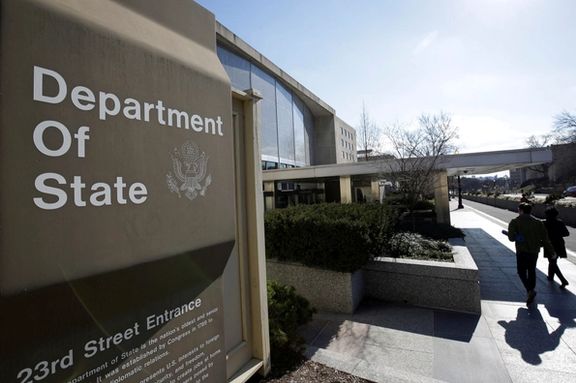
People enter the State Department Building in Washington, US, January 26, 2017.

The backlash by Iranians to a US State Department post on Instagram continued Saturday with 80 Iranian-American activists and citizens urging the Secretary of State to have it removed.

“It is deeply concerning that the US State Department would endorse and promote an individual with such tainted history and character as a defender of Iranian women,” the signatories write in their open letter. “This decision undermines the credibility of the United States in advocating for human rights and democracy… in Iran.”

The ‘individual’ in question is Faezeh Hashemi Rafsanjani, a former member of parliament in Iran and daughter to a former president of the Islamic Republic. In recent years, she has become a critic of government policies and has voiced support for women's rights. She has been hailed as a “champion of women rights across Iran” by the State Department’s official account in Persian @USAbehFarsi.

“Ms. Rafsanjani is against compulsory hijab, supports women's rights and defends other prisoners whom she considers innocent,” reads the original State Department post. “Even when her rights were violated, Ms Rafsanjani bravely fought for the rights of others.”

The post was received by anger and disbelief among Iranians, who felt the choice was “at best distasteful”, given that Ms. Rafsanjani’s father, Ali Akbar Hashemi Rafsanjani, was the main architect of the regime and at the heart of its every malign activity –inside Iran and overseas– for almost four decades.

“The Islamic Republic regime routinely imprisons individuals within the establishment for minor disagreements, and Mrs. Hashemi Rafsanjani's situation appears to be part of an internal power struggle, rather than genuine commitment to justice on either party,” reads the letter to Secretary Blinken. “We urge you to… support individuals who genuinely champion the rights and freedoms of all Iranians –women and men– and their struggles for a secular, democratic Iran.”

Faezeh Rafsanjani, daughter of former Iranian president Akbar Hashemi Rafsanjani (2016)
100%
Faezeh Rafsanjani, daughter of former Iranian president Akbar Hashemi Rafsanjani

The sentiment in the letter was shared by many Iranians who have moved on from the Reformist-Fundamentalist duality of regime insiders to reject the Islamic Republic in its entirety. In this view, Faezeh Hashemi Rafsanjani is ultimately an “insider” with unmatched privilege in her social and political life, despite her having become a critic of regime policies. Hence the outrage at the State Department’s decision to pick and promote her.

Within a few hours of appearing on Instagram, the Faezeh Hashemi post received just under 5,000 comments, overwhelmingly negative, which forced the account’s administrator to close the comments section. The backlash continued, nonetheless, spilling over to other platforms such as X.

Most notably, several members of the families who have lost loved ones in recent anti-regime protests took to social media to vent their anger, frustration, and often bafflement at the Biden administration’s Iran policy.

“No doubt that the US State Department is consciously walking alongside the Islamic Republic towards common goals,” posted Saeed Afkari, a brother to Navid Afkari, who was executed in 2020 at the age of 27, for protesting, despite pleading innocence in the face of severe mental and physical torture.

Saba Bakhtyari, whose brother and sister-in-law are in prison for speaking against the killing of their son, Pouya, was another of the Families for Justice who denounced the US government and their Instagram post.

“For us who seek justice, there’s no difference between Faezeh Rafsanjani, [current President] Raisi, and [Supreme Leader] Khamenei,” she wrote on her account on X. “And the fact that the US State Department has called one of our killers brave, proves that the US, just like 1979, is still a friend of the mullahs and an enemy of the people of Iran.”

Most Viewed

Iran International says it won’t be silenced after London arson attack
1

Iran International says it won’t be silenced after London arson attack

2
VOICES FROM IRAN

Hope and anger in Iran as fragile ceasefire persists

3
INSIGHT

How Tehran bends its own red lines to boost state rallies

4

State media slam Araghchi's Hormuz tweet, say it let Trump claim victory

5

Iran halts petrochemical exports to supply domestic market

Banner
Banner

Spotlight

  • Too early to tell who is winning Iran war, experts say
    PODCAST

    Too early to tell who is winning Iran war, experts say

  • How Tehran bends its own red lines to boost state rallies
    INSIGHT

    How Tehran bends its own red lines to boost state rallies

  • Iran blackout cripples freelancer, small business incomes
    VOICES FROM IRAN

    Iran blackout cripples freelancer, small business incomes

  • Ideology may be fading in Iran, but not in Kashmir's ‘Mini Iran'
    INSIGHT

    Ideology may be fading in Iran, but not in Kashmir's ‘Mini Iran'

  • US blockade enters murky phase as tankers spoof signals and buyers hesitate
    ANALYSIS

    US blockade enters murky phase as tankers spoof signals and buyers hesitate

  • Why the $100 billion Hormuz toll revenue is a myth
    ANALYSIS

    Why the $100 billion Hormuz toll revenue is a myth

•
•
•

More Stories

Suspicious Prisoner Deaths And Suicides Multiply In Iran

Mar 24, 2024, 02:58 GMT+0
•
Iran International Newsroom

Alireza Khari is not the only political prisoner in Iran who committed suicide under continuous psychological pressure and torture, even after release from prison.

Khari, a young protester in his late twenties from Bandar Gaz in northern Iran, ended his life earlier this week. Rights activists say he was repeatedly called in and threatened by the Revolutionary Guards (IRGC) intelligence organization after his release from prison.

Judiciary officials of the Islamic Republic which has always refused to allow international investigations into Iranian prisons claim conditions at these facilities are suitable. The experience of many prisoners, however, proves that prisons and detention centers run by security forces have become “killing grounds” for prisoners, especially dissidents.

Authorities always attribute suspicious deaths in prisons and detention centers, or shortly after prisoners’ release, to suicide and claim they suffered from mental health or had personal problems.

In the past four decades, dozens of political and ordinary prisoners have committed suicide in prison or shortly after their release.

In the past month alone, several political prisoners attempted or committed suicide. These include Mosayeb Yeganeh who was returned to Tehran’s Evin prison from hospital before the completion of his treatment. Shahin Gallehdari, a Kurdish political prisoner was another victim who passed away at the ultra-security ward of the Central Prison of Orumieh in northwestern Iran, and Hasan Omarpour, another Kurdish prisoner self-immolated at the same prison.

In February Amir Shahbazi, a prisoner sentenced to amputation of his fingers for theft, also committed suicide at the infamous Central Prison of Orumieh. He had reached an out of court agreement with the plaintiff to forgo the amputation sentence, but authorities insisted on carrying out the sentence.

Besides Orumieh Central Prison and Tehran’s Evin Prison, suspicious deaths and suicides have recently been reported at Lakan Prison in Gilan Province, the Central Prison of Tabriz in East Azarbaijan Province, and Ilam Prison in Ilam Province.

During and after the Woman, Life, Freedom protests of 2022-2023, several protesters died suspiciously in detention or shortly after freedom. These included Javad Rouhi (35), Maryam Arvin (29), Arshia Emamgholizadeh (16), Yalda Agha-Afzali (19), Mina Yaghoubi (33), Abbas Mansouri (18), and Atefeh Naami (37).

Coroner’s report attributed Rouhi’s suspicious death in hospital a year after his arrest to interaction of the medicines he was taking. Rouhi who was arrested in September 2022, was sentenced to death in a sham trial. His death sentence was overturned by the Supreme Court but continued to be threatened, tortured, and harassed.

Rights organizations said Rouhi was brutally tortured at a Revolutionary Guards (IRGC) detention center and even lost his power of speech.

Arvin, a lawyer who offered advice to prisoners and their families, also died after her release from prison. Her family reject judiciary officials’ claim that she died of suicide and believe she died because of drugs she had been administered in prison.

In some cases, as in Agha-Afzali’s case, authorities attributed the suspicious deaths of prisoners after freedom, to drug misuse. However, in an audio-file before her death, Agha-Afzali had revealed brutal tortures in prison.

Some former political prisoners have revealed that they were forced to take drugs or injections that they suspect could have contained psychoactive substances. These drugs, they say, highly affected their physical and mental health, they say.

Rights organizations and activists say physical and psychological torture and alleged administration of psychoactive drugs could cause such suspicious deaths and suicides.

Torture, as in the case of dissident Rapper Saman Yasin, sometimes include incarceration at mental facilities. In a letter from prison to the Chief Justice, Yasin begged to be executed, because, he said, death by execution was preferable to the tortures he had endured.

Iranian Cleric Raises Concerns Over Elections, Economy

Mar 24, 2024, 01:09 GMT+0

A member of the Qom Seminary Scholars has voiced significant concerns regarding low electoral participation and the failure of government economic policies in Iran.

Mohammad-Taghi Fazel-Meybodi highlighted the low turnout in the recent elections, emphasizing that over 50% of the population abstained from voting, viewing their non-participation as a form of protest rather than apathy. He urged the government and authorities “to heed the message and demonstrate responsiveness, particularly with the upcoming presidential elections on the horizon.”

Furthermore, Meybodi cautioned that if the Guardian Council maintains its current policies of banning hundreds of candidates, “achieving unity will remain elusive.” Meybodi warned against marginalizing certain groups, as it hinders "the cultivation of unity."

Expressing disappointment with the government's performance, Meybodi criticized the failure to fulfill promises and address economic crisis effectively. He noted that despite proclaiming efforts to control inflation, “the reality on the streets and in the markets contradicts official statistics.” Meybodi highlighted the discrepancy between government claims of a 30% decrease in inflation and the actual rise in inflation rate, which he said stands at 47%.

He also criticized hardliner cleric Ahmad Alamolhoda, who defends the government, questioning his perspectives on economic issues. He urged Alamolhoda to compare inflation rates during President Hassan Rouhani's term with the current administration led by President Ebrahim Raisi,- noting a significant difference in performance.

He also indirectly referred to the misappropriation of land by Tehran's interim Friday Prayer Imam, Kazem Seddiqi, suggesting that such actions have eroded people's trust in religious leaders.

Meybodi highlighted the disconnect between rhetoric and reality, expressing skepticism about the effectiveness of current policies in addressing economic challenges and fostering national unity.

Thousands Of Iranians Visit Persepolis, Ancient Seat Of Monarchy

Mar 23, 2024, 23:07 GMT+0

Images and videos posted online show large crowds of people visiting Persepolis, the ancient seat of Achaemenid kings, and the royal Sa'dabad Palace in Tehran during Norouz holidays.

Thousands celebrated the moment of the beginning of the Iranian New Year at Persepolis on Wednesday morning. Despite the strict measures by the Iranian regime and the coincidence of Norouz and the Islamic fasting month of Ramadan, many Iranians danced and rejoiced in this historical venue in southern Iran to celebrate the New Year.

Ettela’at Online news website described as “unprecedented” the presence of people at Persepolis. Mohammad Sabet Eghlidi, Director General of Tourism Department at Fars province, announced that more than 10,000 people, including tourists, attended the New Year’s celebration at Persepolis.

Over the past decades, the Iranian government has systematically tried to distance people from the pre-Islamic traditions, rituals and cultural heritage. It has frequently banned people from visiting the Pasargadae and Persepolis, ancient sites dating back to the Achaemenid Empire, on Cyrus the Great Day.

The coincidence of Nowruz and Ramadan this year has prompted the Islamic Republic to step up its harsh measures against those opting for a different lifestyle and worldview than those endorsed by the regime. On Thursday, Iran’s deputy interior minister for security affairs said Nowruz travelers eating in public will be punished. “The sacredness of Ramadan must be respected,” stressed Majid Mirahmadi.

Meanwhile, photos from Iran in the past four days show thousands of people waiting in long lines to enter the Sa'dabad Palace, one of the main residences of Iran's last king, Mohammad Reza Pahlavi. During the Norouz holidays last year, the Sa'dabad Palace was declared the most visited historical site in the Iranian capital city Tehran.

The Islamic Republic has tried in vain to spread a negative picture of the Pahlavi dynasty and reduce their popularity.

US Lawmakers Urge Blocking Entry To Iranian Officials

Mar 23, 2024, 21:01 GMT+0

In a letter to the State Department, 27 members of the House of Representatives have urged the Biden administration to ban the entry of Iranian officials to the United States.

“We must not offer the Iranian regime the privilege of setting foot on US soil or the validation of speaking at the United Nations,” read the bipartisan letter addressed to Secretary of State Antony Blinken.

The lawmakers referred to the involvement of Iranian President Ebrahim Raisi in the massacre of thousands of political prisoners in 1988 and his current role in suppressing dissidents in the country, calling for “the denial of visas to President Raisi and any government officials or organizations connected to the regime.”

In 1988, Raisi was a member of an ad hoc judicial committee known as the “Death Commission,” responsible for deciding the fates of prisoners during summary trials that were held in secret.

According to the bipartisan group, the Iranian government continues to destabilize the region by funding, training and supplying its proxies, such as Hamas, Yemeni Houthis and Hezbollah, which target American forces in the region and seek to destroy Washington’s ally, Israel.

“The barbaric October 7, 2023, attack on Israel was a stark wake-up call about the threats Iranian-backed terrorist groups pose to both Israelis and Americans,” the letter added.

Over the past years and particularly, following the 2022 nationwide uprising, Iranian political activists and opposition figures have called on Western countries not to issue visas for regime officials and block their presence in international organizations.

Back in January, the World Economic Forum was urged to revoke its invitation to Iran’s Foreign Minister Hossein Amir-Abdollahian over his close links to the IRGC.

As New Year Begins, Iran Grapples With Inflation And Poverty

Mar 23, 2024, 20:21 GMT+0
•
Iran International Newsroom

As the new Iranian year commenced on March 20, the Iranian press overflowed with complaints, criticism of the government, and dire economic forecasts.

A video released by Etemad online, showed prominent cleric Alavi Boroujerdi speaking out against the government regarding the people's challenging circumstances. He protested that "The people are no longer able to endure the economic hardships," and pointed out that "the clerics are being held responsible for all their troubles."

Boroujerdi also criticized the government for the way it is running the affairs of the state. He said: "The people's economic situation is very bad. Bring in a few honest experts to address the problems as people's patience has come to an end."

Meanwhile, in an interview with Rouiydad24 website, labor activist Hassan Sadeghi warned the government about a fast approaching 67-percent inflation rate in the new year. Sadeghi also warned that the price of gasoline is also going to rise in the new year. The latest gasoline price increase by the government in 2019 led to nationwide protests in Iran during which security forces reportedly killed around 1,500 Iranians.

Sadeghi lamented the state of the country's economy, criticizing the decision to entrust economic matters to individuals lacking adequate expertise in the field of economics. He cautioned that with inexperienced non-experts overseeing the nation's economy, the Iranian currency is poised to face further devaluation in the upcoming New Year, beginning on March 20.

Former central bank chief Abdolnaser Hemmati
100%
Former central bank chief Abdolnaser Hemmati

Expressing concern, Sadeghi cautioned that these developments could precipitate crises, including widespread protests in Iran in the coming year. He highlighted the anticipated impact of inflation and rising prices, particularly on the most vulnerable segments of the population. Additionally, he noted that the heavy reliance on taxation in the government's budget for the New Year is likely to exacerbate the inflationary pressures.

Furthermore, Sadeghi suggested that the Iranian government should take cues from Turkey's approach and adjust wages to keep pace with the rise in inflation. However, talks between the government and representatives of workers yielded no progress on the eve of the New Year.

In another development, former Central Bank Governor Abdolnaser Hemmati, who was President Ebrahim Raisi's rival in the 2021 presidential election, wrote in a tweet: "Government officials are lauding each other for achieving a 4 percent economic growth rate, even as the official inflation rate stands at a staggering 42 percent. Hemmati pointed out that "in 2020, despite facing intense pressure from the US and grappling with the pandemic, Iran managed to achieve a 4.2 percent economic growth, with meager oil revenue of only $7.4 billion." This achievement is particularly noteworthy considering that Iran faced fewer obstacles in exporting oil last year, resulting in oil revenues exceeding $30 billion."

In an earlier letter to the Iranian President, Hemmati had told Raisi that "With the plan you called 'economic surgery' you created a triple-digit inflation rate for commodities such as meat, poultry, and dairy products people need on a daily basis.”

He addressed Raisi directly, stating, "You recently expressed your desire for a headline in the press that reflects the government's empowerment of Iran! But can we truly consider the sharp decline in people's purchasing power, in a country endowed with the world's largest oil and gas resources, and the fact that over 30 percent of the population has fallen below the poverty line as indicators of a powerful nation?"

As evidence of the Iranian government's inefficiency, Hemmati highlighted that one year after the conclusion of Iran's 6th development plan, the country's 7th development plan remains unfinished. Additionally, just five days before the end of the current Iranian year, the government has yet to finalize the annual budget bill for the upcoming year.