• العربية
  • فارسی
Brand
  • Iran Insight
  • Politics
  • Economy
  • Analysis
  • Special Report
  • Opinion
  • Podcast
  • Iran Insight
  • Politics
  • Economy
  • Analysis
  • Special Report
  • Opinion
  • Podcast
  • Theme
  • Language
    • العربية
    • فارسی
  • Iran Insight
  • Politics
  • Economy
  • Analysis
  • Special Report
  • Opinion
  • Podcast
All rights reserved for Volant Media UK Limited
volant media logo

BBC's Deal With Iran Over Election Coverage Angers Staffers
Iran International Newsroom
Mar 5, 2024, 19:50 GMT+0Updated: 10:58 GMT+0
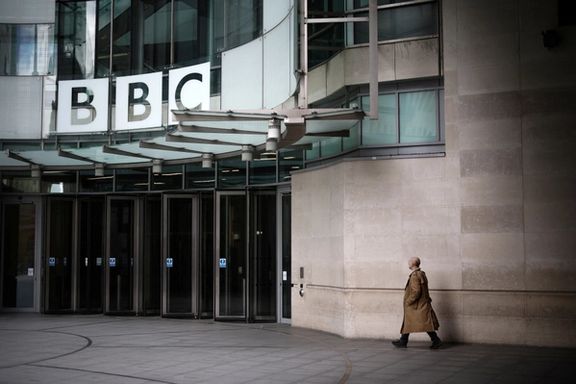
Pedestrians walk past a BBC logo at Broadcasting House in London, Britain, January 29, 2020.

A reported deal between the BBC and authorities in Tehran over the coverage of Iran's controversial elections has outraged its Persian service staffers, Iran International has learned.

The BBC's decision to send its correspondent Caroline Davies to cover Iran's elections in Tehran has resulted in internal tensions at the broadcaster, as managers are believed to have acquiesced to the Iranian regime's condition that its Persian broadcast department be barred from using her reports and videos.

Staff members of the Persian service believe "by accepting this conditionality, the BBC has allowed the Iranian government to dictate the terms of BBC's reporting."

They have warned that BBC's decision "isolates" them, "divides the BBC, and signals to the Iranian government that BBC Persian is fair game for harassment and persecution," particularly of their families in Iran.

BBC has repeatedly stated in recent years that the Islamic Republic has harassed, intimidated, and threatened BBC Persian journalists and their families in Iran over the past decade, including death threats against BBC journalists and their families in London, blocking their assets in Iran, and online harassment, and sexual assaults against female journalists.

The Persian service staff members say they had made it clear to the BBC's top management a few years ago that such decisions are "unacceptable". However, "it has happened again."

Asked about the issue, a BBC spokesperson told Iran International, "The BBC is committed to providing our UK and global audiences with impartial coverage of the Iran elections and our correspondent, Caroline Davies, has been granted rare access to the country to report for BBC News across TV, radio and online."

"The BBC has not been able to report from Iran since 2019. Reporting from the country at this critical time does not reduce our condemnation for the harassment faced by BBC News Persian staff and we continue to call out the utterly unacceptable treatment for those simply doing their jobs," the spokesperson added.

BBC Persian, which broadcasts on TV, on radio and online, is banned in Iran. BBC Persian obtained in 2017 a court order that listed the names of 152 staff, former staff and contributors whose non-liquid assets were frozen by Iran's judiciary.

BBC Persian journalists had not been able to return to Iran for fear of arrest, while family members had been subjected to travel bans, interrogated and arbitrarily detained.

Iranian social media users have in recent days criticized the BBC correspondent's reports from Tehran, saying she did not cover the key issues including the widespread boycott of elections. There is also a perception that the BBC had not acted impartially in its reporting. Iranian users specifically compared Caroline Davies's reports with those of Deutsche Welle’s (DW) correspondent whose reports from Tehran covered issues like the election boycott, compulsory hijab, and the impact of the Woman, Life, Freedom movement on these elections.

Back in 2019, the Huffington Post reported that the BBC had "agreed to conditions set by the Islamic Republic of Iran to not share reporting materials it gathers in Iran with its Persian-language channel, BBC Persian, in exchange for Iran allowing a BBC correspondent into the country."

"The agreement represents a capitulation to a government that has been hostile to press freedom. The Iranian government routinely shuts down media organizations critical of the regime and imprisons, tortures and executes journalists," the Post reported at the time.

Most Viewed

State media slam Araghchi's Hormuz tweet, say it let Trump claim victory
1

State media slam Araghchi's Hormuz tweet, say it let Trump claim victory

2

Iran International says it won’t be silenced after London arson attack

3
INSIGHT

How Tehran bends its own red lines to boost state rallies

4
OPINION

The Hormuz get out of jail card turned to a grave

5

Iran halts petrochemical exports to supply domestic market

Banner
Banner

Spotlight

  • Too early to tell who is winning Iran war, experts say
    PODCAST

    Too early to tell who is winning Iran war, experts say

  • How Tehran bends its own red lines to boost state rallies
    INSIGHT

    How Tehran bends its own red lines to boost state rallies

  • Iran blackout cripples freelancer, small business incomes
    VOICES FROM IRAN

    Iran blackout cripples freelancer, small business incomes

  • Ideology may be fading in Iran, but not in Kashmir's ‘Mini Iran'
    INSIGHT

    Ideology may be fading in Iran, but not in Kashmir's ‘Mini Iran'

  • US blockade enters murky phase as tankers spoof signals and buyers hesitate
    ANALYSIS

    US blockade enters murky phase as tankers spoof signals and buyers hesitate

  • Why the $100 billion Hormuz toll revenue is a myth
    ANALYSIS

    Why the $100 billion Hormuz toll revenue is a myth

•
•
•

More Stories

Israel Says Hezbollah Aggression Bringing Critical Point Nearer

Mar 5, 2024, 17:52 GMT+0

Israeli Defense Minister Yoav Gallant said on Tuesday the continuing tension with Iran-backed Hezbollah at the border with Lebanon was moving the situation nearer to a military escalation.

Israel and Hezbollah have been trading fire since Iran-backed Palestinian group Hamas attacked Israel on October 7, fuelling concern about the danger of all-out war between the heavily armed adversaries.

"We are committed to the diplomatic process, however Hezbollah's aggression is bringing us closer to a critical point in the decision-making regarding our military activities in Lebanon," Gallant said in a statement after meeting US envoy Amos Hochstein, who is seeking a mediated end to that conflict.

Hezbollah has indicated it will cease fire if Israel's offensive in the Gaza Strip stops, describing its campaign as aimed at supporting Palestinians under fire in Gaza.

But visiting Beirut on Monday, Hochstein warned that a truce in Gaza would not necessarily bring an automatic end to hostilities across Lebanon's southern border.

He said a temporary ceasefire was not enough and a limited war was not containable.

Mediators have been seeking to clinch a 40-day ceasefire in the Gaza war in time for the Ramadan Muslim fasting month, which begins at the start of next week.

Much of the violence between Israel and Hezbollah has played out near the border, with notable exceptions including a February 26 Israeli airstrike in the Bekaa Valley, and a January 2 Israeli drone strike in Beirut that killed a top Hamas leader.

Israeli strikes since October have killed more than 200 Hezbollah fighters and some 50 civilians in Lebanon, while attacks from Lebanon into Israel have killed a dozen Israeli soldiers and six civilians. Tens of thousands of Israelis and Lebanese have fled villages on both sides of the frontier.

(Report by Reuters)

Iranian Currency Continues To Tumble In Wake Of Elections

Mar 5, 2024, 16:43 GMT+0

Iran's currency continued to plummet on Tuesday, with the US dollar surging to 610,000 rials as the currency hits all-time lows in the wake of the country's sham elections.

It marks a downward trend for the currency which has continued to fall since Friday's polls. The dollar has doubled against the rial since March 2022 after Iranian hardliners established control over the government and nuclear negotiations with the United States and its European allies failed to progress.

The rial, which has steadily fallen since the 1979 revolution, began a steep dive in 2018 when the United States withdrew from the JCPOA nuclear deal and imposed oil export as well as banking sanctions on Iran. The currency traded at 70 rials per dollar in 1978.

Contrary to the reality on the ground, in a meeting held a month ago, Ali Khamenei, Iran's Supreme Leader, praised the country's economic situation. He said, "We regret that the progress has not been explained to the people, and most of the nation is unaware of the efforts, successes, and innovations, which are among God's blessings."

The depreciation of the rial has exacerbated inflationary pressures in the past five years, with millions of people falling below the poverty line. Official government figures indicate more than 40 percent annual inflation, while many in Iran believe the real figure is higher.

Many Iranians Struggle With Poverty As They Greet Norouz

Mar 5, 2024, 15:55 GMT+0
•
Iran International Newsroom

Two weeks before the Norouz (Nowruz) Iranian New Year, reports received by Iran International indicate a significant drop in people’s purchasing power and the elimination of many food items in their diets.

According to what audiences have reported to Iran International, items such as red meat, chicken, fish, rice, and dairy products had the highest share among the goods removed from households' consumption baskets.

Iran’s currency, rial, has lost 20 percent of its value since early January, which directly contributes to rising prices of wheat, rice and animal feed that are largely imported and subject to currency fluctuations.

Annual inflation in Iran has hovered at or above 40 percent since 2019, one year after the United States withdrew from the 2015 JCPOA nuclear deal and imposed sanctions on the main source of Tehran’s revenues; oil exports. The already weak economy, over-burdened by government control and limited international trade, has shrank further in the past five years. Real incomes have decreased many-fold pushing tens of millions of people into poverty.

Now, at the onset of the New Year on March 21, legumes, milk, nuts, and pistachios, cheese, clothing, and eggs are among other items that, according to audience feedback reports, have been removed from their shopping baskets or purchased in limited quantities in some cases. Iran International, like many other media outlets, are not allowed to have a presence in Iran and audience feedback constitutes one of the main sources of information.

Norouz nuts are one of the main components of family gatherings during the holidays.  (file photo)
100%
Norouz nuts are one of the main components of family gatherings during the holidays.

Some have also expressed concern about the worsening economic conditions in the near future, stating that they have been unable to afford their children's favorite foods for a long time. The unchecked drop in the value of the rial, price inflation and lack of adequate pay increases are the main reasons for people’s pessimism.

Newspapers in Iran report that canned tuna prices have jumped by 113% in the past 12 months and prices for red meat by 100%. As protein-rich foods become unaffordable for ordinary people, Eghtesad 24 website reported recently that one-third of Iranians live below the “poverty line.”

One of Iran International's audience members, referring to the fact that due to high prices, chicken and red meat have been removed from his table in the past year, said: "We can no longer afford to buy rice, and with this situation of inflation, no one is accountable, and we do not know what future awaits us."

A retired person sent a message saying that he and his family struggle because his income is far below of what it was when he was employed, and inflation was lower. “In these circumstances, we do not have the purchasing power for buying new clothes for New Year’s Eve and must suffice with buying basic necessities. Our life is such that we can only survive,” he said.

Reza Gheybi, an economic reporter, told Iran International that food and consumer items related to the New Year have become more expensive in recent days and some supermarket chains have even began selling to consumers on credit. The government is thinking of providing emergency loans of up to $400 (200 million rials). However, the government can only afford assistance by printing more money, which in turn lowers the value of its currency and makes inflation worse.

Before the 1979 revolution, the dollar was worth just 70 rials and Iran was one of the richest countries in Asia. In the 1970s, Iran hosted guest workers from South Korea and other countries amid a high annual growth rate.

One person told Iran International this week that bananas have been removed from their family's shopping basket and they are forced to buy low-grade oranges. "Consider that we are from the middle class. Those who are economically weaker than us may even end up picking from trash cans."

One of the audience members, referring to the removal of many items from their family's table, said, "I attribute all of these to the fact that the country is not being managed well; otherwise, with all this wealth and resources, we should not live like this."

Iran Supplies Russia With Ballistic Missiles, Says UK Defense Secretary

Mar 5, 2024, 14:59 GMT+0

UK Defense Secretary Grant Shapps has accused Iran of supplying Russia with ballistic missiles for use in Ukraine, claiming the regime is a "bad influence" not only on the Middle East but in Europe too.

While Shapps confirmed the UK's possession of information regarding the alleged provision of surface-to-surface missiles from Iran to Russia, he refrained from delving into specifics, saying only that he "can't go into detail".

In an interview with the House Magazine, the senior minister said, “Whether it's ballistic missiles, or the Shahed drones that they supplied Russia with, we've seen that if there's a struggle in the world, often Iran are egging it on, or helping to supply the food chain in this case".. 

The revelation follows a report by Reuters in February, which suggested that the Iranian regime had furnished Russia with a significant quantity of ballistic missiles. The report prompted a reaction from the United States, warning Iran of severe consequences from the international community if the claims were substantiated.

Iran has publicly refuted allegations of supplying missiles to Russia. However, Shapps implied that Britain possesses intelligence supporting the claim.

In October, UN Security Council restrictions on Iran's export of certain missiles, drones, and related technologies expired. Nonetheless, the United States and European Union maintained sanctions on Iran's ballistic missile program, citing worries over the export of weaponry to its proxies in the Middle East and to Russia.


Authorities Destroy Over 30 Baha'i Graves At Mass Site In Tehran

Mar 5, 2024, 13:05 GMT+0

Iranian authorities have demolished more than 30 graves belonging to the Baha'i community at a mass gravesite in Tehran this week as oppression of the minority continues.

The act, which involved the removal of grave markers and the flattening of resting places using bulldozers, was slammed by rights activists, the latest in a series of actions taken against the community which has been systematically targeted since the founding of the Islamic Republic in 1979.

Simin Fahandej, Representative of the Baha'i International Community to the United Nations in Geneva, said, “In the last few months, the deceased loved ones of the Baha’is have been forcibly buried by government agents in the Khavaran mass grave site, further desecrating a burial place sacred to many.

"Now these same new graves have been destroyed. It is clear that this was always their plan. All Iranians are weighed down by unprecedented social and economic challenges, and amid this general suffering, Baha’is have been targeted by intensified and brutal new tactics in the Iranian government’s persecution of its community".

Before the 1979 Islamic Revolution, Tehran's Baha'i community owned two large cemeteries, both of which were confiscated by the Islamic Republic in the 1980s. Thousands of graves were demolished at the Khavaran cemetery, and the Baha'is were given limited access to a smaller property known as Golestan Javid. However, Ministry of Intelligence agents took over Golestan Javid in 2021, making it increasingly difficult for Baha'is to use their own cemetery.

Unofficial estimates suggest that more than 300,000 Baha'i people live in Iran. However, the Constitution officially acknowledges only Islam, Christianity, Judaism, and Zoroastrianism, thereby rendering Baha'is the most significant non-Muslim religious minority in the country.