• العربية
  • فارسی
Brand
  • Iran Insight
  • Politics
  • Economy
  • Analysis
  • Special Report
  • Opinion
  • Podcast
  • Iran Insight
  • Politics
  • Economy
  • Analysis
  • Special Report
  • Opinion
  • Podcast
  • Theme
  • Language
    • العربية
    • فارسی
  • Iran Insight
  • Politics
  • Economy
  • Analysis
  • Special Report
  • Opinion
  • Podcast
All rights reserved for Volant Media UK Limited
volant media logo

Houthis Continue Attacks As Israel Hits Targets Deep In Syria
Iran International Newsroom
Feb 7, 2024, 08:36 GMT+0Updated: 11:06 GMT+0
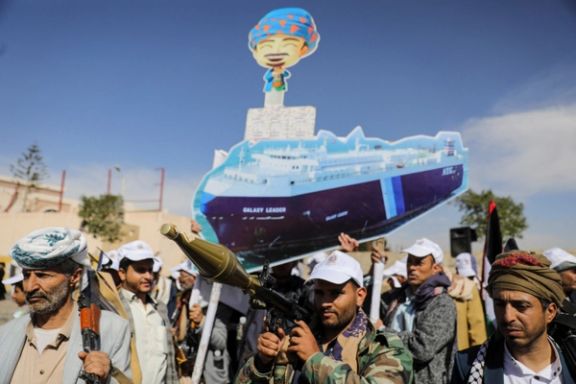
Houthi followers hold a cutout banner, portraying the Galaxy Leader cargo ship which was seized by Houthis, Sanaa, Yemen, February 7, 2024.

As Iranian backed Houthis Continued missile attacks against ships in the Red Sea, aircraft believed to be Israel hit at least nine Iran-affiliated targets in Syria’s Homs province.

What the targets represented is not exactly known, but Syrian activists claimed they were all sites linked with Iran and Hezbollah. The possibility exists that in one case a gathering of commanders was targeted. Syrian state television showed ambulances rushing to the scene of a strike, where wreckage and debris lay from a building that was hit.

Israel, which has targeted Iran-linked military sites and convoys in Syria for years, appears to have intensified targeted attacks based on precise and timely intelligence, eliminating Iranian IRGC officers.

Just last week, a suspected Israeli strike killed Saeid Alidadi, a Revolutionary Guard senior officer, south of the Syrian capital Damascus. In a devastating attack on January 29, in Damascus, several top IRGC officers and operatives were killed. Reports followed that the Iranians, fearing more attacks began reducing their presence in Syria. The United States also targeted Iran-linked sites in Syria on February 3 in retaliation for a drone attack days earlier that killed three US soldiers.

However, Houthi forces in Yemen continued their attacks on shipping in the strategically important Red Sea area on Tuesday, firing at two vessels. Houthis, a large military force, have received extensive Iranian military support for more than a decade. The began targeting commercial and naval vessels in mid-November after Iran’s ruler Ali Khamenei called on Muslims to blockade Israel.

An RAF Voyager tanker prepares to take-off to support an operation undertaken to conduct further strikes against Houthi targets February 3, 2024.
100%
An RAF Voyager tanker prepares to take-off to support an operation undertaken to conduct further strikes against Houthi targets February 3, 2024.

The US military's Central Command said the Houthis fired three missiles at the Star Nasia, which reported minor damage but no injuries. A US Navy ship operating near the Star Nasia shot down one of the missiles, Centcom said on X, formerly known as Twitter. It said the Star Nasia remained seaworthy and was continuing toward its destination.

Separately, the United Kingdom Maritime Trade Operations (UKMTO) agency and British maritime security firm Ambrey reported an explosion near a merchant vessel off Yemen's port of Aden on Tuesday.

Ambrey said the southbound Greek-owned bulk carrier had been targeted while heading through the Maritime Security Transit Corridor about 53 nautical miles southwest of Aden, en route from the US to India.

The Houthi attacks have affected the free flow of good through the Suez Canal between Asia and Europe. The United States began launching attacks on Houthi military installations last month, with dozens of sites bombed by missiles and aircraft. However, the attacks have continued.

Ambrey said the second vessel, a Barbados-flagged general cargo ship owned by a British company, had suffered damage from an unmanned aerial vehicle (UAV) while sailing south through the Red Sea.

No injuries were reported. The ship performed evasive maneuvers and continued its journey, Ambrey said.

The owner of the Morning Tide, British firm Furadino Shipping, told Reuters the ship was currently sailing without problems, but gave no further information.

US Centcom said three missiles fired by the Houthis had hit the water near the Morning Tide but caused no damage or injuries.

Iranian government media on Wednesday simply reported the news about the attack in Syria and the Houthi strikes but mostly avoided the typical rhetoric about the power of their proxy forces.


Most Viewed

Ghalibaf defends Iran-US talks amid hardline backlash
1
INSIGHT

Ghalibaf defends Iran-US talks amid hardline backlash

2
VOICES FROM IRAN

Bread shortages, soaring prices strain households in Iran, residents say

3
ANALYSIS

From instability to influence: Pakistan’s pivotal role in US-Iran diplomacy

4
ANALYSIS

100 days on: why Iran’s January protests spread across social classes

5

War-hit homeowners feel abandoned as Iran’s reconstruction aid fades

Banner
Banner

Spotlight

  • Is Iran entering its Gorbachev moment?
    INSIGHT

    Is Iran entering its Gorbachev moment?

  • Iran crackdown reaches cemeteries as graves of slain protesters defaced
    EXCLUSIVE

    Iran crackdown reaches cemeteries as graves of slain protesters defaced

  • Iran diplomacy wobbles as factions compete to avoid looking soft on US
    INSIGHT

    Iran diplomacy wobbles as factions compete to avoid looking soft on US

  • The politics of pink: how Iran uses cuteness to rebrand violence
    ANALYSIS

    The politics of pink: how Iran uses cuteness to rebrand violence

  • Bread shortages, soaring prices strain households in Iran, residents say
    VOICES FROM IRAN

    Bread shortages, soaring prices strain households in Iran, residents say

  • Ghalibaf defends Iran-US talks amid hardline backlash
    INSIGHT

    Ghalibaf defends Iran-US talks amid hardline backlash

•
•
•

More Stories

Senate In The Dark On Impact Of US Strikes In Mideast

Feb 6, 2024, 17:30 GMT+0

The US Senate Armed Services Committee has received no information from the Biden Administration regarding the impact of air strikes on Iran-linked targets, Sen. Tommy Tuberville told Iran International.

“I am on the Armed Services Committee, and we don’t know what we hit. We got no return summary of the bombing, and if anyone was hurt, anyone was killed, or anything was destroyed, and we spent a lot of money,” the Senator told our reporter Arash Alaei on Tuesday.

After a drone attack on January 28 on a US base in Jordan where three soldiers were killed, President Joe Biden pledged to retaliate, declaring that the attack was linked to Iran. However, the administration waited more than five full days before responding by air strikes on bases in Iraq and Syria, giving ample warning to Iranian IRGC and its proxies.

Critics have insisted that relentless attacks by Iran-backed forces against US targets in the region since mid-October warrants a more direct response against Iranian targets to re-establish deterrence. Reportedly, more ammunition was dropped than the number of armed individuals killed at the bombed locations.

Sen. Tuberville (R-AL) also expressed concern that the conflict in the Middle East is spreading because “others are getting involved” and not allowing the United States to calm the situation. He also expressed doubt that US retaliation against Iran-backed Houthi group, who attack vessels in the Red Sea, will have much of an impact

Iran To Conduct Joint Naval Exercise With Russia, China

Feb 6, 2024, 16:43 GMT+0

Iran, China and Russia will conduct a joint naval exercise in the coming weeks under what the trio claims aims at "ensuring regional security."

The commander of Iran's Navy, Shahram Irani, announced that other countries have also been invited to participate, although did not specify beyond China and Russia.

Irani emphasized that “the primary strategy of the Iranian Army Navy in the current situation is to safeguard the interests and economic resources of the Islamic system and its people,” referring to growing tensions in the Middle East sparked by Iran-backed militia Hamas's invasion of Israel on October 7.

In the wake of Israel's retaliatory attacks, Iran's proxies came out in allegiance, triggering a simmering regional conflict. US bases have been targeted over 160 times across the region as punishment for supporting Israel's right to defend itself.

Last year the three pariah states conducted a joint naval maneuver in the Gulf of Oman as they become a growing threat to the wider global landscape. 

This week, the think tank Policy Exchange revealed that the UK faces "a back-door threat from the growing Iranian, Russian and Chinese presence in the Republic of Ireland, a mounting challenge for a chronically deficient Irish security and intelligence apparatus".

The threat from the anti-Western trio, experts warned, requires the UK to expand its air and naval presence in Northern Ireland, to counter a growing threat.

Iran's Top Security Official Meets Iraqi PM

Feb 6, 2024, 15:56 GMT+0

Amid tensions fueled by Iran's proxies in the region, Ali Akbar Ahmadian, the Secretary of Iran's Supreme National Security Council, met the Iraqi Prime Minister in Baghdad.

Iraqi National Security Council chief Qassem al-Araji was with Prime Minister Mohamed Shia al-Sudani in the discussions regarding the escalating tensions in the region.

"Iraq has deployed, and continues to deploy, important efforts towards preserving stability and establishing de-escalation, in the interests of all the people of the region," Sudani said, according to a statement from his office.

The meeting occurred against the backdrop of recent US airstrikes in Syria and Iraq targeting elite Iranian forces and pro-Tehran armed groups. The strikes were a response to a drone attack on January 28 that resulted in the deaths of three US soldiers at a base near the Syrian border in Jordan and over 160 attacks since the Gaza war broke out on October 7.

Iran's proxies have come out in allegiance with Iran-backed Hamas, which waged war on Israel in an invasion which was the most deadly single day for Jews since the Holocaust. The US has come under fire for its support of Israel's right to defend itself.

The US airstrikes in Iraq, close to the Syrian border, resulted in the deaths of 16 fighters from Hashed al-Shaabi, a coalition predominantly comprising pro-Iran paramilitary groups now integrated into Iraq's regular security forces.

Iran, a significant trade partner of Iraq, holds substantial political sway in Baghdad, with its Iraqi allies holding considerable influence in parliament and forming the current government.

After a meeting with Secretary of State Antony Blinken in November, Al-Sudani pledged to pursue the perpetrators of the rocket attacks on US bases in Iraq. The day after their meeting, the PM visited Tehran to meet President Ebrahim Raisi, Iraq in the middle of two allies amid wider regional conflict. 


Iran Proxies Continue Attacks Despite US Airstrikes

Feb 6, 2024, 08:15 GMT+0
•
Iran International Newsroom

Armed groups backed by Iran have carried out at least two strikes on American forces since Friday, when the United States hit dozens of Iran-related targets in Syria and Iraq.

Pentagon spokesperson Maj. Gen. Patrick Ryder confirmed in a press briefing Monday that two attacks had taken place in Syria and that there had been no casualties. He also suggested that the Pentagon expects Iran's proxy groups to continue their targeting of American forces in spite of the February 3rd US airstrikes.

In the meantime, Yemen's Iran-aligned Houthis said on Tuesday they fired naval missiles at two ships, Star Nasia and Morning Tide, in the Red Sea.

The group's military spokesman Yahya Sarea said in a televised speech that they were US and British ships, but records from shipping trackers show they are flagged to the Marshall Islands and Barbados.

The US air campaign against targets in Syria and Iraq was authorized in response to the drone attack on January 28 that resulted in the deaths of three American soldiers and injuries to 40 others at a US base in Jordan. President Joe Biden and his team heavily publicized it both domestically, as evidence of their resolve, and internationally, as a deterrent against such attacks. As things stand, it is hard to say if the administration achieved these two goals.

At home, pressure is still mounting. Biden critics are by no means satisfied with his shot at ‘retaliation’. They accuse him of giving Iran’s Revolutionary Guards (IRGC) enough time and clues to disperse and avoid a bloodied nose. And abroad, the message from Iran is clear: we had no presence or interest in the sites targeted –if we had, we would have hit back.

Ryder confirmed in his briefing that no Iranians were killed in the US airstrikes in Iraq and Syria in the early hours of Saturday local time. “CENTCOM is continuing to assess but initial indications are: we’re not aware of any Iranians killed,” he said.

What irked the critics was Maj. Gen. Ryder's remark that the administration doesn’t want a long-term campaign against Iran's military and associated proxy groups in Iraq and Syria. This apparently contradicts statements in the past ten days that the US is not done with those groups and will continue to target them.

“Our goal is not to… go full-scale war against Iranian proxy groups in Iraq and Syria,” Ryder said. “That’s not what we’re there for. We’re there to conduct the mission and support the defeat of [the Islamic State].”

Critics of the Biden administration say that such messaging is counterproductive as it signals “weakness”, which emboldens Iran and its proxies to be more adventurous, ultimately forcing the US to target IRGC or other regime assets directly, which, ironically, is what President Biden seems determined to avoid at all costs.

“I think you need a decisive strike, just like Trump did with Soleimani,” the House Foreign Affairs Committee Chair Michael McCaul told Fox News Monday. “They took Soleimani out and guess what, Iran backed down.”

Rep. McCaul also said that the retaliatory strikes last Friday were not satisfactory, contrary to what Ryder said in his briefing. “The targets may have been good,” McCaul said, “but the success was not.”

Officials from the Biden administration have repeatedly said that the airstrikes on IRGC-affiliated targets in Iraq and Syria were just the beginning, and that there’s more to come. But there seems to be a growing concern in Washington that even a string of attacks would fail to deter Iran –unless it hits “what matters to the Ayatollah.”

A Wall Street Journal editorial Tuesday drew a bleak picture, taking into account Iran’s nuclear ambitions.

“President Biden’s retaliatory strikes in Iraq and Syria on the weekend were targeted to avoid hitting Iranians to avoid escalation,” the WSJ editorial reads,. “Imagine the restraints on the U.S. when Iran has nuclear weapons and the missiles to deliver them against U.S. allies or the U.S. homeland.”

Trump Claims Israel Helped Plan Soleimani Assassination

Feb 5, 2024, 18:41 GMT+0

Former US President Donald Trump claimed Israel helped plan the 2020 assassination of Quds Force commander Qassem Soleimani, but pulled out of the operation two days prior to the killing.

In an interview with Fox News, Trump said, “When we took out Soleimani, you know Israel was supposed to do it with us. Two days before the take-out, they said, ‘We can’t do it. We can’t do it.’ I said ‘What?’ ‘We can’t do it,'” the Republican presidential frontrunner added.

Despite Israel's withdrawal, Trump claimed he proceeded with the operation in Iraq after consulting with a general who affirmed the possibility of executing it independently. He was killed in a drone strike near Baghdad Airport.

The former president, currently vying for a new presidential term, also highlighted his administration's efforts in deterring attacks by Iranian militias on US forces in a veiled reference to the more than 160 attacks since October 7 alone, under Joe Biden.

Qassem Soleimani was instrumental in arming and training various armed groups across the Middle East as the head of Iran's proxy forces.

Following Soleimani's death, Israeli Prime Minister Benjamin Netanyahu had commended Trump for the strike that eliminated the influential Iranian general in January 2020.

At the time, he said, “Trump is worthy of full appreciation for acting with determination, strongly and swiftly ... We stand fully by the United States in its just battle for security, peace, and self-defense.”