• العربية
  • فارسی
Brand
  • Iran Insight
  • Politics
  • Economy
  • Analysis
  • Special Report
  • Opinion
  • Podcast
  • Iran Insight
  • Politics
  • Economy
  • Analysis
  • Special Report
  • Opinion
  • Podcast
  • Theme
  • Language
    • العربية
    • فارسی
  • Iran Insight
  • Politics
  • Economy
  • Analysis
  • Special Report
  • Opinion
  • Podcast
All rights reserved for Volant Media UK Limited
volant media logo

Iran Faces US Lawsuits Over Role In October 7 Atrocities
Iran International Newsroom
Feb 1, 2024, 14:37 GMT+0Updated: 11:07 GMT+0
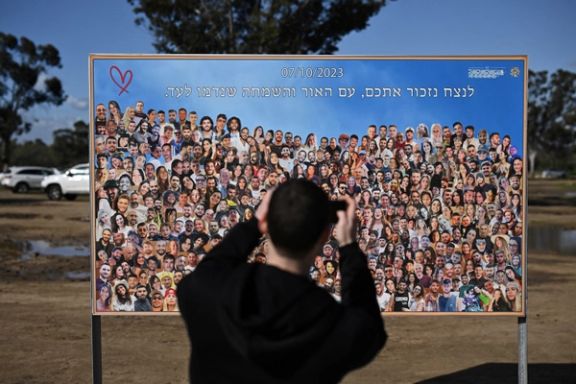
A person takes a picture of photos of the people who were killed and kidnapped during the October 7 attack by Hamas gunmen from Gaza, at the site of the Nova festival, amid the ongoing conflict between Israel and the Palestinian Islamist group Hamas, in Reim, southern Israel, February 1, 2024.

A lawsuit has been filed in New York by three families of October 7 victims against Iran, Syria and Binance, the world’s largest cryptocurrency exchange.

According to the Semafor news website, the claimants include the Raanan family who saw Judith Raanan and her daughter Natalie kidnapped to the Gaza Strip. They were both released under a prisoner swap deal between Hamas and Israel.

Two other claimants are the families of Daniel Levi Ludmir and Itay Glisko, both murdered by Hamas militants. Ludmir was a 34-year-old physician who was killed at Kibbutz Be’eri on October 7 when he was tending to the injured. Glisko, a 20-year-old sergeant of the Israeli army, lost his life on October 8 during clashes with Palestinian militants.

According to Semafor, the victims’ families hold Tehran and Damascus responsible for “arming and financing Hamas” and “helping to orchestrate” the October 7 offensive.

Binance and its former chief executive Changpeng Zhao have also been accused of “allowing Hamas to use the cryptocurrency platform to conduct financial transactions and make payments.”

The silhouette of a helicopter, which the Israel Defense Forces say was used to evacuate the injured soldiers, in a location given as Gaza, amid the ongoing conflict between Israel and the Palestinian Islamist group Hamas, in this handout image released on January 31, 2024.
100%
The silhouette of a helicopter, which the Israel Defense Forces say was used to evacuate the injured soldiers, in a location given as Gaza, amid the ongoing conflict between Israel and the Palestinian Islamist group Hamas, in this handout image released on January 31, 2024.

In November, the US Department of Justice, Treasury, and the Commodity Futures Trading Commission imposed a record $4.4 billion fine on Binance on allegations that it enabled the laundering of substantial sums of illicit money worldwide.

US Treasury Secretary Janet Yellen stated, “Binance turned a blind eye to its legal obligations in the pursuit of profit. Its wilful failures allowed money to flow to terrorists, cybercriminals, and child abusers through its platform.”

Meanwhile, in a second case, NBC News reported that 67 US citizens filed a $1 billion federal lawsuit against Iran over its role in Hamas’s onslaught on Israel.

Some of those who were injured or taken hostage by Hamas militants as well as the families of the murdered are among the plaintiffs in the suit which was filed in US District Court for the District of Columbia.

“Iran bears direct responsibility for the October 7 attacks. Indeed, that point is essentially undisputed. The Iranian regime has openly flaunted its motive for aiding the horrors,” read the lawsuit.

The plaintiffs called Iran the “sworn enemy of Israel and the United States,” further adding that the regime “masterminded and funded” Hamas’ rampage in an attempt to disrupt the normalization talks between Israel and Saudi Arabia.

The lawsuits appear to be the first legal attempts to hold Tehran accountable for October 7's attacks which saw at least 1,200 killed, including at least 30 US citizens, and 250 more taken hostage.

It was the single most deadly day for Jews since the Holocaust, with hostages hailing from around 40 nationalities including Thai, Russian, British and German.

Though Iran has officially denied involvement in the massacre, Tehran held celebrations just hours after the atrocities with huge posters around the city, suggesting foreknowledge of the horrors which unfolded after thousands of Hamas militants invaded Israel by air, land and sea.

Leaders as high up as Supreme Leader Ali Khamenei had met with Hamas leaders at an increasing pace last year suggesting the highest level of coordination with the regime in the attacks which sparked a region-wide escalation.

Iran-backed proxies in Lebanon, Syria, Iraq and Yemen have pledged solidarity with Hamas after Israel’s relentless retaliation has left devastation in the strip, targeting both US and Israeli targets as well as international shipping in the Red Sea in a bid to force Israel into a ceasefire.

US intelligence has shown that on average, Tehran has funded Hamas $100 million annually in addition to provision of weaponry and training.

The IRGC’s top commander Hossein Salami is one of the many who have denied Iran’s involvement in the attack and claimed that “it was designed and implemented by Palestinians and no decision was made outside of Palestine.”



Most Viewed

US blockade enters murky phase as tankers spoof signals and buyers hesitate
1
ANALYSIS

US blockade enters murky phase as tankers spoof signals and buyers hesitate

2

US tightens financial squeeze on Iran, warns banks over oil money flows

3
INSIGHT

Ideology may be fading in Iran, but not in Kashmir's ‘Mini Iran'

4
INSIGHT

Hardliners push Hormuz ‘red line’ as US blockade tests Iran’s leverage

5
VOICES FROM IRAN

Hope and anger in Iran as fragile ceasefire persists

Banner
Banner

Spotlight

  • Hardliners push Hormuz ‘red line’ as US blockade tests Iran’s leverage
    INSIGHT

    Hardliners push Hormuz ‘red line’ as US blockade tests Iran’s leverage

  • Ideology may be fading in Iran, but not in Kashmir's ‘Mini Iran'
    INSIGHT

    Ideology may be fading in Iran, but not in Kashmir's ‘Mini Iran'

  • War damage amounts to $3,000 per Iranian, with blockade set to add to losses
    INSIGHT

    War damage amounts to $3,000 per Iranian, with blockade set to add to losses

  • Why the $100 billion Hormuz toll revenue is a myth
    ANALYSIS

    Why the $100 billion Hormuz toll revenue is a myth

  • US blockade targets Iran oil boom amid regional disruption
    ANALYSIS

    US blockade targets Iran oil boom amid regional disruption

  • Iran's digital economy battered by prolonged blackout
    INSIGHT

    Iran's digital economy battered by prolonged blackout

•
•
•

More Stories

Global Music Industry Demand Release Of Iranian Rapper Toomaj Salehi

Feb 1, 2024, 11:31 GMT+0

The International Federation of Musicians, alongside three other music organizations, has issued a joint statement demanding the immediate release of Iranian rapper Toomaj Salehi.

Salehi's recent re-arrest has sparked condemnation from civil society organizations, denouncing the suppression of artistic expression in Iran.

Salehi, who was previously imprisoned for one year and 21 days, with 252 days spent in solitary confinement, was released on bail on November 18th. However, he was detained again just 12 days later after releasing a video detailing the torture he endured while in prison. In the video, Salehi accused prison authorities and government-affiliated media of misconduct.

“We would like to remind the Iranian Government and State about their international obligations of respecting international conventions, and we refer to a previous condemnation by UN Special Rapporteurs as well as UNESCO when Iran has violated artists rights to freedom of expression,” reads the statement shared by Salehi’s X account.

“Iran has an obligation to respect freedom of expression which includes that right to seek, receive and impart information and ideas, including through art and culture."

Salehi, known for his protest rap songs and support for the Woman, Life, Freedom protests, was first arrested in November 2022 and has since become a global face of the dissident movement in Iran.

IRGC Reduces Presence In Syria After Israeli Strikes - Reuters

Feb 1, 2024, 11:30 GMT+0
•
Iran International Newsroom

Iran's IRGC has reduced the presence of its senior officers in Syria due to a spate of deadly Israeli strikes and will rely more on its militia proxies, Reuters quoted five sources as saying.

The Guards have suffered one of their most bruising spells in Syria since arriving a decade ago to aid President Bashar al-Assad in the Syrian war. Since December, Israeli strikes have killed more than half a dozen of their members, among them one of the Guards' top intelligence generals.

As hardliners in Tehran demand retaliation, Iran's decision to pull out senior officers is driven partly by its aversion to being sucked directly into a conflict bubbling across the Middle East, three sources told Reuters.

Iran International reported last week that some in Tehran suspect an Israeli infiltration in tracking and pinpointing the whereabouts of senior IRGC officers in Syria.

Moreover, after a January drone attack by an Iranian-backed Iraqi group in Jordan that killed three US soldiers, Washington has vowed to retaliate against unknown targets, that could include IRGC assets in Syria.

While the sources said Iran has no intention of quitting Syria - a key part of Tehran's sphere of influence - the rethink underscores how the consequences of the war ignited by Palestinian militant group Hamas' Oct. 7 attack on Israel are unfolding in the region.

Iran, a backer of Hamas, has sought to stay out of the conflict itself even as its proxy groups that have entered the fray from Lebanon, Yemen, Iraq and Syria - the so-called "Axis of Resistance" have intensified attacks on US and Israeli targets, as well as international maritime traffic in the Red Sea.

One of the sources - a senior regional security official briefed by Tehran - said senior Iranian commanders had left Syria along with dozens of mid-ranking officers, describing it as a downsizing of the presence.

The source did not say how many Iranians had left and Reuters was unable independently to determine that.

Iran has sent thousands of fighters to Syria during the Syrian war. While these have included members of the Guards, officially serving in the role of advisors, the bulk have been Shi'ite militiamen from all over the region, specially from Afghanistan.

Three of the sources said the Guards would manage Syrian operations remotely, with help from ally Hezbollah.

Another source, a regional official close to Iran, told Reuters those still in Syria had left their offices and were staying out of sight. "The Iranians won't abandon Syria, but they reduced their presence and movements to the greatest extent."

The sources said the changes so far had not had an impact on operations. The downsizing would "help Tehran to avoid being pulled into the Israel-Gaza war," one of the sources, an Iranian, said.

'INTELLIGENCE BREACH'

In one of Israeli attacks, on Jan. 20, five members of the Guards were killed, Iranian state media reported, including a general who ran intelligence for the Quds Force, which is responsible for the Guards' overseas operations. The strike flattened a Damascus building.

Another, on Dec. 25 outside Damascus, killed a senior Guards adviser responsible for coordinating between Syria and Iran. Iran's Supreme Leader Ayatollah Ali Khamenei led prayers at his funeral.

Three of the sources told Reuters the Guards had raised concerns with Syrian authorities that information leaks from within the Syrian security forces played a part in the recent lethal strikes.

Another source familiar with Iranian operations in Syria said the precise Israeli strikes had prompted the Guards to relocate operational sites and officers' residences, amidst concerns of an "intelligence breach".

The prolonged presence of Iranian forces in Syria has cemented a zone of Iranian influence stretching through Iraq, Syria and Lebanon to the Mediterranean, creating a considerable threat to Israel and other countries.

Three of the sources said the Guards were once again recruiting Shi'ite fighters from Afghanistan and Pakistan to deploy to Syria, echoing earlier phases of the war when Shi'ite militias played a part in turning the tide of the conflict.

The regional official close to Iran said the Guards were drawing more on Syrian Shi'ite militias.

Gregory Brew, an analyst with Eurasia group, a political risk consultancy, told Reuters the failure to protect Iranian commanders had "clearly undermined Iran's position" but Tehran was unlikely to end its commitment to Syria to preserving its role in Syria.

Iran's Attorney General Uses Fears Of Foreign Threats To Entice Voter Turnout

Feb 1, 2024, 09:50 GMT+0

As the regime fears a national boycott of upcoming elections, Iran's attorney general has played on foreign security threats to incentivize participation.

Speaking on Wednesday, Mohammad Movahedi Azad stated, "Holding elections and the people’s turnout ensures the country’s immunity against enemy aggression."

The claims were unfounded, and come amidst Iran's proxy war being waged across the region.

As Iran gears up for parliamentary and Assembly of Experts elections scheduled for March 1, the country stands at a pivotal juncture, particularly with the assembly responsible for appointing Supreme Leader Ali Khamenei's successor.

The upcoming elections hold weight not only in terms of leadership transitions but also in affirming the regime's legitimacy. However, concerns loom over anticipated low voter turnout, with recent polls suggesting a potential decline compared to previous records, sounding alarms among authorities, including Khamenei, who have historically linked high turnout to regime credibility.

Nevertheless, a growing sense of disillusionment pervades various segments of Iranian society, fueled by perceived failures in addressing socio-political grievances, widespread corruption, and restrictions on freedoms with brutal oppression.

Many Iranians, skeptical of the regime's promises, have chosen to abstain from electoral participation, viewing it as futile in bringing about meaningful change.

Despite Khamenei's recent calls for mobilization, the widespread exclusion of moderate and reformist candidates underscores a widening gap between the regime and certain segments of the populace. Consequently, he resorted to ordering officials and institutions to push the people to the polls in any way they could.

Ex-Presidential Advisor Urges Iran To Negotiate With US

Feb 1, 2024, 09:08 GMT+0

Hesamoddin Ashena, a former presidential advisor under Hassan Rouhani, has advocated for talks with the United States amid brewing regional conflict.

Suggesting this is the opportune moment for dialogue, Ashena wrote on X, "If one believes negotiations must occur from a position of strength, then is now the time?"

It comes in the wake of an Iran-backed proxy attack on US troops in Jordan, which left three US personnel died on Sunday, leaving questions for the Biden administration as to what comes next in the face of an emboldened Iran.

Tensions between Iran and the US have reached a new level since the Gaza war, when over 160 Iran-backed proxy attacks have targeted US facilities and personnel in Iraq and Syria, as well as the Red Sea shipping routes. They claim to be acting in allegiance with Iran-backed Hamas in Gaza.

On October 7, the militant group launched a surprise invasion of Israel, sparking the worst war between Israel and the Gaza-based group since they took over the strip in 2007. Iran's proxies claim to be pressuring for a ceasefire, and targeting the US for its support of Israel's retaliatory attacks which Hamas claims has killed over 20,000 Gazans.

Iran's Supreme Leader Ali Khamenei has consistently rejected the prospect of direct talks with the United States. Throughout the 11-month period of nuclear negotiations held in Vienna from April 2021 to March 2022, the United States remained involved but primarily on the sidelines and Tehran refused to hold talks directly.

US Destroys Houthi Targets Amid More Attacks In Red Sea

Feb 1, 2024, 08:35 GMT+0
•
Iran International Newsroom

The US military conducted four operations from Wednesday afternoon until early Thursday local time, targeting Houthi drone control stations and shooting down several Iran-made drones.

The first operation destroyed a Houthi surface-to-air missile as it was preparing to launch. In the second operation, a missile and three Iran-made drones were shot down as they approached the USS Carney. A few hours later, another operation targeted a Houthi control station along with 10 'suicide drones' on the ground.

The US Central Command issued three statements in less than ten hours, stating that all the operations were carried out in self-defense because the drones posed an imminent threat to merchant vessels and US Navy ships in the region.

Earlier, a spokesman for the Houthis had claimed an attack on the US merchant ship “KOI” in the Gulf of Aden. CENTCOM confirmed this report, adding that USS Carney had shot down three Iranian drones and one anti-ship ballistic missile launched from Houthi-controlled areas of Yemen.

The uptick in hostilities at the Red Sea comes at a time when the the Biden administration is weighing its options for attacking Iran, in response to last weekend’s drone attack on a US base in Jordan, which killed three American soldiers and wounded dozens.

An Iranian proxy militant group in Iraq, Kataib Hezbollah, responsible for the attack on US troops in Jordan, announced a halt to further operations against US targets, but the Houthi forces have vowed to continue attacks on US and British warships, as well as commercial vessels.

President Biden announced on Tuesday that he has made a decision regarding the response, but no strikes have been launched, and no official details have been shared.

Wednesday evening, NBC News reported that the retaliation against Iran-backed militants could last for “weeks.” Quoting US officials, the news channel claimed that the targets may include Iranian interests outside Iran.

The Biden administration is under growing pressure to retaliate. But ‘retaliation without escalation’ (Biden’s preferred option) seems hard to accomplish. Soon, it will be a week since the killing of American soldiers. At the Capitol, patience is running out.

“[Iran] should be hit, and it should be hit hard,” Democratic Senator John Fetterman told Iran International’s Arash Alaei Wednesday. “Any nation that’s underwriting terrorism across that region has to be punished. But that doesn’t mean it has to be attacked directly.”

Iranian officials say their allied armed groups are independent and often leave Tehran in the dark. But many in Washington blame Iran for most –if not all– attacks against the US and its allies. However, Houthis attacks on commercial vessels began in mid-November after Iran's Supreme Leader Ali Khamenei urged Muslim nations to blockade Israeli ports.

Iran and its proxies have launched more than 160 strikes against US forces in Syria and Iraq since October. And Houthis in Yemen have managed to disrupt shipping in the Red Sea with their regular attacks on commercial vessels and even US warships.

The Houthis say their attacks are in response to the Israeli onslaught in Gaza and should thus concern only the ships with some connection to Israel. In reality, however, several ships with no discernible ties to Israel have been targeted.

It’s unclear if President Biden’s avowed retaliatory ‘campaign’ –if and when it happens– would replace the existing operation against the Houthis. Either way, judging by their relentless attacks on commercial vessels in spite of US (and UK) airstrikes in the past few weeks, the Houthis seem to not really care.