• العربية
  • فارسی
Brand
  • Iran Insight
  • Politics
  • Economy
  • Analysis
  • Special Report
  • Opinion
  • Podcast
  • Iran Insight
  • Politics
  • Economy
  • Analysis
  • Special Report
  • Opinion
  • Podcast
  • Theme
  • Language
    • العربية
    • فارسی
  • Iran Insight
  • Politics
  • Economy
  • Analysis
  • Special Report
  • Opinion
  • Podcast
All rights reserved for Volant Media UK Limited
volant media logo

Mideast, Iran Paying Price Of Tehran's Appeasement - Exiled Prince
Iran International Newsroom
Jan 31, 2024, 21:48 GMT+0Updated: 11:07 GMT+0
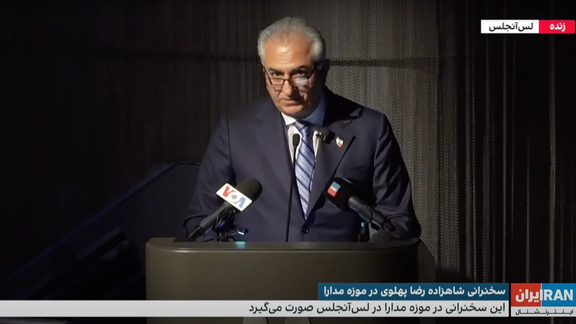
Iran’s exiled prince, Reza Pahlavi, during a speech at the Simon Wiesenthal Center’s Museum of Tolerance in Los Angeles on January 30, 2024

Iran’s exiled prince, Reza Pahlavi, says the region's problems are a result of global appeasement with the Islamic Republic. 

Pahlavi highlighted Tehran’s destabilizing activities through its regional proxies such as Hamas, Hezbollah, and the Houthis and crackdown on dissent within Iran, calling on the world to support the revolutionary uprising of the Iranian people to end the regime. 

“There is only one solution: help the people of Iran in their fight for liberation from the Islamic regime, and put an end to war and conflict,” he said after an Iran-backed militia attacked US troops on Sunday in Jordan, leaving three dead.

During a speech at the Simon Wiesenthal Center’s Museum of Tolerance in Los Angeles on Tuesday, he pointed out that nothing can push Iran into reform, the regime only more emboldened in the face of global sanctions. It has continued its nuclear program at an accelerated speed, supported Russia's invasion of Ukraine and continued to crack down on dissent at home with over 800 executions last year alone.

Pahlavi also called for the formation of a coalition working towards the overthrow of the Islamic Republic, not only for the sake of Iran, but the world. The UK alone has foiled tens of attacks since 2022, with dozens more around the world. In September, Israel's spy chief said it had also foiled 27 attacks on Israelis and Jews abroad in the past year. 

The exiled prince stated that Iranians do not ask the US to send soldiers into Iran, instead, they want the US to support their aspirations for freedom and their fight against the regime. Pahlavi called for global efforts to facilitate Iranians' access to free internet and financial support for striking workers, utilizing the Islamic Republic’s funds currently blocked in the US. 

He also renewed his criticism of the prisoner exchange deal between Tehran and Washington, in which Washington released five Iranians in addition to $6 billion of the country's frozen assets in South Korea in exchange for five Iranian-Americans who were held hostage in Iran. "The United States should give Iran's assets to the protesters instead of the Islamic Republic," he said. 

Pahlavi’s message to the world echoes the demands of several opposition figures and international activists, especially since the Middle East conflict began on October 7, when Tehran-backed Islamist group Hamas invaded Israel, killed 1,400 mostly civilians and took hundreds of hostages.

In the wake of the attack, several other Iran-funded groups have intensified attacks on US and Israeli targets in Iraq and Syria while the Houthis of Yemen have been attacking international shipping in the Red Sea. Iranian officials claim that the country has had no active role in the conflict, but the proxies are the brainchild of Iran's Supreme Leader who himself called for the Red Sea blockade. During 2023, he met with leaders of Hamas and Hezbollah, suggesting top level coordination of the attacks which have triggered the worst violence in the region in years. 

Echoing the exiled prince's calls, on the occasion of Holocaust Remembrance Day, women’s rights activist Masih Alinejad called on the Western world “to take a tough stance against the regime in Iran which is determined to eliminate Israel and kill its own people too.” 

Most Viewed

US blockade enters murky phase as tankers spoof signals and buyers hesitate
1
ANALYSIS

US blockade enters murky phase as tankers spoof signals and buyers hesitate

2
INSIGHT

Ideology may be fading in Iran, but not in Kashmir's ‘Mini Iran'

3
INSIGHT

Hardliners push Hormuz ‘red line’ as US blockade tests Iran’s leverage

4
VOICES FROM IRAN

Hope and anger in Iran as fragile ceasefire persists

5

US sanctions oil network tied to Iranian tycoon Shamkhani

Banner
Banner

Spotlight

  • Hardliners push Hormuz ‘red line’ as US blockade tests Iran’s leverage
    INSIGHT

    Hardliners push Hormuz ‘red line’ as US blockade tests Iran’s leverage

  • Ideology may be fading in Iran, but not in Kashmir's ‘Mini Iran'
    INSIGHT

    Ideology may be fading in Iran, but not in Kashmir's ‘Mini Iran'

  • War damage amounts to $3,000 per Iranian, with blockade set to add to losses
    INSIGHT

    War damage amounts to $3,000 per Iranian, with blockade set to add to losses

  • Why the $100 billion Hormuz toll revenue is a myth
    ANALYSIS

    Why the $100 billion Hormuz toll revenue is a myth

  • US blockade targets Iran oil boom amid regional disruption
    ANALYSIS

    US blockade targets Iran oil boom amid regional disruption

  • Iran's digital economy battered by prolonged blackout
    INSIGHT

    Iran's digital economy battered by prolonged blackout

•
•
•

More Stories

Iran Calls For Halt To Relocation Of Ancient Babylonian Artifact To Israel

Jan 31, 2024, 18:58 GMT+0

Iranian authorities have issued a plea to halt the planned transfer of a 6th century Babylonian artifact from the British Museum to Jerusalem citing safety concerns amidst the war.

The artifact in question is a fragment of a 2,600-year-old object from ancient Babylonian territory, now situated in modern-day Iraq, adorned with inscriptions in cuneiform on its clay surface. It serves as a primary historical document depicting the establishment of Persian rule and records the edict of Persian King Cyrus, granting freedom to slaves to return to their native lands.

Expressing apprehension about the proposed relocation to the National Library of Israel in Jerusalem, Hadi Mirzaei, Iran’s director-general of the General Office of Museums, conveyed his concerns in letters addressed to key officials including Amir-Hossein Gharibnejad, the vice president for cultural cooperation at the Ministry of Foreign Affairs, and Ali-Akbar Mottakan, the secretary-general of the National Commission for UNESCO-Iran, as reported by the Tehran Times in mid-January.

In a letter published via the Iranian news agency Mehr, Mirzaei emphasized the potential risks associated with the impending transfer, deeming it "inappropriate", the regime desperate the artifact does not end up in the hands of its archenemy, Israel.

Iran, celebrated for its ancient cultural heritage spanning millennia, has encountered numerous hurdles in safeguarding and conserving its artifacts.

Since the Islamic Revolution in 1979, the Iranian government has shifted its focus to promoting Islamic culture and values, sometimes adopting a more conservative approach towards pre-Islamic relics.

Numerous historical sites and artifacts have suffered from neglect, inadequate maintenance, and the impact of environmental factors.


More Than 60 US Lawmakers Ask Biden For Stricter Enforcement Of Iran Sanctions

Jan 31, 2024, 18:27 GMT+0
•
Iran International Newsroom

US lawmakers are pushing for stricter enforcement of Iran's oil sanctions, adding to the growing pressure on the Biden administration following a deadly attack on a US base in Jordan.

In a letter addressed to the President, more than 60 House members from both parties are calling for "immediate action" to prevent the Iranian regime from obtaining "additional financial resources that it can use to continue supporting terrorism."

Iran's oil revenue has significantly increased in the past year or two, partially due to the Biden administration's more lenient approach compared to Donald Trump's "maximum pressure" policy.

Earlier this year, there were reports that the administration had reduced enforcement efforts against Iranian oil shipments as part of negotiations with Iran. The representatives are now urging the reversal of this policy.

The Republican-led House has been advocating for a tougher stance against Iran since the Biden administration initiated back-channel talks with the regime three years ago to pursue another nuclear agreement. Several bipartisan initiatives have passed the House on this issue, but none have been successful.

However, the dynamic shifted against Biden after Hamas launched an attack on Israel on October 7. In the three months following the Israeli response to Gaza, armed groups supported and trained by Iran's IRGC conducted over 150 attacks on US forces in Iraq and Syria, exposing the failure of Biden's Iran policy.

Last week, before the killing of US troops, reports indicated that the Biden administration was in discussions with European countries to increase sanctions on Iran in response to its destabilizing activities in the Middle East, particularly its support for the Houthi rebels in Yemen.

This was perhaps the first clear indication that the administration was contemplating a shift in its Iran policy. The recent drone strike may have made this shift inevitable. The loss of American lives has put immense pressure on Biden to take action against Iran, and it has emboldened both Republican and Democrat critics to push for a policy change.

The House letter to President Biden emphasizes the need to crack down on Iran's expanding and lucrative illicit oil trade, which provides crucial funding for Hamas and other terrorist proxies, including Hezbollah.

While President Biden holds Iran responsible for supplying weapons to those who carried out the attack on American soldiers, he has not revealed the specific course of action. However, experts speculate on potential targets, which could include IRGC personnel and facilities outside Iran. Still, it is unlikely to involve military action within Iran itself, as the Biden administration seeks to avoid war with the country.

Targeting Iran's financial resources, particularly its oil trade, appears to be a more feasible and effective strategy in influencing its behavior. The House representatives are calling on the administration to take swift action to halt Iran's illicit oil trade, which sustains and expands Tehran's sponsorship of terrorist groups seeking Israel's destruction.

Tehran Initiates Talks With China To Tackle Housing Shortage

Jan 31, 2024, 16:27 GMT+0

The deputy mayor of Tehran revealed that discussions have begun with Chinese developers regarding the construction of subsidized residential units within the city.

In discussions about the Chinese Housing Construction plan, Hamid-Reza Saremi stated, "We have initiated negotiations with Chinese developers, leading to the allocation of parcels of land exceeding one hectare in size in the southern regions of the city."

He elaborated, "Under the initiative, homeowners will exchange their keys for newly constructed Chinese apartments."

His comments come as a recent report highlights the significant economic hardships faced by workers in Iran, with approximately 55% of laborers' wages being consumed by rental costs. The minimum wage for married workers, including all benefits, barely exceeds $180 per month, while the minimum monthly expenditure on food for an average three-person household ranges between $140 and $160.

Last month, the Iranian government delivered housing units as part of the Mehr Housing initiative to long-awaiting owners. However, the newly allocated units lacked essential utilities such as water, electricity, and gas.

The Mehr Housing scheme, initially launched during President Mahmoud Ahmadinejad's tenure from 2005 to 2013, aimed to construct a total of 4.3 million housing units and continued under President Hassan Rouhani's administration.

During his campaign, President Ebrahim Raisi pledged to build one million housing units annually. However, housing market experts and some politicians have criticized this commitment as "impractical." The average price of one square meter of housing in Tehran stands at approximately 600 million rials ($1,200), significantly surpassing the monthly minimum wage of around $120 (excluding benefits).


Iranian Political Prisoner Faces Risk Of Execution In Mashhad

Jan 31, 2024, 14:53 GMT+0

Mohammad Javad Vafaei Sani, an Iranian political prisoner held in Vakilabad Prison in Mashhad, is at risk of imminent execution.

The US-based Human Rights Activists News Agency (HRANA) announced the news saying that Vafaei Sani was sentenced to death earlier by Branch Two of the Revolutionary Court in Mashhad, following a retrial.

Babak Paknia, Vafaei Sani's lawyer, revealed that his client initially received the death sentence from the Mashhad Revolutionary Court in January 2022. The charges against him include "corruption on earth through intentional arson and destruction of specific places, including government buildings."

However, following the verdict, the supreme court overturned the decision, returning the case for further review, but his death penalty was upheld.

Vafaei Sani, a 28-year-old boxing coach, was apprehended by security forces in March 2020 during protests triggered by a government decision to hike gasoline prices and demonstrations related to the January 2020 downing of a Ukrainian airliner by Iranian forces.

Before the court's ruling, a substantial bail amount was set for Vafaei Sani's release, set so prohibitively high that it was impossible to meet.

Iran has seen a surge in executions, with the Islamic Republic executing 90 Iranians between December 22 and January 21. UN experts reported that in 2023, Iran executed at least 834 people, eight of whom were linked to nationwide protests. The experts have urgently called on the Iranian government to halt the rising trend of executions and conduct a comprehensive evaluation of death penalty practices.

Tehran Governor Admits Iran's Water Shortage Worsens

Jan 31, 2024, 13:46 GMT+0

Amidst government denials, the governor of Tehran admitted the country is "confronting a significant challenge in the water sector".

Alireza Fakhari warned that the government "must openly acknowledge the crisis, pointing out the dwindling rainfall which has led to a depletion of crucial water reserves stored behind dams.

Iran is currently grappling with one of its most severe droughts in over half a century, marking the fourth consecutive year of significant water scarcity. The situation has prompted criticism of the Iranian government's environmental management.

Fakhari underscored the urgent need to address the issue, stating, "While some suggest utilizing Tehran's wells for water supply, it's vital to recognize that water stress is a nationwide concern."

Reports indicate that a quarter of Iran's farmers have lost their livelihoods in the past seven years, predominantly due to water scarcity. The repercussions of the drought extend beyond economic impacts, with soil erosion, desertification, and dust storms affecting nearly half of Iran's population, as reported by the country's health ministry.

Expressing concern over the concealment of water shortages, Fakhari criticized the practice and asserted, "It's imperative for people to understand the reality of our water scarcity. It's the responsibility of all officials to communicate this issue accurately and transparently."