• العربية
  • فارسی
Brand
  • Iran Insight
  • Politics
  • Economy
  • Analysis
  • Special Report
  • Opinion
  • Podcast
  • Iran Insight
  • Politics
  • Economy
  • Analysis
  • Special Report
  • Opinion
  • Podcast
  • Theme
  • Language
    • العربية
    • فارسی
  • Iran Insight
  • Politics
  • Economy
  • Analysis
  • Special Report
  • Opinion
  • Podcast
All rights reserved for Volant Media UK Limited
volant media logo

Iran-Backed Houthis Defiant As US-UK Strike Again
Iran International Newsroom
Jan 23, 2024, 08:58 GMT+0Updated: 11:10 GMT+0
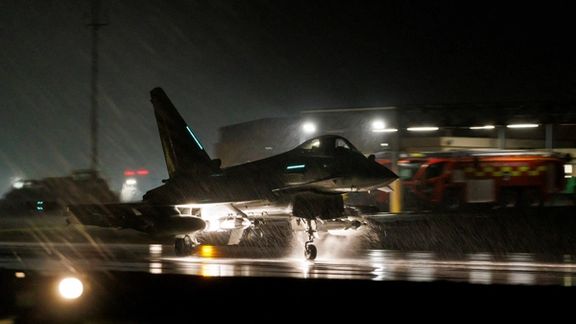
Royal Air Force Typhoon FGR4 taking off precision strike operations against Houthi military targets in response to further attacks on shipping in the Red Sea

The Yemen Houthis say they will carry on with their attack on shipping in the Red sea, despite the intensification of US airstrikes on the Iran-backed group.

“The American-British aggression will only increase the Yemeni people’s determination to carry out their moral and humanitarian responsibilities towards the oppressed in Gaza,” Mohammed Albukhaiti, a member of the Houthi’s ruling council, said Monday evening, shortly after the latest round of airstrikes.

US and British forces carried out a fresh round of strikes late on Monday against eight locations in Yemen, targeting a Houthi underground storage site as well as missile and surveillance capabilities used by the Iran-aligned group against Red Sea shipping, the Pentagon said.

This is the eighth time in about two weeks that the US has hit Houthi targets, validating suggestions last week that the Biden administration may be gearing up for an extensive and prolonged campaign against Iran’s ‘wild card’ in its fight against the interests of the United States and its allies.

Tribesmen loyal to the Houthis march on US and Israeli flags during a military parade for new tribal recruits amid escalating tensions with the US-led coalition in the Red Sea, in Bani Hushaish, Yemen January 22, 2024.
100%
Tribesmen loyal to the Houthis march on US and Israeli flags during a military parade for new tribal recruits amid escalating tensions with the US-led coalition in the Red Sea, in Bani Hushaish, Yemen January 22, 2024.

Iran has made it known that its ultimate goal is to ‘oust’ the Americans from the Middle East and fill in the ensuing power vacuum.

Late Monday, hours after the airstrike on Houthis in Yemen, Iran’s foreign minister Amir-Abdollahian once more threatened the US and UK –this time on US soil.

“We have sent a serious message to the Americans, warning them that what they did with the UK in attacking certain areas in Yemen endangers peace and security in the region,”Amirabdollahian told Iran’s official news agency IRNA, while in New York to take part in meetings at the UN. “This is intensification of war.”

Iran and the US seem to be on a collision course, despite signs that both the Iranian regime and the Biden administrations prefer to avoid direct confrontation.

On Monday, a top US Navy commander told the Associated Press that Iran was “very directly involved” in the Houthi operations in the Red Sea, which began in response to Israeli onslaught in Gaza mid-October.

“What I’ll say is Iran is clearly funding, they’re resourcing, they are supplying and they’re providing training,” said Vice Adm. Brad Cooper, the head of the US Navy’s 5th Fleet “They’re obviously very directly involved. There’s no secret there.

He said Iran-related attacks have outgrown the Persian Gulf to reach waters across the Middle East.

Iran and its regional proxy forces are engaged in attacks on the US and its allies almost daily, from Yemen to Iraq and Syria and Lebanon. The Biden administration seems to have failed to stop the attacks, despite repeated warnings and airstrikes.

Biden critics say his soft stance against Iran in the past three years has emboldened the regime and its proxies to the detriment of American troops and interests.

“There's a direct link between the Biden Admin’s futile Iran policy and our inability to stop attacks against American troops,” Senator Jim Risch, ranking member of the Foreign Relations Committee posted on X Monday night. “Iran doesn't think the U.S. is willing to act. We must permanently freeze funds, enforce oil sanctions & restore credible deterrence.”

Experts warn that the Houthis may continue their attacks on vessels in the Red Sea –as they have repeatedly stated– and force the Biden administration to pursue harsher measures that some argue should include direct attacks on IRGC targets.

Early Tuesday local time, Mohammad Ali al-Houthi, a member of Houthi supreme revolutionary committee, vowed to leave no airstrike unanswered.

“Trust well that every operation and every aggression against our country will not be without a response,” he wrote on X.

The latest round of airstrikes on the Houthis was not as extensive as the first round ten days earlier. The objective, as set out by the Biden administration, is to degenerate the Houthis’ capabilities –something that the President himself has admitted has not been achieved.


Most Viewed

Iran International says it won’t be silenced after London arson attack
1

Iran International says it won’t be silenced after London arson attack

2
VOICES FROM IRAN

Hope and anger in Iran as fragile ceasefire persists

3
INSIGHT

How Tehran bends its own red lines to boost state rallies

4

Iran halts petrochemical exports to supply domestic market

5

US arrests Iranian national over alleged Basij-linked visa fraud

Banner
Banner

Spotlight

  • Too early to tell who is winning Iran war, experts say
    PODCAST

    Too early to tell who is winning Iran war, experts say

  • How Tehran bends its own red lines to boost state rallies
    INSIGHT

    How Tehran bends its own red lines to boost state rallies

  • Iran blackout cripples freelancer, small business incomes
    VOICES FROM IRAN

    Iran blackout cripples freelancer, small business incomes

  • Ideology may be fading in Iran, but not in Kashmir's ‘Mini Iran'
    INSIGHT

    Ideology may be fading in Iran, but not in Kashmir's ‘Mini Iran'

  • US blockade enters murky phase as tankers spoof signals and buyers hesitate
    ANALYSIS

    US blockade enters murky phase as tankers spoof signals and buyers hesitate

  • Why the $100 billion Hormuz toll revenue is a myth
    ANALYSIS

    Why the $100 billion Hormuz toll revenue is a myth

•
•
•

More Stories

Iran-Backed Militants Claim Rocket Attacks On US Base In Syria

Jan 22, 2024, 18:27 GMT+0

The Islamic Resistance in Iraq, an umbrella group representing several Iran-backed factions, has claimed responsibility for launching two rocket attacks on US forces in Syria on Monday.

The attack on the Conoco Base in Deir Ezzor marks the 164th attack on US facilities and personnel in Syria and Iraq in the past 96 days, escalating since October 7 when Iran-backed Hamas invaded Israel. Iran's proxies have since launched attacks on the US in response to the country's support of Israel's right to defend itself in the face of the Hamas attacks which killed 1,200 mostly civilians and saw over 250 more taken hostage to Gaza.

“In adherence to our continuous resistance policy against American forces in Iraq and the region, and in response to the Zionist regime's actions against the people of Gaza, our fighters launched multiple rockets at the American base in the Conoco oil field in eastern Deir Ezzor," the group said.

Currently, the United States has several hundred troops stationed in northern and eastern Syria, primarily engaged in the international coalition against ISIS.

The coalition bases in the region have faced intermittent attacks over recent years but not to the extent seen since October 7. While the Iranian government has consistently denied any direct involvement in the attacks by Hamas, Tehran claims that the proxies operate independently, in spite of the fact the militias are the brainchild of Iran's supreme leader as a weapon against both Israel and the West.

US, UK Sanctions Tighten Grip On Iran's Proxies

Jan 22, 2024, 18:01 GMT+0
•
Iran International Newsroom

Amid simmering Middle East tensions, the US and UK have announced new rounds of sanctions against financial and logistic supply networks of Iran’s proxies.

On Monday, the US Department of the Treasury’s Office of Foreign Assets Control (OFAC) designated Iraqi airline Fly Baghdad and its CEO, Basheer Abdulkadhim Alwan al-Shabbani, for helping Iran’s Revolutionary Guard’s extraterritorial Qods (Quds) Force (IRGC-QF) and its proxy groups in Iraq, Syria, and Lebanon. 

The new measures also include designating three leaders and supporters of one of the IRGC-QF’s main militias in Iraq, Kata’ib Hizballah (Kata'ib Hezbollah or KH), as well as a business that moves and launders funds for the group, officially listed as a terrorist organization by Japan, the United Arab Emirates, and the United States.

According to the Treasury, Iraqi airline Fly Baghdad has for years supported the operations of the IRGC-QF and its proxies by delivering materiel and personnel throughout the region. “Fly Baghdad flights have delivered shipments of weapons to Damascus International Airport in Syria for transfer to members of the IRGC-QF and Iran-aligned militia groups on the ground in Syria, including the Syrian Arab Republican Guard, Lebanese Hezbollah, KH, and the KH-affiliated Abu al-Fadl al-Abbas Brigade.”

Iraqi Shiite Muslim men from the Iranian-backed militia Kataib Hezbollah hold the party's flags as they walk along a street painted in the colours of the Israeli flag during a parade in Baghdad in this July 25, 2014.
100%
Iraqi Shiite Muslim men from the Iranian-backed militia Kataib Hezbollah hold the party's flags as they walk along a street painted in the colours of the Israeli flag during a parade in Baghdad in this July 25, 2014.

Fly Baghdad, which has a fleet of eight aircraft including six Boeing 737s, has delivered the groups a range of weapons, including Iranian-made Fateh, Zulfiqar, and al-Fajr series missiles, as well as AK-47s, RPG-7s, and other grenades and machine guns. The airline has also been involved in the transfer of hundreds of Iraqi fighters, including fighters affiliated with the US-designated Iranian proxy militia Asa’ib Ahl al-Haq (AAH), in support of the Iranian proxies’ attacks on Israel on October 7. 

Underscoring the ongoing threat the IRGC-QF and its proxy network pose to US personnel and the region, the Treasury said Kata’ib Hizballah has carried out a series of sharply escalating drone and missile attacks against American personnel in Iraq and Syria since Hamas’s attack on Israel on October 7.

Monday's sanctions came a day after US Central Command announced that multiple ballistic missiles and rockets were launched by Iranian-backed militants in western Iraq targeting al-Assad Airbase, which hosts US troops. “A number of US personnel are undergoing evaluation for traumatic brain injuries,” read the statement by CENTCOM. 

“Iran and its proxies have sought to abuse regional economies and use seemingly legitimate businesses as cover for funding and facilitating their attacks,” said Under Secretary for Terrorism and Financial Intelligence, Brian E. Nelson. “The United States will continue to disrupt Iran’s illicit activities aimed at undermining the stability of the region.”

Also on Monday, the US, UK and Australia announced new sanctions on key figures in the financial networks of Hamas and Palestinian Islamic Jihad (PIJ). The measure targets networks of Hamas-affiliated financial exchanges in Gaza, their owners, and associates, and particularly financial facilitators that have played key roles in funds transfers, including cryptocurrency transfers, from the IRGC-QF to Hamas and the PIJ. 

Britain's foreign office said the sanctions target Zuheir Shamlakh, a Gaza-based financial facilitator known as Hamas’s "main money changer" and a key figure involved in the group's shift towards cryptocurrencies who helped transfer large sums of money from Iran to Hamas ahead of the group's October 7 atrocities which saw at least 1,200 mostly civilians murdered and another 250 taken hostage in Gaza. 

“Over the last several years, members of the Shamlakh family have become the main end point for funds transferred from the IRGC-QF to Hamas and PIJ in Gaza,” said the US Treasury. 

Zuhair has used his companies Al-Markaziya Li-Siarafa (Al-Markaziya) and Arab China Trading Company to channel funds for the Izz al-Din al Qassam Brigades (al-Qassam Brigades), the military wing of Hamas. Gaza-based financial facilitators Ahmed Shamlakh (Ahmed), Alaa Shamlakh (Alaa), and Imad Shamlakh (Imad), also serve as key players in the financial flow from Iran to Hamas and PIJ. 

“Hamas has sought to leverage a variety of financial transfer mechanisms, including the exploitation of cryptocurrency, to channel funds to support the group’s terrorist activities,” Nelson added. 

According to the UK's Foreign Secretary David Cameron, “These sanctions send a clear message to Hamas: the UK and our partners are committed to ensuring there is no hiding place for those financing terrorist activities.” 

Protests Erupt In Iraqi Kurdistan After IRGC Missile Attack

Jan 22, 2024, 15:54 GMT+0

Thousands took to the streets in the Kurdistan region of Iraq on Sunday to denounce the IRGC missile attack on Erbil which killed four civilians and injured six others.

The IRGC launched ballistic missiles on Erbil last Monday citing the destruction of alleged "spy headquarters" and the dispersal of "anti-Iranian groups" as its objectives, causing a diplomatic furore in its wake. Iraq summoned Tehran’s chargé d’affaires in Baghdad to condemn the move and withdrew its ambassador from Tehran.

Hassan Hassanzadeh, the commander of the IRGC in Tehran, declared that the strikes were executed under the orders of Ali Khamenei, the Supreme Leader of the Islamic Republic.

While the IRGC claimed to have targeted a Mossad headquarters in the Kurdistan region of Iraq, referring to Israel's spy agency, Masrour Barzani, the Prime Minister of the Kurdistan Region categorically denied Iran's claims. Barzani condemned the attack on Erbil as a “crime against the Kurdish people,” accusing Iran of killing innocent civilians in its missile strikes.

The Arab League condemned the IRGC's attack, characterizing it as a “blatant aggression on the sovereignty of Iraq.” The condemnation rejected all "justifications and pretexts" put forward by the Islamic Republic for the attack, emphasizing the potential threat it poses to regional peace and security.

In a press conference on Monday, Naser Kanaani, the spokesman for the Iranian Ministry of Foreign Affairs, said the attacks were due to "tangible threats to Iran's national security" suggesting an imminent threat on its border.

Iraqis have since initiated a campaign to boycott Iranian products, encouraging the substitution of Iranian goods with locally-produced or Arab alternatives.

Tensions Remain As Pakistan Arrests Alleged Iran-Backed Militant

Jan 22, 2024, 14:42 GMT+0
•
Iran International Newsroom

After last week’s IRGC missile and drone attack in Iraq and Pakistan, tensions remain high with both countries, despite Tehran’s attempts to show an air of normality.

Tehran has tried to quash talk of trouble with Pakistan, but Pakistan's Counter-Terrorism Department (CTD) has said it arrested a suspect in the 2019 assassination attempt on a top Pakistani cleric, saying the suspect is a "trained terrorist" who belongs to the Zainebiyoun Brigade, a militant group of Pakistani Shiites created by Iran to fight in Syria.

Pakistan’s CTD said that Syed Mohammad Mehdi was arrested in an operation at a bazaar in Karachi, accusing him of targeting clerics in the provincial capital and of working for Iranian intelligence.

This seems to be a signal by Islamabad that not everything is resolved with Iran, and the Pakistani government remains vigilant about any further actions by Tehran.

Similarly, Kurds in Iraq held a large protest rally on Monday to condemn Iran’s ballistic missile strikes on their capital Erbil a week ago that killed a Kurdish businessman.

People demonstrate in front of the United Nations headquarters, following missile attacks by Iran's Revolutionary Guards, in Erbil, Iraq, January 16, 2024.
100%
People demonstrate in front of the United Nations headquarters, following missile attacks by Iran's Revolutionary Guards, in Erbil, Iraq, January 16, 2024.

Khuram Waris, who heads the CTD in Karachi, told Radio Mashaal that Mehdi is a Pakistani citizen who received training in a "neighboring country”, implicitly pointing the finger at Iran. He said:” He is a member of the Zainabiyoun Brigade. He was involved in many attacks, including the attack on Mufti Taqi Usmani in Karachi."

Usmani, a religious scholar and former top court judge in Pakistan, narrowly escaped an assassination attempt in Karachi in 2019. Two of Usmani's bodyguards were killed in the attack, for which no group claimed responsibility.

The IRGC’s January 16 attacks against Jaish al-Adl, a US designated terrorist group accused by Tehran of carrying out deadly attacks in Iran, were justified by Tehran as its "legitimate and legal right to deter national security threats."

Pakistan condemned the strike on its territory and responded on January 18 with air strikes against separatist groups allegedly hiding out on Iranian territory.

In Tehran, the government is trying to act as if it is business as usual, but the tension is palpable. Foreign Ministry spokesman Nasser Kanaani said that while the recent attack on “terrorist bases” was due to what he called “an immediate necessity to deal with terrorists ready to operate”, suggesting an imminent attack had been thwarted, he stressed that relations between the two nations are “strong and fraternal”. 

Addressing the media, he said: “Terrorism is a common threat of both sides, and Tehran and Islamabad emphasize on fighting it, and the recent action cannot create a disruption in the relations between the two countries.

But as Pakistan continues to claim the terror on its soil is backed by the Iranian government itself, the question remains as to how diplomatic relations move forward. 

In a span of 24 hours, Iran’s IRGC launched missile and drone strikes on three neighboring countries, claiming ‘revenge’ for civilians and troops killed in the past few weeks. Having hit several locations in Syria and Iraqi Kurdistan Monday, Pakistan was the final country to feel the wrath of Iran’s Quds Forces. 

Pakistan swiftly responded by a targeted assassination of IRGC Colonel Hossein-Ali Javdanfar, killed in a car near the Pakistan border. Two of his bodyguards were also killed. 

The incident led to both Iraq and Pakistan withdrawing its ambassadors and Pakistan threatening to permanently close borders. The issue has also been raised to the Arab League which is set to hold an emergency meeting in the coming days or weeks. 

The Sunni group, Jaish al-Adl, could just be the fan to the flames of a relationship which was never entirely on solid ground and with the latest attacks on Pakistan, look to face a troubled future.

Mysterious Boom In Iranian Industrial Zone Sparks Concerns

Jan 22, 2024, 13:38 GMT+0

In the wake of a huge sound echoing through the industrial zone of Garmsar, officials claim the noise was merely the sonic boom produced by a fighter jet breaking the sound barrier.

In a bid to calm fears, the state news agency IRNA, citing an anonymous source, reported on Monday that the “terrifying sound experienced in Garmsar was a result of the breaking of the sound barrier by a fighter jet.” The incident unfolded at approximately 9:15 local time, with the audible disturbance reaching the airspace of Garmsar, it added.

While IRNA did not disclose the affiliation of the fighter jet, the Islamic Republic of Iran Broadcasting (IRIB) referred to the aircraft as "educational" without specifying its organizational ownership.

Ahmad Rivadeh, the political, security, and social deputy of the Semnan governor, stated that the sonic boom occurred during a training flight mission. “Investigations are underway to determine the exact cause of the incident,” he claimed.

Behnam Bakhtiyari, head of the industry and mining office in Garmsar, earlier confirmed the sound of an explosion but stressed that the cause remains unknown. However, Governor Reza Khani asserted that no explosions occurred in any part of the city.

Since mid-2020, a series of explosions and fires have plagued various Iranian military, nuclear, and industrial sites, including pipelines and refineries.

One year ago, a blaze engulfed an Iranian military industrial factory in Esfahan, with suspicions pointing towards a drone strike as the cause.

Although authorities have not offered exhaustive clarifications for the incidents, they have linked several prominent sabotage attacks on facilities to Israel.