A $500 Billion Economic Deficit Pushes Iran Toward 'Catastrophe'

Iran is grappling with a significant infrastructure deficit of $500 billion, yet the political elite is largely unaware of the problem, according to an economist in Tehran.
Iran is grappling with a significant infrastructure deficit of $500 billion, yet the political elite is largely unaware of the problem, according to an economist in Tehran.
Economics professor, Vahid Shahri, told local media that the government’s annual budget deficit of a few billions of dollars is not the most serious issue. What is crucial is the declining energy and water resources in the country, serious imbalances in the economy, lack of money in the government pension funds and other shortages. These imbalances will add pressure to the government every year and require larger operating budgets.
“The government should consider all of these deficits in its economic analysis, and the problem lies in the fact that the government does not see these deficits, even though it will be responsible for financing every single one of them,” Shahri argued.
Iran is facing a serious economic crisis since the United States withdrew from the JCPAO nuclear accord and imposed sanctions in 2018. However, the country’s economic vows go much deeper, as the Islamic regime failed to leverage its oil export revenues to properly invest in infrastructure and development since the 1990s. It is estimated that Iran sold around $1.5 trillion of oil in the past two decades, yet it faces a bankrupt government that has a stranglehold over 80 percent of the economy.
Shahri explained that in order to prevent a catastrophic situation, the government needs to spend $100-150 billion annually in the next few years. If this investment is not made, the cumulative effect of imbalances can lead to the collapse of the system.
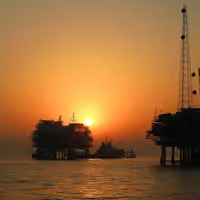
Restricted by US oil export sanctions, Iran sells its crude at lower prices to China and earns around $30 billion per year, with no other significant revenues in hard currencies. This does not even cover the annual budget of the government and there are no other funds for long-term investment.
Government officials have recently admitted that most of the $150-billion National Development Fund, or the sovereign wealth fund has been spent, since 2012, leaving nothing for investment. Foreign investments are also virtually non-existent due to sanctions and lack of political confidence in the Islamic Republic regime that has adversarial relations with Western countries and a government-controlled economy.
A report in Tehran media on Monday showed that there are more than 2,000 registered quasi-governmental companies that are often exempt from taxes, enjoy monopolies and avoid any accountability. These companies are run by regime insiders as their private fiefdoms, and often when they lose money, they turn to borrow from government banks, which are also run through the same political network of government loyalists.
Shahri argued that the fundamental imbalances also exacerbate Iran’s high annual inflation rate, which hovers at around 50 percent.
“If we cannot address these deficits, Iran will enter a hyperinflation path. It should be noted that hyperinflation does not mean a 40% inflation growth per year; rather, it means a 50% inflation growth every month. In this case, Iran will face unprecedented conditions. If we cannot control the imbalances, we are destined for hyperinflation in the next 5 years,” the economist emphasized.
Most commentators in Iran, along with many regime politicians, frequently attribute the current economic difficulties to President Ebrahim Raisi's weak administration. This perspective often overlooks the country's foreign policy, which is typically viewed as the domain of Supreme Leader Ali Khamenei. US and European sanctions and a lack of foreign investments have left Iran with sole reliance on limited oil exports.
Additionally, commentators often neglect to address the fundamental causes of economic inefficiencies, which critics argue stem from a government-controlled economy that fosters corruption and nepotism.