• العربية
  • فارسی
Brand
  • Iran Insight
  • Politics
  • Economy
  • Analysis
  • Special Report
  • Opinion
  • Podcast
  • Iran Insight
  • Politics
  • Economy
  • Analysis
  • Special Report
  • Opinion
  • Podcast
  • Theme
  • Language
    • العربية
    • فارسی
  • Iran Insight
  • Politics
  • Economy
  • Analysis
  • Special Report
  • Opinion
  • Podcast
All rights reserved for Volant Media UK Limited
volant media logo

Succession After Khamenei’s Death Will Not Be Smooth
Majid Mohammadi

Contributor

Jan 14, 2024, 23:03 GMT+0Updated: 11:12 GMT+0
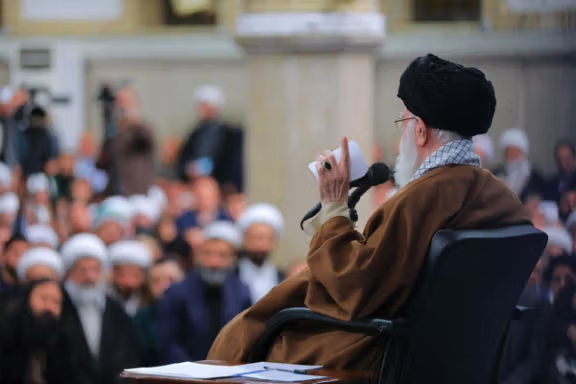
Iran's ruler Ali Khamenei during a meeting with a group of clergy in Tehran

After nearly 45 years of Ali Khamenei’s rule in Iran, the most important question for many is what will happen after his death, a smooth or a rocky transition.

Contrary to what has been presented so far in the discussion on succession after Ali Khamenei, this article will not speculate about the time of his death, the identity of his successor, power struggles between the clerics and the IRGC, or the role of China, Russia, and the West in the matter. Instead, we will delve into the decision-making process. Presenting two sets of facts concerning the background of power transfer from Khomeini to Khamenei and from Khamenei to the next leader, should the regime remain intact.

1989: Smooth Transition

After Khomeini's death, the succession process unfolded relatively smoothly, devoid of tension, and can be attributed to five key factors. Firstly, the presence of an influential figure like Akbar Hashemi Rafsanjani, who held sway among middle, left, and right-wing officials within the system, played a pivotal role. Rafsanjani was essentially a ‘kingmaker’ who not only influenced Khamenei's ascent to power with his unverifiable narratives but also held sway over numerous pivotal institutions, from parliament and the executive branch to state media, the police force, IRGC, and the Ministry of Information.

Secondly, a five-member board comprised of Mir Hossein Mousavi, Abdul Karim Mousavi Ardebili, Akbar Hashemi Rafsanjani, Ali Khamenei, and Ahmad Khomeini made critical decisions during Khomeini's illness, exercising comprehensive control over all centers of power. This board effectively prevented marginal power centers from gaining influence, holding the reins of coercive powers after the removal of Hossein Ali Montazeri and his supporters from key positions. Montazeri had been Khamenei’s designated successor who had fallen out of favor before the leader’s death.

Ali Khamenei (center) and Hossein Ali Montazeri (right) (undated)
100%
Ali Khamenei (center) and Hossein Ali Montazeri (right)

Among second-tier officials, there existed dozens of relatively influential figures aligned with different political factions, including Ali Meshkini, Mohammad Reza Mahdavi Kani, and Ahmad Azari Qomi on the right, and Jalaluddin Taheri, Yusuf Sanei, and Mohammad Mousavi Khoiniha on the left. Political groups were attentive to their advice, which mitigated concerns within security and military institutions regarding infighting. Additionally, only a minimal number of Islamist figures were subjected to persecution, torture, or harassment by the regime, which limited internal opposition to the new leader.

The absence of any significant social movement in the post-war period left the regime with ample latitude to designate the next leader. Consequently, both Khomeini's funeral and the Experts Assembly session that elected Khamenei, unfolded without societal tension or challenges. While the populace might not have been content with the status quo, the absence of a sizable opposing movement or dissenting voices was notable.

Furthermore, the tranquil security and political landscape in the region after the Iran-Iraq war, combined with the relative weakening of the Iranian navy by the US in the southern waters, contributed to the smooth transition of power. There was a notable absence of perceived foreign threats to the regime.

Turbulent Transition

After Khamenei's passing, the situation will not be as peaceful as before, as none of the five conditions mentioned earlier will apply. Instead, the opposite circumstances are in place. There is no one within Ali Khamenei's inner circle who possesses the stature, power, and influence of Hashemi Rafsanjani, capable of assuming the role of a "king-maker." Rafsanjani's absence poses a greater threat to the system than his presence would have. In totalitarian systems, individuals often play a more significant role compared to institutions.

Khamenei's close associates, such as the head of his office, the president, or the head of the Expediency Council, are more disliked among the people and political figures than Khamenei himself. Even cabinet members and lawmakers view them with disdain. The removal of Qasem Soleimani by President Donald Trump in 2020 had a considerable impact, as Soleimani could have been such a kingmaker. Even the reformists praised him for his role in advancing their agenda and did not consider him an adversary.

Former president Akbar Hashemi Rafsanjani (left) and Ali Khamenei  (undated)
100%
Former president Akbar Hashemi Rafsanjani (left) and Ali Khamenei

Khamenei has transferred power primarily to IRGC commanders but has consistently rotated them, preventing any one of them from developing significant influence. Figures like Hossein Salami, the commander of the IRGC, and Esmail Qaani, the commander of the Quds Force, are not taken seriously by most. Beyond the upper echelon, there is no alternative power center capable of leading state affairs. Various power centers on the periphery, in the form of factions and dormant assets, could be rapidly mobilized.

Former high-ranking officials have been either isolated or eliminated, losing their previous support base. They have been marginalized to the point of becoming detested by insiders. The well-know influencers within the regime are now the preachers, eulogists, and Basij members, all unpopular among the public. There is a lack of charismatic political figures.

In 2024, numerous political and social movements are active and prepared to exploit any power vacuum. Hundreds of thousands of young individuals, suppressed during the Mahsa movement, and families who have lost loved ones may take to the streets under the right conditions. However, the government has become more repressive and brutal. The next confrontation between the opposition and the government will likely result in more casualties on both sides. Society is in turmoil due to the regime's oppression and abuses, making it unlikely for the government to rely on silence and social passivity during the succession process.

The regime's interventions across the Middle East have led regional countries to view the Islamic Republic as a threat and welcome any domestic instability and turmoil in Iran. When Israel can remove nuclear and military officials openly and steal nuclear documents without significant repercussions, it is evident that more significant actions can be taken in a chaotic situation.

For these five reasons, there is no one to jump-start the leadership "junk car" in the event of a jurist guardian's death, allowing the next jurist guardian to seize the steering wheel. In such a situation, those seeking control will likely have to engage in internal power struggles.

Despite the limited number of leadership candidates backed by influential factions, there are imminent violent clashes between these factions for three key reasons:


  1. The Expert Assembly lacks legitimacy among insiders, as it comprises low-level clerics, who have not won their seats in competitive and free elections but essentially appointed to their positions.
  2. There is fierce competition for the country’s resources in an environment, which has become much more corrupt since 1989.
  3. Apprehensions of swift elimination of opponents after a new leader is chosen, given the historical trend of the system eradicating all internal opposition in the past two decades.

Most Viewed

Iran negotiators ordered to return after internal rift over Islamabad talks
1
EXCLUSIVE

Iran negotiators ordered to return after internal rift over Islamabad talks

2
ANALYSIS

US blockade enters murky phase as tankers spoof signals and buyers hesitate

3
ANALYSIS

Why the $100 billion Hormuz toll revenue is a myth

4

US tightens financial squeeze on Iran, warns banks over oil money flows

5
INSIGHT

Ideology may be fading in Iran, but not in Kashmir's ‘Mini Iran'

Banner
Banner

Spotlight

  • Hardliners push Hormuz ‘red line’ as US blockade tests Iran’s leverage
    INSIGHT

    Hardliners push Hormuz ‘red line’ as US blockade tests Iran’s leverage

  • Ideology may be fading in Iran, but not in Kashmir's ‘Mini Iran'
    INSIGHT

    Ideology may be fading in Iran, but not in Kashmir's ‘Mini Iran'

  • War damage amounts to $3,000 per Iranian, with blockade set to add to losses
    INSIGHT

    War damage amounts to $3,000 per Iranian, with blockade set to add to losses

  • Why the $100 billion Hormuz toll revenue is a myth
    ANALYSIS

    Why the $100 billion Hormuz toll revenue is a myth

  • US blockade targets Iran oil boom amid regional disruption
    ANALYSIS

    US blockade targets Iran oil boom amid regional disruption

  • Iran's digital economy battered by prolonged blackout
    INSIGHT

    Iran's digital economy battered by prolonged blackout

•
•
•

More Stories

Iranian Official Faces Health Speculation Following Viral Video

Jan 14, 2024, 20:59 GMT+0

A video circulating on social media has sparked concerns about the health of Ali Akbar Velayati, the prominent foreign policy advisor to Iran's Supreme Leader Ali Khamenei.

The footage reveals Dr. Velayati walking with noticeable difficulty and a curved back, requiring assistance from his bodyguards.

The video follows earlier images depicting Velayati in a weakened state, contributing to widespread speculation about his well-being. Despite the public's curiosity, no official information regarding the current health status of the head of Masih Daneshvari Hospital has been disclosed.

In response to the video, social media users have drawn attention to Velayati's extensive responsibilities. Ali Qolhaki on the X network expressed astonishment at Velayati's ability to maintain roles such as the international advisor to the Supreme Leader, member of the Expediency Discernment Council, chairman of the founding board of Azad University, and secretary-general of the Islamic Awakening Assembly, considering his apparent physical challenges.

Born in 1945 in Tehran, Velayati, a pediatric specialist from the University of Tehran, acquired expertise in infectious diseases from Johns Hopkins University in the United States. Serving in various governmental roles, including Minister of Foreign Affairs, and as a member of the Islamic Consultative Assembly, Velayati has played a significant role in the regime’s politics.

Iranian Journalists Detained During 2022 Protests Furloughed On Bail

Jan 14, 2024, 19:56 GMT+0

Two female Iranian journalists Elaheh Mohammadi and Niloufar Hamedi have been temporarily released after posting hefty bails of approximately $200,000.

Mohammadi faces a 12-year sentence, 6 years executable, and Hamedi, 13 years with 7 years executable.

Hamedi's arrest on September 22, 2022, followed her reporting on Mahsa Amini's critical situation in the hospital, after she received serious head injuries in hijab police custody. Amini's eventual death sparked nationwide protests. A week later, Mohammadi, a Ham-Mihan newspaper reporter, was arrested covering Amini's funeral in Saqqez. Accused of informing about Amini's death, both faced pressure from security entities.

Amini was detained on charges of violating rules mandating women to wear a hijab. While Iran's state coroner claimed her death was due to pre-existing medical conditions, a UN human rights expert argued that evidence pointed to her dying "as a result of beatings" by morality police.

Hamedi, a Shargh newspaper journalist, was convicted of collaborating with the US government (7 years), conspiracy against national security (5 years), and anti-regime propaganda (1 year).

Mohammadi, received a 6-year sentence for collaborating with the US, 5 years for conspiracy against national security, and 1 year for anti-system propaganda, with 6 years to be executed.

Both also face a two-year prohibition of membership in parties and political groups, online activities, and media engagement.

The verdict, released over a year after detention, stirred widespread domestic and international reactions. Advocacy for press freedom and human rights intensified in response to the two journalists' challenging circumstances.

Iranian Criminal Who Fought In Syria Badly Wounded In Gang Fight

Jan 14, 2024, 17:05 GMT+0
•
Maryam Sinaiee

Iranian media reported recently that a notorious criminal who fought with IRGC forces in Syria in 2018 was hospitalized after being shot by a rival gang in Tehran.

An official of the Greater Tehran Police told Etemad Online on January 10 that the three men responsible for shooting Hani Kordeh (a nickname) a day earlier were arrested at their hideout and promised further information later.

Iranian newspapers claim Hani Kordeh, whose real name is not mentioned anywhere in the media, has close ties with some high-profile politicians, officials, and a former coach of Esteghlal FC. There have been allegations that he has collaborated with Iran's security and intelligence bodies for years.

In 2018, Hani Kordeh posted videos of himself on Instagram suggesting that he was involved in the fight against Bishar al-Assad’s opposition in Syria alongside IRGC forces.

A photo showing Hani Kordeh in hospital after a gang fight
100%
A photo showing Hani Kordeh in hospital after a gang fight

In one of the videos that showed him in Syria, he appears with a group of IRGC soldiers with a rifle on his shoulder bragging and vowing to crush the enemy. In other videos he is shown visiting a Shiite shrine in Damascus. Fighting in Syria allowed him to call himself a “Defender of the Shrine”, a misleading title reserved for the forces that were sent to Syria.

The tens of thousands of Iranian, Afghan and other forces that the IRGC deployed in Syria were simply there to save the country’s dictator, Bashar al-Assad, not to defend any shrine.

Omid Shams, a UK-based human rights lawyer, believes the publication of these images was a form of propaganda for the IRGC forces which were sustaining heavy casualties in Syria but confirmed the statements of Brigadier General Hossein Hamdani in 2015 about the recruitment of criminals and thugs into the IRGC's combat ranks in 2009.

Hamedani who was head of the IRGC's Rassoulollah Corps in charge of Greater Tehran from November 2009 until January 2014, admitted in an interview that in 2009 he had recruited 5,000 “apolitical” violent criminals and organized them in three battalions to suppress the Green Movement protests following the disputed presidential election that brought Mahmoud Ahmadinejad to power.

Gen. Hossein Hamedani meeting with Supreme Leader Ali Khamenei in the presence of Qasem Soleimani. Undated
100%
Gen. Hossein Hamedani meeting with Supreme Leader Ali Khamenei in the presence of Qasem Soleimani. Undated

The opposition has for many years alleged that the IRGC employs the services of thugs and hooligans to quell anti-government protests. Shams and some other Iran experts also believe that the Fatehin Brigade, the first of the IRGC’s Basij volunteer forces to be sent to Syria to fight alongside Assad forces under the command of the extraterritorial Quds Force, must have been the IRGC unit Hamedani used to organize thugs in 2009.

“These [videos] also proved that the main force, which recruits criminals and thugs is Fatehin (Conquerors) Special Forces has specifically been active in deadly suppression of popular protests, both in Iran and in Syria. The role of this unit in suppressing the recent [Woman, Life, Freedom] protests was confirmed after Ebrahim Raisi’s meeting with Fatehin forces,” Shams wrote in December 2022.

Hamedani who was killed in Syria in October 2015 was twice decorated by Supreme Leader Ali Khamenei and promoted to major general posthumously. He was subjected to international sanctions in April 2011, including by Britain, the European Union, the United States and Canada for human rights violations.

Hani Kordeh is said to have been born in 1980s in Hamedan in western Iran and spent sixteen years of his life in prison since the age of fourteen. He has been wounded in gang fights several times including in 2019 when he was critically stabbed nearly fatally by the leader of a rival gang in Tehran and his hospitalization made headlines.

The notorious man who many including police officials often refer to as a thug and ruffian has been well known for many years for his criminal activities including extortion, organizing as well as leading football thugs and numerous violent gangland wars. His source of income is not clear, but in social media posts he often appears on the streets of the capital driving an expensive Porsche.

He has also claimed on various occasions that he runs a drug rehabilitation facility in the south of Tehran.

Houthi Envoy Warns Of US Responsibility In Any Red Sea Incident

Jan 14, 2024, 14:39 GMT+0

The representative of Houthi rebels in Iran has issued a warning, stating that the United States would bear responsibility for any incidents occurring in the Red Sea.

Ibrahim Al-Dailami emphasized that the Houthis were determined to respond to what they viewed as US aggressions.

In an interview with ISNA news website in Tehran on Saturday, when asked about allegations of the Houthi militants serving as proxies for Iran in the Red Sea, Al-Dailami rejected these claims as baseless. He emphasized that the primary concern was the US support for what he referred to as the "crimes of the Zionist regime" in Gaza.

The United States and Britain launched an extensive airstrike against Houthi targets this week, after they repeatedly warned the militant group to stop its attacks on commercial shipping.

Iran's support for the Houthi rebels, ongoing for a decade, involves the supply of weapons and military expertise to the Muslim sect in Yemen, closer religiously to the Shia sect. While Iran has avoided direct military involvement in the Israel-Hamas conflict, its proxy groups, including Houthi militants, have escalated attacks on commercial vessels in the Red Sea. This comes in response to Iran's Supreme Leader Ali Khamenei's call in early November for blockading Israel. In December, the US-led multinational naval coalition was launched in the Red Sea to protect commercial vessels, gaining support from various countries.

The UN Security Council recently passed a resolution urging the Houthis to cease Red Sea shipping attacks, with notable abstentions from Russia and China.

Raisi Government Lacks Vision And Plan For Iran – Pundit

Jan 14, 2024, 13:02 GMT+0

Amid conflicts between Iran’s two main political camps and an election on the horizon, a prominent commentator says the hardliner president has no plan for the country.

In an interview published Saturday, influential reformist pundit Abbas Abdi criticized the government of President Ebrahim Raisi -- hailing from the ultraconservative or the so-called principlist camp -- claiming that it lacks any plan or vision for governing the country.

Abdi said Raisi had announced during the 2021 election campaign that he had a 7,000-page plan for solving Iran's pressing issues, but now after 30 months, his government says it has a limited plan for certain issues. "Seven lines would have been enough to understand what you intend to do," Abdi retorted and argued that the government is evaluated by its actions and results, pointing out that the economic situation proves they do not have any concrete plans that would yield tangible results.

Mocking the government’s strategies, he said if you compile remarks by the top economic decision-makers --including the president himself, his economy minister, the Central Bank Governor, and the head of the Planning and Budget Organization --, you can see there is not a single practical plan to address the country’s woes.

As an example, Abdi, who is allowed to comment on various issues in the government-controlled media, mentioned that when the inflation rate is over 40 percent, how the government can justify raising wages by less than 20 percent. He noted that the government claims economic growth, but the people are increasingly sinking into poverty. "Why doesn't this economic growth benefit the people? Where does the rest of the money go?" he asked. The root cause of such problems is the government’s inefficiency, he stated. 

Commentator Abbas Abdi (undated)
100%
Commentator Abbas Abdi

Highlighting an expected low turnout in the upcoming parliamentary elections, he said people do not care about the election because they have seen that nothing can change the status quo. “Elections, in and of themselves, may not be significant; rather, their importance lies in the consequences and results. When people see that in the previous election, representatives who lacked competence were elected – even a lawmaker with two doctorates who struggles with basic legislative terms – questions arise about the quality of the parliament they have formed.” 

Abdi also criticized the ruling hardliners for removing political rivals, claiming that such a lack of diversity will further damage the country’s political dynamism. Earlier this month, Iran’s clerical watchdog, the Guardian Council, rejected a large number of potential candidates, including many current lawmakers, who sought to run for a seat in the March 1 parliamentary elections.

The disqualifications are in line with a wider purge of critics of the ruling hardliners, known in Iran as “purification.” Various organizations and institutions have faced purges as hardline elements of the regime sideline their rivals. The notion of "purification" was initially coined by former Parliament Speaker Ali Larijani to describe the actions of ultraconservative allies of President Raisi, aiming to consolidate government power by marginalizing other politicians and officials, who are also regime insiders.

Abdi underlined the influence of a political faction in Iran's executive bodies and oversight committees that does not embrace the principle of republicanism. Implicitly addressing the reasons behind the ruling faction's rejection of the parliamentary candidates, he stated, "Ideologically, they may not align with republicanism, but in practice, they recognize that without a certain level of support from the ballot box, their survival is at risk.”

The Secretary General of harliner Paydari party, Sadegh Mahsouli (undated)
100%
The Secretary General of harliner Paydari party, Sadegh Mahsouli

Meanwhile, the leader of ultra-hardliner Paydari Party, whose members occupy almost all key posts in state organizations and offices, defended the political trend, claiming that "purification" is just a code word coined by enemies to impose Western ideals of democracy on Iran. Mahsouli emphasized that the “righteous people” should take the helm of the country and defined ‘righteous’ as the most deserving.

"The opposing faction claims that by 'righteous’ we mean purification, but I argue that purification is a code name for the dominance of Western-leaning individuals... Even the moderates and reformists who criticize us are seeking the most deserving people, but their criteria are different and based more on a secular perspective,"Mahsouli said.