• العربية
  • فارسی
Brand
  • Iran Insight
  • Politics
  • Economy
  • Analysis
  • Special Report
  • Opinion
  • Podcast
  • Iran Insight
  • Politics
  • Economy
  • Analysis
  • Special Report
  • Opinion
  • Podcast
  • Theme
  • Language
    • العربية
    • فارسی
  • Iran Insight
  • Politics
  • Economy
  • Analysis
  • Special Report
  • Opinion
  • Podcast
All rights reserved for Volant Media UK Limited
volant media logo

Ultraconservatives Plan To Tighten Their Monopoly In Iran
Iran International Newsroom
Nov 8, 2023, 06:32 GMT+0Updated: 11:38 GMT+0
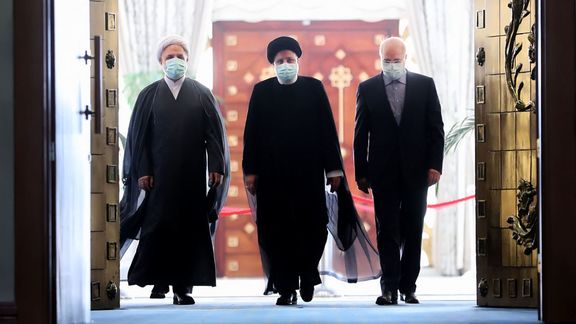
Judiciary Chief Gholamhossein Mohseni Ejei (left), Iranian President Ebrahim Raisi (center), and Parliament Speaker Bagher Ghalibaf

Iranian President Ebrahim Raisi and his ultraconservative allies are likely to present three different lists of candidates for the parliamentary elections in March.

This move seems aimed at creating an overwhelming propaganda push to secure a parliament dominated by Raisi's supporters, ensuring minimal opposition to their complete takeover of the executive and legislative powers. Some social media reports also suggest an effort to replace Judiciary Chief Gholamhossein Mohseni Ejei with an ultraconservative figure, further consolidating power.

A “political purification” push has already begun, with all regime loyalists outside the circle of hardliners being purged from managerial and even teaching positions.

Abdolreza Davari, an aide to former President Mahmoud Ahmadinejad has alleged that Iranian state television plays a pivotal role in this "political purification" project, with Ejei not immune to the attempts to eliminate anyone not closely aligned with the ultraconservative Paydari Party.

Meanwhile, Khabar Online website in Tehran revealed that the Raisi administration is preparing three lists of ultraconservative candidates to overwhelm voters. The website said that the Strategic Network of Friends of Revolution [Persian acronym SHARIAN] led by Roads and Urban Planning Minister Mehrdad Bazrpash will be the leading group among the three.

While Raisi and his associates deny any concerted efforts to influence the upcoming elections, political figures linked to Paydari confirm re-branding and renaming of ultraconservative groups in preparation for the elections. The deliberate tactic is aimed at confusing voters, who may have lost trust in ultraconservative politicians over the past four years due to inefficiency and opposition to nationwide protests in 2022.

Nonetheless, political figures close to Paydari, such as Esmail Kowsari have confirmed that groups linked to Paydari have been re-branding ahead of the elections. Other reports have indicated that re-branding and name changes among ultraconservative groups are likely to confuse the voters. 

Ultraconservative leaders know that their likeminded politicians have lost the nation's trust in the course of the past four years both in terms of the inefficiency of their representatives in the parliament and in the government and as a result of their violent reaction to the nationwide protests that shook Iran in 2022.

Ultraconservative politicians may be also hoping that the same groups under different names can be attractive for voters particularly if they come up with generous pledges to voters, although unmet promises about building four million homes, reducing employment and controlling inflation in the past two years have made people numb to any rosy promises.

Politicians and political analysts in Tehran do not hide their concern about yet another drop in election turnout after the disgraceful low turnouts in the parliamentary elections of 2020 and presidential elections of 2021, the lowest since 1979. In some districts just around 20 percent of voters cast ballots. However, Iran's reformists and moderates who were barred from running in those elections and are likely to be barred again in March, maintain that the ultraconservatives favor a low-turnout election as it would guarantee their win despite the embarrassment for the regime.

According to Khabar Online, politicians in Tehran have said that Paydari will coordinate its lists with Raisi. Moderate conservatives have already nicknamed groups such as SHARIAN as "Raisi's proxy groups." Salman Zakeri, a lawmaker from Urmia in northwestern Iran, says the idea of proxy groups is also meant to cover up the discords among the ultraconservative groups. He argued, "It is strange that they have a unity Council, and still they are divided into at least three groups."

In another development, while all of these tactics ahead of the elections are part of the campaign toward political purification, Expediency Council member Mohammad Sadr is adamant that "The idea of political purification has been wrong from the start." He stated, "When we talk about different shades of ultraconservative, it proves that there is no consolidated ultraconservative government."



Most Viewed

Iran negotiators ordered to return after internal rift over Islamabad talks
1
EXCLUSIVE

Iran negotiators ordered to return after internal rift over Islamabad talks

2
ANALYSIS

US blockade enters murky phase as tankers spoof signals and buyers hesitate

3
ANALYSIS

Why the $100 billion Hormuz toll revenue is a myth

4

US tightens financial squeeze on Iran, warns banks over oil money flows

5
ANALYSIS

US blockade targets Iran oil boom amid regional disruption

Banner
Banner

Spotlight

  • Hardliners push Hormuz ‘red line’ as US blockade tests Iran’s leverage
    INSIGHT

    Hardliners push Hormuz ‘red line’ as US blockade tests Iran’s leverage

  • Ideology may be fading in Iran, but not in Kashmir's ‘Mini Iran'
    INSIGHT

    Ideology may be fading in Iran, but not in Kashmir's ‘Mini Iran'

  • War damage amounts to $3,000 per Iranian, with blockade set to add to losses
    INSIGHT

    War damage amounts to $3,000 per Iranian, with blockade set to add to losses

  • Why the $100 billion Hormuz toll revenue is a myth
    ANALYSIS

    Why the $100 billion Hormuz toll revenue is a myth

  • US blockade targets Iran oil boom amid regional disruption
    ANALYSIS

    US blockade targets Iran oil boom amid regional disruption

  • Iran's digital economy battered by prolonged blackout
    INSIGHT

    Iran's digital economy battered by prolonged blackout

•
•
•

More Stories

Thailand In Talks With Iran, Qatar To Release Hostages In Gaza

Nov 8, 2023, 06:08 GMT+0

The Thai government is currently in discussions with Iran and Qatar to secure the release of 23 hostages held in Gaza, as reported by Hebrew media sources.

Thai citizens were killed and abducted during an assault on southern Israeli communities in a terror raid by Hamas on October 7. Foreign workers, many from Thailand, have long been employed in Israeli farms bordering Gaza, contributing to various agricultural tasks.

Thai Prime Minister Srettha Thavisin has assured that the hostages in Gaza are safe and will soon be freed. However, details regarding the negotiations and the mediators involved have not been disclosed.

Israeli Channel 12 reported on Monday that the Thai government recently made a donation of 3 million baht, equivalent to approximately $85,000, to the United Nations' agency for Palestinian refugees. Questions have risen regarding whether the donation is linked to the ongoing negotiations.

Channel 12 has also revealed that Iran is playing a pivotal role in the negotiations for the release of the captured Thai nationals. If an agreement is reached, the captives may be transferred to Egypt and then to Tehran before being repatriated to Thailand.

Moreover, Channel 12 showcased a photograph of a Thai delegation, led by the country's deputy prime minister, meeting in Tehran with Iran's Foreign Minister Hossein Amir-Abdollahian a few days ago.

During the October 7 onslaught, which marked the beginning of the Israel-Hamas war, 32 Thai citizens were killed, and 23 were abducted, according to official Thai government figures.

The toll from the attack resulted in the loss of approximately 1,400 lives, with the majority being civilians, and over 240 individuals kidnapped.

Political Prisoner Remains Incommunicado For Six Months In Evin Prison

Nov 7, 2023, 18:27 GMT+0

Nasim Simiari, a political prisoner detained in Iran, has been held incommunicado in the women's ward of Evin Prison for six months.

Simiari faces a series of charges, including "collusion and conspiracy to act against the country's security, setting bombs in public places, and disrupting public order."

On May 18th, Simiari was taken into custody by Intelligence agents of the Islamic Revolutionary Guard Corps and transferred to a detention center within Evin Prison.

Following her arrest, authorities conducted a search of her residence, seizing personal belongings, including identification documents, mobile phones, a computer, money, gold, watches, and clothing belonging to her and her family.

After enduring two months of interrogation and detention in a separate cell, Simiari was moved to another solitary cell. A source close to Simiari's family revealed that prior to her transfer, she was coerced into a forced confession to camera.

Despite being transferred to the women's ward of Evin Prison in October, Simiari remains in detention without a court hearing or a verdict. It has been a recurring practice in the Islamic Republic to force detainees to provide forced confessions, subsequently leading to verdicts against political prisoners, a practice strongly criticized by human rights organizations.

Born in 1988 in Tehran, Simiari holds a degree in architecture and operated a women's beauty salon in Tehran before her detention. Her story underscores the ongoing concerns regarding human rights and due process in Iran's judicial system.


Water Tensions Remain Between Iran And Taliban

Nov 7, 2023, 15:41 GMT+0

Iran's interior minister has appealed to the Taliban to take more measures to ensure Iran's water rights from the Helmand River, known as Hirmand in Iran.

The river plays a vital role in sustaining both Afghanistan and Iran, serving as a critical source for agriculture and drinking water. However, it has been a persistent source of tension between the two neighboring countries.

Iran has long accused Afghanistan of obstructing the river's water flow through the construction of dams, a claim vehemently denied by Afghan authorities.

During a Monday meeting with Abdul Ghani Baradar, the Deputy Prime Minister for Economic Affairs in the Taliban government, Ahmad Vahidi also engaged in discussions with a Taliban official on matters related to border security, counterterrorism, and creating conditions for the return of Afghan refugees, as reported by the IRNA state news agency.

Baradar, along with a 30-member delegation of Taliban officials, arrived in Tehran on November 4 and is expected to travel to other provinces in Iran, according.

Vahidi said during the meeting, "The issue of water casts a shadow on the medium-term and long-term plans of the two countries, and efforts must be made to resolve the problem."

Tensions regarding the Helmand River have persisted since the spring, and in early June, a clash between Iranian border forces and the Taliban resulted in the death of at least one Iranian soldier.

In the Taliban’s statement, it is said that Baradar requested that Iran release Afghan prisoners accused of minor crimes from prisons and transfer other Afghan prisoners to the Taliban government.

Iranian officials estimate that there are five million Afghans in Iran, with only 780,000 having refugee status, while the majority are undocumented. Some estimates even reach as high as eight million.


Alienating Remark By Iranian Hardliner Irks Even Regime Supporters

Nov 7, 2023, 14:43 GMT+0
•
Maryam Sinaiee

An official from Supreme Leader Ali Khamenei's office has tried damage control following remarks by a female hardliner, which risk alienating even regime supporters.

“This country belongs to Hezbollahis,” said Mansooreh Masoumi-Asl, an aspiring politician with close ties to the ultra-hardliner Paydari Party on live TV on Saturday. The context clearly indicated that she was demanding the total exclusion of all but her own party from the media and politics including other hardliners and conservatives.

Mehdi Fazaeil, a member of Khamenei’s office who has been responsible for publishing his writings for several years, responded to Masoumi-Asl by quoting Khamenei’s remarks about the revolution and those who “own” it.

“The Leader of the Revolution: This is a divine revolution, and its pillars are the people… No one, no group, can and should lay claim to owning this revolution …This revolution is owned by the people,” is a quote from a Khamenei speech in June 2008 that Fazaeli posted on X Monday evening read.

Hardliner politician Mansooreh Masoumi-Asl (undated)
100%
Hardliner politician Mansooreh Masoumi-Asl

However, Khamenei had also said in a speech that the country belongs to hezbollahis, which seems to have been the inspiration for Masoumi-Asl’s statement two days ago.

“This country is the country of hezbollahis, and its future will be built by these hezbollahis and revolutionary and pious forces. Whenever a problem occurs, they should come and solve it. God willing, this will be the case,” Khamenei had said in September 1995.

The term "Hezbollah," originally employed to denote the Islamic Republic's revolutionaries in their struggle against perceived evil forces, has never held official political party status. In common usage, "hezbollahi" has evolved to describe fervent supporters of the regime and Supreme Leader Ali Khamenei.

Hezbollah and hezbollahi (belonging to Hezbollah) became part of the political jargon in 1979, when Islamist revolutionaries described themselves as hezbollahi against the liberal who were soon excluded from the government.

Masoumi-Asl, who is very active on social media and is often invited by the state broadcaster (IRIB) to comment on an array of topics, is a member of the central council of the Paydari-affiliated Strategic Network of Islamic Revolution’s Helper (SHARIAN). The group held its first general meeting in early March.

Iranian media say the group which includes many officials of President Ebrahim Raisi’s administration, as well as deputy parliament speaker Mojtaba Zolnour, seeks to oust the incumbent speaker of the parliament, Mohammad-Bagher Ghalibaf and his supporters in the upcoming March elections, and to take full control of the parliament.

The group’s activities have caused serious disputes between the Ghalibaf and the Raisi camps, Entekhab, a moderate conservative news website wrote Sunday.

“Our Iran is now at the center of a serious and dangerous development, and we witness a new episode of extremist behavior and deviations by hardliners. [They believe] whoever thinks differently should collect their things and get out [of the political scene],” Mostafa Faghihi, Entekhab’s chief editor, warned in a series of tweets.

Vahid Ashtari, an independent hardliner whistle-blower, tweeted that there are many theoreticians behind the phrase, ‘The country belongs to hezbollahis’ and several billions have been spent to promote this view. Many in power share this view, he said.

Ashtari who is an ardent supporter of the Islamic Republic but critical of most of the ruling cast and their corruption, also emphasized that limiting the criticism to Masoumi-Asl was “reducing the importance of the matter”.

“She will soon be given a good position [in the government] or become a lawmaker … She will mature a little bit and learn like others that she doesn’t have to say out loud everything that she believes in,” Ashtari wrote.

“Don’t mislead the people if you know where the roots of such a belief are and how it has affected policymaking, the money that has been spent, and the consequences it has had and tell the truth about this issue,” he added.


Iranian MP Challenges Practicality Of Closing Supply Routes To Israel

Nov 7, 2023, 14:02 GMT+0

An Iranian member of parliament has voiced doubts regarding Supreme Leader Ali Khamenei's call to close off supply routes for oil and resources to Israel.

Mahmoud Abbaszadeh said that achieving the goal from “areas controlled by the Axis of Resistance may be unfeasible, and some regional reactionary countries might resist efforts to cut off oil and resources to Israel.”

Axis of Resistance is a term coined by the Islamic Republic to refer to its proxy forces in the region including, Palestinian militant groups, the Syrian regime, the Lebanese militant group Hezbollah and other factions.

Khamenei on Wednesday made an appeal to Muslim countries, urging them to halt oil and food exports to Israel, while demanding an immediate end to the bombings in the Gaza Strip.

"The bombings on Gaza must stop immediately ... the path of oil and food exports to the Zionist regime should be stopped," Khamenei told a group of students in Tehran, according to Iranian state media.

Israel, in retaliation for an attack on October 7 that claimed many lives and resulted in hostage situations, has vowed to take action against Hamas, which is backed by Tehran.

Iran is one of Hamas' biggest backers, supporting the group, proscribed by countries including the US and UK, financially and militarily.