• العربية
  • فارسی
Brand
  • Iran Insight
  • Politics
  • Economy
  • Analysis
  • Special Report
  • Opinion
  • Podcast
  • Iran Insight
  • Politics
  • Economy
  • Analysis
  • Special Report
  • Opinion
  • Podcast
  • Theme
  • Language
    • العربية
    • فارسی
  • Iran Insight
  • Politics
  • Economy
  • Analysis
  • Special Report
  • Opinion
  • Podcast
All rights reserved for Volant Media UK Limited
volant media logo

Iran's Reformists Call For Delaying Parliamentary Elections
Iran International Newsroom
Jan 4, 2024, 16:59 GMT+0Updated: 11:17 GMT+0
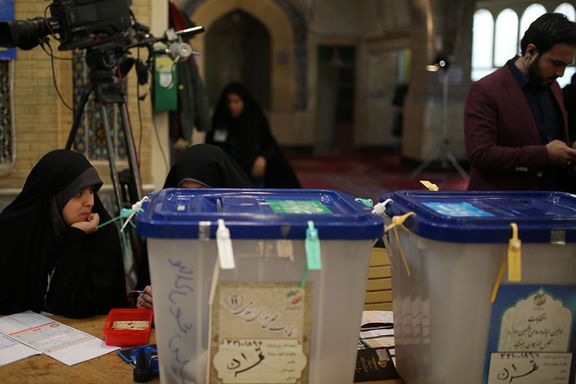
Ballot boxes on an election day in Iran’s capital Tehran

A politician in Iran says Reformists have offered ways out of the current political impasse to the President, such as delaying the upcoming parliamentary elections.

The managing editor of one of Iran's leading reformist newspapers, Elias Hazrati revealed on Wednesday that in their meeting with President Ebrahim Raisi on Monday the Reformists urged him to delay the elections and renew the registration of candidates.

Most Reformist political groups did not name any candidates and their members refused to register as they were sulking with the government following large-scale banning of non-conservative candidates in the previous two election in 2020 and 2021. As a result, both the parliament and the executive branch are dominated by hardliners, who appear eager to monopolize power.

Iranian politician and former military officer Elias Hazrati (undated)
100%
Iranian politician and former military officer Elias Hazrati

Meanwhile, the Reformists called on the government to endorse the qualifications of a majority of the 24,000 candidates who have registered their candidacy.

The other two demands by reformists were more general and not necessarily linked to the elections. They called on Raisi to take prompt measures to solve the country's long-standing economic problems and to promote the status of the parliament (Majles). During recent years the government has side-lined the parliament and most key decisions, such as increasing the price of fuel, were made by the heads of the three government branches.

Hazrati pointed out that some reformist figures did not take part in the meeting with Raisi and some others, including Reform Front leader Azar Mansouri were not invited. In all, some 50 Reformist and conservative figures were invited and half of them were given the opportunity to speak during the meeting. Most of the Reformists who spoke at the meeting, explained their views about improving political participation.

The government remained silent about what was discussed at the meeting and the President's Office's news dissemination chief Mohammad Hassan Najmi announced on Wednesday that "Raisi did a favor to political activists to allow them to take part in a meeting with him."

According to Hazrati, some of the conservative figures such Paydari Party leader Sadeq Mahsouli's behavior at the meeting was confrontational and he and some others were trying to change the discussions to factional infighting. He also observed that Raisi himself mainly talked about his expectations from the media to promote the "government's achievements."

He said the main problem with the meeting was that it took place when the disqualifications of reformist candidates have been completed and apparently there is nothing that can be done to avert a political debacle. The final result of the vetting is likely to be announced during the coming week.

The move by hardliners to block others from parliament is expected to turn the election into a low-turnout event.

Despite the grievances partly discussed by Hazrati, Iran's Reformists appear to settle for an arrangement that would give them the opportunity to form a small minority at the parliament.

A report on Rouydad24 website which called the next election "a loss for the reform camp," not only suggested the formation of "an influential reformist minority" at the Majles, but also briefly introduced 20 reformist figure who could be the members of the Reformist Fraction at the Iranian parliament.

The list of the imaginary faction members include former vice President Mohammad Bagher Nobakht, former lawmaker and government's critic Ali Motahari, Massoud Pezeshkian whom the website called "The senator from Tabriz" after Supreme Leader Ali Khamenei criticized the Interior Ministry for barring him from running, and former lawmaker Mostafa Kavakebian the leader of a small reformist party called Mardom Salari (Democracy).

Interestingly, the qualifications of 12 of the 20- candidates suggested for membership in the Reform Fraction have been already rejected by the Interior Ministry.


Most Viewed

State media slam Araghchi's Hormuz tweet, say it let Trump claim victory
1

State media slam Araghchi's Hormuz tweet, say it let Trump claim victory

2

Iran International says it won’t be silenced after London arson attack

3
INSIGHT

How Tehran bends its own red lines to boost state rallies

4

Iran halts petrochemical exports to supply domestic market

5
OPINION

The Hormuz get out of jail card turned to a grave

Banner
Banner

Spotlight

  • Too early to tell who is winning Iran war, experts say
    PODCAST

    Too early to tell who is winning Iran war, experts say

  • How Tehran bends its own red lines to boost state rallies
    INSIGHT

    How Tehran bends its own red lines to boost state rallies

  • Iran blackout cripples freelancer, small business incomes
    VOICES FROM IRAN

    Iran blackout cripples freelancer, small business incomes

  • Ideology may be fading in Iran, but not in Kashmir's ‘Mini Iran'
    INSIGHT

    Ideology may be fading in Iran, but not in Kashmir's ‘Mini Iran'

  • US blockade enters murky phase as tankers spoof signals and buyers hesitate
    ANALYSIS

    US blockade enters murky phase as tankers spoof signals and buyers hesitate

  • Why the $100 billion Hormuz toll revenue is a myth
    ANALYSIS

    Why the $100 billion Hormuz toll revenue is a myth

•
•
•

More Stories

Russia In Negotiations To Buy Short-Range Ballistic Missiles From Iran

Jan 4, 2024, 15:45 GMT+0

Moscow intends to purchase short-range ballistic missiles from the Islamic Republic, according to The Wall Street Journal.

The ongoing military talks between the two countries have caused concern among US government officials as Iran’s possible delivery of missiles to Russia can further improve Moscow’s capabilities in its war against Ukraine.

“The United States is concerned that Russian negotiations to acquire close-range ballistic missiles from Iran are actively advancing,” The Wall Street Journal quoted a US official as saying.

The deal between Tehran and Moscow has not been sealed yet, the report added, noting that in case of its finalization, the Iranian missiles might be delivered to Russia in the coming months.

The revelations come while it came to light that North Korea supplied Russia with dozens of ballistic missiles and several ballistic missile launchers.

The Islamic Republic has been one of the staunch allies of Russia in its war against Ukraine. Since mid-2022, Iran has supplied a substantial number of kamikaze Unmanned Aerial Vehicles (UAVs) to Russia, which have been extensively deployed to target civilian infrastructure and cities in Ukraine.

Despite Iran’s denials regarding its involvement in supplying drones and other weaponry to Russia, the United States and its NATO allies have imposed a series of sanctions on individuals and entities implicated in the drone shipments.

In December, US National Security spokesman John Kirby emphasized that Washington will continue to hold Tehran and Moscow accountable for their growing military ties.

Referring to Iran’s military assistance to Russia and extremist militant groups in the Middle East, Kirby warned that the burgeoning relationship between Tehran and Moscow “is not only not good for the Ukrainian people but it’s certainly not good for the region.”

While Iran Blames Israel And US For Bombing, Iranians Look To Regime

Jan 4, 2024, 13:34 GMT+0
•
Iran International Newsroom

Seeking a scapegoat for a deadly bombing on Wednesday, Iran has turned to its old foes Israel and the US, but the Iranian public is not so easily fooled.

While both Israel and the US have carried out targeted assassinations and attacks on Iran's military and nuclear facilities, the two have never committed such an attack in built-up populations and with potential civilians, unlike Islamist groups such as the Islamic State group and Al Qaeda, which have.

But Iranians, who have been victims of violent suppression since the 2022 uprising and long before, have begun to look closer to home. In the wake of the Women, Life, Freedom protests, over 550 Iranians were brutally murdered, with no implications from the regime to rein in its security forces.

Thousands of Iranians on social media have claimed the attack was organized by the Islamic Republic itself in an attempt to further its domestic and foreign policies.

They cite the absence of Soleimani’s family members and high-ranking political and military officials in Kerman at Qasem Soleimani's tomb during the incident marking the fourth anniversary of the proxy leader's death, suggesting an indication of the regime’s complicity.

Zeynab Soleimani, the daughter of IRGC commander Qasem Soleimani, during a ceremony for his father's death anniversary in Tehran, January 3, 2024
100%
Zeynab Soleimani, the daughter of IRGC commander Qasem Soleimani, during a ceremony for his father's death anniversary in Tehran, January 3, 2024

On Wednesday, prominent Iranian dissident Masih Alinejad wrote on X: “Why were Qasem Soleimani’s children absent from their father’s funeral? … As the regime blames Israel and America, Iranians hold the Islamic regime leaders accountable for this deadly attack, recalling the regime’s history of crimes against their people.”

In the usual regime rhetoric, Mohammad Movahedi-Azad, Iran’s Attorney General, held responsible “the global arrogance led by the US and Israel” for the attacks which have so far claimed the lives of 84 people.

Esmail Qaani, the head of IRGC Qods Force, vowed revenge against the “bloodthirsty criminals” who launched the attack, adding that they were “fed by the US and Zionists.”

Reiterating a similar stance, Gholamreza Soleimani, the commander of Basij militias, said CIA and Mossad are “behind the scene” of the blasts.

But history tells a different story. There have been numerous reports about the Islamic Republic’s involvement in “terrorist attacks” carried out previously in Iran. Five years ago, Mostafa Tajzadeh, a former government official, admitted that the Iranian regime had a role to play in the explosions in Imam Reza’s shrine in Mashhad in 1994.

Iranians have accused the regime of planning the attacks on Shahcheragh shrine, another religious site, in Shiraz last year, following the national uprising in 2022, claiming it was a desperate attempt on the part of the Islamic Republic to frighten the protesters and mobilize its supporters via appropriating religious sentiments.

US State Department spokesman Matthew Miller strongly rejected the allegation regarding Washington’s involvement in the attack: “The United States was not involved in any way, and any suggestion to the contrary is ridiculous.”

“We have no reason to believe that Israel was involved in this explosion,” he went on to say.

The attack had the hallmarks of one of the region's Islamist groups such as Islamic State or Al Qaeda though none has yet claimed responsibility.

It is familiar rhetoric for Iranians who are well versed in the propaganda churned out by Tehran, using the US and Israel as easy fall guys for actions perpetrated if not by their own security apparatus, then by other militias.


Drone Strike Kills Iran-Backed Militia In Baghdad

Jan 4, 2024, 10:42 GMT+0

At least four fighters were killed and six others injured in a drone strike targeting an Iran-backed militia headquarters in eastern Baghdad on Thursday.

Reuters received information from police and security sources, but no further details were provided regarding the party responsible for the attack.

Field sources have indicated that a high-ranking commander of the Iran-backed armed group Harakat Hezbollah al-Nujaba (HHN), along with his assistant, was killed in the attack.

However, social media reports suggest that the targeted facility was Hashd al-Shaabi's logistics base in Baghdad and that US drones carried out the strike.

If so, it would be a rare retaliation for over 100 attacks since the Gaza war broke out in October, Iran's proxies targeting US facilities in Iraq and Syria, and now the Red Sea shipping route, in retaliation for US support of Israel's right to defend itself.

While Iran has not directly engaged in the conflict, it has utilized its network of armed groups to target both Israel and US forces in the region. Iran, a staunch supporter of Hamas, has issued threats to the United States, warning that if the attacks on Gaza persist, they may impact US interests.


US Denies Involvement In Deadly Iran Blasts

Jan 4, 2024, 10:02 GMT+0

US State Department spokesman Matthew Miller dismissed suggestions of US or Israeli involvement in Wednesday's deadly Iran blasts as "ridiculous".

He stressed that there is no credible reason to believe Israel played a role in the incident and conveyed condolences to the victims, cautioning against further escalation.

“We have no reason to believe that Israel was involved in this explosion,” he said.

In the aftermath of Iran's leaders vowing revenge, a senior administration official, in a subsequent briefing with reporters, noted that the attack exhibited similarities to previous actions by ISIS. No group has as yet claimed responsibility.

Iran is amidst a complex situation, facing potential adversaries that include exile groups, militant organizations, and state actors.

The blast unfolded in southern Iranian city of Kerman at the gravesite of former IRGC Quds Force Commander Qassem Soleimani on Wednesday, claiming the lives of at least 95 people and injuring more on the fourth anniversary of his US drone strike killing. The event occurred following a suspected Israeli attack in Lebanon, resulting in the death of Saleh al-Arouri, the deputy political leader of the Palestinian designated terror group Hamas. 

While Israel has undertaken operations in Iran related to its nuclear program, they have typically involved targeted assassinations and targeted military and nuclear infrastructure. Large-scale attacks resulting in civilian casualties in Shiite-majority Iran have been historically attributed to Sunni extremist groups, such as the Islamic State group, although not specifically in relatively peaceful regions like Kerman.


US Extends Protection To Pompeo, Hook Over 'Serious' Iran Threats

Jan 4, 2024, 08:20 GMT+0

Washington extended protection for Mike Pompeo and Brian Hook, officials in Donald Trump’s administration, over the Islamic Republic’s threats, AP reported on Wednesday.

Last month, the State Department informed Congress that the threats against Pompeo, former secretary of state, and Hook, former special envoy for Iran, are still “serious and credible,” which justify the renewal of their protection programs.

According to the Associated Press, the notifications to Congress regarding the extension were signed by Deputy Secretary of State for Management Richard Verma.

This is the 13th and 16th time that the State Department has extended protection to Pompeo and Hook, respectively, since they left office. The 24-hour security measures to protect the former officials cost the US government more than $2 million per month.

Pompeo and Hook were among the staunch supporters of President Donald Trump’s “maximum pressure” sanctions campaign against Tehran.

The Islamic Republic has time and again threatened revenge against former US officials for the killing of Qasem Soleimani, the Iranian regime’s top military and intelligence operator in the Middle East who died in a US drone strike in January 2020 in Iraq.

In February 2023, Amirali Hajizadeh, the head of the Revolutionary Guards aerospace force, repeated the threat to avenge the US killing of Soleimani.

“God willing, we are looking to kill Trump. Pompeo ... and military commanders who issued the order (to kill Soleimani) should be killed,” Hajizadeh said.

Another former official with government protection is John Bolton, UN ambassador during President George Bush and National Security Advisor during Trump. The Justice Department revealed in August 2022 that an operative of Iran’s Revolutionary Guard tried to hire a hitman in the US to kill Bolton.