• العربية
  • فارسی
Brand
  • Iran Insight
  • Politics
  • Economy
  • Analysis
  • Special Report
  • Opinion
  • Podcast
  • Iran Insight
  • Politics
  • Economy
  • Analysis
  • Special Report
  • Opinion
  • Podcast
  • Theme
  • Language
    • العربية
    • فارسی
  • Iran Insight
  • Politics
  • Economy
  • Analysis
  • Special Report
  • Opinion
  • Podcast
All rights reserved for Volant Media UK Limited
volant media logo

Concerns Mount Over Full-Scale War Between Israel, Hezbollah
Dec 19, 2023, 11:59 GMT+0
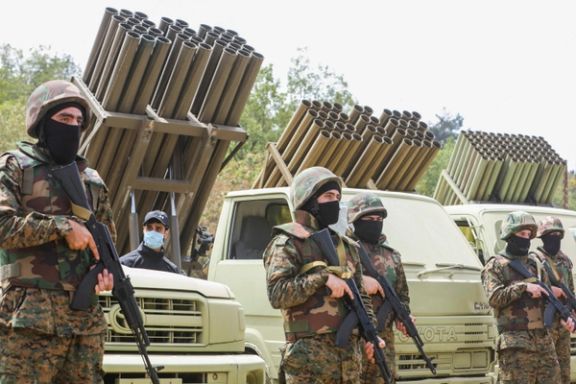
Hezbollah members take part in a military exercise during a media tour organized for the occasion of Resistance and Liberation Day, in Aaramta, Lebanon May 21, 2023.

Amidst the Gaza war, tensions on Israel's northern front are mounting, fueling concerns of a second war on the horizon from Iran's biggest proxy militia.

Based on a report by Guardian, many within Israel perceive Hezbollah as a more substantial threat than Hamas, leading to an increasing belief among Israeli politicians, generals, and a segment of the public that a new conflict in Lebanon is becoming unavoidable.

Initial calls for a preemptive strike by Israeli hawks were halted by US intervention, preventing immediate military action. However, recent developments, including a November opinion poll indicating 52% support for an immediate strike against Hezbollah, suggest a shifting sentiment within the Israeli population.

The intensification of the conflict has resulted in a rising civilian death toll, with four Israelis and at least 14 local Lebanese reported dead, according to Guardian. Israeli drone and tank strikes have claimed the lives of three journalists. Despite 17 years of relative calm since Israel's second Lebanon war, the terms outlined in UN Security Council Resolution 1701 in 2006, requiring Hezbollah to pull back from the border and disarm, remain unimplemented.

Since October 7, when Iran-backed Hamas invaded Israel, hundreds of thousands of Israelis have been displaced from their homes on both the Gaza and Lebanon borders.

Hezbollah has reportedly amassed a formidable arsenal, with Iranian support, comprising over 120,000 rockets capable of overwhelming Israel's Iron Dome defenses and causing significant damage. It would trigger a war which would be immensely destructive to both sides.

After the Hamas attack on Israel, Hezbollah conducted measured operations, firing on border villages and sending raiding parties across the border. Such actions, seemingly expressing solidarity with the Palestinians without provoking a full-scale war, may indicate a delicate balance in the region. The situation remains fluid, with the international community closely monitoring developments and expressing deep concern over the potential for further escalation.



Most Viewed

Ideology may be fading in Iran, but not in Kashmir's ‘Mini Iran'
1
INSIGHT

Ideology may be fading in Iran, but not in Kashmir's ‘Mini Iran'

2
INSIGHT

Hardliners push Hormuz ‘red line’ as US blockade tests Iran’s leverage

3
VOICES FROM IRAN

Hope and anger in Iran as fragile ceasefire persists

4

US sanctions oil network tied to Iranian tycoon Shamkhani

5

Iran halts petrochemical exports to supply domestic market

Banner
Banner

Spotlight

  • Hardliners push Hormuz ‘red line’ as US blockade tests Iran’s leverage
    INSIGHT

    Hardliners push Hormuz ‘red line’ as US blockade tests Iran’s leverage

  • Ideology may be fading in Iran, but not in Kashmir's ‘Mini Iran'
    INSIGHT

    Ideology may be fading in Iran, but not in Kashmir's ‘Mini Iran'

  • War damage amounts to $3,000 per Iranian, with blockade set to add to losses
    INSIGHT

    War damage amounts to $3,000 per Iranian, with blockade set to add to losses

  • Why the $100 billion Hormuz toll revenue is a myth
    ANALYSIS

    Why the $100 billion Hormuz toll revenue is a myth

  • US blockade targets Iran oil boom amid regional disruption
    ANALYSIS

    US blockade targets Iran oil boom amid regional disruption

  • Iran's digital economy battered by prolonged blackout
    INSIGHT

    Iran's digital economy battered by prolonged blackout

•
•
•

More Stories

Sixty Percent Of Iran's Gas Stations Down After Cyber Attack

Dec 19, 2023, 11:14 GMT+0

After a major cyber attack, only 40 percent of Iran's gas stations were operational on Tuesday morning, and only cash payments able to be processed.

The cyberattack responsible for crippling gas stations across Iran on Monday was claimed by the hacking group "Gonjeshk-e-Darande" or Predatory Sparrow. The group, previously accused by Iran of having links to Israel, announced the attack on X, stating that they took out "a majority of the gas pumps throughout Iran." 

In statements in both Persian and English, the hacking group declared that the "cyberattack comes in response to the aggression of the Islamic Republic and its proxies in the region." They further warned, "We will impose a cost for your provocations. This is just a taste of what we have in store."

The ongoing disruption follows a commitment made by Javad Owji, the Minister of Oil, who assured on Monday that "within 2-3 hours, all stations in the country will be manually active."

On October 26, 2021, another widespread cyberattack affected all 4,300 fuel stations in Iran. Despite initial assurances of a one-day resolution, it took an additional three days for all stations to return to the online system.

Meanwhile, the Ministry of Oil dismissed any connection between the disruption and changes in gasoline prices. Salarinasab emphasized, "The news related to an increase in gasoline prices is a rumor."

The disruption in Iran's fuel distribution network comes just a month after an official claimed on television that the "smart fueling system" is "completely independent" and "not susceptible to hacking or disruption."


IRGC Navy Establishes Shadow Basij Navy

Dec 19, 2023, 10:46 GMT+0

The Islamic Revolution Guards Corps (IRGC) Navy has established a voluntary unit with scope to carry out marine military operations, according to a top commander.

Local sailors will be allowed to carry out missions on vessels armed with rockets, according to IRGC Navy Commander Rear Admiral Alireza Tangsiri, who said the naval Basij has been organized after the successful formation of the maritime Basij in the Persian Gulf.

According to local reports, he said the maritime Basij in the Persian Gulf includes 55,000 voluntary forces with 33,000 vessels, noting that the second phase will be established in the Caspian Sea.

Tangsiri said the naval Basij involves large boats and launches that can sail as far as Tanzania. The shadow navy will have a presence in a series of coastal villages in southern Iran which have been equipped with military vessels.

“The Basij forces use those vessels that are furnished with weapons such as 107mm rockets, and fire them when necessary,” he said.

The revelations come against the backdrop of heightened tensions prompted by attacks on commercial shipping off the coast of Yemen, attributed to Iran-backed Houthis. Simultaneously, Washington is considering reinforcing measures to protect shipping in the Red Sea, where the Yemeni Houthis, with support from Iran, have targeted vessels in recent weeks.

Despite steering clear of direct military involvement in the Israel-Hamas conflict, Iran has leveraged allies such as the Houthis and militant groups in Iraq and Syria to target both Israel and American interests in the region.

Criticism has been directed at the Biden administration for perceived shortcomings in deterring Iran and its proxies in the Middle East, Iran's involvement in the seizure and harassment of vessels forcing the United States to bolster its military presence in the region.


Houthis Warn Maritime Coalition: Red Sea Will Be Your Graveyard

Dec 19, 2023, 08:27 GMT+0
•
Iran International Newsroom

Iran-backed Houthis threatened on Tuesday to ‘sink’ US warships, hours after Washington launched a multinational force to protect vessels transiting the Red Sea.

“We have capabilities to sink your fleet, your submarines, your warships,” a top Houthi official said, according to the IRGC-affiliated Tasnim news agency. “The Red Sea will be your graveyard.”

The new maritime coalition includes Britain, Canada, France, Italy, Spain, Norway, Netherlands, Seychelles and Bahrain. It has been formed in response to Houthi attacks on commercial vessels passing through the Bab el-Mandeb Strait and the Red Sea, transiting between Asia and Europe through the Suez Canal.

In the past few days, half a dozen shipping companies, including four of the biggest five, have ceased operations on this route, citing security concerns for their assets and their personnel.

“This is an international challenge that demands collective action,” US defense secretary Lloyd Austin while in Bahrain on his tour of the Middle East. “Therefore today I am announcing the establishment of Operation Prosperity Guardian, an important new multinational security initiative.”

It is not clear how this naval force seeks to stop Houthis from launching Iranian drones and missiles at vessels transiting the Red Sea. The naval force can only shoot down missiles and drones fired by the Houthis, but short of a military response, the Iranian proxy force can continue to disrupt shipping.

What is known is that some countries will conduct joint patrols, while others provide intelligence support in the southern Red Sea and the Gulf of Aden.

Several other countries have also agreed to be involved without being named, according to Associated Press. Nevertheless, the Biden administration would have a hard time selling it as a victory, since of the many Arab (and Red Sea) states only Bahrain has agreed to join the coalition. The Arab states, including Saudi Arabia, seem to fear the consequences of being seen as siding with the Israelis and the Americans.

The Biden administration has so far refrained from striking back at the Iranian-backed Houthis in Yemen. In his press conference Monday, Secretary Austin refused to answer a question as to why the Pentagon had not conducted a counterstrike.

Biden critics say his soft Iran policy is to blame for emboldening not only the regime in Tehran, but its proxies in Iraq, Syria, Yemen and Lebanon.

“This is beyond ridiculous,” said Senator Dan Sullivan in a thread posted on X, “as part of the Biden administration’s day-one appeasement strategy toward Iran, they delisted the Houthis, an Iranian terror proxy, as a foreign terrorist organization… Now, hardly a day goes by without another headline about the Houthis striking commercial vessels in the region.”

Last weekend, IRGC’s commander-in-chief taunted Americans, claiming that they’d leave the region soon.

“The US and Israel are reliving their bitter experiences,” said Maj. Gen. Hossein Salami. “Did they find victory in their occupation of Afghanistan? Were they able to stay in Iraq after its occupation? They are gradually packing up to leave this land.”

The Biden administration has asked the UN Security Council to intervene in order to stop Houthi attacks in the Red Sea. In a letter to council members US Ambassador Linda Thomas-Greenfield said the attacks on commercial ships threaten “international maritime security and international commerce.”

On Monday, oil giant BP announced that it will pause all shipments of oil through the Red Sea due to “deteriorating security situation” in the region. This could turn into a major headache for world’s big economies, if other oil companies were to follow BP.

“Biden’s failure to respond to Iran-backed militia attacks on shipping is going to start hitting Americans' pocket books,” wrote Senator Ted Budd on X.

Jordan Stops Infiltration By Iran-Backed Drug Smugglers

Dec 19, 2023, 07:59 GMT+0

Jordan's army foiled a plot on Monday by dozens of infiltrators from Syria linked to pro-Iranian militias, who crossed its border with rocket launchers and explosives.

Jordan’s State broadcaster said the army blew up a vehicle laden with explosives as it resisted the biggest armed cross-border operation to smuggle weapons and drugs in recent years.

The army earlier said the infiltrators had fled back across the border after injuring several army personnel in the latest of several major incursions since the start of the month that has left one Jordanian soldier and at least a dozen smugglers dead.

Intelligence sources said Jordanian jets launched rare raids into its northern neighbor Syria against hideouts of Iranian-backed drug smugglers in retaliation against the smuggling operation. Iran controls thousands of fighters in Syria for more than a decade, when it got involved in the country’s civil war to support the Syrian strongman Bashar al-Assad.

They said the bombing targeted homes of leading drug dealers and farms that intelligence showed were safe houses for the heavily armed traffickers who have also used drones to drop their hauls.

Earlier officials had said the Jordanian army was considering conducting pre-emptive strikes inside Syria against those militias linked to the drug trade and their facilities in a bid to stem what they say is an alarming rise in cross-border incursions.

Jordanian officials, like their Western allies, say that Lebanon's Iran-backed Hezbollah group and pro-Iranian militias who control much of southern Syria were behind a surge in drug and weapons smuggling.

"Jordan knows the country that stands behind this. It's Iran that is sponsoring these militias. These are hostile military actions against Jordan on its territory," said Samih Maayteh, a former minister briefed by officials on developments.

Iran and Hezbollah say the allegations are part of Western plots against the country. Syria denies complicity with Iranian-backed militias linked to its army and security forces.

UN experts and US and European officials say the illicit drug trade finances a proliferation of pro-Iranian militias and pro-government paramilitary forces created by more than a decade of conflict in Syria.

War-torn Syria has become the region's main site for a multi-billion-dollar drug trade, with Jordan being a key transit route to the oil-rich Gulf states for a Syrian-made amphetamine known as captagon, Western anti-narcotics officials and Washington say.

The army which said it had seized nearly five million pills of captagon on Monday in one of the largest hauls in recent years, warned it would "continue to track these armed groups and prevent any attempt to undermine the kingdom's national security".

"The last few days have seen a spike in these operations that are changing from infiltration attempts and smuggling to armed clashes with the goal of crossing the border by force and targeting border guards," the army statement added.

Jordan's Foreign Minister Ayman Safadi last week told Iran's Foreign Minister Hossien Amir-Abdollahian during a meeting in Geneva that Tehran should do more to rein in militias it finances that are active along the Syrian-Jordanian border, officials say.

The raids by Jordanian jets come as the monarch, a staunch US ally, discussed bolstering the country's defenses with the top US commander, General Charles Q. Brown, chairman of the Joint Chiefs of Staff.

Jordan has been promised more US military aid to improve security on the border, where Washington has given around $1 billion to establish border posts since the Syrian conflict began in 2011, Jordanian officials say.

Report by Reuters

US Deploys A Third Warship In The Red Sea After More Houthi Attacks

Dec 18, 2023, 18:12 GMT+0

The destroyer USS Laboon has entered the Red Sea joining USS Mason and USS Carney amid continuous attacks by Iran-backed Houthis on international shipping.

USS Laboon (DDG-58) is an Arleigh Burke-class destroyer in the task force headed by the aircraft carrier Dwight D. Eisenhower that was dispatched to the Middle East as war broke out between Israel and Hamas in October.

USS Mason and Carney have been patrolling the Red Sea for more than a month and intercepting dozens of drones and missiles launched by Houthi forces from Yemen. The Houthis have been armed by the Iranian regime for nearly a decade and began targeting shipping after Iran’s ruler Ali Khamenei called for blocking Israeli commerce.

Houthis first began targeting vessels that they claimed were headed to Israeli ports, but announced earlier this month that would attack all ships in the strategically vital waterway connecting Asia with Europe.

About 15 percent of world shipping traffic transits via the Red Sea and Suez Canal, the shortest shipping route between Europe and Asia.

The Houthi group said it launched a drone attack on two cargo vessels in the area on Monday, as BP and many other shippers announced in recent days that they would pause operations through the Red Sea. 

US Defense Secretary Lloyd Austin, speaking on a visit to Israel, said Washington was building a coalition to address the Houthi threat and said defense ministers from the region and beyond would hold virtual talks on the issue on Tuesday.

Italy said it is considering joining the coalition and Norway said it was ready to provide naval officers, while other NATO states said they were ready to consider support.