• العربية
  • فارسی
Brand
  • Iran Insight
  • Politics
  • Economy
  • Analysis
  • Special Report
  • Opinion
  • Podcast
  • Iran Insight
  • Politics
  • Economy
  • Analysis
  • Special Report
  • Opinion
  • Podcast
  • Theme
  • Language
    • العربية
    • فارسی
  • Iran Insight
  • Politics
  • Economy
  • Analysis
  • Special Report
  • Opinion
  • Podcast
All rights reserved for Volant Media UK Limited
volant media logo

IRGC Navy Harasses US Attack Chopper In Persian Gulf
Iran International Newsroom
Sep 28, 2023, 22:56 GMT+1Updated: 11:51 GMT+0
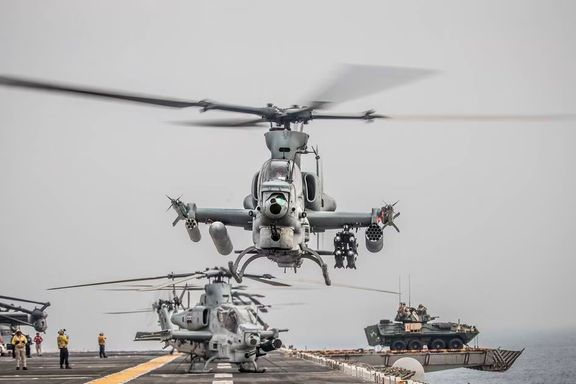
An AH-1Z Viper helicopter taking off during a Strait of Hormuz transit aboard the amphibious assault ship Boxer (August 2019)

The United States Navy has condemned Iran’s Revolutionary Guard's Navy for pointing lasers against a US attack helicopter operating in the Persian Gulf.

According to a statement by US Naval Forces Central Command Spokesman Cmdr. Rick Chernitzer on Thursday, personnel aboard vessels belonging to the IRGC’s Navy pointed lasers at a US Marine Corps AH-1Z Viper attack helicopter while in flight, calling it “unsafe, unprofessional and irresponsible.”

The chopper, assigned to the 26th Marine Expeditionary Unit (Special Operations Capable), was conducting routine operations in the international airspace of the Persian Gulf when the interaction took place on Wednesday, the US Navy said, explaining that “The aircraft is attached to Marine Medium Tiltrotor Squadron (VMM) 162 (Reinforced), deployed aboard the Wasp-class amphibious assault ship USS Bataan (LHD 5), on a scheduled deployment to the Middle East Region.”

“Iran’s Islamic Revolutionary Guard Corps Navy (IRGCN) vessels shone a laser multiple times at the aircraft while in flight," the Navy statement said. No one aboard was injured, and the helicopter was not damaged.

USS Bataan (LHD-5) (file photo)
100%
USS Bataan (LHD-5)

Warning about such acts by the Iranian military, Cmdr. Chernitzer said, “These are not the actions of a professional maritime force. This unsafe, unprofessional, and irresponsible behavior by the Iranian Revolutionary Guard Corps Navy risks US and partner nation lives and needs to cease immediately.”

Chernitzer noted that naval forces will “remain vigilant and will continue to fly, sail and operate anywhere international law allows while promoting regional maritime security.”

This is the second time in six years that Iranian units have targeted a helicopter associated with the USS Bataan with lasers. In 2017, an Iranian naval patrol boat used lasers against a Marine helicopter moving through the Strait of Hormuz with three US vessels.

Iranian state media also reported in 2022 that the Iranian military was developing a laser cannon to shoot down aerial targets. In September 2019, Electronic Industries Organization of Iran announced it has succeeded to acquire the knowledge for the laser weapons technology, saying its laser weapons can destroy radar evading UAVs that are made up of composite layers.

Although Iran wants to highlight its laser weapon capabilities to target drones and cruise missiles, the directed-energy weapons including lasers are still at their experimental stage, and are not seen as practical, high-performance military weapons, because a laser generates a beam of light which needs clear air, or a vacuum, to work. The US-Israeli project for such a weapon was canceled in 2005 because of "its bulkiness, high costs and poor anticipated results on the battlefield".

Tensions in the Persian Gulf region have intensified following a series of maritime incidents involving Iran's seizure and harassment of vessels that prompted the US to strengthen its military presence in the region.

In recent months, Tehran's military forces have tried to hijack several Western tankers in what is seen as retaliation for previous Western seizures of Iranian oil. In early-July, Iran tried to seize two oil tankers near the Strait of Hormuz, opening fire on one of them, the US Navy said, adding that the Iranian naval vessels backed off after the US Navy dispatched a guided missile destroyer to the scene.

Iran's introduction of advanced maritime weaponry prompted Washington to extend armed protection to commercial ships traversing the Strait of Hormuz. Later in July, the US Defense Department announced the deployment of additional F-35 and F-16 fighter jets along with a warship to the Middle East in a bid to monitor key waterways in the region following Iran's seizure and harassment of commercial vessels.

Having found itself under US pressure in the Persian Gulf, Iran unveiled a series of what it called new maritime weapons in August. The IRGC held drills around three Iranian islands in the Persian Gulf contested by the United Arab Emirates and claimed that it has added a 600-kilometer-range new missile to its arsenal “for defending the islands’ territory.”


Most Viewed

Iran negotiators ordered to return after internal rift over Islamabad talks
1
EXCLUSIVE

Iran negotiators ordered to return after internal rift over Islamabad talks

2
ANALYSIS

US blockade enters murky phase as tankers spoof signals and buyers hesitate

3
ANALYSIS

Why the $100 billion Hormuz toll revenue is a myth

4

US tightens financial squeeze on Iran, warns banks over oil money flows

5
ANALYSIS

US blockade targets Iran oil boom amid regional disruption

Banner
Banner

Spotlight

  • Hardliners push Hormuz ‘red line’ as US blockade tests Iran’s leverage
    INSIGHT

    Hardliners push Hormuz ‘red line’ as US blockade tests Iran’s leverage

  • Ideology may be fading in Iran, but not in Kashmir's ‘Mini Iran'
    INSIGHT

    Ideology may be fading in Iran, but not in Kashmir's ‘Mini Iran'

  • War damage amounts to $3,000 per Iranian, with blockade set to add to losses
    INSIGHT

    War damage amounts to $3,000 per Iranian, with blockade set to add to losses

  • Why the $100 billion Hormuz toll revenue is a myth
    ANALYSIS

    Why the $100 billion Hormuz toll revenue is a myth

  • US blockade targets Iran oil boom amid regional disruption
    ANALYSIS

    US blockade targets Iran oil boom amid regional disruption

  • Iran's digital economy battered by prolonged blackout
    INSIGHT

    Iran's digital economy battered by prolonged blackout

•
•
•

More Stories

Pentagon Looking Into Suspected Case Of Official With Iran Ties

Sep 28, 2023, 18:35 GMT+1

US Assistant Secretary of Defense Christopher Maier told a Congressional panel on Thursday that the Defense Department is looking into reports whether his chief of staff had contacts had covert contacts with Iran.

Iran International published a report September 26, detailing information obtained from hundreds of emails by Iranian diplomats showing that three individuals close to US Special Envoy for Iran Robert Malley, were part of a group called the Iran Experts Initiative established by the Iranian foreign ministry to promote Tehran’s interests within the US policy centers. One of this individuals, Ariane Tabatabai is currently the chief of staff of Undersecretary Maier at the defense department.

During a hearing at the Foreign Affairs Committee of the House of Representatives, Congressman Brian Mast (Rep-Fl) asked Maier to answer candidly if Ms. Tabatabai listed on her security questionnaire that she had had any contacts with the Iranian foreign ministry.

Maier replied, “This is an ongoing personnel matter…We are actively looking into whether all law and policy was properly followed in granting my chief of staff top secret special compartmented information.”

The undersecretary and the department’s counsel at the hearing said they were not involved in the security clearance decision making, and did not have information about what Tabatabai answered in related questionnaires, but were looking into this matter.

Rep. Mast asked Maier whether Tabatabai had included anyone from the Iranian foreign ministry as her foreign contacts in her national security questionnaire while seeking security clearance. Maier responded that this was part of their current investigation.

Mast noted that in the national security questionnaire, questions about foreign associates have a statute of limitations of seven years. He asked Maier if he could confirm whether it was possible any contact Tabatabai had with Iranian officials was not listed due to this “seven-year time window.”

However, the investigation by Iran International shows that there was only a period of six years and seven months between the time Ariane Tabatabai was in contact with a top Iranian official and her appointment at the State Department.

Malley recruited Ariane Tabatabai for his State Department team in February 2021.

In an email dated June 27, 2014, Ariane Tabatabai informed Zahrani that she had met in Turkey Saudi Prince Turki al Faisal -- a former ambassador to the US -- and he extended an invitation for her to visit Saudi Arabia and showed interest in collaborating. Tabatabai further inquired "I would like to know your opinion; would you be interested in this?”

She also mentioned that Ben-Gurion University in Israel had invited her to a workshop on arms control and Iran's nuclear program. Ariane Tabatabai asked, " I would like to ask your opinion too and see if you think I should accept the invitation and go.”

Zahrani replied on the same day: “All things considered, it seems Saudi Arabia is a good case, but the second case [Israel] is better to be avoided.”

Iran International's report was a joint project with Semafor and has led to intense Congressional questioning as to how individuals so close to the Biden administration's policy making could have had secret ties with Iran without the knowledge of people who either hired them or had ongoing political ties with them.

Iran Experts Initiative (IEI) is the name of a scheme devised by Iran’s foreign ministry in 2014 to bring together a network of scholars outside Iran to advocate the regime’s foreign policy and nuclear strategy.

“These are troubling allegations about Iran’s attempts to influence US Iran policy,” wrote Sen. Jim Risch, ranking member of the Senate Foreign Relations Committee, on X. “Potential involvement of Biden Admin officials with the Iran Experts Initiative must be taken seriously & warrants further review.”

Robert Malley, who initially hired Tabatabai at the State Department, was the Biden administration’s special envoy on Iran until late April 2023, when his security clearance was suspended and was then placed on unpaid leave in June 2023 without any explanation from the State Department. It’s not clear if the Iranian influence operation had anything to do with his suspension.

In light of the revelations, Sen. Ted Cruz called on the Biden administration to suspend the clearances of those linked to IEI “until these allegations are fully resolved and accountability is imposed.”

On Wednesday, Republican Senator Bill Hagerty called the story “a complete scandal and outrage”.

In a thread on his X account, the Senator posted a few questions for the Biden administration, including one on Ariane Tabatabai: “Does Ariane Tabatabai, as current COS to Assistant Secretary of Defense for Special Operations/Low-Intensity Conflict, have access to Special Access Programs? If so, did DeptofDefense subject her to further vetting or was that somehow waived by a DoD senior official?”

So far, Democratic lawmakers have been silent about the revelations, but Republicans appear determined to continue investigating and asking questions from the administration.

Another Mysterious Explosion Shakes Iranian Military Site

Sep 28, 2023, 17:45 GMT+1

Another mysterious explosion has hit a facility belonging to Iran's sanctioned Ministry of Defense and Armed Forces Logistics (MODAFL) in Tehran.

It marks the third such incident in just a matter of days, with a particular focus on MODAFL installations across Iran. According to the Iranian Ministry of Defense, the incident was played down, described as a fire that was extinguished within one of its battery storage warehouses, causing no casualties.

The ministry released a statement on Thursday, stating, "Following last week's fire in a storage facility linked to our organization, the area was undergoing cleaning procedures when the remaining debris and waste unexpectedly ignited."

Last week, another explosion was contained at the battery warehouse belonging to Iran's Ministry of Defense.

Since July 2020, a series of sabotage acts and drone attacks have targeted sensitive military and industrial installations within Iran. These incidents have included at least three major operations resulting in substantial damage to nuclear facilities.

Iran has attributed these attacks to Israel, while successive Israeli administrations have refrained from publicly acknowledging or accepting responsibility. However, they have consistently issued warnings that Israel would employ all available means, including military actions, to thwart Iran's progress in its nuclear weapons program and the acquisition of such capabilities.

Back in March, the US Department of the Treasury's Office of Foreign Assets Control (OFAC), in cooperation with the Federal Bureau of Investigation (FBI), designated four entities and three individuals in Iran and Turkey for their role in procuring equipment, including European-origin unmanned aerial vehicle (UAV) engines, in support of Iran's UAV and weapons initiatives. The procurement network operates on behalf of MODAFL, overseeing several firms engaged in UAV and ballistic missile development.

President Raisi’s Systematic Purge Of Professors Extends To Schools

Sep 28, 2023, 17:07 GMT+1
•
Iran International Newsroom

The mass sacking of academics in Iran has extended to school principals and even clerics of seminaries as revelations show President Raisi’s purge plans date back to his early days in office. 

Last week, hardliner Education Minister Reza-Morad Sahrai said "This year [which started in March], nearly 20,000 school principals have been replaced to bring about changes in schools." 

Mansour Haghighatdoust, a conservative political activist, criticized the “purification process” that is seen in almost all state organizations, describing it as “worrisome” that now educators and cultural figures are under the scrutiny of hardliners, fearing for how the sudden mass redundancies will affect children. “How can 20,000 school principals be replaced in a short period?"

Mohsen Borhani, a professor of criminal law at Tehran university, who was recently sacked for criticizing the regime on social media after the execution of four young protesters, told reformist daily Etemad that the order to remove professors critical of the regime was issued about a month after Ebrahim Raisi took office. 

Mohsen Borhani, a professor of criminal law at Tehran university (undated)
100%
Mohsen Borhani, a professor of criminal law at Tehran university

By protocol, the President of Iran is ex officio the chairman of the Supreme Council of the Cultural Revolution, a hardliner-dominated body with a declared goal of ensuring that the education and culture of Iran remains "100% Islamic." Its duties include working against outside "cultural influences" and ideologies, a pretext that is used to sack academics who do not abide by regime dogma. It is also the body responsible for depriving the Baha'i religious minority of education, forcing university professors into retirement and gender segregation of educational centers. 

Teaching restrictions on Mohammad Soroush Mahallati, a professor of Islamic jurisprudence at Qom seminary, may be a sign that the purge has reached Iran’s seminaries, showing that Iran’s hardliners seek to sideline critics who once were members of their own circles. "These restrictions are clearly because of my critical remarks in speeches and articles, and they intend to dissuade students from engaging with me so that no one has any contact with me," Mahallati said about removing official credits from the courses he teaches at the seminary. 

Although the purge of academics has accelerated since last year’s protests ignited by the death in custody of 22-year-old Mahsa Amini, Borhani said that “based on undeniable documents, the process of purging academics had been planned long before the protests and is now being implemented.”

Iran’s President Ebrahim Raisi among a group of schoolgirls in Tehran  (undated)
100%
Iran’s President Ebrahim Raisi among a group of schoolgirls in Tehran

Raisi embarked on his ‘purification’ in the first month of his tenure, expelling Bijan Abdolkarimi, an associate professor in the Department of Philosophy at the Islamic Azad University. However, Borhani claims that the firing of professors is based on the systematic plan that was started in former hardliner governments, and Raisi just made the best use of Women, Life, Freedom protests as a momentum to expedite the process. 

Since the uprising began in September last year, a large number of academics voiced solidarity with protesters and once the unrest was quelled, the Raisi administration intensified the crackdown, pushing professors into early retirement, not renewing teaching contracts, cancelling classes without prior notice, removing and suspending professors, and reducing monthly salaries. Tens of professors have also been summoned or temporarily detained.

In August, Etemad published a list of 157 tenured professors who were dismissed, forced into retirement, or banned from teaching for their criticism and dissenting views from 2006 to the end of August 2023. Of the 157 previously announced names, 58 were removed during Ebrahim Raisi's administration. The daily published another article to add 52 more names, illustrating the continuing effort by hardliners to eliminate dissenting voices from academia.

The purge of university professors in the past 17 years went beyond that, when non-tenured lecturers were replaced by "religious" and "revolutionary" professors. The trend started after Mahmoud Ahmadinejad took office and continued in Hassan Rouhani’s administration. Continuing into the Raisi era, it has seen successive governments in the Islamic Republic systematically expelling seasoned professors for their "secular views," among other political reasons.

According to a report from the Ministry of Science, Research, and Technology in 2013, during Ahmadinejad's presidency, approximately 17,000 new faculty members were added to universities payroll. Such a move is speculated to be repeated as President Raisi plans to add 15,000 "revolutionary" professors to the academic faculty of universities nationwide.

Iran Continues Women's Stadium Ban

Sep 28, 2023, 15:57 GMT+1

Despite the Asian Football Confederation's insistence on the presence of women in stadiums, Iranian women are still unable to purchase tickets for Sepahan FC's match in the Champions League.

The online ticket sales process for Sepahan's match against Saudi's Al Ittihad club in the second week of the AFC Champions League began without any provisions for female spectators, a move that clearly contradicts AFC regulations.

The incident occurred despite announcements from Iran's Football Federation regarding the readiness of Naqsh-e Jahan Stadium's infrastructure in Esfahan for accommodating women. Also, Sepahan's matches in Iran's Premier League have taken place without the presence of women.

The issue of women's presence in stadiums outside of Tehran has become increasingly controversial in recent years. FIFA has long advocated for women's access to stadiums, but Iran's Football Federation and other relevant entities persistently delayed its full implementation.

Iran had banned female spectators from stadiums for years, citing religious decency rules. The ban resulted in numerous arrests, beatings, detentions, and abuses against women.

The Iranian regime's handling of women's participation in football matches has also drawn international scrutiny. While there were some limited concessions granted last year, allowing controlled entry, the government's response to nationwide protests eventually led to the revocation of this privilege, resulting in months of matches conducted without spectators.


Iranian MP Reveals Plans To Grant Political Citizenship To Afghans

Sep 28, 2023, 11:32 GMT+1

Iran is planning to grant political citizenship to Afghan residents within the country in a move set to divide the country.

MP Mahmoud Ahmadi Bighash said the primary aim of the move is to formalize the presence of millions of illegal Afghan nationals in Iran, though it is understood to be a means of bolstering regime support and a declining population, amid a mass exodus of Iranians fleeing the country.

He admitted that “there is a lack of a comprehensive strategy to regulate and address the illegal entry of Afghans into Iran", where many come to work as economic migrants.

"The government appears to be inclined towards facilitating their entry and long-term residence, disregarding the extensive social, security, political, economic, and cultural repercussions stemming from the presence of over 8 to 10 million Afghans in Iran,” he said this week.

The issue of unlawful entry of Afghans into Iran is not a recent concern, the unregulated and unrestrained flow of Afghan nationals across the Iranian borders only intensifying since the takeover of the Taliban two years ago, prompting growing apprehension.

While the Islamic Republic may be considering accepting more Afghan Hazaras, who share Shiite beliefs with Iranians, there is a concern that an influx of Sunni migrants could potentially alter the demographic balance in the country.

Currently, Sunni Muslims constitute around 10 percent of Iran's nearly 88-million population. Hazaras make up the largest ethnic group among Afghan immigrants to Iran, followed by Sunni Tajiks, Pashtuns, and Uzbeks.