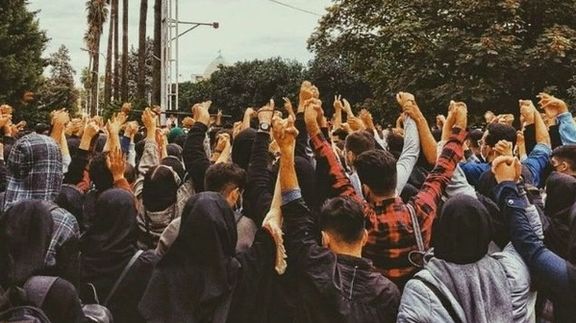
To bring universities under control in the aftermath of the crackdown on protests, authorities in Iran are suspending, exiling, and expelling students everywhere.
Reliable sources tell Iran International that since September, more than 400 students have faced suspensions, threats from disciplinary committees, or dormitory expulsions due to their refusal to adhere to hijab regulations, engaging in student activism, or expressing their political views on social media.
Many of these affected students, apprehensive about further repercussions, remain hesitant to disclose the suspension sentences imposed on them or share details of their harassment experiences.
A 20-year-old student from Tehran's Al-Zahra University did speak out recently, revealing that her university's disciplinary committee demanded a written apology for her actions. They sought her admission of wrongdoing and a pledge not to repeat her supposed mistake. Refusing to comply, she was subsequently suspended from studying for two terms and permanently barred from accessing university services. To make matters worse, she was abruptly evicted from her dormitory at ten in the evening.
Several students of Al-Zahra university without mandatory hijab in the capital Tehran
Another student from Tehran University of Art told Ham-Mihan newspaper she was expelled from her dormitory and banned from entering the campus. “When I asked [the university authorities] for a [disciplinary committee] ruling and citing existing regulations, pointing out the illegality of their action, they called my family,” she said.
“When my family also protested to the decision, they were threatened with my arrest,” she said, adding that her frightened family had to immediately set on road from their hometown to get to the dormitory and take her away to prevent her arrest.
A scuffle over hijab between a female student and a Harasat agent who pushes her down the stairs.
“We protested to a death sentence to show our sensitivity to human rights issues as students, but I was subjected to interrogation for this outside the university,” another student from Tehran’s Shahid Beheshti University, who described the environment on the campus as “nerve-wracking,” said.
In some cases, students say, pro-government professors have helped the disciplinary committees by taking photos of students who did not abide by hijab rules in their classes.
On Sunday the chancellor of the Islamic Azad University with campuses around the country said the university has hired 18,000 young and revolutionary Ph.D. students” to replace lecturers. “A revolutionary atmosphere will be made possible through employment of young lecturers.
The Islamic Azad University, a private university system which is nevertheless controlled by the government, has over 350 campuses across the country and over one million students.
The purge of academia which was dubbed as “homogenization” of the academia by hardliners is widely seen as another attempt at “Islamification of the academia” and “a second Cultural Revolution” similar to the Cultural Revolution following the establishment of the Islamic Republic in the early 1980s, during which universities remained closed for nearly three years.
Students have been defying stricter hijab regulations including wearing the maqna’e, a black veil with a stitched front coming down to the chest that is much more conservative than the headscarf, and long-shapeless tunics.
Last month the intelligence and security body known as ‘Harasat’ raided classrooms in several faculties of the Shahid Beheshti University of Tehran during the lectures and confiscated the student ID cards of those who were not wearing maqna’e.
Harasat, a body present in all universities and government organizations, often works in tandem with the intelligence ministry and other intelligence agencies to gather information against both students and academic staff and its reports are often very instrumental in admission to post-graduate schools and even government employment.
“The figures for the immigration of doctors are not publicized because they will be misused. Even the departure of one member of the medical community is a loss for us; because we need their expertise,” Dr Raeeszadeh said.
There are no reliable official figures concerning emigration.
Hossein Salami, the commander-in-chief of the Islamic Revolution Guard Corps (IRGC), on Tuesday dismissed the alarming reports about the mass emigration of doctors and nurses as “psychological warfare” and "negative propaganda and lies."
Earlier on December 7, Ali Fadavi, Acting IRGC Commander said the wave of migration by doctors and nurses is "planned by the enemy" and emphasized, "We are aware of each and every doctor and nurse who left. We know what hospital they go to and how much they get paid."
An Iranian parliament member, Masoud Pezeshkian, warned of an imminent shortage of healthcare professionals as a result of growing emigration. He emphasized that the primary reason for the exodus is financial.
A report released on Tuesday by Iran Open Data (IOD) revealed that the number of doctors who leave Iran to work in more prosperous countries outweighs the number of new doctors by 30% on an annual basis. Officials attribute the exodus to poor economic condition, but there is also a political component of lack of freedoms and persecution.
In July, it was reported that Iran's Association of Medical Academic Societies had warned against the recent forced retirement and dismissal of over 100 doctors from residency admissions boards.
Reformist Ham-Mihan newspaper reported in July that most of the doctors who were forced to retire or were removed from boards had signed statements supporting protests.
During the “Woman, Life, Freedom” protests last year, doctors and nurses condemned the use of ambulances for the transport of detainees by security forces, as well as their use of shotgun “birdshots” that blinded or injured hundreds of protesters.
Moreover, they stated that they could not comply with authorities' demands to deny services to women who defy hijab restrictions.
Screen grab from a video showing the police station in Rask. Dec. 15, 2023
An armed group believed to be the militant Sunni Jaish al-Adl launched a deadly attack on a police station in Rask, a small city in Iran’s Sistan-Baluchistan Province.
Iranian state media and Baluch groups reported that at least 12 police officers and several of the attackers were killed as gunfire continued for hours at the main police headquarters. Seven police officers were injured, with some in critical condition, media in Tehran reported.
The poverty-stricken province bordering Afghanistan and Pakistan has a large Sunni population from the Baluch ethnic group, that has been under pressure by Iran’s Shiite clerical rulers. It has long been the site of frequent clashes between security forces and Sunni militants, as well as drug smugglers.
The militant group Jaish al-Adl, which says it seeks greater rights and better living conditions for ethnic minority Baluchis, claimed responsibility for the attack. The group has launched several attacks in recent years on Iranian security forces in the province.
A police spokesman confirmed the attack and said several assailants and officers have been killed but insisted that the situation in Rask is under control. Jaish al-Adl in a statement said that its forces attacked the police headquarters at 2:00 am Friday.
Fars news agency affiliated with the IRGC published photos of 11 police officers initially announced as victims of the attack.
Baluch human rights monitoring groups reported large explosions and sounds of intense gunfights around the police headquarters. One group said that government surveillance drones were flying over Rask and added that fighting was continuing after five hours. Quoting local sources, the monitoring group said that there is a heavy presence of security forces in Rask and surrounding hills. Internet access is also affected.
The report said that three hours after the attack started, reinforcements that were coming to assist the police station were also targeted by militants.
In July, Jaish al-Adl attacked a police station in Zahedan, the provincial capital. It said that the particular police station was involved in the massacre of around 90 civilians on September 30, 2022, known as “Black Friday.” Worshippers who began anti-government protests after Friday prayers were met with gunfire by security forces. This was when protests were spreading elsewhere in the country following the death of Mahsa Amini in the hands of the hijab police.
Since Black Friday, the people of Zahedan have been protesting every Friday amid tight security and hundreds of arrests by security forces.
The outspoken Sunni cleric in Zahedan, Mowlavi Abolhamid, has repeatedly criticized the Shiite-led government in Iran, asking for tolerance for religious minorities, equal rights for women and an end to repression. During anti-government protests in 2022 and early 2023, Iranian Sunnis suffered more casualties than the Shiite majority, showing harsh methods by security forces in Sunni majority regions. A substantial number of Kurds living in Western Iran are also Sunnis, that are estimated to be 10-15 percent of Iran’s 85-million population.
Jailed Iranian Nobel Peace Prize laureate Narges Mohammadi
Jailed Iranian Nobel Peace Prize laureate Narges Mohammadi has written to Sweden’s prime minister, highlighting President Ebrahim Raisi’s role in mass executions in 1980s.
Mohammadi explained that Ebrahim Raisi had served on a "Death Panel" overseeing the execution of at least two thousand Iranian political prisoners during the 1980s. She stated, "A key member of the 1980s Death Panel, Ebrahim Raisi, now holds the presidency.” She also referred to Hamid Nouri, a former prison official who was arrested in Sweden and convicted for his role in the prison killing. Mohammadi wrote that “Justice cannot be silenced."
Hamid Nouri, 61, was arrested in Sweden in 2019, convicted of crimes against humanity and mass murder, and sentenced to life imprisonment in July 2022. Despite facing international war crime charges, Nouri denies wrongdoing. His appeal proceedings began in January, with a final verdict expected on December 19.
Mohammadi emphasized that "achieving democracy in Iran requires dismantling the oppressive Islamic Republic regime."
Tensions between Iran and Sweden rose with the Iranian government's announcement of the arrest of EU diplomat Johan Floderus, 33, held in Tehran's Evin prison and accused of spying for Israel, which can be punishable by death.
This mirrors a pattern seen during Hamid Nouri's 2022 investigation when Iran announced the imminent execution of Swedish-Iranian researcher Ahmadreza Jalali, also held hostage in Iran on vague security charges.
Majid Nouri, Hamid Nouri's son, said recently that he hopes "Sweden corrects their mistake" with a favorable appeal outcome for his father. He said, "My father's trial was a spectacle; justice was disregarded due to a lack of media attention."
Majid Nouri's comments come amid the backdrop of the Iranian regime's consistent pattern of unjust court proceedings and biased judgments.
Twenty-seven prisoners in Iran have been executed since last Friday, including a dozen killed on Wednesday alone.
It comes as the islamic Republic has already carried out hundreds of executions this year in a near-record killing spree.
Reports from Oslo-based Iran Human Rights Organization reveal that seven prisoners died in Karaj Central Prison on Wednesday. Among them were three prisoners sentenced to death for "intentional murder," three for drug-related offenses, and one for "moharebeh" (waging war against God).
Also on Wednesday, five prisoners were executed in jails in in Ahvaz, Sanandaj, Qom, Zahedan, Babol and Kermanshah, with charges ranging from "murder" to "drug-related offenses."
Iran's Human Rights Organization had previously reported on November 30 that the total number of executions carried out by the Islamic Republic in 2023 had already reached a staggering 707 individuals, an unprecedented figure in the past eight years.
UN Secretary-General Antonio Guterres raised the subject of Iran's alarming execution rate in his October report to the General Assembly on human rights violations. He expressed deep concern, revealing that at least 419 executions had occurred in the first seven months of the year alone, representing a shocking 30% increase compared to the same period in 2022. Over half of the individuals sentenced to death were found guilty of charges related to drug crimes.
Amnesty International reports that Iran consistently ranks second globally in terms of annual executions, surpassed only by China.
Iranian dissident rapper Toomaj Salehi was violently assaulted during his arrest two weeks ago, it has been revealed.
Witnesses have reported that on Salehi's arrival in prison, his eyes and face were bruised and swollen, and his arms had also sustained injuries.
Salehi, 33, was arrested on November 30, just under two weeks after being released on bail following a year in custody for his involvement in supporting the nationwide protests last year.
He was snatched off the street in Babol by security officers in plainclothes.
They are alleged to have assaulted him with the butts of their pistols and AK-47 rifles.
Salehi’s recent arrest was on charges of "disseminating falsehoods and inciting public opinion.", according to Mizan online, a website associated with Iran's Judiciary,
The singer rose to prominence for his protest songs addressing social issues and government injustices in Iran.
He had originally been arrested November 2022, as part of a broader crackdown on political dissent following the death of Mahsa Amini in morality police custody.
Salehi was held in jail for a year, including 252 days in solitary confinement.
Activist inside Iran and abroad have been actively campaigning for his release, with a number of figures in Western nations championinh his cause.