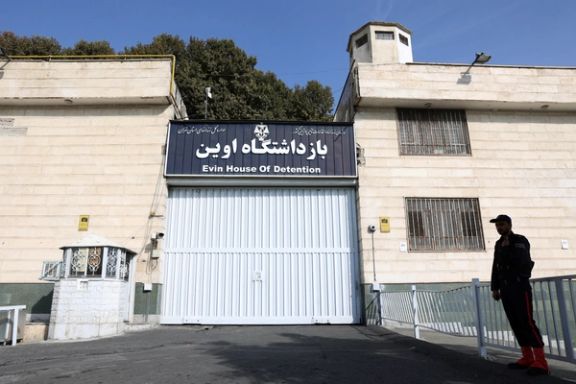
A view of the entrance of Evin prison in Tehran, October 17, 2022
The Campaign to Free Political Prisoners in Iran (CFPPI) says use of pharmacological torture against political prisoners has increased alarmingly in the past year.
The Canada-based non-profit has urged the international community to investigate this type of torture and deaths resulting from it in Iran. “The Islamic regime in Iran must be held accountable for its crimes against political prisoners,” a recent report by CFPPI, said.
Pharmacological torture is the use of psychoactive, psychotropic drugs or other types of drugs to punish, extract information, or to subdue prisoners into compliance by causing distress in the form of pain, anxiety, panic, psychological disturbances, immobilization, hallucination, paranoia, disorientation, and addiction without leaving obvious physical signs of violence.
CFPPI has said in its report that it conducted extensive investigations that indicated an alarming increase in the use of pharmacological torture in Iran in the past five year and particularly since Women, Life, Freedom protests that began in late September 2022. Their findings draw on testimonies of those arrested during the protests of 2022-2023 as well as on the accounts of former political prisoners.
According to CFPPI's report, the regime has intentionally and systematically subjected more political prisoners to pharmacological torture by sending detainees to mental hospitals and forcibly administering anti-psychotic drugs at multiple prisons across the country, as well as by mixing drugs into their food and drinks.
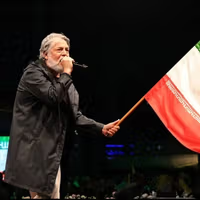
Iranian rapper Saman Seydi (Yasin)
“Whereas formerly, prison guards would offer sedatives to prisoners, which many of the younger and newer prisoners voluntarily accepted to ease their experience, new reports suggest that since September 2022 the practice has changed to violent and coercive administering of unwanted drugs,” the report said.
One of the victims interviewed for the report, a 27-year-old woman who said she had been raped several times during her detention, told CFPPI that she was forced into taking unidentified pills which had a profound impact on her, leading to psychotic episodes. After her release from prison, she attempted to take her own life and lost one of her kidneys.
Prisoners say they have also noted serious pains and aches in the absence of the drugs.
Dissident rapper Saman Seydi (Yasin) is among political prisoners who have spoken up about their tortures including administration of unidentified pills and injections at a very high cost. He has been sentenced to death and is still in prison.
Yasin was held at a mental hospital on the orders of the notorious judge Abolghasem Salavati for four days as punishment for smuggling out an audio file from Tehran’s Evin Prison in which he described tortures including being subjected to mock execution.
At the mental hospital where he was tied to the bed, security forces beat him for refusing to allow them to inject him with an unknown substance. Yasin claims he fell unconscious for 24 hours after the injection and has been having problems with his eyesight and balance since then.
Yasin’s torturers, he says, wanted to force him to “confess” to possession and use of a firearm during last year’s protests.
In several other cases in the past year, detainees including young protesters have died soon after their release from prison under suspicious circumstances.
Pressure on victims’ families to accept “suicide”, “sudden death”, or “overdose” as cause of death of individuals with no prior record of major health problems, depression or addiction has raised suspicions that the deaths may have resulted from pharmacological torture.
“Pharmacological torture is extremely distressing and punitive as it causes severe physical pain, harmful and painful physiological changes, confusion, perceptual abnormalities, fearfulness and anxiety, lethargy, and loss of personal agency,” William Hopkins, Consultant Psychiatrist at Freedom from Torture who has worked to rehabilitate survivors of pharmacological torture from various countries is quoted by the report as saying.
Several followers of the Baha’i faith targeted by the Islamic Republic
Followers of the Baha’i faith continue to be systematically persecuted by the Iranian authorities, in cases uncovered by Iran International.
One adherent of the religion, Nahaleh Shahidi, is still in jail after being apprehended in April by security forces at the Kerman railway station and subsequently transferred to Kerman prison.
He is reportedly facing charges of "propaganda against the system" and "formation of groups with the intention of disrupting national security."
He was informed of the accusations months ago, but no formal indictment has been issued. A source close to Shahidi’s family says the prosecutor's representative has allegedly halted the progression of the case on a number of pretexts.
The source said that Shahidi's detention is routinely extended each month, without any indication of a trial or release with bail in sight.
On Thursday, legal proceedings were initiated against five Baha'i residents from Ghaemshahr in northern Iran. The defendants learned about the prosecution through text messages on their phones.
A source close to the families of the residents expressed concern, saying, "It seems that security forces are attempting to fabricate cases against the individuals, as there is still no news about the charges and reasons for filing a case against them."
Informal sources estimate that over 300,000 Baha'i citizens reside in Iran. However, the Constitution of the Islamic Republic officially recognizes only Islam, Christianity, Judaism, and Zoroastrianism. Baha'is constitute the largest non-Muslim religious minority in Iran and have been systematically targeted for persecution since the 1979 revolution, facing arbitrary detentions, discrimination, and restrictions on religious practices.
A photo from Roohollah Firooznam’s file in Canada's Federal Court taken in Italy (undated)
An Iranian businessman living in Canada is facing deportation for alleged complicity in crimes against humanity after supplying surveillance cameras to the Tehran regime.
Roohollah Firooznam ran a business for 12 years which provided the equipment to Iran's intelligence services, including the IRGC.
The cameras were used to monitor detainees in prisons where torture was used, and to watch political opponents, the Global News reported.
Senior members of the intelligence ministry were directors of Firooznam’s company, while a former vice-president of Iran was a shareholder. Firooznam's business partner in a separate venture was a high-ranking Islamic Revolutionary Guard Corps commander who had previously spent a decade guarding Iran's Supreme Leader Ali Khamenei.
Despite allegations of involvement with Iran's regime, Firooznam managed to obtain a travel visa from the Canadian embassy in Turkey in 2018, ostensibly for visiting tourist attractions. Upon arriving in Toronto, he engaged the services of an immigration lawyer and applied for refugee status.
Earlier this year, an Ontario judge sanctioned his deportation, citing his complicity in Iran's crimes against humanity.
Firooznam, a former member of the IRGC naval branch turned CEO, claimed ignorance of the regime's abuses until 2017. He claimed that he took action against the regime upon discovering that his cameras were used against anti-government opposition.
However, the Canadian Refugee Board rejected his refugee claim in 2021, asserting his complicity in Iran's crimes against humanity. In response, Firooznam filed a new case in the Federal Court of Appeal in November 2023, seeking expedited processing of his immigration application.
An Iranian activist who has campaigned for justice for victims of the Islamic Republic since the death of his son in a protest has been given an international human rights award.
Manouchehr Bakhtiari lost his 27-year-old son Pouya during the November 2019 protests in Iran. Pouya was shot and killed by security forces, according to the family.
Bakhtiari has now been awarded the 2023 Human Rights Prize of the International Center for Human Rights in Canada (ICHR).
He has been a steadfast advocate for accountability against the regime since Pouya’s death, demanding justice for his son and many other protestors allegedly killed by government agents and IRGC officers during political demonstrations.
The ICHR praised Bakhtiari for his resilience in the fight for freedom, emphasizing his inspirational impact on thousands in Iran aspiring for a better future.
The authorities have subjected Bakhtiari to harsh measures in response to his campaign for justice. He was detained at his home Tehran in 2021 and beaten by members of the security forces. A subsequent sentence from the Revolutionary Court included two years and six months of internal exile, a two-year travel ban, and an initial three years and six months prison term. In November, Bakhtiari received an additional six-month prison sentence for "insulting the leader," as confirmed by the Qazvin Revolutionary Court.
The award ceremony, held in Toronto, featured Canadian MP Mellisa Lantsman and ICHR Director Ardeshir Zarezadeh presenting the prize to Bahman Sadeghi Nour, a relative of the Bakhtiari family. The ICHR traditionally bestows its annual award on individuals who risk their lives for human rights, marking the occasion of Universal Human Rights Day.
Houthi military helicopter flies over the Galaxy Leader cargo ship in the Red Sea in this photo released November 20, 2023.
The US government has once again blamed Iran for Houthi drone and missile attacks on ships in the Red Sea, according to a senior White House official.
Reuters reported Thursday that deputy national security adviser Jon Finer has said that the Biden administration thinks the IRGC is behind the attacks, helping with planning and action.
"We believe that they are involved in the conduct of these attacks, the planning of them, the execution of them, the authorization of them and ultimately they support them," he told the Aspen Security Forum.
This is the first time the IRGC is directly linked to Houthi operations by a US official.
US National Security spokesman John Kirby took Iran to task on Wednesday for destabilizing the region by providing financial and military assistance to extremist militant groups, such as Yemeni Houthis.
“We know that the Houthis are supported by Iran, not just politically and philosophically but, of course, with weapon systems,” he stressed.
White House national security spokesperson John Kirby during a press briefing at the White House in Washington, December 7, 2023
The Biden administration has been trying to avoid conflict with Iran ever since Hamas forces attacked Israel, fearing that the war on Gaza could expand and set the whole region ablaze.
On Wednesday, the USS Mason intercepted and shot down a drone launched from a Houthi-controlled area. Three days earlier, USS Carney shot down three drones after it received distress calls from vessels that had come under attack from Iran-backed Houthis in the Red Sea.
The Houthis say their attacks are in response to the Israeli onslaught on Gaza, which began after Hamas rampaged Israel on 7 October, killing a thousand people.
On Thursday, the US treasury sanctioned 13 people and entities over claims they provided “tens of millions of dollars” in Iran-linked funds to Houthi rebels in Yemen.
“The Houthis continue to receive funding and support from Iran,” the under secretary of the Treasury for terrorism Brian Nelson said. “Treasury will continue to disrupt the financial facilitation and procurement networks that enable these destabilizing activities.”
Iran of course denies involvement in the missile and drone attacks by the Houthis on Israel and vessels in the Red Sea. The official line from the regime spokespersons is that militant groups linked with Tehran act independently.
Earlier in the week, a senior adviser to Ali Khamenei said the same about Hamas – that the group had the means necessary to plan and execute operations, notwithstanding the fact, he suggested, that Iran would help the group militarily if it had access to Gaza Strip.
Asked about the future of the conflict and the hopes for a two state solution between Israel and the Palestinians, Kamal Kharrazi told Aljazeera, “this is their own business, of course. We have our own positions but we’re not going to dictate our positions to others.”
The former foreign minister of the Islamic Republic reiterated, however, that the regime didn’t “believe in” a two state solution. “Israel itself is not supporting this plan… and it’s not practical,” Kharrazi said, “We believe the final solution must be one state, composed of Muslims, Christians and Jews.”
The Islamic Republic has for long maintained this ambiguous, sit-on-the-fence politics, sending mixed messages on their intentions and their actions. In recent years, this has been largely helped by the Biden administration’s leniency, which many in Washington say has emboldened the regime and its proxies in the region.
“It [is] President Biden who refuses to respond to the recent attacks on American troops by Iran in Syria, in Iraq, in the Red Sea,” Senator John Kennedy told Fox News Thursday.
“The sad reality is that our enemies - China, Russia, North Korea, Iran - are not scared of President Biden. And for good reason," he said. “The Biden administration would rather debate whether man can breastfeed than protect the interests of this country.”
Pro-Iran protesters attacking US embassy in Baghdad In Dec. 2019
A US military official told Iran International that on Friday, a multi-rocket attack was launched at US forces in the vicinity of Union III and the Baghdad Embassy Complex.
The official also said that no casualties and no damage to infrastructure was reported. Earlier, Al Mayadeen television affiliated with the Iranian government reported attacks on Baghdad's Green Zone, where the US embassy is located.
Explosions were heard near the US embassy in Baghdad's heavily fortified Green Zone early on Friday, according to social media videos verified by Reuters.
Embassy spokespeople did not immediately respond to requests for comment when contacted by Reuters and there has been no official US announcement yet. Social media reports also said sirens calling on people to "duck and cover" were activated.
It was not immediately clear whether the embassy's air defense systems were activated or whether there was damage.
US forces at military bases in Iraq and Syria have faced more than 70 attacks since mid-October claimed by an Iran-backed umbrella organization of Iraqi Shi'ite Muslim armed groups, though diplomatic missions have been spared. The US military has retaliated against militant targets on a few occasions.
Yemen’s Houthis, backed by Tehran, have also launched attacks on commercial shipping and US naval vessels in the Red Sea in the past two weeks. The US this week accused Iran of involvement in assisting the Houthi drone and missile attacks.