• العربية
  • فارسی
Brand
  • Iran Insight
  • Politics
  • Economy
  • Analysis
  • Special Report
  • Opinion
  • Podcast
  • Iran Insight
  • Politics
  • Economy
  • Analysis
  • Special Report
  • Opinion
  • Podcast
  • Theme
  • Language
    • العربية
    • فارسی
  • Iran Insight
  • Politics
  • Economy
  • Analysis
  • Special Report
  • Opinion
  • Podcast
All rights reserved for Volant Media UK Limited
volant media logo

Ahmadinejad Under Attack By Old Friends, New Rivals
Iran International Newsroom
Dec 3, 2023, 09:11 GMT+0Updated: 11:25 GMT+0
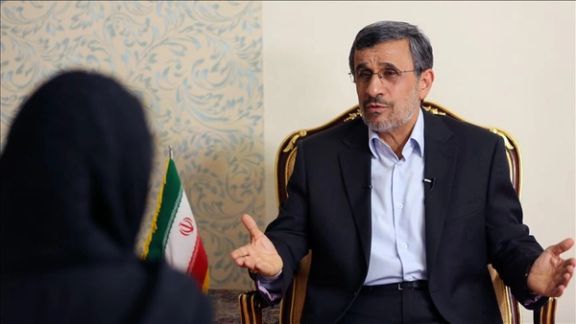
Former President Mahmoud Ahmadinejad

Iran's hardliners have recently made comments against former President Mahmoud Ahmadinejad, seemingly aiming to tarnish his image.

While Ahmadinejad faced considerable criticism for his populist policies during his presidency from 2005 to 2013, he stands out as one of the few politicians in the Islamic Republic who maintained popularity with a segment of the population during his provincial visits after leaving office.

Abdolreza Davari, one of Ahmadinejad's top aides during his presidency, recently said that "Ahmadinejad is under the illusion that the Islamic Republic is going to collapse." Davari claimed that Ahmadinejad’s apparent differences with the regime stem from the fact that he has been ostracized. He added that "After Supreme Leader Ali Khamenei cautioned him not to run for the 2017 Presidential elections, Ahmadinejad realized that he can no longer return to power."

At the time, Ahmadinejad had said that if Khamenei was against his decision to run for the presidency, he would have said it with a loudspeaker [meaning during a broadcast]. Khamenei made his opposition to Ahmadinejad’s presidential run public during a meeting with other politicians and added that "Well, this has been now said on a loudspeaker!"

Speaking about Ahmadinejad's silence about the Gaza war, Davari said "Ahmadinejad has now realized that he cannot return to power as long as the current regime and political structure are in place in Iran,” implying that the former president had no reason to support Tehran’s position in the Gaza war.

Former President Mahmoud Ahmadinejad (right) and his aide Abdolreza Davari   (undated)
100%
Former President Mahmoud Ahmadinejad (right) and his aide Abdolreza Davari

He pointed out that except Ahmadinejad all political factions and politicians including former reformist President Mohammad Khatami have voiced support for Hamas and condemned Israel. They all echoed Khamenei’s position while perhaps Ahmadinejad had a different opinion.

He further accused Ahmadinejad of believing that "the Islamic Republic cannot survive, and he can be the regime's alternative when it collapses."

Meanwhile, In a video that surfaced on social media, vigilante leader Hossein Allahkaram said that because of Ahmadinejad's poor performance during his presidency Iran nearly lost Syria as the "Resistance's most important base” in the region. Resistance is the Islamic Republic's jargon for anti-US forces in Iran, Syria, Iraq, Lebanon and Yemen. 

Another close aide of Ahmadinejad, Mehdi Kalhor, also made negative comments to Asr Iran news website about Ahmadinejad’s populism and how his aides fanned his ambitions.

Kalhor accused Ahmadinejad of disclosing family information about his opponent, Mir Hossein Mousavi in the 2009 presidential campaign. Kolhar alleged that Ahmadinejad was privy to Mousavi’s family life because of his close ties with him and his family. Mousavi was one of Ahmadinejad's teachers when he was a student. Later they became family friends. He even admitted during the televised debate that he was one of Mousavi's students.

Kolhar admitted, however, that what Ahmadinejad disclosed about Mousavi and his wife was insignificant and only showed that Ahmadinejad was an opportunist who would use information about a friend for political gain.

Other politicians and media, noted that some of Ahmadinejad's former allies are now working with hardliner Paydari Party Leader Sadeq Mahsouli and Parviz Fattah, another powerful politician close to Khamenei’s office. Mahsouli and Fattah were Ahmadinejad's aids and cabinet ministers during his presidency.

Recently, conservative heavyweight Mohammad Reza Bahonar who is a candidate for the March parliamentary elections had said that Ahmadinejad is planning to present a list of candidates. The mudslinging against Ahmadinejad by conservatives, who are likely to be the only players in the election, could be an attempt to tarnish his image among those who are likely to vote for the candidates he nominates.



Most Viewed

State media slam Araghchi's Hormuz tweet, say it let Trump claim victory
1

State media slam Araghchi's Hormuz tweet, say it let Trump claim victory

2
OPINION

The Hormuz get out of jail card turned to a grave

3

Iran International says it won’t be silenced after London arson attack

4
INSIGHT

How Tehran bends its own red lines to boost state rallies

5

Iran halts petrochemical exports to supply domestic market

Banner
Banner

Spotlight

  • Too early to tell who is winning Iran war, experts say
    PODCAST

    Too early to tell who is winning Iran war, experts say

  • How Tehran bends its own red lines to boost state rallies
    INSIGHT

    How Tehran bends its own red lines to boost state rallies

  • Iran blackout cripples freelancer, small business incomes
    VOICES FROM IRAN

    Iran blackout cripples freelancer, small business incomes

  • Ideology may be fading in Iran, but not in Kashmir's ‘Mini Iran'
    INSIGHT

    Ideology may be fading in Iran, but not in Kashmir's ‘Mini Iran'

  • US blockade enters murky phase as tankers spoof signals and buyers hesitate
    ANALYSIS

    US blockade enters murky phase as tankers spoof signals and buyers hesitate

  • Why the $100 billion Hormuz toll revenue is a myth
    ANALYSIS

    Why the $100 billion Hormuz toll revenue is a myth

•
•
•

More Stories

US Navy 'Intercepts' Iranian Drone Over The Persian Gulf

Dec 3, 2023, 07:46 GMT+0

The US Navy in the Persian Gulf “intercepted” an Iranian drone “operating in an unsafe and unprofessional” manner, CENTCOM reported on Saturday.

Announcing the incident on X, the US military did not provide more detail except a photo taken from a US aircraft showing an unmanned aerial aircraft flying above what appeared to be an aircraft carrier. It did not say if the drone had left after it was intercepted, or what that term exactly meant.

Iranian military officials boasted earlier that their drones were closely following the US naval strike group led by the aircraft carrier Dwight D Eisenhower that entered the Persian Gulf earlier in the week. The naval group was first sent to the eastern Mediterranean after war broke out between Israel and Hamas following the October 7 attack on Israel that killed more than 1,000 civilians and the taking of more than 200 hostages by Hamas.

Despite daily statements in support of Hamas, Iran has avoided direct involvement in the war, but its proxy forces in the region have attacked US forces dozens of times since mid-October.

Alireza Tangsiri, commander of the IRGC navy said on Friday that warships belonging to foreign countries were in the Persian Gulf region only to “foment tensions”.

Tangsiri claimed earlier in the week that his forces had sent drones to harass the operations of the USS Dwight D. Eisenhower aircraft carrier and its strike group. The incident was confirmed and described as "unsafe, unprofessional and irresponsible" in a statement issued Wednesday by US Naval Forces Central Command chief Vice Admiral Brad Cooper.

German Human Rights Official Who Snubbed Iranian Dissident Is Pro-Hijab

Dec 2, 2023, 23:47 GMT+0
•
Benjamin Weinthal

The German human rights commissioner who rebuffed Iranian female dissidents on Thursday, reportedly views the hijab as a form of emancipation for women.

The Iranian dissident, Masih Alinejad, pulled the plug on a meeting with the federal human rights commissioner, Luise Amtsberg, because Amtsberg did not wish to publicize the substance of the discussion.

The German magazine Stern reported in 2017 that the Green party politician had said she learned the head scarf can be a sign of emancipation, adding “We forget that sometimes.”

Amtsberg wrote her master’s thesis on “Feminism in Islam: Using the example of the Palestinian women’s movement.”

Lawdan Bazargan, a California-based Iranian-American political and human rights activist, told Iran International, “The hijab is an ideology, and like any ideological belief, it is linked to 'interests' and 'power.’ The hijab serves a dual function; it privileges veiled women in Islamic societies while also helping to reproduce the system's inherent patriarchy."

Bazargan, who is currently campaigning to secure the dismissal of Oberlin College’s Mohammad Jafar Mahallati, Iran’s former ambassador to the UN, added, “Ultimately, the hijab humiliates and disempowers women in society. It is shameful for a European woman, born and raised in a democratic country with liberal values, to idolize a symbol that oppresses millions of women, acting like a chain around their necks, suffocating them.”

Alinejad has long campaigned against the hijab. The Islamic Republic of Iran imposed the mandatory hijab on women after the 1979 revolution in 1981.

Iran International reported last week that the clerical regime has impounded the cars of people who violate the rules of the mandatory Hijab. In 2022, after dozens of Iranian women unveiled in public and sent their videos to Alinejad in New York, the clerical regime said women can be sentenced up to 10 years in jail for sending Alinjead the footage.

The outrage over Amtsberg’s attempt to silence the Iranian dissidents in Berlin has shined a new spotlight on the Green party’s overly cordial relationship with the Islamic Republic.

Amtsberg’s Green party has a long tradition of holding public meetings with Iranian regime officials and politicians who have denied the Holocaust, defended the use of stoning for adultery, and engaged in killing Iranians.

Bundestag Vice President Claudia Roth (Green Party), Dagmar Wöhrl (Christian Social Union party) in Tehran  (undated)
100%
Bundestag Vice President Claudia Roth (Green Party), Dagmar Wöhrl (Christian Social Union party) in Tehran

In 2019, Germany’s best-selling newspaper, Bild, published a series of news articles and an editorial titled “Shame on the Bundestag” that exposed the then-Green party Bundestag vice president Claudia Roth’s enthusiastic greeting of the former speaker of the Iran’s ersatz parliament, Ali Larijani.

Larijani defended former Iranian president Mahmoud Ahmadinejad’s denial of the Holocaust at the 2009 Munich Security Conference.

Roth is currently Germany’s cultural minister and, in 2010, met in Tehran with the former speaker's brother, Mohammad-Javad Larijani, who defended the stoning of people who committed adultery. Mohammad-Javad Larijani served as the head of the Iranian Human Rights Council. A year before Roth’s meeting, he denied the Holocaust at a German foreign ministry-sponsored event in Berlin held close to the Holocaust memorial.

Roth courted Manouchehr Mottaki who, while foreign minister, delivered a key speech at Tehran’s 2006 Holocaust denial conference.

The largely pro-Iran politician, Roth, also high-fived then-Iran ambassador to Germany, Reza Sheikh Attar, at the 2013 Munich Security Conference. Iranian Kurdish dissidents accused Attar of carrying out a massacre of Kurds during his tenure as governor of Kurdistan and West Azerbaijan provinces between 1980-1985.

The German foreign minister, Annalena Baerbock, has also faced intense criticism from German opposition politicians and Iranian dissidents for her dovish posture toward Tehran. Baerbock refuses to sanction the IRGC as a terrorist organization. She claims to practice a “feminist foreign policy” but her inaction toward the IRGC—a US-designated terrorist organization dedicated to enforcing the mandatory hijab—has sparked criticism from Alinejad and other Iranian dissidents.


Israeli Airstrike Claims Lives Of Two IRGC Generals In Syria

Dec 2, 2023, 23:27 GMT+0

In the latest Israeli airstrike targeting Syria, Brigadier Generals Panah Taghizadeh and Mohammad-Ali Ataei (Shoorcheh) of the Islamic Revolutionary Guard Corps (IRGC) were killed.

The IRGC confirmed their deaths, stating that the generals were on an "advisory" mission in Syria. The Guards' Sepah News website reported, "Mohammed Ali Ataei Shoorcheh and Panah Taghizadeh... were martyred by the Zionist usurper enemy while conducting an advisory mission in the Syrian Islamic resistance front," without providing further details.

Israeli airstrikes hit several areas on the outskirts of Damascus early Saturday, causing "material losses," according to Syrian state media. The strikes targeted the southern Damascus suburb of Sayyida Zeinab, where Hezbollah-affiliated forces operate. The Syrian Observatory for Human Rights reported two Syrian citizens and two foreigners killed, with five others wounded.

Israel has frequently conducted airstrikes in Syria since the civil war began in 2011, focusing on Iran-backed forces, Hezbollah fighters, and Syrian army positions. The recent surge in attacks aligns with the Israel-Hamas conflict that started in October.

The incident is expected to heighten tensions between Israel and Iran, a key supporter of the Palestinian group Hamas. Iran has warned of the conflict's potential spread to other regional areas. Israel remains concerned about Iran's military presence in Syria and is committed to preventing Iranian entrenchment along its northern border.

During the ongoing Israel-Hamas conflict, Israel has targeted Syria, impacting international airports in Damascus and Aleppo for over a month. Iran has played a significant role in supporting Syrian President Bashar al-Assad throughout the 12-year civil war, deploying fighters to tip the balance in Assad's favor. Despite Tehran maintaining a military advisory role, numerous Iranian Revolutionary Guard members have lost their lives in the Syrian conflict.


German MP Urgently Calls For Release Of Detained Iranian Rapper

Dec 2, 2023, 21:57 GMT+0

Ye-One Rhie, a German lawmaker and political sponsor of Iranian rapper Toomaj Salehi, has issued an urgent call for his release after his second arrest.

In a conversation with Iran International, Rhie expressed deep concern about Salehi's well-being, emphasizing the lack of information about his whereabouts.

Toomaj Salehi, 33, was apprehended by plainclothes individuals on a street in Babol, northern Iran, on Thursday. He was reportedly subjected to severe physical abuse during the arrest, including beatings with the butts of AK-47 rifles and pistols, as reported on his social media page.

Rhie underscored the Iranian regime's fear of Salehi's message, stating, “The fact that he was taken again shows the Iranian regime is very, very afraid of him and what kind of message he's sending to all those people who are unhappy, who are not satisfied with how the country is going, how Iran is developing.”

Salehi had previously spent over a year in prison, with 252 days in solitary confinement, before being released on bail on November 18th. Following his re-arrest, social media erupted with a trending campaign, garnering over 75,000 mentions of Toomaj Salehi on various platforms.

Rhie concluded by demanding answers from the Iranian authorities, stating, “I am very positive that Salehi is such a man that the Iranian regime will not be able to break him at all and not to break his spirits. I'm demanding answers as I wrote to the ambassador of the Islamic Republic of Iran in Berlin, to tell me where he is.”

Salehi gained prominence for his protest songs addressing social issues and government injustices in Iran. His initial arrest in October 2022 was part of a broader crackdown on political opponents of the regime. Rhie urged the dropping of all accusations, sentences, and the release of Salehi and other political prisoners, emphasizing the injustice of their detention.

Iranian Tea Importer Faces Allegations Of Currency Misuse

Dec 2, 2023, 19:20 GMT+0

The head of Iran’s Inspection Organization has disclosed that a prominent tea importer has come under scrutiny for questionable financial practices.

The company, handling the majority of the country's tea imports, reportedly received a staggering $3.37 billion in foreign currency at discounted government rate for tea and machinery imports from 2019 to 2022. However, it has allegedly sold $1.4 billion of the currency on the free market at a higher rate.

Zabihollah Khodayian highlighted the company's alleged transgressions, emphasizing its violation of premium-grade tea orders. However, he did not disclose the name of the company.

“Despite registering a $14 per kilogram order for premium Darjeeling tea from India, the company purportedly imported significantly cheaper Kenyan tea and bought Iranian grade-two tea at a value of around $2 per kilogram,” added Khodayian.

The government, controlling the economy and foreign currencies allocates cheaper foreign currency to facilitate crucial imports.

The Central Bank of Iran operates the NIMA currency scheme to make imports more affordable and control inflation. The system allows exporters to sell foreign currency at a reduced rate and permits importers to purchase currency at the same lower rate to finance their transactions abroad.

However, the official government rate of around 370,000 rials to the dollar in the NIMA scheme contrasts sharply with the free market rate of about 510,000 rials. This disparity has led to corrupt practices, where well-connected entities exploit the lower rate, obtaining cheap dollars and diverting them for purposes other than intended imports.

The Iranian government, grappling with economic complexities exacerbated by sanctions, regularly intervenes in the currency market to stabilize the beleaguered rial. Despite these efforts, the challenges persist, and instances of currency misuse continue to pose serious concerns.