• العربية
  • فارسی
Brand
  • Iran Insight
  • Politics
  • Economy
  • Analysis
  • Special Report
  • Opinion
  • Podcast
  • Iran Insight
  • Politics
  • Economy
  • Analysis
  • Special Report
  • Opinion
  • Podcast
  • Theme
  • Language
    • العربية
    • فارسی
  • Iran Insight
  • Politics
  • Economy
  • Analysis
  • Special Report
  • Opinion
  • Podcast
All rights reserved for Volant Media UK Limited
volant media logo

US Slaps New Sanctions On Iran’s Arms Supply Network
Iran International Newsroom
Nov 30, 2023, 12:22 GMT+0Updated: 11:26 GMT+0
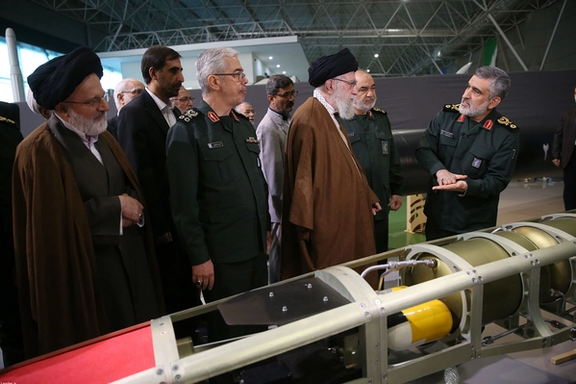
Iran’s Supreme Leader Ali Khamenei during a visit to an exhibition of IRGC’s new weapons

The US Treasury Department has announced sanctions on 21 Iranian and foreign nationals and entities for involvement in financial networks helping Iran's military.

On Wednesday, the Treasury said those sanctioned helped generate funds for Iran’s Ministry of Defense and Armed Forces Logistics, the Iranian Armed Forces General Staff (AFGS), and the Islamic Revolutionary Guard Corps-Qods Force (IRGC-QF), the extraterritorial wing of the IRGC.

"Iran generates the equivalent of billions of dollars via commodity sales to fund its destabilizing regional activities and support of multiple regional proxy groups, including Hamas and Hezbollah," the Treasury said, referring to the Islamist Palestinian militant group and the Lebanese Shiite armed force and political party.

The Treasury said the Iranian military used "intricate networks of foreign-based front companies and brokers to enable these illicit commercial activities."

US Department of State Spokesperson Matthew Miller noted that Iranian military entities and their business partners enable these sales and exploit the international financial system to recoup the revenue, further fueling the conflict in Israel - which broke out on October 7 following a surprise invasion by Hamas - and spreading terror throughout the Middle East. “The United States will continue to disrupt Iran’s funding support for terrorists.”

The Iranian regime has become the focus of attention in the West after the terror attack on Israel by Hamas which has led to the bloodiest conflict in Gaza since the militant group took control in 2007.

Although voicing unequivocal support for Hamas, Tehran has been denying any role in the bloody invasion that killed around 1,400 Israelis. Iran’s strategy since the 1980s, when it helped establish Hezbollah, has been to use militant and violent groups to build influence around the world and target the interests of Israel and Western countries.

The new round of sanctions includes Iran-based companies Sepehr Energy Jahan Nama Pars Company and Pishro Tejarat Sana Company as well as Iranian citizens Majid A’zami, Elyas Niroomand Toomaj and Abdoljavad Alavi. Treasury also put sanctions on two Hong Kong-based firms, accusing Puyuan Trade Co Limited of brokering sales of tens of millions of condensate, a form of ultralight crude oil, to HK Sihang Haochen Trading Limited.

Also sanctioned were several United Arab Emirates-based firms. These included Unique Performance General Trading LLC, to which Sepehr Energy agreed to sell Iranian light crude for delivery in China, and OPG Global General Trading Co LLC, which offered to sell crude and gasoline on Sepehr Energy's behalf to Persian Gulf customers for onward shipment to Europe, the Treasury said.

In addition, Washington sanctioned Dubai-based JEP Petrochemical Trading LLC, which paid Dubai-based Future Energy Trading LLC the equivalent of more than $400 million to buy Iranian oil from Sepehr Energy.

Three other companies targeted were Dubai-based A Three Energy FZE along with Sharjah-based brokers Tetis Global FZE and Royal Shell Goods Wholesalers LLC, which Sepehr Energy used to enable sales of Iranian commodities to foreign buyers.

After the US, Dubai has one of the largest populations of Iranians outside Iran, both pro and anti regime.

In addition, the Treasury said it had imposed sanctions on four companies and three individuals for supporting illicit financial networks on behalf of the IRGC-QF.

It named the companies as UAE-based Transmart DMCC and Solise Energy (FZE) and as Singapore-based MSE Overseas PTE Ltd and Sealink Overseas PTE Ltd and the individuals as Zabi Vahap, Adelina Kuliyeva and Mehboob Thachankandy Palikandy.

US officials have attributed the prevention of specific weapons parts sales to Iran to a controversial surveillance authority, Section 702 of the Foreign Intelligence Surveillance Act, a tool that is set to expire at the end of the year.

The surveillance effort successfully thwarted multiple shipments of advanced weapons components intended for Iran via land, air, and sea as the CIA and various intelligence agencies leveraged data collected through monitoring the electronic communications of foreign weapons manufacturers. Section 702 allows intelligence agencies to collect and analyze communications such as emails and text messages of foreigners living abroad.

There is a hot debate in Washington over whether to reauthorize the tool or reform it, with the Biden administration arguing that it is crucial to national security and Section 702 will lose much of its usefulness if more guardrails are put on it.

US officials say Section 702 was critical to stopping the weapons sales in the case of Iran’s advanced weapons program. They said they used other spying activities to identify what US-made supplies the Iranians needed, and then plugged the names of those components and their manufacturers into the 702 databases.

Despite US restrictive measures, more and more controls are falling away as Iran is eying even further market for its cheap drones and missiles. Last month, the UN sent letters to countries announcing the end of bans on Iran's missile program, removing barriers for the clerical regime to sell dangerous technologies. Iran, historically allied with Russia, faces accusations of supplying lethal drones to Moscow for use in Ukraine, though it asserts its neutrality in the conflict. Iran is now free to sell its drones, ballistic missiles, and related long-range strike technologies to its anti-Western partners and clients and can also procure technology for further development.


Most Viewed

Ghalibaf defends Iran-US talks amid hardline backlash
1
INSIGHT

Ghalibaf defends Iran-US talks amid hardline backlash

2
VOICES FROM IRAN

Bread shortages, soaring prices strain households in Iran, residents say

3
ANALYSIS

From instability to influence: Pakistan’s pivotal role in US-Iran diplomacy

4
ANALYSIS

100 days on: why Iran’s January protests spread across social classes

5

War-hit homeowners feel abandoned as Iran’s reconstruction aid fades

Banner
Banner

Spotlight

  • Iran crackdown reaches cemeteries as graves of slain protesters defaced
    EXCLUSIVE

    Iran crackdown reaches cemeteries as graves of slain protesters defaced

  • Iran diplomacy wobbles as factions compete to avoid looking soft on US
    INSIGHT

    Iran diplomacy wobbles as factions compete to avoid looking soft on US

  • The politics of pink: how Iran uses cuteness to rebrand violence
    ANALYSIS

    The politics of pink: how Iran uses cuteness to rebrand violence

  • Bread shortages, soaring prices strain households in Iran, residents say
    VOICES FROM IRAN

    Bread shortages, soaring prices strain households in Iran, residents say

  • 100 days on: the anatomy of Iran’s January crackdown
    INSIGHT

    100 days on: the anatomy of Iran’s January crackdown

  • Ghalibaf defends Iran-US talks amid hardline backlash
    INSIGHT

    Ghalibaf defends Iran-US talks amid hardline backlash

•
•
•

More Stories

Iran Claims Military Self-Sufficiency Amidst Concerns Over Arms Exports

Nov 30, 2023, 11:40 GMT+0

Despite Western arms embargoes, an Iranian army commander says Tehran has achieved self-sufficiency to export military equipment amidst global sanctions.

The announcement by Rear Admiral Habibollah Sayyari, the Coordinating Deputy of the Islamic Republic's Army shows the disregard for arms embargoes imposed by the United States and the European Union, the military chief saying on Thursday that "the capabilities of the Islamic Republic of Iran, especially in the field of military equipment, have grown and developed."

The United Nations Security Council's Resolution 2231 enforced a conventional arms embargo on Iran which expired in October 2020. Despite former President Donald Trump's efforts to extend the embargo after the US withdrawal from the nuclear deal in 2018, the Security Council rejected the proposal, allowing Iran to resume arms exports, but a full embargo from the EU, from 2007, remains in place.

The expiration of UN sanctions on Iran's missile program in October has also raised concerns about the accelerated proliferation of potentially dangerous weapons. Iran is now free to sell its drones, ballistic missiles, and related long-range strike technologies to its anti-Western partners and clients and can also procure technology for further development.

The lifting of sanctions provides Iran with the opportunity to generate revenue from missile sales, potentially using the profits to finance militant and terror proxies in the Middle East.


US Navy Shoots Down Iranian Drone Launched From Houthi-Controlled Yemen

Nov 30, 2023, 08:33 GMT+0

The United States intercepted and shot down an Iranian-produced drone near the Bab el-Mandeb Strait in the southern Red Sea on Wednesday.

The US Central Command (CENTCOM) announced in a post on Xthat the unmanned aerial vehicle was shot down by the USS Carney, an Arleigh Burke-class guided missile destroyer, at 11:00 (Sanaa time) on November 29.

CENTCOM identified the drone as an Iranian-produced KAS-04 and said it was launched from Houthi-controlled areas of Yemen.

“Although its intentions are not known, the UAV was heading toward the warship,” added the report.

According to CENTCOM, at the time of the incident, “the USS Carney was escorting the USNS SUPPLY (Oiler) and another US flagged and crewed ship carrying military equipment to the region.”

The vessels and their crews sustained no damage or injury, the report said.

The incident came a week after the USS Thomas Hudner, another American warship deployed in the region, shot down several one-way attack drones launched by Iran-backed Yemeni Houthis.

Since Hamas’s deadly onslaught on Israel on October 7, Yemen’s Houthis, backed by the Iranian regime, have launched several drone and missile attacks against US and Israeli targets in the region.

Earlier in the month, the Israeli Defense Forces (IDF) also shot down a cruise missile over the Red Sea before it could infiltrate into the Israeli territory.

The missile, which targeted Israel’s southernmost city of Eilat, was believed to have been launched by Yemen’s Houthis, The Times of Israel reported.

Though the Islamic Republic has avoided any direct involvement in the Israel-Hamas conflict, the regime has used its proxy groups in the region such as Houthis and Hezbollah to attack Israel and American targets.

Iran Proxies Resume Attacks On US Troops

Nov 30, 2023, 08:05 GMT+0

Attacks on US forces in the Middle East resumed Wednesday, after several days of relative calm which coincided with the ceasefire between Israel and Hamas.

A US defense official told Iran International that American troops in Syria were targeted Wednesday morning, only a day after the Pentagon press secretary spoke of a lull in hostile activities since 23 November.

Also on Wednesday, an Iranian-made drone launched from Yemen was shot down by USS Carney destroyer near the Bab el-Mandeb Strait.

“Although its intentions are not known, the UAV was heading toward the warship,” read the statement from the US Central Command (CENTCOM). “The USS Carney was escorting the USNS SUPPLY (Oiler) and another U.S. flagged and crewed ship carrying military equipment to the region. There were no injuries to U.S. personnel and no damage to U.S. vessels.”

Since mid-October, US forces in Iraq and Syria have come under attack 74 times. It is widely believed that all have been carried out by Iran proxies. The regime officials, however, deny involvement while praising the “courage” of those they call ‘axis of resistance’ –from Iraq to Syria to Yemen and southern Lebanon.

Iran’s ambassador to the UN claimed Tuesday that his country has “never had a hand in actions or attacks against US military forces in Syria or elsewhere.”

Iran having provided financial and military support to Hamas for two decades, has preferred not get directly involved in the Gaza war, but its proxy forces conduct attacks for what they say is US support for Israel.

Biden critics say his Iran policy has emboldened the regime and its proxies, who see little downside to their adventurism. Although the US military has launched several retaliatory attacks in Syria and Iraq, but Iran's Revolutionary Guard who control the proxy forces have not been targeted. In addition, while these attacks take place, the Biden administration has allowed Iraq to release billion of dollars of frozen Iranian funds.

On Tuesday, an IRGC-affiliated news agency published a video of the aircraft carrier USS Dwight D. Eisenhower being monitored with drones while passing through the Strait of Hormuz.

“Multiple hails and warnings were ignored by Iran,” according to a CENTCOM statement condemning the incident. “This unsafe, unprofessional, and irresponsible behavior by Iran risks US and partner nation lives and needs to cease immediately.”

The Biden administration has repeatedly stated that it reserves the right to defend American troops and that it would do so with whatever means necessary. But many on the Capitol question the will and the judgment of the administration when it comes to dealing with Iran and its proxies.

“Biden unfroze $6 billion in Iranian funds. Weeks later, Hamas terrorists attacked Israel,” Congressman Russell Fry posted on X Wednesday. “Iran knowingly funds Hamas. Actions have consequences. We must pass the No Funds for Iranian Terrorism Act, which would refreeze these funds and limit Iran's ability to fund terrorism."

A former IRGC officer Ezzatollah Zarghami recently admitted on Iranian state TV that the regime was responsible for supplying rockets to Hamas and Hezbollah.

Zarghami, currently Iran’s minister for Cultural Heritage, said: “I traveled to the region as the production manager of those rockets... I spent some time underground (inside tunnels). I held training sessions for them: on the usage of the rockets, their features. And they were successful classes.”

US Forces Targeted In Syria, No Casualties Reported

Nov 29, 2023, 20:29 GMT+0

A US defense official told Iran International that a rocket attack targeted American troops at Mission Support Site Euphrates in Syria on Wednesday morning.

The official added that the attack left "no injuries or damages to infrastructure," noting that "This brings the total number of attacks (since mid-October) to 74 (36 in Iraq and 38 in Syria).”

Attacks on US troops in the region have intensified since Israel began its retaliatory offensive on Gaza in response to the Hamas attack of 7 October, which killed 1,200. Iran-backed militant groups in Iraq and Syria have claimed responsibility for the attacks, but Tehran denies any role, claiming that they are acting independently. However, the Islamic Republic calls these militant groups part of its axis of resistance against the United States and Israel. Almost every armed group that has targeted US forces in recent weeks is backed by or affiliated with the regime in Iran.

The American defense official added that he cannot speculate on future attacks, emphasizing that “Our forces in Iraq and Syria will stay focused on the mission we have at hand, which is preventing Daesh resurgence and advising, assisting and enabling our partner forces.”

The United States has 2,500 troops in Iraq, and 900 more in neighboring Syria, on a mission to advise and assist local forces in combating Islamic State, which in 2014 seized swathes of territory in both countries.

The official reiterated that US and Coalition forces “reserve the inherent right to self-defense.”

While Iran-backed groups have regularly attacked American bases in Iraq and Syria, injuring dozens, the Houthis in Yemen have seized a container ship and frequently launched missiles, including a ballistic missile last weekend that aimed at a US warship in the Gulf of Aden. The US has issued a warning to commercial shipping in the Indian Ocean.

Israel Increases Pressure On EU And Germany To Outlaw IRGC

Nov 29, 2023, 20:11 GMT+0
•
Benjamin Weinthal

Israeli government officials were today renewing their efforts to intensify the pressure on the EU and Germany to sanction Iran’s Islamic Revolutionary Guard Corps (IRGC) as a terrorist entity.

When asked if the EU and Germany should outlaw the IRGC, Lior Haiat, a spokesman for Israel’s foreign ministry told Iran International “We do. Because it is a terror organization.”

Israel’s special envoy for combating antisemitism, Michal Cotler-Wunsh, told Iran International, that the “IRGC and Hezbollah are terror groups and must be designated as such”.

Norbert Röttgen, a German MP from the Christian Democratic Union, told Iran International that "The German government has now repeatedly stated that the legal prerequisites for putting the IRGC on the EU terror list do not exist. This is simply not true. There are numerous cases, from within the EU as well as Canada and the US, which could be used as a basis for the process. I believe that the German government and the EU do not want to put the IRGC on the terror list, because they still hope for a revival of the JCPOA. But this is wishful thinking.“

The JCPOA is an acronym for the Joint Comprehensive Plan of Action, the formal name for the Iran nuclear deal.

Israel's Special Envoy for Combatting Antisemitism Michal Cotler-Wunsh (undated)
100%
Israel's Special Envoy for Combatting Antisemitism Michal Cotler-Wunsh

Röttgen, who has spearheaded the efforts in Germany and on the continent to classify the IRGC as a terrorist organization, added “The regime has made it abundantly clear that they have no interest in a new deal. They are playing for time to finish building the nuclear bomb and they are already dangerously close. Germany and the EU urgently need a new Iran policy which focuses on supporting the people in Iran which want to get rid of the regime. This entails doing everything within our means to make life as difficult as possible for the Islamic Republic, including putting the IRGC as the political, economic and military center of power of the regime on the EU terror list."

Iran International sent press queries to Germany’s foreign minister, Annalena Baerbock, from the Green party, who has consistently refused to designate the IRGC a terrorist organization.

The United States during the Trump administration designated the IRGC as a foreign terrorist organization in 2019. US lawmakers previously called on American allies to outlaw the IRGC as a terrorist entity.

Iran International reported that Iranians pressed the EU in January to list the IRGC as a terrorist organization.

The European Union Parliament passed a non-binding resolution in early 2023 to sanction the IRGC as a terrorist movement.

Josep Borrell, Europe’s foreign policy chief, according to reports, does not wish to sanction the IRGC because it could impact the Islamic Republic’s willingness to negotiate an atomic deal that would impose temporary restrictions on its illegal nuclear program. Borrell also argues there needs to be a European judicial ruling against the IRGC’s terrorism activities to secure a ban of the Revolutionary Guard Corps.

German lawmaker Norbert Roettgen (undated)
100%
German lawmaker Norbert Roettgen

However, Röttgen and counter-terrorism experts have provided rulings. A telling example was the A German court convicted a Pakistani man in 2017 who was paid by the IRGC to engage in an assassination attempt of pro-Israel advocates.

The Quds Force—a part of the IRGC—paid Pakistani Syed Mustaf at least 2,052 euros from July 2015 to 2016 to spy on Jewish and Israel institutions and carry out the assassination plot.

Borrell’s office did not immediately answer Iran International press queries.

The Islamic Republic’s organized plan to aid Hamas in its massacre of 1,200 people, including at least 31 Americans, was front-and-center in the thinking of Supreme Leader Ali Khamenei, according to a report published by the Middle East Media Research Institute (MEMRI). Khamenei hinted on two different occasions, in 2022 and 2023, at "The Complete Conquest" of Israel in his media mouthpiece Kayhan.

According to a MEMRI translation from Khamenei’s propaganda outlet, Kayhan, the plan of mass murder was engineered by the late Iranian global terrorist Qassem Soleimani in 2020. The U.S. military assassinated Soleimani in early January 2020 for his overseeing the killing of over 600 American military personnel.

Kayhan wrote, according to the translation, that in August 2023 "The significance is that, last year, the Leader [Khamenei] gave 'the promise of the imminent conquest,' and this year he gave 'the announcement of the complete conquest,' and Operation Al-Aqsa Flood is part of this imminent conquest. This promise and announcement, along with the clarity and power of [Khamenei's] statements and positions in his meeting [with leaders and ambassadors of Islamic countries] on the occasion of the Prophet [Muhammad's] birthday, have profound significance and content."

The European Union has only classified Hezbollah's so-called “military wing” a terrorist entity but permits its “political wing” to raise funds and recruit new members. Hezbollah considers its movement to be a monolithic organization without wings.

The EU commissioner tasked with fighting anti-semitism, Katherina von Schnurbein, and her German counterpart, Felix Klein, have repeatedly refused to urge the EU and Germany to outlaw the lethal antisemitic organization IRGC. Both von Schnurbein and Klein faced criticism this year from Israeli General Amir Avivi because they praised an allegedly deficient German national report to combat antisemitism as a “milestone.” Avivi objected to the report because Klein and Germany’s interior ministry failed to include antisemitism from Hamas and Iran’s regime in the report as major threats to German Jews and the state of Israel.

Klein and von Schnurbein declined to respond if they agreed with their Israeli counterpart, Cotler-Wunsh, about the immediate need to designate Hezbollah and the IRGC as terrorist entities.

After considerable pressure from then-US ambassador to Germany, Richard Grenell, the German interior ministry outlawed all Hezbollah activities within its territory in 2020. Germany, however, has failed to enforce the ban, argue critics. According to German intelligence reports from 2023, there are 1,250 active Hezbollah operatives in Germany.