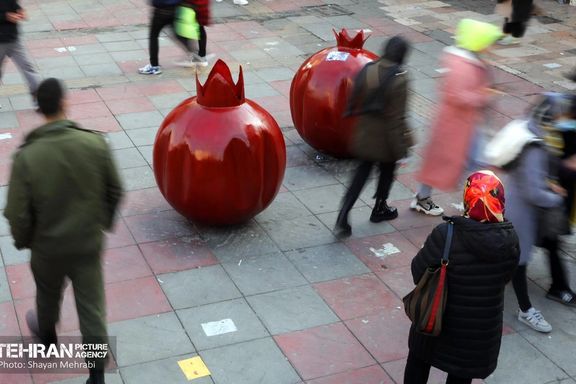
Iranians shopping for the winter solstice festival called Yalda in Persian at Tajrish bazaar in Tehran
Iranians are expressing outrage on social media over the renaming of two beloved pre-Islamic festivals, viewed as an attempt to erode "ancient Iranian culture."
This week, Iranian media reported that the Supreme Council of Cultural Revolution (SCCR) has chosen to rename certain events on the official calendar of the Islamic Republic, including the festivals of Yalda and Charshanbeh Souri, both of which predate the Islamization of Iran in the 6th century AD.
The Supreme Council of Cultural Revolution, comprising several appointees of Supreme Leader Ali Khamenei, is tasked with neutralizing external cultural influences and ideologies, particularly Western, and ensuring that education and culture align with Islamic values.
Social media users vow to celebrate the two festivals "with even more splendor" in defiance of the regime. They have also shared numerous jokes about the lengthy and irrelevant new names assigned to their cherished festivals.
They have also highlighted the regime's past attempts to erase the country's history by renaming numerous streets, buildings, and even cities and provinces, like Shahi and Kermanshah, often due to their association with the monarchy and the deposed royal family. However, most people have persisted in using the old names until now.
Iranians shopping for the winter solstice festival called Yalda in Persian at Tajrish bazaar in Tehran
"At the end of the day, we will still call these occasions Yalda night and Charshanbeh Souri. Are they going to install CCTV and bring in their plainclothesmen to our homes to make sure we are not doing so?" one of the many tweets about the renaming of festivals said, reflecting the sentiment surrounding the renaming of the festivals.
For over four decades since the early years of the Islamic Revolution, the religious establishment and Islamic revolutionaries have opposed the celebration of ancient festivals, including Nowruz (Persian New Year). Instead, they have sought to substitute them with Islamic calendar events such as Eid al-Fitr, Eid ul-Adha, Mab’ath (the beginning of the Prophet Muhammad’s mission), and the birthdays of the Prophet and Shiite Imams.
Most Iranians, even many religious families, however, have not forsaken their beloved ancient festivals and continue to celebrate them alongside religious occasions.
The first of the two festivals renamed by the Council, Yalda, also known as Chelleh Night, traditionally takes place on the longest and darkest night of the year.
This Winter Solstice festival has been observed by Iranian peoples and others in the region since ancient times. People come together at home to enjoy special foods, play music, read poetry, tell fortunes, and engage in various customs that vary across regions.
The SCCR has now renamed the day as the "Day of Promotion of the Culture of Hosting and Connecting with Relatives."
The second festival, Charshanbeh Souri, celebrated on the evening of the last Tuesday of the year just before the Nowruz holiday on March 21, involves similar customs of food, music, fortune-telling, poetry recitation, and the distinctive tradition of lighting small bonfires on the streets and jumping over them.
The hardliner religious establishment, in particular, strongly disapproves of the practice of lighting fires during Charshanbeh Souri. To them, this act evokes memories of the pre-Islamic religion of Iran, Zoroastrianism, where the lighting and tending of fire played a significant role in worship rituals. They view this association with fire as a form of paganism and consider it as "worshipping of fire."
The Council has decided to rename Charshanbeh Souri as “Day of Honouring Neighbors”.
Sizdah-be-dar, celebrated on the 13th day of the Persian calendar (April 1/2), is another ancient festival with uncertain origins cherished and observed by most Iranians, despite disapproval from the religious establishment. This festival, during which everyone leaves their homes to picnic in the open air, was renamed "Nature Day" years ago.
The public's reaction to the renaming of the two festivals was so strong that the Council's spokesman, Abbas Mirza Hosseini, had to deny the removal of the names of ancient festivals from the official calendar. He claimed that the new names were only complementary and emphasized the "national identity and Islamic-Iranian culture and civilization."
Reza Morad Sahraei, the Minister of Education in the Islamic Republic of Iran
Reza Morad Sahraei, the Minister of Education in the Islamic Republic of Iran, insists on the need for gender-specific school curricula.
In an interview on Saturday, Sahraei said that there is currently no plan for gender segregation on the agenda of the ministry of education. He confirmed that some textbooks will change.
He said textbooks for subjects such as Life Skills, Social Studies, and Religious Studies are already based on students' gender.
Last week, Sahraei had stated, in accordance with the Fundamental Transformation of Education document, textbooks should be customized differently for girls and boys. He emphasized the necessity of institutionalizing a culture of “modesty” throughout society.
Sahraei went on to emphasize that the Islamic Republic rejects both an "Eastern perspective" and a "feminist perspective" concerning women and girls, deeming the latter as "deviant."
His statements advocating gender-specific textbooks have triggered widespread negative reactions among experts in the field.
Iran’s parliament speaker Mohammad-Bagher Ghalibaf (left) and former vice president Es’haq Jahangiri
Iran’s former vice president under Hassan Rouhani, Es’haq Jahangiri, has been sentenced to 12 months' imprisonment for “false accusations against the parliament speaker.”
The court's recent verdict sentences Jahangiri to “four months of imprisonment for defamation and eight months for spreading falsehoods,” but considering Jahangiri's legal position, the prison term has been commuted to a cash fine of 440 million rials (less than 1$,000).
The sentence, based on a complaint filed by Parliament Speaker Mohammad Bagher Ghalibaf, is preliminary and subject to appeal.
Earlier this year, Mohammad Saeed Ahadian, the political and media assistant to the Parliament Speaker, referred to Ghalibaf's complaint against Jahangiri in a tweet, explaining that “Ghalibaf had filed a complaint in 2017 due to false statements made by Jahangiri.”
Simultaneously, media reports claimed that Ghalibaf's complaint against Jahangiri was related to the debates during the presidential elections in 2017. Mohammad Bagher Ghalibaf, one of the two main conservative candidates, targeted the Rouhani administration in his sharp attacks. The heated exchanges between Ghalibaf and Jahangiri led to intense debates.
Both Jahangiri and Ghalibaf withdrew in favor of their respective main faction candidates at the end of the debates. Ghalibaf supported Ebrahim Raisi, while Jahangiri cast his vote in favor of Hassan Rouhani.
The reopening of the old case by Ghalibaf is viewed by observers as an attempt to attract public attention on the eve of the upcoming parliamentary elections scheduled for the winter.
An Iranian official has acknowledged that the country’s net electricity export has reached zero, due to internal power deficit.
Official statistics indicate that during the last three years, Iran’s electricity exports were plunging gradually, while imports increased.
Mohammad Elahdad, the Deputy for Transmission and Foreign Trade at the Energy Ministry, said on November 15 that now the net electricity export decreased to zero.
This marks the first time in decades that Iran's electricity exports have equaled the country's imports. Iran imports electricity from Armenia, Azerbaijan, and Turkmenistan while exporting to Iraq. On Saturday, Arash Kordi, the managing director of Iran's electricity company Tavanir, claimed that the country is doubling the import of electricity from Turkmenistan.
Despite having net electricity exports of 8 terawatt-hours (TWh) a decade ago, this figure dropped to just over 1 TWh last year and has now reached zero.
The are reasons behind the decline in electricity exports. Domestic consumption increases at a high rate, because the government sells electricity at rock-bottom prices to consumers in a decades-old subsidy scheme. Inertia and fear of protests prevents the government from adjusting prices. Another major reason is the inefficiency of a government-controlled economy that breeds mismanagement and the expansion of the sector. Years of foreign sanctions have also played their role.
Over the past few years, Iran has struggled to meet its electricity generation growth targets, facing a shortfall of 14 megawatts (MW) during peak summer consumption.
Recent statistics from the Ministry of Energy indicate that only 20% of Iran's electricity generation growth targets were achieved in the first seven months of this fiscal year, that started March 22.
On the other hand, a big part of newly launched power plants has very low efficiency. If this trend continues, the country is likely to become a net electricity importer in the coming years.
The Ministry of Energy has recently omitted the monthly reports on Iran's electricity imports and exports, suggesting that the balance reaching zero is the reason behind this decision.
Iran, in exchange for importing electricity from Armenia, provides gas to this country (1 cubic meter of gas for every 3 kilowatts of electricity). However, for the imported electricity from Azerbaijan and Turkmenistan, Iran pays in currency.
The funds from Iran's electricity exports to Iraq are deposited into an account at the Trade Bank of Iraq in dinars. Due to Iran's limited imports from Iraq, approximately $10 billions of Iran's earnings from electricity and gas exports to Iraq over the past few years were effectively blocked in the Trade Bank of Iraq.
Until the middle of this year, Iran was only allowed to use these funds for importing non-sanctioned goods from Iraq, but the US government has issued sanctions waivers, allowing the Islamic Republic to transfer these funds to Oman in euros for importing non-sanctioned goods from third countries. It is still unclear how long Iran will continue its electricity exports, given the severity of the country's shortages.
For the current fiscal year (starting March 22), Iran had aimed to launch of over 5,000 megawatts of new power plants. However, in the first seven months (March-October), only 1,020 MW of power plants have been commissioned, with the majority being gas-powered plants with a modest efficiency of 30%. Iran has inaugurated only 33 MW of solar and wind power plants as well as 116 MW of relatively more efficient "combined cycle" power plants.
Although the country's power generation capacity is 92,000 MW, the operational capacity of the national grid is only around 71,000 MW. This means that approximately 23% of the country's power generation capacity is wasted due to aging and obsolescence.
Iranian authorities have repeatedly announced that the country faces a deficit of 14,000 MW during peak summer consumption.
Moreover, thermal power plants using mazut, diesel, and gas account for over 93% of Iran's total electricity generation. About three-quarters of Iran's thermal power plants are gas or steam-based, with a very low efficiency rate of around 30%. Iran had targeted converting these power plants to "combined-cycle" types with 45% efficiency for two decades ago but has not succeeded in this endeavor. The reasons include economic mismanagement and inefficiency coupled with various types of foreign sanctions.
Additionally, based on statistics from the Ministry of Energy and the Research Center of the Parliament, about 13% of the country's generated electricity is lost in the aged transmission and distribution network.
In comparison, Iran, only in the transmission and distribution network, loses as much electricity as half of the country's household consumption. The amount of electricity loss in the country's aged network is approximately 48 TWh annually.
Dr Umud Shokri, Energy Strategist and Senior Visiting Fellow at George Mason University
Dalga Khatinoglu, Azerbaijani expert on Iran’s energy issues
File photo of Gol Rezaieh Restaurant and Café in Tehran
Amidst tightening hijab laws, numerous cafes and bookstores in Tehran, Mashhad, Tabriz, and a range of other cities in Iran have been closed.
In Alborz province, the police commander of Savojbolagh, Ali Soleimani, announced the closure of 9 out of 12 traditional cafes and restaurants visited during the implementation of the "Social Security Plan."
Simultaneously, in Semnan province, 23 shops were closed for "failure to observe Islamic norms."
In Esfahan province, police sealed two restaurants and four hair salons in the city for Falavarjan for “non-compliance with compulsory hijab” under the "Social Security Plan."
The wave of closures continues in Mashhad, where, in recent months, numerous cafes have been sealed for failure to observe compulsory hijab. On Tuesday, law enforcement commanders sealed Gorilla Café, a recently opened establishment. Meanwhile, Bakhtiari Café in Tabriz was sealed on November 11 by supervisory authorities for "failure to observe compulsory hijab."
A police official from Eslamshahr in the vicinity of Tehran revealed Saturday the closure of 121 shops and the confiscation of over 500 vehicles in the city due to non-compliance with compulsory hijab.
Hijab police have also been ramped up in Tehran metro stations.
The ongoing crackdown on women removing compulsory hijab, intensified after the death of Mahsa Amini during her detention by the morality police, has gained momentum.
The closure of commercial, business, and tourist facilities, hotels, administrative establishments, as well as internet companies, reflects the Iranian regime's inability to deal with women who defy hijab.
A poster promoting singers from the Iranian diaspora
The Islamic Republic's government has warned travel agencies in Iran against marketing tours abroad featuring concerts by California-based Iranian pop singers.
The directive, issued by the General Directorate of Cultural Heritage, Tourism, and Handicrafts of Tehran Province, targets tours marketed by Iran-based agencies that include performances by diaspora singers that usually take place in neighboring countries. The action highlights a growing tension between the Iranian authorities and artists from the diaspora.
In the recent letter directed to travel and tourism agencies in Tehran, Parham Janfeshan, the director-general of cultural heritage, tourism in Tehran Province, expressed concerns about certain travel agencies advertising and selling tickets for concerts by certain singers, including those from Los Angeles. The communication underscored the importance of adherence to “Islamic values” and warns against potential violations.
The warning includes threats that the travel offices involved in the promotion and sale of services related to these concerts will be referred to a special committee for decision on possible penalties.
Hormatollah Rafiei, the head of the guild for Travel Service Offices and Tourism, warned against violations and emphasized that travel agencies operating permits exclude the right to promote these concerts.
Since the Revolution in 1979 -- when pop music was declared "haram" (forbidden) by the founder of the Islamic Republic Rouhollah Khomeini, Iranians have found ways to follow pop music they love. With domestic performances restricted to a very narrow type of regime-approved songs, a vibrant tradition emerged – Iranians began to travel to nearby countries to attend concerts by their favorite singers from the diaspora.
Iranian superstar Googoosh during a concert featuring a videoart of Mahsa Amini, whose death in police custody sparked Women, Life, Freedom protests in 2022
Primarily based in Los Angeles, these Iranian-American pop stars, barred from performing in their homeland, draw substantial crowds during tours in countries like Turkey, the UAE, Azerbaijan, Georgia, Armenia, and Erbil in Iraqi Kurdistan. These destinations are financially more affordable for Iranians, with fewer visa requirements.
The Los Angeles region is home to the world’s largest Iranian community outside of Iran and has been a scene of anti-Islamic Republic protest rallies especially since the start of the Women, Life, Freedom movement. There are about 400,000 Iranian-born immigrants in the United States and their children. More than a third of them live in the Los Angeles metropolitan region, according to data from the Migration Policy Institute.
Iranian pop stars enjoy significant popularity also among expatriates in European countries. Singer-songwriters Shahin Najafi and Mohsen Namjou are noteworthy artists based in Europe, boasting a sizable fan base of Iranian expatriates.
Shahin Najafi during a concert
The popularity of foreign-based artists surpasses that of their Iran-based counterparts, forming a global community of Iranian music enthusiasts who overcome travel obstacles to enjoy performances prohibited in their country. To gauge their popularity, one can contrast Iranians spending an average of $200 per ticket for concerts by Iranian stars like Ebi, Dariush, or Googoosh in Turkey or Dubai with the popularity of international stars like Taylor Swift and Beyoncé. In Iran, concert tickets typically range from $5 to $10.
Warnings against going to such concerts were issued in previous years when these events were more regularly organized in neighboring countries. However, the recent campaign underscores an escalating divide, intensified by last year's Women, Life, Freedom protests. The nationwide revolt, sparked by the death in custody of 22-year-old woman Mahsa Amini, saw numerous exiled Iranian stars rallying behind the people and denouncing the regime's suppression of dissent.
The majority of these singers utilized their concerts as a platform to amplify the voices of Iranian protesters globally. Concerts by Iranian expatriates commonly featured images of iconic protesters harmed, detained, or killed by Iran's security forces, accompanied by chants against the Islamic Republic.
Iranian state-run media has consistently published reports criticizing the so-called Los Angeles singers, alleging that they take advantage of popular protests for personal gain. At the same time, the Islamic Republicdetained renowned singer Mehdi Yarrahi after releasing a song in support of the opposition to the mandatory hijab, while Shervin Hajipour’s revolution song ‘Baraye’ was crowned the Best Song for Social Change at the Grammys 2023.